
CRE-350 · Lesson 10 of 12 · 27 min
Physical safety at events, meetups, home and while traveling
Most of the risks in this course happen on screens, but some cross into the physical world. Fans may recognize you in public, attend events where you appear or, rarely, try to find your home. Most encounters are friendly and brief. A small number involve boundary-pushing, obsessive behavior or real danger. This lesson covers practical safety planning for events and meetups, public encounters, home security and travel. The goal is not to make you fearful of your audience, but to give you a plan so that you can enjoy in-person moments with confidence.
If you ever feel you are in immediate danger, call 911. For non-urgent concerns, such as a pattern of someone appearing near your home, contact your local police non-emergency line.
Assessing risk before in-person activities
Risk varies with your audience size, your content, your location and any history of harassment. A creator who makes calm cooking videos and has never been harassed faces different risks from one who discusses politics, has been doxxed or has a known stalker. Before any in-person activity, ask a few questions: Who will be there and how many? Is the location public or private? Is there security or staff? Has anyone made threats or shown obsessive behavior recently? How will you arrive and leave? Who will be with you?
Worked problem
Scoring an event risk
A creator uses a simple scale of 1 (low) to 3 (high) for five factors: crowd size, whether the location was announced in advance, history of threats, security provided and whether they will be alone. For a fan meetup of about 300 people at a mall, announced two weeks ahead, with one recent threatening message, mall security but no personal security, and the creator planning to attend with one friend, the scores are 3, 3, 2, 2 and 2. Events scoring 10 or more need a written safety plan and extra support. What is the total?
Show solution
- Add the scores: 3 + 3 + 2 + 2 + 2 = 12.
- Compare with the threshold: 12 is above 10.
- Actions: brief mall security, bring a second trusted person or hire security, plan entry and exit routes and keep the threatening message on file.
Answer: A score of 12, above the threshold, so the creator should write a safety plan and add support before the event.
Events and meetups
Organized events, such as conventions, brand activations and fan meetups, are usually safer than informal ones because there are staff, security and a defined space. Even so, a few practices help.
- Work with organizers. Ask about security, check-in procedures, staff support and how they handle problems such as an attendee who will not leave.
- Bring a trusted person. A friend, manager or assistant can watch the crowd, manage time, handle difficult attendees and get help if needed.
- Plan arrival and departure. Use staff entrances where possible, avoid announcing exact arrival times and do not leave alone through a crowd.
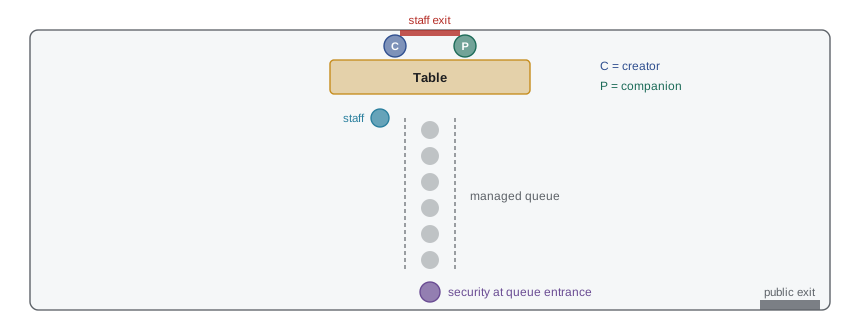
- Set physical boundaries. A table between you and the queue, a staff member managing photos and clear limits on gifts and hugs help everyone.
- Agree a signal. Decide on a word or gesture that tells your companion you want to leave or need help.
- Handle gifts carefully. Accept gifts through staff, do not open packages or eat food from strangers on the spot and check letters for personal information about you.
- Avoid announcing hotel or after-event locations. Post about the event afterward rather than live, especially when you are leaving.
Informal meetups
Informal meetups, such as announcing that you will be at a park or café, carry more risk because there is no security and no control over who comes. If you hold them, choose busy public places, keep them short, bring at least one trusted person, end at a set time and leave in a way that does not reveal where you are going. Avoid meeting individual fans alone, and never go to a private address to meet someone you only know online.
Public encounters
As your audience grows, people may recognize you in shops, on transit or at restaurants. Most will want a quick hello or a photo. It is fine to say no, politely, especially if you are with family or not feeling up to it: "Thanks so much, I'm off duty today, but it's great to meet you." If someone becomes pushy, follows you or makes you uncomfortable, move toward staff or other people, avoid leading them to your car or home, and ask for help if needed. Trust your instincts; you do not need to justify feeling uneasy.
Home security
Home is where most people feel safest, and where a doxxing incident can feel most frightening. Lesson 7 covered how to keep your address private. Physical home security adds another layer.
- Good locks on all doors and windows, and a habit of using them.
- Outdoor lighting and a video doorbell or cameras, positioned so that recordings would be useful to police.
- Deliveries sent to a mailbox service or pickup point rather than home, especially brand packages and fan mail.
- Care with what is visible from outside, such as equipment through windows.
- A plan for unexpected visitors: do not open the door to strangers who say they are fans; talk through the door or intercom and call police if they refuse to leave.
- A safe place to stay temporarily, such as a friend's home, if your address is published alongside threats.
Swatting is a particular risk for creators who stream live, especially in gaming. Some police services let residents register a concern in advance so that dispatchers know a call to that address might be a hoax. If you are at risk, contact your local police non-emergency line to ask whether they offer this, and keep the conversation and any reference number on file.
| Situation | Immediate action | Follow-up |
|---|---|---|
| Fan appears at your home | Do not open the door; ask them to leave; call police if they refuse | Log the incident; review address exposure |
| Address posted with threats | Call police; consider staying elsewhere | Report to platform; full privacy review |
| Someone follows you in public | Go to a busy place or staff; call for help | Note details; report to police if repeated |
| Suspicious package | Do not open; move away; call police | Route mail through a mailbox service |
| Swatting concern | Cooperate calmly with police if they arrive | Ask police about address flagging; document |
Travel
Travel content is popular, and travel is a time when people are less familiar with their surroundings. Post travel content after you have left each location, avoid showing hotel names, room numbers or keys, and be careful with geotags. Share your itinerary with a trusted person and agree on check-in times. If you are traveling to a brand event, ask the organizer about security and transportation. Keep copies of documents and emergency contacts somewhere other than your phone.
Worked problem
Choosing a delay for location posts
A creator visits five places on a one-day trip, spending about 1.5 hours at each. They want each post to go up only after they have left that place and moved at least one stop on. If they film at the first place starting at 9:00, when is the earliest they should post from the first location?
Show solution
- Time at the first place: 9:00 to 10:30.
- Time at the second place: about 10:30 to 12:00 (ignoring travel).
- Rule: post after leaving the place and moving at least one stop on, so after 12:00.
Answer: From about 12:00, once they are at or past the third stop; many creators simply post the whole day's content in the evening or the next day.
Live streaming in public
Streaming live from public places shows your location in real time to anyone watching. If you stream in public, consider a delay on the stream, avoid streaming near home or regular haunts, bring a companion who watches the surroundings rather than the camera, and end the stream before you head home or to your hotel. Many IRL streamers have experienced people arriving at their location after recognizing it on stream.
Stalking and persistent threats
If someone repeatedly contacts you, appears where you are or seems fixated on you, treat it seriously. Keep a detailed log, report to police and consider a protective order. Vary your routines, tell people close to you and your manager, and review your online exposure. Specialized victim services can help with safety planning. Lesson 9 covered the relevant laws.
Safety planning is not a sign of paranoia. Like a fire drill, it is something you prepare in calm times so that you can act clearly in a stressful one. Write your plan, share it with the people involved and review it when your circumstances change.
Safety with brand events and collaborations
Brand trips, launch events and collaborations with other creators bring their own risks. Before agreeing, ask who is organizing, who else will attend, where you will stay and how transport will work. Share the itinerary with someone you trust. Be cautious about invitations from people or companies you cannot verify, especially those that ask you to travel alone, stay at a private residence or keep the details secret. Legitimate brands and agencies are used to these questions and will answer them.
When meeting another creator or a new business contact for the first time, choose a public place, tell someone where you will be and arrange your own transport. These are the same precautions people take for any first meeting with someone they only know online, and they apply just as much to professional contacts.
Debriefing after events
After an event, take a few minutes with your companion or manager to review how it went. Did anything make you uncomfortable? Did anyone behave in a way that should be noted, such as asking repeatedly about where you live or trying to follow you out? Were the entry and exit plans adequate? Log anything significant and update your safety plan. Over time, these debriefs help you spot patterns and improve your arrangements.
Finally, involve the people you live with. Make sure they know your safety rules, such as not confirming your address to callers, not opening the door to unknown visitors who say they are fans and keeping packages out of sight. Agree on what to do if someone suspicious appears, and keep emergency numbers handy for everyone in the household.
Safety plans should also be proportionate. Most creators will never face a serious physical threat, and excessive fear can be harmful in its own way. Match your precautions to your actual risk, and adjust them when that risk changes.
Common mistakes
MistakeAnnouncing exact arrival and departure times for events.
InsteadShare event details afterward and use staff entrances where possible.
MistakeAttending meetups alone.
InsteadBring a trusted companion and agree a signal for help.
MistakeOpening the door to fans who show up at home.
InsteadTalk through the door, ask them to leave and call police if needed.
MistakePosting hotel and travel locations in real time.
InsteadPost after leaving and avoid showing room numbers or hotel names.
MistakeTreating repeated appearances as harmless.
InsteadLog them, report them and consider protective orders.
Summary and key terms
- Most in-person encounters are friendly, but planning reduces the risk from the rare dangerous ones.
- Assess crowd size, announcement, threat history, security and support before events.
- Organized events with staff and security are safer than informal meetups.
- Use table barriers, managed queues, companions, signals and separate exits.
- Home security includes locks, lighting, cameras, separate delivery addresses and a visitor plan.
- Ask police about swatting precautions if you stream live.
- Post travel and live content in ways that do not reveal your current location.
- Safety plan
- A written plan for preventing and responding to physical risks.
- Companion
- A trusted person who accompanies a creator to watch for risks and help.
- Signal
- A pre-agreed word or gesture meaning "I need help" or "let's leave".
- Staff entrance
- A non-public route into and out of a venue.
- IRL streaming
- Live streaming from real-world locations rather than a studio.
- Stream delay
- A deliberate lag between filming and broadcasting.
- Swatting
- A hoax emergency call sending armed police to an address.
- Protective order
- A court order requiring someone to stay away from a person.
- Mailbox service
- An address used for deliveries instead of home.
- Risk score
- A simple rating that combines factors to decide how much planning is needed.
Practice problems
Work each problem on paper first, then reveal the answer to check.
Name five factors in an event risk score.
Show answer
Crowd size, advance announcement, threat history, security and whether you are alone.
Scores of 2, 3, 1, 2 and 1. Total?
Show answer
9.
Why bring a companion to meetups?
Show answer
To watch the crowd, manage time and get help if needed.
What is a safe way to accept gifts at events?
Show answer
Through staff, without opening packages or eating food on the spot.
What should you do if a fan appears at your door?
Show answer
Do not open it; ask them to leave and call police if they refuse.
Name three home security measures.
Show answer
Locks, lighting, cameras, mailbox service, visitor plan.
How can creators reduce swatting risk?
Show answer
Ask police whether they can flag the address and keep records.
When should travel content be posted?
Show answer
After leaving each location.
Name two precautions for IRL streaming.
Show answer
Stream delay, avoid home areas, a companion watching surroundings, end before heading home.
What should you do about repeated appearances by the same person?
Show answer
Log them, report to police and consider a protective order.
Lesson quiz · 5 questions
Score 60% or more to complete this lesson.
Create a free account to save your progress, take quizzes and earn a certificate.