
CRE-350 · Lesson 11 of 12 · 25 min
Support networks, professional help and working with a team
Creators often work alone, but nobody sustains a demanding public career without support. This lesson looks at the people and services that can help: peers, friends and family, mental health professionals, managers, editors and moderators, and the platforms and organizations that serve creators. It also covers how to set up clear wellbeing and safety responsibilities when you work with a team, and the special duties that come with featuring children in content.
Building a support network
A support network is the set of people you can turn to for different kinds of help. Researchers often distinguish emotional support (listening and caring), practical support (help with tasks), informational support (advice and knowledge) and companionship (doing things together). No single person can provide everything, and relying on one person for all of it can strain the relationship. A healthy network spreads support across several people and services.
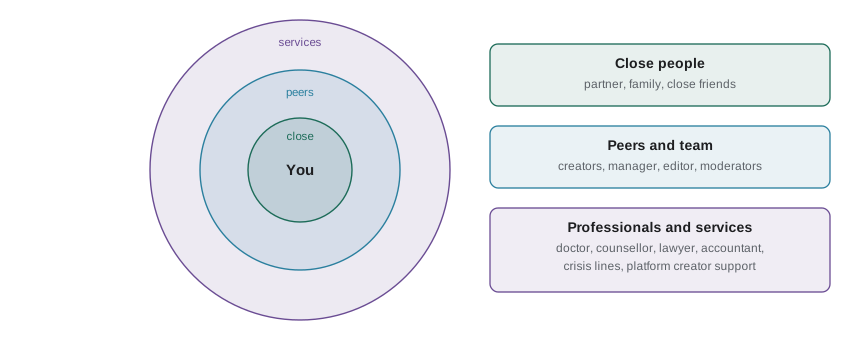
For creators, peer support is especially valuable. Other creators understand the pressures of the job in a way friends outside the industry may not. Peer groups, creator communities, mastermind groups and informal friendships with creators at a similar stage can provide advice, empathy and a reality check about what is normal. Be thoughtful about who you trust with sensitive information, but do not let competition stop you from making genuine connections.
Friends and family outside the industry matter too. They know you as a person rather than a channel, and time with them is a reminder that your worth does not depend on metrics. Protect that time, and share enough about your work that they can understand when it is hard.
Professional mental health support
Sometimes support from friends and peers is not enough. Signs that it may be time to see a professional include low mood, anxiety or exhaustion that lasts more than a couple of weeks, difficulty functioning, reliance on alcohol or other substances to cope, trauma symptoms after harassment, or thoughts of self-harm. Seeking help early is a sign of good judgment, not weakness.
Different professionals offer different kinds of help. Family doctors can assess physical and mental health, prescribe medication and refer to specialists. Psychologists, counselors, social workers and psychotherapists provide talking therapies such as cognitive behavioral therapy. Psychiatrists are medical doctors who specialize in mental health and can prescribe medication. Some professionals have experience with creators, public figures or online harassment, which can be helpful.
In the US, mental health care is usually paid through health insurance, and most plans must cover mental health care on terms comparable to physical health care under federal parity rules. Self-employed creators can buy coverage through the Health Insurance Marketplace or other plans. Community mental health centers, sliding-scale clinics and training clinics at universities offer lower-cost options. For crisis support at any hour, call or text 988.
Worked problem
Budgeting for therapy
A creator plans 12 counseling sessions over six months at $160 a session. Their private insurance reimburses 80 % of the cost up to $750 a year. How much will they pay out of pocket, and how much should they set aside each month?
Show solution
- Total cost: 12 × $160 = $1,920.
- Insurance at 80 % would be $1,536, but it is capped at $750.
- Out of pocket: $1,920 − $750 = $1,170.
- Monthly set-aside over six months: $1,170 ÷ 6 = $195.
Answer: About $1,170 out of pocket, or $195 a month over six months, which can be built into the business budget as an investment in wellbeing.
Working with managers, editors and moderators
As creators grow, they often bring in managers, agents, editors, assistants and moderators. A good team can remove large amounts of work and stress. A poorly organized team can add new pressures, such as deadlines set by others, unclear responsibilities and conflict.
Wellbeing and safety should be part of how a team works, not an afterthought. Useful practices include agreeing on working hours and response times, building buffers into production schedules, deciding who handles harassment and who talks to brands during a crisis, and holding regular check-ins that include how people are doing, not just what they are delivering. Managers should push back on unrealistic brand demands and protect planned breaks.
| Responsibility | Typical owner | Notes |
|---|---|---|
| Daily comment moderation | Moderators | Escalate threats and doxxing to the manager |
| Evidence log and reporting | Manager or assistant | Keep the creator's exposure to abuse low |
| Brand communication during a crisis | Manager | Agree a holding statement in advance |
| Production schedule and buffer | Producer or creator | Protect breaks and avoid last-minute changes |
| Physical safety at events | Manager with organizers | Written plan for higher-risk events |
| Wellbeing check-ins | Manager and creator | Regular, private and supportive |
Team members also need care. Editors and assistants who work long hours to meet upload schedules can burn out, and moderators face exposure to abuse, as Lesson 8 discussed. Fair pay, reasonable deadlines, credit for their work and the same respect for boundaries that you want for yourself make teams healthier and more loyal.
Platforms and industry support
Major platforms offer creator support teams, safety centers and resources on wellbeing, harassment and account security. Larger creators may have partner managers who can escalate safety issues. Multichannel networks, talent agencies and creator unions or associations sometimes provide additional support, such as legal referrals or mental health resources. Creator industry groups are developing in both Canada and the US, and some unions that represent performers, such as those for actors and broadcasters, have begun to offer membership options or guidance for content creators. Check what is available for your platform and situation.
Children in content
Children who appear in family vlogs or who run their own channels face all of the pressures in this course with less ability to consent or protect themselves. Their images, names and routines may be public for life. Their earnings may be controlled by adults. Several US states have passed laws that protect children who appear in monetized content. Illinois was first, with a law in force from July 1, 2024, requiring creators who regularly feature children under 16 in paid content to set aside a share of earnings in a trust for the child. Minnesota followed in 2025 with a similar trust requirement, a ban on children under 14 engaging in content creation work, and a right to have content deleted. California and several other states have passed or considered similar laws.
At the time of writing, there was no federal law covering children in monetized online content, so protection depends on state law. Some states' child performer laws, such as California's Coogan law for entertainment earnings, cover traditional entertainment but were written before online content. Check current state law, as this area is changing quickly.
Whatever the law requires, ethical practice goes further: limit what is shared about children, never share their school or routines, ask older children for consent and respect their wishes, keep their earnings separate and safe, and consider how they might feel about the content as adults.
Asking for help
Many creators find it hard to ask for help. They worry about seeming weak, burdening others or losing control. It may help to remember that every sustainable business delegates, and every healthy person relies on others. Start small: tell one person how you are really doing, hand off one task, book one appointment. Each step builds a resource that reduces the demands on you.
Talking to friends and family about your work
People outside the creator industry may not understand why a hostile comment hurts, why you cannot simply take a week off or why a drop in views worries you. It can help to explain your work in concrete terms: how you earn money, what a typical week involves and what kinds of pressure you face. When the people close to you understand the job, they are better able to support you and to notice when something is wrong. They can also help protect your privacy by following the boundaries you agree on.
It is equally important to have relationships where your channel is not the main topic. Friends who know you from school, sports, work or your neighborhood remind you that you are more than your content. Make time for those relationships, especially during busy periods when it is tempting to cancel plans.
Finding the right professional
Finding a good fit with a counselor or therapist can take time. Look for someone who is registered or licensed with the appropriate professional body, has experience with the issues you are facing and works in a way that suits you. Many offer a short free consultation. It is fine to try someone else if the first person does not feel right. Online and video sessions can make it easier to find a professional with relevant experience, though you should check that they are licensed to practice where you live.
State licensing boards for psychologists, counselors and social workers maintain public registers where you can check a professional's license.
Creator collectives and mutual aid
Some creators form collectives or informal groups that share resources, such as moderators, legal contacts, editing help or emergency cover when someone needs a break. A collective might agree that members will cross-promote each other during a member's hiatus, share a list of trusted professionals or pool money for security at joint events. These arrangements turn individual vulnerability into shared resilience. They work best with clear agreements about what each member contributes and how decisions are made.
When a team member is struggling
If someone on your team seems to be struggling, use the supportive conversation steps from Lesson 3: notice, ask privately, listen and connect them to help. Adjust their workload where possible, and make it clear that their job is not at risk because they are having a hard time. Respect their privacy; share what is happening with others only if they agree or if there is a safety concern.
Planning for absence
Every creator business should have a plan for what happens if the creator is suddenly unable to work for weeks, because of illness, injury or a family emergency. The plan might name who will post a brief update to the audience, who will contact brand partners about deadlines, who has access to schedule buffer content and how income will be managed. Writing this down, and sharing it with one or two trusted people, means that a crisis in your personal life does not also become a crisis for your business.
Support works best when it is arranged in advance. Save the contact details of your doctor, a counselor, a lawyer referral service and your crisis line now, so that you are not searching for them in a difficult moment. Share the list with someone you trust, and tell them how they can help if you are ever struggling.
Common mistakes
MistakeRelying on one person for all support.
InsteadBuild a network that spreads emotional, practical and informational support.
MistakeWaiting until a crisis to see a professional.
InsteadSeek help when symptoms last more than a couple of weeks or affect daily life.
MistakeHiring a team without agreeing on responsibilities.
InsteadWrite down who handles moderation, evidence, crises and safety.
MistakeForgetting that team members can burn out too.
InsteadOffer fair pay, reasonable deadlines and respect for boundaries.
MistakeTreating children in content as props.
InsteadLimit sharing, protect earnings and respect their wishes and future privacy.
Summary and key terms
- Support networks provide emotional, practical, informational and companionship support.
- Peer support from other creators is especially valuable.
- Persistent symptoms, substance reliance, trauma or thoughts of self-harm are signs to seek professional help.
- Mental health care is usually paid through insurance, with parity rules and lower-cost community options.
- Teams should share wellbeing and safety responsibilities explicitly.
- Several US states protect children in monetized content; Canadian provinces have no dedicated law yet.
- Asking for help builds the resources that prevent burnout.
- Support network
- The people and services a person can turn to for help.
- Emotional support
- Listening, empathy and care.
- Practical support
- Help with tasks.
- Peer support
- Support from people with similar experiences.
- Cognitive behavioral therapy
- A structured talking therapy that addresses thoughts and behaviors.
- Psychiatrist
- A medical doctor specializing in mental health.
- Holding statement
- A brief prepared statement used in the early stage of a crisis.
- Wellbeing check-in
- A regular conversation about how team members are doing.
- Trust account
- Money held for a child's benefit until adulthood.
- Parity
- Equal treatment of mental and physical health care in insurance coverage.
Practice problems
Work each problem on paper first, then reveal the answer to check.
Name four types of support.
Show answer
Emotional, practical, informational and companionship.
Why is peer support valuable for creators?
Show answer
Other creators understand the job's pressures.
Name two signs it may be time to see a professional.
Show answer
Persistent symptoms, difficulty functioning, substance reliance, trauma, thoughts of self-harm.
10 sessions at $150 with $600 insurance cover. Out of pocket?
Show answer
$1,500 − $600 = $900.
Who should usually handle brand communication during a crisis?
Show answer
The manager.
Name two ways to support team members' wellbeing.
Show answer
Fair pay, reasonable deadlines, credit, respect for boundaries, rotation for moderators.
Which state first passed a child influencer earnings law?
Show answer
Illinois, in force from July 1, 2024.
Name two ethical practices for children in content.
Show answer
Limit sharing, protect earnings, ask for consent, hide schools and routines.
What is a holding statement?
Show answer
A short prepared statement for the early stage of a crisis.
Where can creators get crisis support at any hour?
Show answer
By calling or texting 988.
Lesson quiz · 5 questions
Score 60% or more to complete this lesson.
Create a free account to save your progress, take quizzes and earn a certificate.