
CRE-350 · Lesson 5 of 12 · 28 min
Money stress and income volatility
Financial worry is one of the strongest drivers of creator burnout. In the 2025 Billion Dollar Boy survey discussed in Lesson 1, financial instability was the most severe factor named by creators who had burned out. Money stress feeds every other pressure in this course: it makes breaks feel unaffordable, makes creators accept bad brand deals and keeps them glued to analytics. This lesson looks at why creator income is so volatile and at practical ways to reduce the stress it causes. CRE-302 and CRE-330 cover monetization, contracts and taxes in depth; here the focus is on financial resilience as a wellbeing tool.
For personal decisions, talk to a qualified accountant or financial planner.
Why creator income swings
Creator income usually comes from several sources, each with its own rhythm. Platform ad revenue rises and falls with views and with advertising seasons: rates tend to be higher before the winter holidays and lower in January. Brand deals arrive unevenly, often clustered around product launches and holiday campaigns, and payment can take 30 to 90 days or longer after delivery. Affiliate income depends on audience buying patterns. Memberships and subscriptions are steadier but can drop when content slows. A viral hit can produce a spike that is unlikely to repeat.
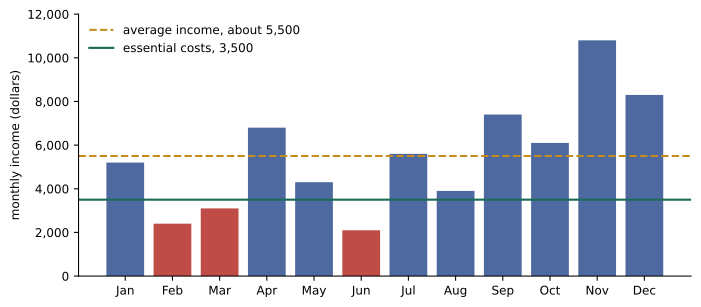
The result is income that may vary by a factor of three or more between a good and a bad month. Volatility is stressful even when average income is healthy, because bills arrive every month whether income does or not. It also makes planning hard: it is difficult to know what you can afford to spend, save or invest when next month is unknown.
Know your numbers
The first step in reducing money stress is replacing vague worry with numbers. Track income by source and by month for at least the last twelve months, if you have that history. Calculate the average, the lowest month and the highest month. Then list your essential monthly costs: housing, food, utilities, transportation, insurance, minimum debt payments and essential business costs such as software and internet. The gap between your lowest months and your essential costs shows how much protection you need.
Worked problem
Measuring volatility
A creator's monthly income over the past six months was $3,000, $8,500, $4,200, $2,600, $6,700 and $5,000. Their essential monthly costs are $3,400. Find the average, the range and how many months fell short of essential costs.
Show solution
- Total: 3,000 + 8,500 + 4,200 + 2,600 + 6,700 + 5,000 = $30,000.
- Average: 30,000 ÷ 6 = $5,000.
- Range: highest $8,500 − lowest $2,600 = $5,900.
- Months below $3,400: $3,000 and $2,600, so 2 of 6 months.
Answer: Average $5,000, range $5,900, and 2 of 6 months below essential costs, so the creator needs a buffer to cover shortfalls.
Emergency funds
An emergency fund is money set aside for shortfalls and surprises. Employees are often advised to keep three to six months of essential costs. Because creator income is more volatile, many advisers suggest that self-employed people aim for six months or more, depending on how stable their income sources are. The fund should be kept somewhere safe and easy to reach, such as a high-interest savings account, rather than invested in assets that might fall in value just when you need them.
Worked problem
Setting an emergency fund target
A creator's essential monthly costs are $3,400. They choose a 6-month target. They currently have $5,000 saved and can add $700 a month. How long until they reach the target?
Show solution
- Target: $3,400 × 6 = $20,400.
- Gap: $20,400 − $5,000 = $15,400.
- Months: $15,400 ÷ $700 = 22 months.
Answer: Target $20,400; at $700 a month, about 22 months to reach it, with the first milestone of 3 months ($10,200) reached in about 7.5 months.
Reaching even one month of essential costs makes a noticeable difference to stress. Treat the fund in milestones: one month, three months, six months. Every milestone is a resource that makes breaks, bad months and difficult negotiations easier.
Paying yourself a steady salary
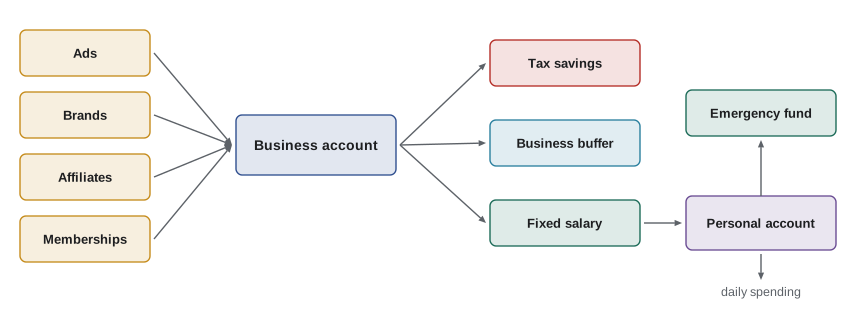
A practical way to smooth volatile income is to separate business money from personal money and pay yourself a fixed amount each month. All creator income goes into a business account. Each month, you transfer a set amount to your personal account, like a salary. In good months, the surplus stays in the business account and builds a buffer. In lean months, the buffer covers the salary. Money for taxes should be set aside in a separate account as income arrives, so that tax bills do not become a crisis.
Worked problem
Setting a sustainable salary
A creator's average monthly income over the past year was $6,000 before tax. They set aside 25 % of income for taxes and 10 % for business costs. What fixed monthly salary can they pay themselves on average, and how should they handle a $2,500 month?
Show solution
- Tax set-aside: $6,000 × 0.25 = $1,500.
- Business costs: $6,000 × 0.10 = $600.
- Available for salary: $6,000 − $1,500 − $600 = $3,900.
- A cautious salary might be about $3,500, leaving room to build the buffer.
- In a $2,500 month, set aside tax and costs on that income and top up the salary from the business buffer.
Answer: About $3,500 a month as a cautious salary, with the business buffer covering lean months such as a $2,500 month.
The right tax set-aside depends on your state, income and business structure. Self-employed people in the US pay self-employment tax for Social Security and Medicare in addition to income tax, and usually need to make quarterly estimated tax payments. CRE-330 covers these details.
Diversifying income
Relying on one income source is risky. A policy change, a demonetization decision, a lost sponsor or an algorithm shift can wipe out most of a creator's income overnight. Diversifying across platforms and revenue types spreads that risk. A creator might combine ad revenue, two or three ongoing brand partnerships, affiliate links, a membership program and a small product line. CRE-302 introduced a simple concentration measure: the share of income from the largest single source. A useful rule of thumb is to watch out when one source passes about half of total income.
| Income source | Typical stability | Main risk |
|---|---|---|
| Platform ad revenue | Medium; seasonal | Policy changes, demonetization, algorithm shifts |
| Brand deals | Low to medium; lumpy | Lost partners, late payment |
| Affiliate links | Medium | Program or commission changes |
| Memberships and subscriptions | Higher | Churn when content slows |
| Digital products and courses | Medium | Launch-driven spikes |
| Services, speaking and licensing | Variable | Depends on demand and time |
Lean-month plans
Even with a buffer, it helps to decide in advance what you will do in a lean month. A lean-month plan lists actions in order, from easy to drastic: pause non-essential subscriptions, delay equipment purchases, push affiliate content, pitch evergreen sponsorship packages, offer a product sale, take on freelance work and, as a last resort, draw down the emergency fund. Writing the plan when you are calm stops you from making panicked decisions, such as accepting a brand deal that conflicts with your values, when money is tight.
Late payment and money conflict
Late payment from brands and agencies is a common source of stress. Clear contracts with payment terms, deposits for large projects and polite but firm follow-up help. Keep a simple receivables list showing what you are owed, when it was due and when you followed up. CRE-330 covers invoicing and collections in detail. If a large payment is overdue, a buffer means it is an annoyance rather than an emergency.
Money can also strain relationships with partners, family members or business collaborators. Being open about income, costs and plans, and agreeing on how shared costs are handled, can prevent conflict. If money worries are affecting your sleep or mental health, a financial counselor or credit counseling service can help, and many offer free or low-cost advice.
In the US, non-profit credit counseling agencies offer free or low-cost budgeting help, and the Consumer Financial Protection Bureau publishes free budgeting tools.
Money and wellbeing decisions
Financial resilience changes what feels possible. A creator with six months of costs saved can take a two-week break, turn down a poor brand deal or ride out a demonetization. A creator living month to month cannot. That is why this lesson belongs in a wellbeing course: building financial resources is one of the most effective ways to reduce the demands that lead to burnout.
Insurance and protection
Employees often receive benefits such as health coverage, disability insurance and paid sick leave through an employer. Self-employed creators usually have to arrange these themselves. Disability insurance replaces part of your income if illness or injury stops you working, which matters for a business that depends on one person. Health and dental plans can cover prescriptions, therapy and other care. Business insurance, such as general liability or errors and omissions coverage, protects against claims arising from your work. Equipment insurance covers cameras and computers that are expensive to replace.
In the US, health insurance is a major cost for self-employed people. Plans are available through the Health Insurance Marketplace, where premium tax credits may reduce costs for people with moderate incomes. Self-employed people do not have access to unemployment insurance in most situations, so an emergency fund and disability insurance are especially important.
Insurance costs money, and it is easy to skip when income is tight. A useful exercise is to list the events that would hurt your business most, such as a serious illness, a stolen camera or a lawsuit, and check which ones you are protected against. Even a basic level of coverage can turn a disaster into a manageable setback.
Saying no to bad deals
Money stress pushes creators to accept deals they would otherwise refuse: products they do not believe in, rates below their worth, unreasonable deadlines or contracts with broad usage rights. These deals can damage audience trust and add stress for months. A financial buffer is what makes it possible to say no. When you are tempted by a deal mainly because you need the money, pause and ask whether you would accept it with three months of savings in the bank. If the answer is no, look at your lean-month plan for other options first.
A final money habit is a short monthly review. Once a month, record income by source, check that taxes and savings were set aside, compare spending with your plan and note any payments overdue. Fifteen minutes a month keeps small problems from growing and makes the quarterly review in your sustainability plan much easier. Many creators find that simply knowing their numbers, even when they are not ideal, reduces anxiety more than they expected.
Common mistakes
MistakePlanning around your best months.
InsteadUse averages and lowest months, and compare them with essential costs.
MistakeSpending all income in good months.
InsteadPay yourself a fixed salary and keep the surplus as a buffer.
MistakeForgetting to set aside money for taxes.
InsteadMove a percentage of each payment into a separate tax account.
MistakeRelying on a single platform or sponsor.
InsteadDiversify and watch when one source passes about half of income.
MistakeMaking money decisions in a panic.
InsteadWrite a lean-month plan in advance.
Summary and key terms
- Creator income is volatile because each revenue source has its own rhythm and risks.
- Track income by source and month, and compare lowest months with essential costs.
- Self-employed people often aim for six months or more of essential costs in an emergency fund.
- Separate accounts and a fixed monthly salary smooth volatile income.
- Set aside money for taxes as income arrives.
- Diversifying income spreads the risk of policy changes and lost partners.
- A lean-month plan and financial buffer make breaks and difficult decisions possible.
- Income volatility
- Large swings in income from month to month.
- Essential costs
- Monthly expenses that must be paid, such as housing and food.
- Emergency fund
- Savings set aside for shortfalls and surprises.
- Fixed salary
- A set monthly transfer from a business account to a personal account.
- Business buffer
- Surplus kept in the business account to cover lean months.
- Tax set-aside
- A share of income saved for tax bills.
- Concentration
- The share of income coming from the largest single source.
- Lean-month plan
- A pre-written list of actions for low-income months.
- Receivables
- Money owed to you for work already delivered.
- Range
- The difference between the highest and lowest values.
Practice problems
Work each problem on paper first, then reveal the answer to check.
Income of $2,000, $6,000, $4,000 and $8,000. Average?
Show answer
$5,000.
In that data, what is the range?
Show answer
$8,000 − $2,000 = $6,000.
Essential costs are $2,800 and the target is 6 months. Fund target?
Show answer
$16,800.
A $12,000 gap saved at $600 a month takes how long?
Show answer
20 months.
Why pay yourself a fixed salary?
Show answer
It smooths volatile income and builds a buffer in good months.
Average income $5,000, tax 25 %, costs 10 %. Available for salary?
Show answer
$5,000 − $1,250 − $500 = $3,250.
When should a creator worry about concentration?
Show answer
When one source passes about half of total income.
Name two items on a lean-month plan.
Show answer
Pause subscriptions, delay purchases, push affiliates, pitch packages, freelance work.
Which income source is usually most stable?
Show answer
Memberships and subscriptions.
Name a free source of budgeting help.
Show answer
A non-profit credit counseling agency or the Consumer Financial Protection Bureau.
Lesson quiz · 5 questions
Score 60% or more to complete this lesson.
Create a free account to save your progress, take quizzes and earn a certificate.