
HSE-362 · Lesson 1 of 12 · 23 min
Emergency plans in schools: hazards, roles and who decides
▶ Video coming soon A video version of this lesson is on the way.
A school is one of the few places where hundreds of children spend most of their waking day in the care of adults who are not their parents. On an ordinary morning, nobody thinks about what would happen if the fire alarm sounded during a first-grade class's assembly, if a gas main broke in the street outside, if a tornado warning arrived ten minutes before dismissal, or if a staff member collapsed in the gym. Emergency procedures are the plans and habits that turn those moments from chaos into a sequence of steps that every adult in the building already knows. This course is about those steps: what they are, why they are built the way they are, and how ordinary staff members carry them out.
The course follows staff in the invented Riverbend Public Schools, the same setting used in HSE-360 and HSE-361. Pinecrest High School is a 1968 building with additions from 1989 and 2011, about 1,350 students, labs and shops, two gyms, a cafeteria and a closed pool. Willow Park Elementary is a K-8 school with 480 students in a 1958 wing and a 2004 wing, a resource room for students with disabilities, a playground and a busy drop-off loop. The district has 34 schools, about 3,100 staff and 21,000 students in and around Riverbend, Minnesota.
The people in this course
- Marion Clarke is the principal of Pinecrest High School and leads its emergency response team.
- Priya Nair is the office administrator at Willow Park and is usually the first person to answer the phone, make an announcement or call 911.
- Daniel Lefebvre is the district's district safety coordinator and coordinates emergency planning across all 34 schools.
- Hannah Osei teaches chemistry at Pinecrest High School and is the worker co-chair of its safety committee.
- Victor Alvarez is the head custodian at Pinecrest High School and knows where every shut-off valve, panel and roof hatch is.
- Jenna Kowalchuk is a paraprofessional in Willow Park's resource room and supports several students who need help to move, communicate or regulate their behavior.
- Sam Whitford teaches physical education at Pinecrest High School, coaches two teams and is often outside with a class when the weather turns.
What counts as an emergency
An emergency is any event that threatens the safety of people in or around the school and needs an immediate, organized response. School emergencies fall into a handful of groups, and each group has a different basic response. The point of grouping them is that staff do not need a separate procedure for every possible event. They need to recognize which group an event belongs to and then carry out the matching action.
| Group | Examples | Basic action |
|---|---|---|
| Fire and smoke | Fire, smoke, burning smell, fire alarm activation | Evacuate |
| Threat inside the building | An armed or violent intruder, a serious fight with weapons | Lockdown |
| Threat outside or nearby | Law enforcement activity in the neighborhood, a dangerous animal, a nearby robbery | Secure |
| Hazard in the outside air | Chemical spill on a nearby rail line, gas leak outside, heavy wildfire smoke | Shelter (for hazmat) |
| Severe weather | Tornado warning, severe thunderstorm, extreme cold or heat | Shelter (for tornado), or modified schedule |
| Medical emergency | Cardiac arrest, anaphylaxis, seizure, serious injury | First aid, call 911, AED |
| Building or utility failure | Gas leak inside, flooding, loss of heat or power, structural damage | Evacuate or relocate |
| Threats and suspicious items | Bomb threat, suspicious package, threatening message | Assess, then evacuate or hold as directed |
Some events need more than one action in sequence. A fire alarm during a lockdown is the classic example: staff must decide whether the alarm is real or a trick to draw people into hallways, and the plan should tell them how to make that call. A tornado warning during an evacuation drill means the drill stops and everyone goes to refuge areas. A medical emergency can happen during any of the others. Later lessons return to these combinations.
The plan itself
Every school in the district has an emergency operations plan (EOP) and a fire safety and evacuation plan. Minnesota law requires each school board to adopt a crisis management policy for potential violent crisis situations, developed together with administrators, teachers, employees, students, parents, law enforcement, emergency management officials, emergency medical responders and other community partners. The district sets a common template, following federal guidance on high-quality school emergency operations plans, and each principal fills in the school-specific details: floor plans, exits, assembly areas, refuge areas, shut-off locations, staff roles and the names of the people who fill them.
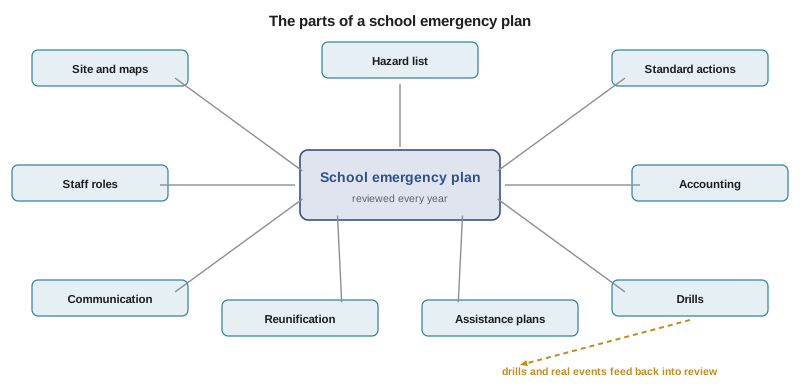
A good school plan has the same basic parts, whatever it is called:
- A description of the building and site: floor plans, exits, stairwells, refuge areas, assembly areas, gas and power shut-offs, the fire alarm panel, the sprinkler riser and the location of first aid kits and automated external defibrillators (AEDs).
- The hazards the school faces, ranked by how likely and how serious they are.
- The standard actions, with the exact words used to announce each one.
- Staff roles and alternates.
- How to account for every student and staff member.
- How to communicate with emergency services, the district office and families.
- How students are released to families after an event that closes the school.
- Plans for students and staff who need help in an emergency.
- The drill schedule and how drills are recorded.
- How the plan is reviewed and kept up to date.
Looking at the school's hazards
A plan starts with a realistic look at what could happen. The district does this with a simple scoring exercise each spring: for each hazard, the school's emergency team rates how likely it is and how serious the consequences would be, each on a scale of 1 to 5, and multiplies the two. The result is not precise, but it shows where the school's time and money should go. A rural school next to a rail line carrying chemicals has a different list from an urban school beside a busy police station.
At Pinecrest High School, the 2026 review put severe weather, medical emergencies and fire at the top, followed by an outside threat near the school, a hazardous release from the rail yard two kilometers away, and a violent intruder. Willow Park's list was similar, but with a higher score for a lost or missing child and for medical emergencies involving students with complex needs. The program below repeats the Pinecrest High School scoring and sorts the results.
# Simple hazard ranking: likelihood x severity, each scored 1 to 5.
hazards = [
    ("Severe weather (tornado, storm)", 4, 4),
    ("Medical emergency (cardiac, anaphylaxis)", 4, 5),
    ("Fire in the building", 2, 5),
    ("Threat outside near the school", 3, 3),
    ("Hazardous release from rail yard", 2, 4),
    ("Violent intruder", 1, 5),
    ("Loss of heat or power", 3, 2),
    ("Bomb threat or suspicious package", 2, 3),
]
ranked = sorted(hazards, key=lambda h: h[1] * h[2], reverse=True)
for name, like, sev in ranked:
    score = like * sev
    band = "high" if score >= 15 else "medium" if score >= 8 else "low"
print(f"{name:42} L{like} x S{sev} = {score:2d} {band}")Medical emergency (cardiac, anaphylaxis) L4 x S5 = 20 high Severe weather (tornado, storm) L4 x S4 = 16 high Fire in the building L2 x S5 = 10 medium Threat outside near the school L3 x S3 = 9 medium Hazardous release from rail yard L2 x S4 = 8 medium Loss of heat or power L3 x S2 = 6 low Bomb threat or suspicious package L2 x S3 = 6 low Violent intruder L1 x S5 = 5 low
The ranking does not mean the low-scoring hazards are ignored. A violent intruder is rare, but the consequences are so serious that lockdown is drilled several times a year. What the ranking does is stop the school from spending all its planning time on dramatic, rare events while the common ones, such as a staff member having a heart attack in the parking lot, get a single line in the binder.
Who is in charge
In an emergency, someone has to make decisions, and everyone else has to know who that person is. Schools use a simplified version of the incident command system (ICS) used by fire, police and emergency management agencies. ICS has a few principles that work well in schools:
- One person is in command at any time, and everyone knows who it is.
- Each person supervises a manageable number of people, usually between three and seven.
- Roles are assigned by function, not by job title, so that whoever is present can fill them.
- Command passes clearly when a more senior or better-qualified person arrives, such as the fire department.
At Pinecrest High School, the principal is the incident commander, with the vice-principals as alternates. If none of them is in the building, the plan names the next people in line, such as the head of guidance or a department head. That alternate list matters: emergencies do not wait for the principal to be back from a meeting at the district office.
| Role | Usually filled by | Main tasks |
|---|---|---|
| Incident commander | Principal, then vice-principals, then named alternates | Decides which action to call, directs the response, hands over to emergency services |
| Communications | Office administrator | Calls 911, makes announcements, keeps a written log, contacts the district office |
| Accounting | Attendance clerk or guidance staff | Collects class counts and missing-student reports at the assembly area |
| First aid | Trained staff on the first aid list | Responds to injuries, brings the AED and first aid kits |
| Facilities | Head custodian | Shuts off gas, ventilation or power, meets the fire department, provides keys |
| Sweep team | Assigned teachers or custodians | Checks washrooms, change rooms, library and other common areas |
| Student care | Teachers and paraprofessionals | Stay with their students, take attendance, support students who need help |
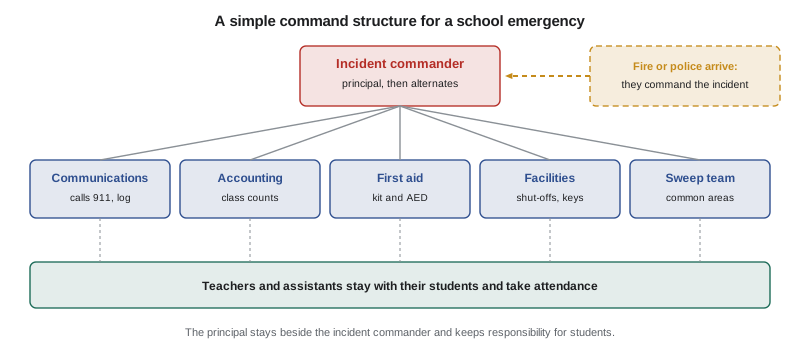
When the fire department or law enforcement arrive, the principal does not simply step aside. ICS calls this a unified approach: the emergency service takes command of the incident itself, such as fighting the fire or securing a threat, while the principal keeps responsibility for the students and works beside the incident commander. The principal is the person who knows how many students are in the building, which exits are blocked, where the student with a wheelchair was last seen, and which parents are already arriving. That knowledge is only useful if the principal is easy to find, which is why many schools give their incident commander a bright vest.
Every adult has a role
The incident commander and the named roles cover a handful of people. Everyone else on staff has one of the most important roles of all: taking care of the students in front of them. In a real emergency, the teacher in the room is the first responder. The principal may not reach the office for two minutes; the law enforcement may not arrive for eight. During those minutes, it is the teacher, the paraprofessional, the coach or the custodian who hears the announcement, sees the smoke or finds the student collapsed in the hallway, and acts.
That is why this course is written for every staff member, not just administrators. Supply teachers, lunchroom supervisors, bus drivers, volunteers and contracted cafeteria staff all need to know the basic actions. A school where only the office knows the plan is a school that will freeze when the office cannot be reached.
The duty behind the plan
Two sets of duties stand behind school emergency planning in Minnesota. Under the state's occupational safety and health law, enforced by MNOSHA, the district as employer must protect employees, which includes emergency action and fire prevention planning and training. Under Minnesota education law, districts must adopt a crisis management policy, and principals and teachers owe students a duty of care during the school day. The state fire code and the drill requirements in Minnesota law add specific requirements for fire safety and drills. These duties overlap: a well-drilled evacuation protects staff and students alike.
A plan that lives
A binder on a shelf is not a plan. A plan lives when staff know their part without looking it up, when drills are realistic enough to show where it fails, and when the school learns from every drill and every real event. Daniel's rule for the district is simple: if a drill went perfectly, it was probably too easy. The point of practice is to find the locked door, the classroom that could not hear the announcement, the student who panicked and the substitute who did not know where the assembly area was, and to fix those things before they matter.
Plans also go out of date quickly. Staff move, portables are added, construction closes an exit, a new student arrives who uses a wheelchair, a new housing development changes traffic around the school. The district requires each school to review its plan at the start of each school year and after any real emergency or significant change, and to confirm in writing that staff have been briefed.
How this course is organized
Lessons 2 and 3 cover fire safety and evacuation, including students and staff who need help to get out. Lessons 4 and 5 cover lockdown, secure and hold. Lessons 6 and 7 cover shelter for hazardous materials and severe weather. Lesson 8 covers medical emergencies. Lesson 9 covers bomb threats and suspicious items. Lessons 10 and 11 cover accounting for students, reunification and communication. Lesson 12 covers recovery, psychological first aid and improving the plan.
Worked problem
Checking a school plan at the start of the year
Show solution
- At the first staff meeting in August, Marion hands each department lead a one-page summary of the plan and a checklist.
- The checklist asks: Are the floor plans current, including the two new portables? Are the alternates for every role still on staff? Is the first aid and AED list up to date? Do all classrooms have a red and green card and a class list for accounting?
- Victor walks the building and finds that the 1989 wing's east exit is blocked by construction fencing until November. The fire safety and evacuation plan and the evacuation maps in that wing are updated, and the fire department is told.
- Jenna reviews the assistance plans for the four students in her room who cannot use stairs, and confirms which staff will help each of them.
- Marion records the review, the changes and the staff briefing date, and sends the updated plan to Daniel.
Answer: Review the plan against the building and the people as they are this year, fix what has changed, brief staff and record it.
Common mistakes
MistakeWriting a separate procedure for every possible event.
InsteadGroup events and train a small set of standard actions that everyone can remember.
MistakeNaming only the principal as incident commander.
InsteadName alternates in order, so someone in the building can always take charge.
MistakeTraining only office staff and administrators.
InsteadEvery adult in the building, including supply staff and volunteers, needs the basic actions.
MistakeTreating the plan as finished once it is approved.
InsteadReview it every year and after any real event, drill problem or building change.
MistakeSpending planning time only on rare, dramatic events.
InsteadRank hazards by likelihood and severity so common emergencies get attention too.
Summary and key terms
- School emergencies fall into a few groups, each with a standard basic action.
- A school plan describes the site, the hazards, the actions, the roles, accounting, communication, reunification, assistance plans and drills.
- A simple likelihood times severity score helps rank hazards and direct planning effort.
- Schools use a simplified incident command system with one person in charge and named alternates.
- Emergency services take command of the incident when they arrive, while the principal keeps responsibility for students.
- Every adult in the building has a role, and the teacher in the room is the first responder.
- Plans must be reviewed every year and after real events or changes.
- Emergency plan
- The written plan (an emergency response plan in Ontario boards, an emergency operations plan in US districts) that sets out how a school prepares for, responds to and recovers from emergencies.
- Incident command system (ICS)
- A standard way of organizing an emergency response with one person in command and clear roles.
- Incident commander
- The person in charge of the emergency response at a given moment.
- Standard action
- A short, practiced response, such as evacuation or lockdown, that applies to a group of similar emergencies.
- Alternate
- A named person who takes over a role when the usual person is absent.
Practice problems
Work each problem on paper first, then reveal the answer to check.
Why do schools group emergencies instead of writing a procedure for each event?
Show answer
So staff only need to recognize the group and carry out a small set of standard actions they have practiced.
What happens to the principal's role when the fire department arrives?
Show answer
The fire department takes command of the incident, and the principal works beside them and keeps responsibility for students.
Who is the first responder in most school emergencies?
Show answer
The teacher or other adult who is with the students when the event happens.
Name four parts of a good school emergency plan.
Show answer
Any four of: site description and maps, hazard list, standard actions, staff roles, accounting, communication, reunification, assistance plans, drills, review.
When should a school plan be reviewed?
Show answer
At the start of every school year and after any real emergency, drill problem or significant change to the building or people.
Lesson quiz · 5 questions
Score 60% or more to complete this lesson.
Create a free account to save your progress, take quizzes and earn a certificate.