
HSE-362 · Lesson 3 of 12 · 22 min
Evacuating everyone: students and staff who need assistance
▶ Video coming soon A video version of this lesson is on the way.
An evacuation plan that works for a class of able-bodied teenagers can fail completely for a second-grade student who uses a wheelchair, a kindergarten child who bolts when the alarm sounds, a deaf student in a washroom, a student with autism who cannot tolerate the noise, or a teacher on crutches after knee surgery. Every school has people like this, and in an emergency they are often the ones at greatest risk. This lesson is about planning so that everyone gets out, or gets to a safe place, without depending on improvisation in the worst moment.
Who may need help
The group is larger and more varied than people expect. It includes:
- Students and staff who use wheelchairs, walkers, crutches or canes, or who cannot manage stairs quickly.
- People who are deaf or hard of hearing and may not hear an alarm or announcement, especially in a washroom or a quiet room.
- People who are blind or have low vision and need guidance through unfamiliar routes or around obstacles.
- Students with autism, sensory processing differences, anxiety or past trauma, for whom the alarm, the crowd and the change of routine can cause distress, shutdown or running.
- Students with intellectual disabilities who may not understand what is happening or what to do.
- Students with medical conditions such as severe asthma, seizures or heart conditions that may be triggered by exertion, cold or stress.
- Very young children, who need close supervision and may freeze, hide or run.
- Temporary needs: a broken leg, late pregnancy, a recent surgery, or a student who has just arrived and does not know the building or the language.
- Visitors, volunteers and members of the public using the building after hours, whose needs are unknown.
Many of these students have an Individualized Education Program (IEP), a Section 504 plan, an individualized health plan or a behavior intervention plan. The emergency assistance plan should be connected to those documents, so that the information is consistent and kept up to date.
Individual emergency assistance plans
The district requires an individual emergency assistance plan for every student or staff member who may need help in an emergency. The plan is short, usually one page, and answers a handful of practical questions:
- What help does this person need in each type of emergency: evacuation, lockdown, shelter, severe weather?
- Who is the primary helper, and who are the alternates for each period of the day, including lunch, recess and before and after school?
- What route does the person use, and what is the backup if an elevator or ramp cannot be used?
- What equipment is needed: an evacuation chair, a manual wheelchair, noise-canceling headphones, a visual card, medication?
- How is the person alerted if they cannot hear the alarm?
- What calms or helps the person, and what makes things worse?
- Who do the staff tell if the person is not with them when the alarm sounds?
The plan is shared with everyone who may be responsible for the person, including supply staff, and a copy is kept in the class emergency folder. It is reviewed at the start of each year, when the person's needs change, and after every drill that shows a problem.
Elevators, stairs and areas of refuge
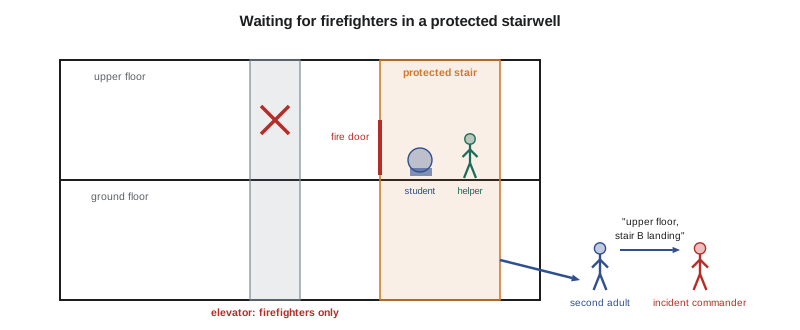
Elevators are not used for evacuation during a fire unless the fire department directs it, because the elevator may stop at the fire floor, the shaft can fill with smoke, and power may fail. Most elevators return to the ground floor automatically when the fire alarm sounds and are then available only to firefighters. That leaves a problem for anyone on an upper floor who cannot use stairs.
Building codes deal with this in a few ways. Many buildings have protected stairwells with a landing large enough for a wheelchair, or a designated area of refuge, a space protected from fire and smoke where a person can wait for firefighters. Some newer buildings have elevators designed for occupant evacuation. Older schools may have none of these, which is one reason the district tries to timetable classes with students who cannot use stairs on the ground floor.
When a person who cannot use stairs is on an upper floor during an alarm, the usual procedure is:
- The primary helper goes with the person to the designated refuge area or protected stairwell landing.
- Another adult goes down and outside and reports the person's exact location to the incident commander, who tells the fire department immediately.
- The helper stays with the person unless the danger becomes immediate.
- If the school has an evacuation chair and trained staff, they may move the person down the stairs once the main flow of people has passed, if it is safe to do so.
Evacuation chairs
An evacuation chair is a lightweight chair with tracks or skids that lets one or two trained people move a seated person down stairs. It is safer for the person and the helpers than carrying, which risks dropping the person and injuring the helpers' backs. Evacuation chairs only help if they are in the right place, maintained, and used by people who have practiced. A chair still in its box in a storage room, or a chair that nobody has used since the salesperson's demonstration, is worse than useless because it creates a false sense of safety.
Pinecrest High School has two chairs, one at the top of each main stair in the 1968 wing, and six staff trained to use them, including Sam Whitford and two custodians. They practice twice a year with a volunteer, usually a staff member, never with a student until the staff are confident. Willow Park, which is mostly single-story, has one chair for the second floor of the 2004 wing.
Alerting people who cannot hear
Modern alarm systems include visual signals, strobe lights, in classrooms, corridors and washrooms. Older wings may have strobes only in corridors, which leaves gaps. A deaf student alone in a washroom or a single-occupant room may not know an alarm is sounding. Solutions include adding strobes, assigning a buddy who checks on the student, sweeping washrooms as part of every evacuation, and personal devices such as vibrating pagers linked to the alarm system. For announcements that are not fire alarms, such as lockdown or secure, visual displays, text messages to staff devices and a staff member checking in person all help.
Students with behavior or sensory needs
Some students react to an alarm by covering their ears and refusing to move, dropping to the floor, hiding under a desk or running. These reactions are not defiance. They are the student's nervous system responding to a loud, sudden, unexpected event. The assistance plan should describe what the student is likely to do and what helps, such as:
- Noise-canceling headphones kept in a known place, ready to put on at the first sound.
- A visual card or social story, practiced beforehand, that shows the steps of an evacuation.
- A familiar adult who stays close and uses short, calm instructions.
- Leaving slightly before or after the main flow of students, during drills, to reduce crowding, while practicing the full route.
- A plan for running: which adult follows, how the office is told, where the student tends to go.
Jenna's resource room at Willow Park practices evacuation more often than the official drill schedule. In September, she walks each student through the route several times with no alarm. Then she plays a recorded alarm quietly, then louder. By the first official drill, most of her students know what is coming. One student, Mateo, still runs, so his plan names two adults: Jenna stays with the group and the vice-principal, who knows him well, follows Mateo and radios the office. The plan also notes that Mateo usually heads for the swings, which gives the vice-principal somewhere to look first.
Planning helpers for every time of day
The biggest weakness of assistance plans is that they name one helper and assume that person will always be there. In reality, the helper may be on lunch, in a meeting, absent, or with another student. A good plan names helpers by time of day and location and includes a fallback rule, such as: the adult nearest to the student takes responsibility until the named helper arrives. The program below checks a set of assistance plans for gaps, meaning periods of the day when no helper is named.
# Check assistance plans for periods with no named helper.
periods = ["before school", "period 1", "period 2", "lunch", "period 3", "period 4", "after school"]
plans = {
    "Student A (wheelchair, 2nd floor)": {"before school": "J. Kowalchuk", "period 1": "J. Kowalchuk", "period 2": "J. Kowalchuk",
                                          "period 3": "R. Singh", "period 4": "R. Singh"},
    "Student B (deaf)": {p: "class buddy + teacher" for p in periods},
    "Student C (runs when alarmed)": {"period 1": "J. Kowalchuk", "period 2": "J. Kowalchuk", "lunch": "lunch EA",
                                       "period 3": "J. Kowalchuk", "period 4": "J. Kowalchuk"},
    "Staff D (crutches, 6 weeks)": {"period 1": "colleague next door", "period 3": "colleague next door"},
}
for who, helpers in plans.items():
    gaps = [p for p in periods if p not in helpers]
print(f"{who:36} gaps: {', '.join(gaps) if gaps else 'none'}")Student A (wheelchair, 2nd floor) gaps: lunch, after school Student B (deaf) gaps: none Student C (runs when alarmed) gaps: before school, after school Staff D (crutches, 6 weeks) gaps: before school, period 2, lunch, period 4, after school
Every plan except Student B's has gaps, and most are at the edges of the day and at lunch, which is exactly when real emergencies are hardest to manage. The fixes are simple once the gaps are visible: add the before-school supervisor and the lunch paraprofessional to Student A's plan, and add the after-school program staff to Student C's. Staff D's plan needs the colleague for every period the teacher is in that room, and a second option for the periods when the teacher is elsewhere.
Lockdown, shelter and severe weather
Assistance plans must cover more than fire. In a lockdown, a student who vocalizes loudly when stressed, or who cannot stay still, needs a plan for staying quiet and calm, which might involve a weighted blanket, a favorite object or a quiet activity. A student who uses a wheelchair needs a pre-planned out-of-sight spot in the classroom. In a tornado warning, a student with a medical condition may need medication brought to the refuge area. In a long shelter, a student with diabetes needs access to snacks and supplies. Each of these is easy to plan for in advance and very hard to solve in the moment.
Staff with temporary needs and visitors
Staff members should tell the principal when an injury, pregnancy or medical condition might affect their ability to evacuate quickly or lead a class out. The principal then arranges a temporary plan, which might include moving the teacher's classes to the ground floor or pairing the teacher with a colleague. This is kept confidential and limited to what is needed.
Visitors are harder. The school cannot know the needs of every parent at a concert or every community group using the gym in the evening. The plan therefore includes general measures: announcements at the start of large events showing the exits, staff at each exit during events, and a rule that event organizers sweep the areas they are using and report anyone who needs help.
Worked problem
A drill that exposed a gap
Show solution
- During the October drill at Willow Park, Student A, who uses a power wheelchair, is in the second-floor library with a small group, not in her classroom.
- The librarian evacuates the group and assumes the student's paraprofessional will come for her. The paraprofessional is on break in the staff room.
- The librarian realizes at the stairs, goes back, and takes the student to the stairwell refuge landing. A student is sent to tell the office, which is the wrong choice: in a real fire, students should not be sent back through the building.
- The debrief identifies three fixes: the library is added to the student's plan with the librarian as helper, a two-way radio is kept in the library, and staff training emphasizes that the adult present takes responsibility until relieved.
- The plan is updated, shared with the librarian and the supply list, and tested in the next drill with no problems.
Answer: The adult present takes responsibility, the person waits in a protected refuge area with a helper, an adult reports the location, and the plan is updated to cover every place the person goes.
Common mistakes
MistakeNaming one helper and assuming they are always present.
InsteadName helpers for every time and place, with a rule that the nearest adult takes over.
MistakeUsing an elevator during a fire evacuation.
InsteadUse a protected refuge area or evacuation chair unless firefighters direct otherwise.
MistakeBuying an evacuation chair and never practicing with it.
InsteadKeep it in place, maintain it and train staff at least twice a year.
MistakeTreating a student who freezes or runs as being defiant.
InsteadPlan for the reaction with headphones, visual supports and a named adult.
MistakePlanning only for fire.
InsteadCover lockdown, shelter, severe weather and long events in each assistance plan.
Summary and key terms
- Many students and staff may need help in an emergency, including people with temporary needs and visitors.
- Each person who may need help should have a short individual emergency assistance plan linked to their other plans.
- Elevators are not used in a fire; people wait in a protected refuge area with a helper while another adult reports the location.
- Evacuation chairs only help if they are in place and staff have practiced with them.
- People who cannot hear alarms need visual signals, buddies and sweeps.
- Students with sensory or behavior needs benefit from practice, headphones, visual supports and a familiar adult.
- Plans should name helpers for every period and place, and cover every type of emergency.
- Individual emergency assistance plan
- A short written plan setting out the help a particular person needs in each type of emergency and who provides it.
- Area of refuge
- A space protected from fire and smoke where a person who cannot use stairs can wait for rescue.
- Evacuation chair
- A chair with tracks or skids that lets trained staff move a seated person down stairs.
- Visual alarm
- A strobe light that flashes when the fire alarm sounds, for people who cannot hear it.
- Social story
- A short illustrated description of a situation and what to do, used to prepare students for events such as drills.
Practice problems
Work each problem on paper first, then reveal the answer to check.
Why are elevators not used during a fire evacuation?
Show answer
They may stop at the fire floor, the shaft can fill with smoke, power can fail, and they return to the ground floor for firefighters.
What should happen when a student who cannot use stairs is on an upper floor during an alarm?
Show answer
A helper stays with the student in the refuge area while another adult goes out and reports the exact location to the incident commander and firefighters.
Name three supports for a student who is distressed by the alarm.
Show answer
Any three of: headphones, a visual card or social story, a familiar adult, practice before drills, a plan for running.
What is the most common gap in assistance plans?
Show answer
Periods with no named helper, especially before and after school and at lunch.
Why should students not be sent back into the building to report a problem?
Show answer
In a real fire it would put them in danger; an adult should report using a radio, phone or by going out to the incident commander.
Lesson quiz · 5 questions
Score 60% or more to complete this lesson.
Create a free account to save your progress, take quizzes and earn a certificate.