
HSE-362 · Lesson 12 of 12 · 20 min
After the emergency: recovery, psychological first aid and improving the plan
▶ Video coming soon A video version of this lesson is on the way.
An emergency does not end when the all-clear is given. Students and staff go home shaken, families have questions, the building may need repairs, and some people will carry the experience with them for weeks or longer. The school also has a chance to learn: every real event and every drill shows something about the plan that could be better. This last lesson covers the three parts of recovery: caring for people, getting the school running again, and improving the plan.
Phases of recovery
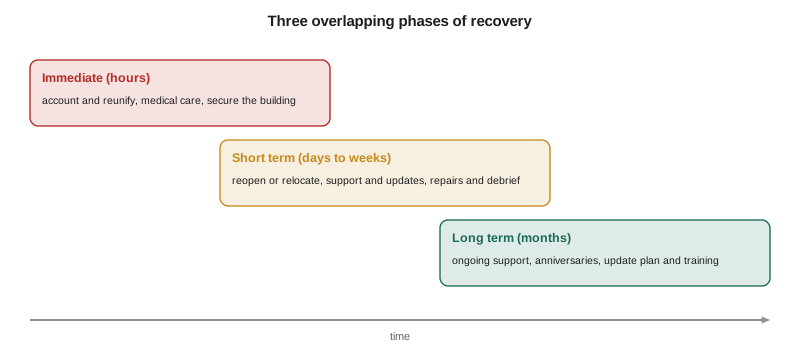
Recovery is usually thought of in three overlapping phases:
- Immediate, in the first hours: accounting, reunification, medical care, telling families, securing the building and making the first decisions about the next day.
- Short term, in the first days and weeks: reopening the school or moving classes, supporting students and staff, communicating regularly, repairing damage and holding the debrief.
- Long term, over months: continuing support for those most affected, dealing with anniversaries, finishing repairs, and putting the lessons learned into the plan, the building and training.
Most school emergencies are small, and recovery may be a quiet conversation in class the next morning and a few changes to the plan. A serious event, such as the death of a student or staff member, a fire that closes the school, or a violent incident, needs a much larger response, and the district has a crisis response team to support schools through it.
How people react
After a frightening event, most people have some reaction, and most of these reactions are normal and fade over days or weeks. Children and adults may have trouble sleeping, feel anxious or jumpy, be irritable, find it hard to concentrate, or keep thinking about what happened. Young children may become clingy, have tantrums, return to younger behavior such as bed-wetting, or play out the event. Older students may withdraw, act out, take risks or seem unaffected and then react later. Staff are affected too, often while they are busy looking after others.
A smaller number of people need more help. Signs that someone needs more help include reactions that are intense or get worse rather than better after a few weeks, that interfere seriously with school, work or relationships, or that include thoughts of self-harm. People who were closest to the event, who lost someone, who were injured, or who have had earlier trauma or losses are at higher risk. These people should be connected with mental health professionals.
Psychological first aid
Psychological first aid (PFA) is an approach for helping people in the hours and days after a traumatic event. It is not therapy, and it does not require staff to be counselors. It is a set of simple, humane actions that any trained adult can take. Several versions exist, including ones written for schools. They share the same core ideas:
- Safety and comfort: make sure the person is physically safe, meet basic needs such as water, warmth and a quiet place, and offer calm, caring contact.
- Listen: let people talk if they want to, without pressing them for details or telling them how to feel.
- Calm: help people who are very upset to settle, for example with slow breathing or by focusing on the present.
- Practical help: help with immediate needs and concerns, such as reaching a parent or getting home.
- Information: give accurate, simple information about what happened and what will happen next, and about common reactions.
- Connection: help people connect with family, friends and others who can support them.
- Linking to services: know when and how to refer someone to more help.
What PFA avoids is just as important: forcing people to describe the event in detail, telling them they should feel a certain way, making promises that cannot be kept, or offering false reassurance such as 'nothing like this will ever happen again.'
The first day back
The first day back after a significant event matters. The district's crisis response team helps the principal plan it. Common elements are:
- A short staff meeting before students arrive, with accurate facts, the plan for the day, and information about support for staff themselves.
- A short, factual statement for teachers to share with classes, written in age-appropriate language, so that every class hears the same accurate information.
- Extra counseling staff, social workers and psychologists available in a quiet room, with a way for students to go there without fuss.
- A gentle return to routine. Familiar routines are reassuring, and most students cope best when the day feels as normal as possible, while allowing flexibility for those who are struggling.
- Attention to students known to be at higher risk, such as close friends of anyone injured, students who saw the event, and students with earlier trauma.
- A letter or message to families explaining what happened, what the school is doing, common reactions to watch for at home, and where to get help.
Teachers often worry about what to say. Simple, honest words are best. It is fine to acknowledge that something frightening happened, to say that it is normal to feel upset, to answer questions with facts when they are known and say 'I don't know' when they are not, and to remind students who they can talk to. Teachers do not need to have all the answers, and they should not share details or rumors that are not confirmed.
Looking after staff
Staff carry two loads after an emergency: their own reactions and their responsibility for students. They may have made fast decisions under pressure and may second-guess them afterward. The district offers support through its employee assistance program and the crisis response team, and principals should check in with staff individually, especially those who were directly involved, such as the teacher who did CPR or the office administrator who took the threat call. Allowing time off, adjusting duties and recognizing what staff did all help.
Memorials and anniversaries
After a death or a very serious event, students and families often want to create memorials. Schools should handle these with care: memorials can comfort, but they can also keep distress alive for some students, and there are particular cautions after a suicide, where the district's procedures follow guidance on safe messaging. The crisis response team helps the school plan memorial activities that are respectful, inclusive and time-limited. Anniversaries of major events can bring reactions back, and schools plan quietly for them.
The debrief
Every real emergency and every drill is followed by a debrief, sometimes called an after-action review. Its purpose is to learn, not to blame. A good debrief asks four questions:
- What was supposed to happen?
- What actually happened?
- Why was there a difference?
- What will we change, who will do it, and by when?
There are usually two stages. A short 'hot' debrief happens right after the event or drill, often in a few minutes with the main people involved, to capture fresh impressions. A fuller debrief follows within a week or two, with input from staff, emergency services and, where suitable, students, and with the incident log, the accounting records and any timing data.
People are more honest in a debrief when they know it is not a search for someone to blame. A teacher who admits that she did not hear the announcement, or a custodian who forgot a fan, gives the school the information it needs to fix the system. Blaming individuals for honest mistakes teaches everyone to stay quiet next time.
Tracking the changes
Debriefs produce action items: a door lock to fix, a speaker to install, a plan to update, a training gap to close. The most common failure is that these items are written down and then forgotten. The district's practice is to keep an action list for each school, with an owner and a due date for every item, reviewed at each safety committee meeting and by the principal each month until every item is closed. The program below shows how a simple tracker flags overdue items.
# Track debrief action items and flag those that are overdue.
from datetime import date
today = date(2026, 11, 20)
items = [
    ("Fix music room door lock", "custodian", date(2026, 10, 30), True),
    ("Add speaker in change rooms", "facilities", date(2026, 12, 15), False),
    ("Lunch accounting procedure in staff handbook", "vice-principal", date(2026, 11, 1), False),
    ("Second threat checklist at office phone 2", "office admin", date(2026, 10, 20), True),
    ("Train two more staff on evacuation chair", "phys ed head", date(2026, 11, 15), False),
    ("Blinds for library glass wall", "facilities", date(2027, 1, 31), False),
]
for task, owner, due, done in sorted(items, key=lambda i: i[2]):
    if done:
        status = "done"
    elif due < today:
        status = f"OVERDUE by {(today - due).days} days"
    else:
        status = f"due in {(due - today).days} days"
print(f"{task:46} {owner:15} {due} {status}")Second threat checklist at office phone 2 office admin 2026-10-20 done Fix music room door lock custodian 2026-10-30 done Lunch accounting procedure in staff handbook vice-principal 2026-11-01 OVERDUE by 19 days Train two more staff on evacuation chair phys ed head 2026-11-15 OVERDUE by 5 days Add speaker in change rooms facilities 2026-12-15 due in 25 days Blinds for library glass wall facilities 2027-01-31 due in 72 days
Two items are overdue and need a nudge at the next safety committee meeting. Making the list visible, with names and dates, is what turns a debrief into a safer school.
Reporting obligations
Some events must be reported outside the district. Under MNOSHA rules, a work-related death of an employee must be reported within 8 hours, and an inpatient hospitalization, amputation or loss of an eye within 24 hours. Injuries to employees are reported to the workers' compensation insurer and recorded on the injury log. Serious incidents involving students are reported through the district's procedures, and some may involve law enforcement or child protection services. Fires are investigated by the fire department and sometimes the State Fire Marshal.
Keeping the plan alive
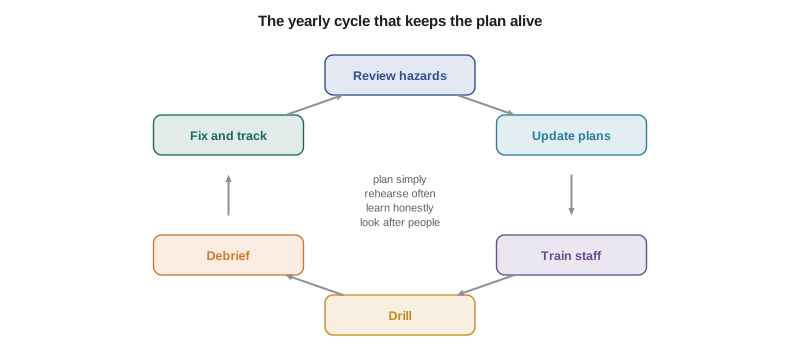
The plan is never finished. Each year, the district and each school go around the same cycle: review hazards, update the plan and assistance plans, train staff, drill, learn from drills and real events, and fix what was found. New research and guidance, new laws, building changes and the experiences of other schools all feed into the cycle. Daniel's summary for new principals is short: plan simply, practice often, learn honestly, and look after people.
Worked problem
Recovery after a staff member collapses
Show solution
- A teacher at Willow Park suffers a cardiac arrest in the hallway during morning recess. Staff give CPR and use the AED, and EMS crews take him to hospital, where he recovers after surgery.
- Several fifth-grade students saw the collapse. The principal calls the district's crisis response team that afternoon.
- Next morning, staff meet before school. Teachers read a short, factual statement to their classes: the teacher became very sick, the adults helped him quickly, he is in hospital getting care. A counselor visits the fifth-grade classes and is available all day.
- The two staff who did CPR are thanked personally, offered time off and connected with the employee assistance program. Families receive a letter about common reactions and where to get help.
- The debrief finds that the AED arrived in two minutes but the call to 911 gave the wrong entrance. The plan is updated to list the best entrance for each area, and a reminder card is placed at each office phone.
Answer: Support students with facts and counseling, look after staff who responded, inform families, debrief without blame and fix what the debrief finds.
Common mistakes
MistakePressing students to describe what they saw in detail.
InsteadListen if they want to talk, give accurate information and connect them with support.
MistakeTelling students "nothing like this will ever happen again."
InsteadBe honest and reassuring about what the school does to keep them safe.
MistakeForgetting the staff who responded.
InsteadCheck in with them, recognize what they did and offer support and time.
MistakeUsing the debrief to find someone to blame.
InsteadFocus on what happened, why, and what to change.
MistakeWriting action items down and never checking them.
InsteadGive each item an owner and date and review the list until it is closed.
Summary and key terms
- Recovery has immediate, short-term and long-term phases.
- Most reactions to frightening events are normal and fade; some people need more help.
- Psychological first aid offers safety, comfort, listening, calm, practical help, information and connection, without pressing for details.
- The first day back should share accurate facts, return to routine and provide extra support.
- Staff who responded need recognition and support too.
- Debriefs ask what was supposed to happen, what happened, why, and what will change, without blame.
- Action items need owners and dates, and some events must be reported outside the school.
- Recovery
- The work of caring for people, restoring the school and learning after an emergency.
- Psychological first aid (PFA)
- A set of simple, supportive actions for helping people in the hours and days after a traumatic event.
- Debrief
- A structured review after a drill or real event to learn what worked and what to change.
- After-action review
- Another name for a debrief that compares what was planned with what happened.
- Crisis response team
- A group of district staff, including counselors and psychologists, who support schools after serious events.
Practice problems
Work each problem on paper first, then reveal the answer to check.
Name three common reactions in children after a frightening event.
Show answer
Any three of: trouble sleeping, anxiety, irritability, clinginess, tantrums, returning to younger behavior, trouble concentrating, withdrawing.
What does psychological first aid avoid?
Show answer
Pressing for details, telling people how to feel, false reassurance and promises that cannot be kept.
What are the four questions of a debrief?
Show answer
What was supposed to happen, what happened, why there was a difference, and what will change, by whom and when.
Why should debriefs avoid blaming individuals?
Show answer
Blame discourages people from reporting mistakes, which the school needs to know about to fix the system.
What makes debrief action items actually get done?
Show answer
Giving each one an owner and due date and reviewing the list regularly until every item is closed.
Lesson quiz · 5 questions
Score 60% or more to complete this lesson.
Create a free account to save your progress, take quizzes and earn a certificate.