
HSE-362 · Lesson 2 of 12 · 22 min
Fire safety, alarms and evacuation drills
▶ Video coming soon A video version of this lesson is on the way.
Fire is the emergency schools have planned for longest, and the reason is history. Deadly school fires in the early twentieth century, and the 1958 fire at Our Lady of the Angels School in Chicago that killed 92 children and 3 nuns, changed building codes and drill practice across North America. Since then, sprinklers, fire alarms, fire separations, protected stairwells and regular drills have made deaths from school fires rare. They are rare because those controls work, and they work only when they are maintained and practiced. This lesson covers the fire safety plan, the alarm system, what staff do when the alarm sounds, and how to run drills that actually test the plan.
How fire spreads in a school
Most school fires start small: a fire set in a washroom garbage can, an overheated appliance in a staff room, a cooking fire in a family and consumer sciences room, a hot work job by a contractor, or an electrical fault in an old wing. What turns a small fire into a deadly one is smoke. Smoke travels along corridors and up stairwells far faster than people expect, and modern furnishings and classroom materials produce thick, toxic smoke within minutes. Most fire deaths are caused by smoke, not flames. That is why fire doors must close, why corridors must stay clear of combustibles, and why evacuation starts at the first alarm, not when someone sees flames.
Schools are built to slow this spread. Corridors and stairwells are separated from classrooms by fire-rated walls and self-closing doors. Many schools have sprinklers throughout, and newer schools almost always do. The fire alarm system detects smoke or heat, sounds the alarm, and in many buildings sends a signal to a monitoring company or directly to the fire department. Magnetic door holders release corridor doors when the alarm sounds. Each of these controls can be defeated by everyday habits: a fire door propped open with a wedge, artwork covering a whole corridor wall, a classroom door left blocked by a cart, a sprinkler head painted over or hung with decorations.
The fire safety and evacuation plan
Under the Minnesota State Fire Code, based on the International Fire Code, schools must have fire safety and evacuation plans that set out how occupants are notified and evacuated, how the fire department is called, the duties of staff, the location of fire protection equipment and the drill schedule. The local fire marshal reviews the plan and inspects the building. A copy is usually kept near the fire alarm control panel or annunciator at the main entrance, where firefighters will look for it.
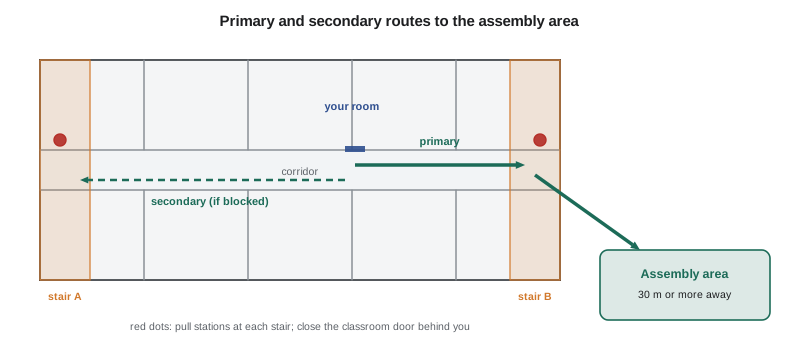
The district uses a common template, and each principal fills in the details for the building: the location of every pull station, extinguisher, fire alarm panel and sprinkler valve; the exit routes from every room, with a primary and a secondary route; the outdoor assembly areas; and the names of the staff responsible for each task. Floor plans showing the evacuation routes are posted in every room, near the door, with a 'you are here' marker.
What happens when the alarm sounds
Most fire alarm systems in schools are single-stage: any activation sounds the alarm everywhere and everyone evacuates. Some larger schools have two-stage systems, where the first stage alerts staff and the second stage orders a full evacuation. The district's schools are all single-stage, which keeps the rule simple: when the alarm sounds, everybody leaves.
The basic steps for a teacher are the same in every school:
- Stop the lesson immediately. Tell students to leave everything except outdoor clothing within arm's reach.
- Lead students out by the posted primary route, or the secondary route if the primary is blocked by smoke or fire.
- Take the class list and the red and green card, or the electronic attendance device if the school uses one.
- Close the classroom door behind the class, but do not lock it.
- Walk, do not run. Keep the class together and keep to the right in stairwells so firefighters can come up.
- Pick up any students in the hallway or washrooms on the way, and add them to your count.
- At the assembly area, line the class up in its assigned spot, take attendance, and report to the accounting station.
Teachers who are not with a class when the alarm sounds have a different job. They help sweep nearby areas such as washrooms, the library or the cafeteria, then go to the assembly area and report to the incident commander for an assignment. The plan also assigns staff to check spaces no class is responsible for: change rooms, the auditorium, music practice rooms, the nurse's or first aid room, and offices.
Assembly areas
The assembly area is where classes gather to be counted. It must be far enough from the building to be safe from smoke, falling glass and firefighting operations, and it must not block fire department access. A common rule of thumb is at least 30 meters (100 feet) from the building, and further for large buildings. At Pinecrest High School, classes assemble on the playing field, with each department assigned a section marked by numbered signs on the fence. Willow Park uses the back playground for the younger grades and the side field for the older grades, so that the K-8 classes do not cross the bus loop.
Every school also needs an alternate assembly area, in case the main one is unsafe or the weather is too severe for students to stand outside for long. Willow Park's agreement with the community center across the road lets classes move indoors there if the evacuation lasts more than about 15 minutes in winter. The plan says who decides to move, and how.
Calling the fire department
A common and dangerous assumption is that the alarm system calls the fire department automatically. Many systems are monitored, but not all are, and a monitoring company may call the school first to check for a false alarm. The district's rule is that the office calls 911 for every alarm that is not a scheduled drill, even if the system is monitored. A fire department that receives two calls is better than one that receives none.
When not to evacuate by the usual route
Evacuation is the right response to fire, but staff have to use judgment. If smoke fills the corridor outside a classroom, students should not walk into it. The safer choice may be to stay in the room with the door closed, seal the gap at the bottom of the door with jackets, open a window for air, call 911 or the office to report the room's location, and signal from the window. Ground-floor rooms may be able to evacuate through windows if they open far enough and the drop is safe. These choices should be discussed in staff training, not invented in the moment.
The other situation is a fire alarm during a lockdown. The plan should be explicit: staff stay in lockdown unless they see or smell fire or smoke, or are told to evacuate by an administrator or emergency services. The reason is that alarms have been pulled deliberately to draw people out of locked rooms. Lesson 4 returns to this.
Drills
Minnesota law requires public schools to hold at least five fire drills each school year, along with at least five lockdown drills and one tornado drill. Drills test whether the alarm can be heard everywhere, whether every class knows its route, how long evacuation takes, and whether accounting works. The district also expects each school to hold at least one drill with an exit blocked, so that classes have to use their secondary routes, and at least one at an inconvenient time, such as lunch or passing time, when students are not in their usual rooms.
A drill that always happens at 10:15 on a sunny Tuesday, with every teacher warned in advance, tests very little. Good drills vary the time, the day, the weather and the starting conditions. Some schools announce drills to staff but not students; others announce only the week. The first drill of the year, however, should be announced and slow, with teachers walking their classes through the route and explaining why each step matters, especially for new students and kindergarten classes.
Timing and recording drills
Every drill is recorded: the date, time, weather, conditions, the time to clear the building, the time to complete accounting, and any problems. The records show trends. If the clear time creeps up over the year, something is wrong: perhaps a new portable has added a long walk, or a hallway is cluttered, or a group of students has learned they can dawdle. The program below uses Pinecrest High School's six drill records from last year to flag drills that took longer than the school's target of four minutes to clear and eight minutes to account for everyone.
# Fire drill log: time to clear the building and to finish accounting (minutes).
drills = [
    ("Sep 12", "announced, sunny", 3.6, 6.9),
    ("Oct 03", "unannounced", 3.9, 7.4),
    ("Nov 21", "east exit blocked", 4.8, 9.6),
    ("Feb 06", "unannounced, -18 C", 4.1, 8.3),
    ("Apr 17", "lunch period", 5.2, 11.0),
    ("May 29", "unannounced", 3.7, 7.1),
]
CLEAR_TARGET, COUNT_TARGET = 4.0, 8.0
for date, note, clear, count in drills:
    flags = []
    if clear > CLEAR_TARGET:
        flags.append(f"clear +{clear - CLEAR_TARGET:.1f}")
    if count > COUNT_TARGET:
        flags.append(f"count +{count - COUNT_TARGET:.1f}")
    print(f"{date} {note:22} clear {clear:.1f} count {count:4.1f}  {', '.join(flags) or 'ok'}")
avg = sum(d[2] for d in drills) / len(drills)
print(f"average clear time: {avg:.2f} min")Sep 12 announced, sunny clear 3.6 count 6.9 ok Oct 03 unannounced clear 3.9 count 7.4 ok Nov 21 east exit blocked clear 4.8 count 9.6 clear +0.8, count +1.6 Feb 06 unannounced, -18 C clear 4.1 count 8.3 clear +0.1, count +0.3 Apr 17 lunch period clear 5.2 count 11.0 clear +1.2, count +3.0 May 29 unannounced clear 3.7 count 7.1 ok average clear time: 4.22 min
The lunch drill is the clear outlier. Students were spread across the cafeteria, library, gyms and outside, and accounting took eleven minutes because teachers had no class to count. The fix the school adopted was a lunch accounting procedure: students go to their period-1 teacher's spot at the assembly area, and teachers on lunch duty sweep their assigned areas. The next lunch drill cleared accounting in 8.2 minutes.
Keeping fire protection working
Daily habits matter as much as the alarm system:
- Fire doors close fully and latch, and are never wedged open.
- Corridors and exits stay clear; storage is never kept in stairwells.
- No more than a set proportion of each corridor and classroom wall is covered with paper, as set by the fire code and the district's rules.
- Nothing hangs from sprinkler heads or pipes, and storage stays at least 18 in (45 cm) below sprinkler heads.
- Extinguishers are in place, visible and inspected monthly.
- Exit signs are lit and emergency lights work.
- Pull stations are not blocked by furniture.
- Hot work by contractors follows the district's permit system, with a fire watch afterward.
Custodians and the safety committee check these items during monthly inspections, but every teacher can see a wedged door or a blocked exit and fix it on the spot.
Fire extinguishers
Staff are not firefighters, and the first priority is always to raise the alarm and get students out. The district trains some staff, such as custodians, family and consumer sciences teachers and science teachers, to use portable extinguishers on small fires, such as a pan fire or a small fire in a waste basket, and only if they have a clear exit behind them. The usual method is PASS: pull the pin, aim at the base of the fire, squeeze the handle and sweep from side to side. If the fire is not out in a few seconds, or is growing, the person leaves and closes the door.
Worked problem
A real alarm during period 3
Show solution
- At 11:20 the alarm sounds at Pinecrest High School. Smoke is coming from a recycling bin in a second-floor washroom.
- Priya, covering the main office that day, calls 911 and reports the alarm and the smoke location reported by a student.
- Teachers on the second floor take the nearest stair. One class finds smoke in the corridor near the washroom and turns back to use the far stair, its secondary route.
- Victor meets the fire department at the main entrance with keys and the floor plan, and points out the annunciator showing the washroom zone.
- At the field, accounting finds two students missing from a class. Their teacher reports they had passes to the library. The library sweep teacher confirms they left with her group and are in the wrong section. All are accounted for after nine minutes.
- The fire department puts out the fire and ventilates the floor. Marion keeps students outside until the fire officer says the building is safe to re-enter.
Answer: Raise the alarm, call 911, evacuate by primary or secondary routes, meet the fire department, account for everyone and re-enter only when the fire officer allows it.
Common mistakes
MistakeAssuming the alarm system calls the fire department.
InsteadCall 911 for every alarm that is not a scheduled drill.
MistakeWedging fire doors open for convenience.
InsteadKeep fire doors closed or on magnetic holders that release when the alarm sounds.
MistakeAlways holding drills at the same time with everyone warned.
InsteadVary times, conditions and blocked exits so drills test the plan.
MistakeWalking a class into a smoke-filled corridor.
InsteadUse the secondary route, or stay in the room with the door sealed and report your location.
MistakeRe-entering the building when the alarm stops.
InsteadWait until the fire department or the incident commander says it is safe.
Summary and key terms
- Smoke, not flame, causes most fire deaths, so evacuation starts at the first alarm.
- Fire separations, closing doors, sprinklers and alarms only work if daily habits keep them working.
- The fire safety plan sets out routes, assembly areas, staff duties, drills and equipment maintenance.
- Teachers stop, lead students out by primary or secondary routes, close the door, and take attendance at the assembly area.
- The office calls 911 for every alarm that is not a scheduled drill.
- Drills should vary time, conditions and blocked exits, and their timing should be recorded and reviewed.
- Only trained staff should use extinguishers, on small fires, with a clear exit behind them.
- Fire safety plan
- The approved plan (called a fire safety and evacuation plan in many US codes) that sets out fire emergency procedures, staff duties, drills and equipment maintenance for a building.
- Assembly area
- The outdoor place where classes gather to be counted after an evacuation.
- Fire separation
- A wall, floor or door built to slow the spread of fire and smoke between parts of a building.
- Secondary route
- The alternate way out of a room or area, used when the primary route is blocked.
- PASS
- Pull, aim, squeeze, sweep: the method for using a portable fire extinguisher.
Practice problems
Work each problem on paper first, then reveal the answer to check.
Why must evacuation begin at the first alarm, even if no flames are visible?
Show answer
Smoke spreads quickly and causes most fire deaths, often before flames are seen.
What should a teacher do if the corridor outside the classroom is full of smoke?
Show answer
Use the secondary route, or stay in the room, close and seal the door, call to report the location and signal from a window.
How many fire drills does Minnesota law require in a school year?
Show answer
At least five.
Why did the lunch drill take so long to account for everyone, and what fixed it?
Show answer
Students were not with a class; a lunch procedure sending them to their period-1 teacher at the assembly area fixed it.
What does PASS stand for?
Show answer
Pull the pin, aim at the base, squeeze the handle, sweep side to side.
Lesson quiz · 5 questions
Score 60% or more to complete this lesson.
Create a free account to save your progress, take quizzes and earn a certificate.