
HSE-362 · Lesson 6 of 12 · 20 min
Shelter for hazardous materials: hazards in the outside air
▶ Video coming soon A video version of this lesson is on the way.
Sometimes the danger is in the air outside. A tanker truck overturns on the highway, a rail car leaks a chemical in the yard two kilometers away, a fire at a nearby plant sends a plume of smoke across the neighborhood, or a gas line ruptures in the street. Sending students outside into that air would be the worst thing to do. The safer choice is usually to keep everyone inside, close the building up, shut down the systems that pull outside air in, and wait for the plume to pass or for emergency officials to give other directions. This is shelter.
In the district's Standard Response Protocol, the shelter action is announced with the hazard and the strategy, for example: 'Shelter for hazmat. Seal the room.' The same shelter action, with a different strategy, is used for tornadoes, which Lesson 7 covers. Shelter for hazmat is different from secure, which deals with a person, and from lockdown, which deals with a threat inside.
Why staying inside works
A closed building does not keep outside air out completely, but it slows it down a great deal. Air leaks in through cracks around windows and doors, through gaps in the walls and roof, and above all through the ventilation system, which in a modern school is designed to bring in large amounts of outside air. If the ventilation is shut off and the windows and doors are closed, the rate at which outside air enters drops sharply. For a release that passes in an hour or two, people inside breathe much less of the chemical than people outside.
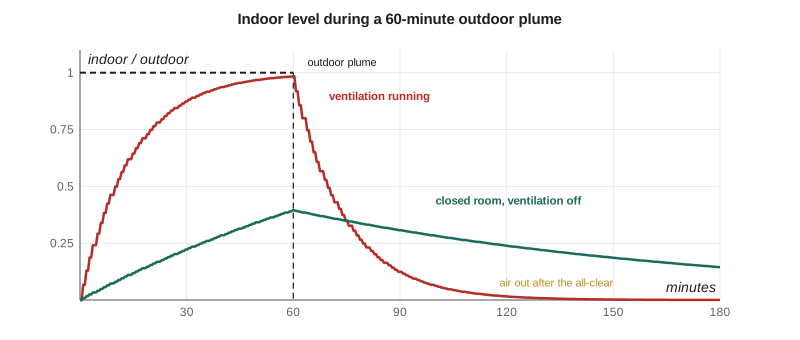
The program below uses a simple model of a room with a given air change rate, meaning how many times per hour the room's air is replaced by outside air. With ventilation running, a classroom might change its air four or more times an hour. With ventilation off and the room closed, leakage might give about half an air change per hour. The model compares the indoor concentration, as a fraction of the outside concentration, during a 60-minute plume.
import math
# Indoor concentration as a fraction of outdoor during a 60-minute plume,
# for a well-mixed room with air changes per hour (ach). Outdoor level = 1.0.
def indoor(ach, minutes, plume_minutes=60, step=1):
    c, out = 0.0, []
    k = ach / 60.0          # fraction of room air replaced per minute
    for t in range(0, minutes + 1, step):
        outside = 1.0 if t < plume_minutes else 0.0
        out.append((t, c))
        c += k * (outside - c) * step
    return out
for ach in (4.0, 0.5):
    data = dict(indoor(ach, 180))
    dose = sum(data.values())          # sum of minute values: a rough exposure index
    print(f"ach {ach}: at 30 min {data[30]:.2f}, at 60 min {data[60]:.2f}, at 120 min {data[120]:.2f}, exposure index {dose:.0f}")
print("outdoors for the whole plume: exposure index 60")ach 4.0: at 30 min 0.87, at 60 min 0.98, at 120 min 0.02, exposure index 60 ach 0.5: at 30 min 0.22, at 60 min 0.39, at 120 min 0.24, exposure index 43 outdoors for the whole plume: exposure index 60
The numbers show why shutting down ventilation matters so much. With ventilation running, the room reaches almost the outside concentration within the hour. With ventilation off and the room closed, the indoor level stays at a fraction of the outside level while the plume passes. The model also shows the catch: once the plume has gone, the closed room still holds some of the chemical, and it clears slowly. That is why, when officials give the all-clear, the building should be aired out, and why shelter is meant for hours, not days.
Who calls it
Shelter is usually called at the request of the fire department, law enforcement or the local emergency management office, often through the district office, or through public alerts such as Wireless Emergency Alerts and NOAA Weather Radio. The principal may also call it on the school's own information, such as a strong chemical odor coming in through the air intakes or a visible plume nearby. Staff who notice a strong smell of gas or chemicals coming from outside should tell the office immediately.
A gas leak inside the building is different. If staff smell natural gas inside, the right response is usually to evacuate, without using light switches or anything that could cause a spark, and to call the gas utility and 911 from outside. Victor knows the location of the gas shut-offs and is trained to close them when it is safe to do so.
What staff do
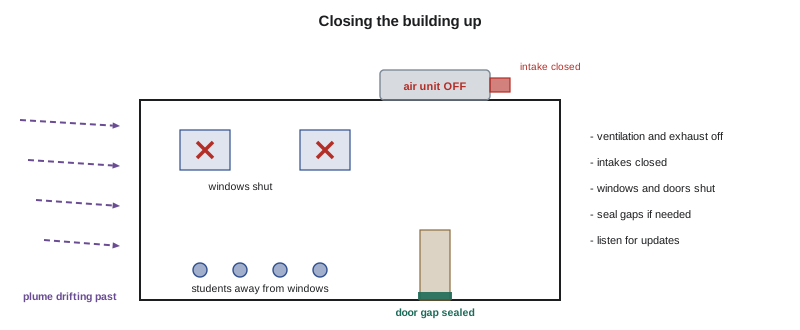
- Bring everyone inside immediately, including classes outside and students in portables, if time allows. If a plume is already over the area, portable classes may be safer staying in their portables with doors and windows closed.
- Close and lock exterior doors, and close all windows.
- Shut down the ventilation system. The custodian or facilities staff do this from the building automation system or the mechanical room; the plan says exactly how and who has the authority.
- Close classroom doors and, if officials advise it or a smell is noticeable, seal gaps around doors and windows with tape, wet towels or plastic sheeting kept in the classroom emergency kit.
- Move students away from windows and, if the release is heavier than air, to upper floors; if officials advise a specific room, go there.
- Take attendance and report to the office.
- Turn off fans, fume hoods and exhaust systems that could draw outside air in through cracks.
- Keep listening for updates and do not leave until told it is safe.
The ventilation shutdown
Shutting down the ventilation is the single most important technical step, and it is the one most often missed. Modern schools have air handling units that bring in outside air continuously, and some have separate exhaust fans for kitchens, washrooms, labs and shops. When those exhaust fans run with the supply air off, they pull outside air in through every crack. The plan must list every unit and fan, where its control is, and who turns it off.
At Pinecrest High School, most systems can be shut down from a single 'emergency off' command on the building automation system, which Victor and the two evening custodians can reach from the custodial office or a tablet. The kitchen hood and the shop dust collector are on separate controls, so they are listed separately. Willow Park's 1958 wing has unit ventilators in each classroom, so each teacher turns off the unit in the room; the switch is labeled with a red tag. During the spring drill, Victor discovered that the gym's rooftop unit was not on the automation system at all. It is now listed in the plan with its own switch location.
Classroom emergency kits
Each classroom in the district has a small emergency kit, kept in a bag or bucket near the door. Most of its contents are useful in any emergency, but a few items are there for shelter in particular:
- Class lists and the red and green card for accounting.
- A flashlight with spare batteries.
- Basic first aid supplies and gloves.
- Duct tape and pre-cut plastic sheeting for sealing gaps, and a few towels.
- Water and a few snacks, plus any medication or supplies listed in students' assistance plans.
- A whistle and a small portable radio.
- A few quiet activities for long waits.
Kits are checked at the start of each year and after any use. Class lists are replaced whenever they change.
Long shelters and student needs
Most shelter events last less than an hour, but some last several. During a long shelter, students need access to restrooms, water, food and medication. The plan should say how this is handled when people cannot move freely: staff escort small groups to the nearest restroom, the office sends supplies to rooms, and students with diabetes, asthma or other conditions have their supplies with them. The cafeteria may be asked to prepare food that can be delivered to rooms. A school that has thought about these questions in advance will cope with a long event far better than one that has not.
Families will be anxious and may try to come to the school. Messages to families should say clearly that students are safe inside, that coming to the school could expose them to the hazard, and that students will not be released until officials say it is safe. Lesson 11 covers this communication.
Ending the shelter and airing out
The shelter ends when emergency officials say the hazard has passed. Then:
- Open windows and doors and restart the ventilation system to flush the building with fresh air, as officials advise.
- Report anyone who feels unwell, such as with coughing, eye irritation or headache, to the first aid team and, if needed, EMS crews.
- Record the times, what was done and any problems, and debrief with staff.
In some events, officials may decide that evacuation is safer than staying, for example if the release will last a long time or a fire is spreading toward the school. The district has agreements with nearby schools and community buildings to receive students, and bus companies to move them, and Lesson 10 covers reunification from those sites.
Wildfire smoke
Smoke from wildfires, sometimes hundreds of miles away, has become a regular problem in Minnesota and much of the country. It is a slower, longer version of the same problem: the outside air is unhealthy, and the building should keep it out. The response is usually not a formal shelter but a set of precautions guided by the Air Quality Index (AQI) and state health department advice: keep students indoors for recess and physical education when air quality is poor, keep windows closed, use the ventilation system with the best filters it can take, and pay special attention to students with asthma and other breathing conditions.
Unlike a chemical plume, smoke can last for days, so shutting down ventilation entirely is not practical. Instead, facilities staff may reduce the amount of outside air while keeping filtration running, and some schools use portable air cleaners in classrooms. Lesson 7 returns to wildfire smoke alongside other weather hazards.
Worked problem
A rail yard release
Show solution
- At 10:40 a.m., the local emergency management office calls the district office: a rail car is leaking a chemical in the yard two kilometers west of Pinecrest High School, and the wind is blowing toward the school. The district calls Marion.
- Marion announces shelter at 10:43. Victor shuts down the ventilation from the automation system and then goes to turn off the kitchen hood and shop dust collector, which are on separate controls.
- Classes outside come in. Teachers close windows and doors, and two classrooms on the west side seal their door gaps when students notice a faint smell.
- At 11:10, the office sends a message to families: students are safe inside the building, which has been closed up as officials advise; please do not come to the school.
- At 12:25, emergency officials give the all-clear. Windows are opened and ventilation is restarted. Two students with mild eye irritation see the first aid team. Lunch is delivered to classrooms, and afternoon classes resume.
Answer: Bring everyone in, close the building up, shut down ventilation and exhaust, seal gaps if needed, communicate, and air out after the all-clear.
Common mistakes
MistakeEvacuating students into a chemical plume.
InsteadKeep everyone inside and close the building up until officials say otherwise.
MistakeClosing windows but leaving the ventilation running.
InsteadShut down air handling units and exhaust fans, which pull outside air in.
MistakeNot knowing which units and fans are on separate controls.
InsteadList every unit, fan and hood in the plan with its control location.
MistakeForgetting to air out the building after the all-clear.
InsteadOpen windows and restart ventilation once the hazard has passed.
MistakeTreating a gas smell inside like an outside release.
InsteadFor gas inside, evacuate without making sparks and call from outside.
Summary and key terms
- Shelter protects people from hazards in the outside air by keeping them in a closed building.
- Shutting down ventilation and exhaust is the most important technical step.
- A closed room keeps indoor levels well below outdoor levels during a short release, but must be aired out afterward.
- Classroom kits include sealing supplies, water, first aid, lists and student supplies.
- Long shelters need plans for washrooms, food, water and medication.
- A gas leak inside calls for evacuation, not shelter.
- Wildfire smoke is managed with indoor recess, closed windows, good filtration and attention to students with breathing conditions.
- Shelter in place
- Staying inside a closed building, with ventilation shut down, to avoid breathing a hazard in the outside air.
- Air change rate
- How many times per hour the air in a room is replaced by outside air.
- Air handling unit
- Equipment that brings in, filters and distributes air through a building.
- Plume
- A cloud of gas, vapor or smoke carried by the wind from a release or fire.
- All-clear
- The message from officials that a hazard has passed and normal activities can resume.
Practice problems
Work each problem on paper first, then reveal the answer to check.
Why does shutting down the ventilation matter so much during shelter?
Show answer
The ventilation system brings in large amounts of outside air; shutting it off sharply reduces how much of the hazard enters.
Why can exhaust fans be a problem during shelter?
Show answer
Running exhaust fans with the supply air off pulls outside air in through cracks.
What should happen after the all-clear?
Show answer
Open windows, restart ventilation to flush the building, check anyone who feels unwell and record and debrief.
What should staff do if they smell natural gas inside the building?
Show answer
Evacuate without making sparks and call the gas utility and 911 from outside.
Name three precautions for wildfire smoke days.
Show answer
Indoor recess and physical education, closed windows, best available filtration, portable air cleaners and attention to students with asthma.
Lesson quiz · 5 questions
Score 60% or more to complete this lesson.
Create a free account to save your progress, take quizzes and earn a certificate.