
HSE-362 · Lesson 7 of 12 · 20 min
Severe weather: tornadoes, storms, cold, heat and smoke
▶ Video coming soon A video version of this lesson is on the way.
Weather is the emergency most schools face most often. In Riverbend, Minnesota, the school year runs from late summer heat through winter storms and deep cold into a spring and early summer season of thunderstorms and, occasionally, tornadoes. Most weather events are handled with routine decisions: indoor recess on a bitterly cold day, a late start after an ice storm, a postponed game when lightning is near. A few, above all a tornado warning, need an immediate, drilled response. This lesson covers both.
Watches and warnings
The National Weather Service (NWS) issues weather alerts. A watch means conditions are favorable for a hazard, such as a tornado or severe thunderstorm, to develop; it is time to be ready. A warning means the hazard is happening or about to happen; it is time to act. Tornado warnings are sent through Wireless Emergency Alerts to mobile phones, broadcast on NOAA Weather Radio and, in many Minnesota communities, sounded on outdoor warning sirens. The district office also monitors alerts and phones schools, but schools are told not to wait for the district: if a tornado warning is issued for the area, or staff see a tornado or funnel cloud, the principal calls the shelter action immediately.
Each school has a weather radio in the main office, set to sound for warnings in its area, and a designated person who monitors forecasts on days when severe weather is possible. On watch days, the principal reviews outdoor plans, such as field trips, outdoor physical education and after-school sports, and makes sure staff know where their refuge areas are.
Tornadoes
Minnesota averages dozens of tornadoes a year, most of them between May and August, and they can strike in other months too. Most are weak, but strong tornadoes have destroyed schools in the United States, and the time between a warning and a tornado's arrival can be only minutes.
The response is to move everyone to the best available refuge area in the building, away from windows, and to protect heads and necks. The safest places in a school are usually:
- Interior corridors on the lowest floor, away from exterior doors and windows.
- Small interior rooms such as restrooms, locker rooms without windows, and storage rooms.
- Basements, if the school has them.
- Areas under strong, short-span roofs, close to load-bearing interior walls.
The worst places are large rooms with long-span roofs, such as gyms, cafeterias, auditoriums and libraries, which can collapse, and any room with large windows or glass walls. Portables offer almost no protection, so portable classes must move into the main building as soon as a warning is issued, or as soon as a watch makes a warning likely.
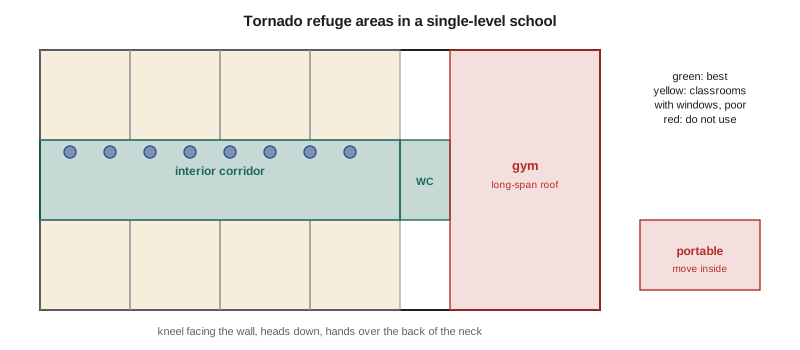
Refuge areas are chosen with help from a structural engineer or the district's facilities department, and each classroom is assigned a specific spot. At Willow Park, the 1958 wing's central corridor has load-bearing block walls on both sides and makes a good refuge; the 2004 wing's main corridor has a long skylight and does not, so those classes go to the interior corridor of the older wing. Assignments are posted with the evacuation maps.
What staff do in a tornado warning
- Move the class to its assigned refuge area quickly, taking the class list and emergency kit. Portables and outdoor classes move in first.
- Close classroom doors behind you to reduce flying debris.
- In the refuge area, have students kneel facing the wall, heads down, hands over the backs of their necks. Students who use wheelchairs lock their brakes and lean forward with arms over their heads, or transfer to the floor if that is part of their plan.
- Take attendance and report missing students.
- Stay in place until the warning ends or emergency officials give the all-clear, even if it seems quiet. The office keeps listening to the weather radio.
- After the storm passes, watch for hazards such as broken glass, fallen ceiling tiles, gas smells or electrical damage before moving students.
Families sometimes arrive during a warning to pick up their children. Releasing students into a storm is dangerous, and the district's practice is to bring parents inside to shelter with everyone else rather than release children until the warning has ended.
Tornado drills
Minnesota law requires at least one tornado drill each school year, and many districts hold theirs during the statewide severe weather awareness week each spring, when the state runs a coordinated tornado drill and sounds outdoor sirens. The district holds its drill then, and some schools add a second drill in the fall.
Drills show whether students can reach refuge areas quickly and fit into them. At Pinecrest High School, the spring drill found that the main floor's interior corridors could hold only about two-thirds of the school's population kneeling against the walls, so a second row was added along the opposite wall and the auditorium lobby was removed from the list because of its glass front.
Thunderstorms and lightning
Lightning is a far more common danger than tornadoes, and it is a particular risk for outdoor physical education, recess, sports practices and field trips. The basic rule is simple: when thunder roars, go indoors. If you can hear thunder, you are close enough to be struck. Everyone should move into a fully enclosed building or a hard-topped vehicle with windows closed. Dugouts, open shelters, picnic shelters, bleachers and tents do not protect against lightning.
Outdoor activities resume only when no thunder has been heard and no lightning seen for at least 30 minutes. Coaches like Sam carry a weather app with lightning alerts and a written policy that gives them the authority to stop a game or practice, whoever is winning. The program below shows how the time between a flash and its thunder gives a rough distance, since sound travels about one kilometer in three seconds (one mile in five).
# Flash-to-bang: estimate distance to lightning from the delay before thunder.
SPEED_SOUND_M_S = 343
for seconds in (3, 6, 10, 15, 20, 30):
    km = SPEED_SOUND_M_S * seconds / 1000
    miles = km / 1.609
    action = "go indoors now" if seconds <= 30 else "watch the sky"
    print(f"{seconds:2d} s delay -> about {km:4.1f} km ({miles:3.1f} mi): {action}")
print("Resume outdoor activity only after 30 minutes with no thunder or lightning.")3 s delay -> about 1.0 km (0.6 mi): go indoors now 6 s delay -> about 2.1 km (1.3 mi): go indoors now 10 s delay -> about 3.4 km (2.1 mi): go indoors now 15 s delay -> about 5.1 km (3.2 mi): go indoors now 20 s delay -> about 6.9 km (4.3 mi): go indoors now 30 s delay -> about 10.3 km (6.4 mi): go indoors now Resume outdoor activity only after 30 minutes with no thunder or lightning.
A 30-second delay means the strike was about ten kilometers away, which is well within the distance lightning can travel from a storm. The practical rule is not to calculate but to go indoors at the first thunder.
Extreme cold
Cold is the weather hazard that affects the most school days in Riverbend, Minnesota. The NWS issues cold weather advisories and extreme cold warnings based on wind chill. The district sets thresholds for indoor recess based on the wind chill, and principals decide on the day, taking into account the age of the students and how long they would be outside. Late starts and closures are decided early in the morning by the superintendent, based on temperature, wind chill, road conditions and visibility.
Wind chill describes how cold the air feels on exposed skin when wind is added to low temperature, and it is a good guide to the risk of frostbite. The program below uses the standard wind chill formula, the same in Canada and the United States, to show how quickly the effective temperature drops as the wind rises.
# Wind chill index (same formula used in Canada and the US), T in deg C, V in km/h.
def wind_chill(t_c, v_kmh):
    if v_kmh < 5:
        return t_c
    return 13.12 + 0.6215 * t_c - 11.37 * v_kmh ** 0.16 + 0.3965 * t_c * v_kmh ** 0.16
for t in (-10, -20, -30):
    row = []
    for v in (10, 30, 50):
        wc = wind_chill(t, v)
        row.append(f"{v} km/h: {wc:6.1f} C ({wc * 9 / 5 + 32:6.1f} F)")
print(f"air {t:4d} C | " + " | ".join(row))air -10 C | 10 km/h: -15.3 C ( 4.5 F) | 30 km/h: -19.5 C ( -3.1 F) | 50 km/h: -21.8 C ( -7.2 F) air -20 C | 10 km/h: -27.2 C ( -17.0 F) | 30 km/h: -32.6 C ( -26.6 F) | 50 km/h: -35.4 C ( -31.7 F) air -30 C | 10 km/h: -39.2 C ( -38.5 F) | 30 km/h: -45.6 C ( -50.1 F) | 50 km/h: -49.0 C ( -56.3 F)
At an air temperature of −4 °F (−20 °C) with a 19 mph (30 km/h) wind, the wind chill is about −33, at which frostbite can occur on exposed skin in well under half an hour. That is why young children at recess need hats, mittens and boots, why staff on yard duty need proper winter clothing, and why evacuation plans need a warm alternate assembly area. In a winter fire drill, students may have no coats, and the plan should allow classes to move quickly to a nearby building or onto buses if the evacuation lasts more than a few minutes.
Winter storms also bring snow and ice. The district's procedures cover early closures when storms arrive during the day, keeping students at school until it is safe to travel, and staying with students whose families cannot reach them.
Extreme heat
Heat is a growing problem, especially in older schools without air conditioning. The NWS issues heat advisories and excessive heat warnings based on the heat index. Students and staff can develop heat exhaustion or heat stroke, especially during physical activity, and students with some medical conditions or medications are at higher risk. On hot days, the district's procedures call for moving physical activity indoors or to cooler times, providing water and shade, using cooler rooms in the building, and watching for signs of heat illness.
Heat stroke is a medical emergency: a person who is hot, confused, collapsing or no longer sweating needs cooling right away and a call to 911. Coaches and physical education teachers should know the signs and have a plan for rapid cooling, such as cold water immersion, ice packs or cold wet towels.
Wildfire smoke
Smoke from distant wildfires can drift over the region for days, as it has in several recent summers and early falls. Lesson 6 described the basic response: keep students indoors when air quality is poor, keep windows closed, run the best filtration the ventilation system can take, and pay attention to students with asthma and other breathing conditions. The AQI is the guide. The district sets thresholds at which outdoor activities are moved indoors or canceled, and principals check the forecast on smoky days before recess, physical education and sports.
Worked problem
A tornado warning near dismissal
Show solution
- On a June afternoon, a tornado watch has been in effect since noon. Marion has moved after-school practices indoors and reminded staff of refuge areas.
- At 2:50 p.m., ten minutes before dismissal, a tornado warning is issued for the area. The office weather radio sounds, and Marion calls the shelter action immediately.
- Portable classes come into the main building first. Classes go to their assigned interior corridors, close doors behind them and take attendance. Two parents who arrive for pickup are brought inside to shelter with the office staff.
- Buses are held at the depot by the transportation office. Families receive a message that students are sheltering safely and dismissal is delayed.
- The warning ends at 3:25. Victor checks the building for damage, and dismissal begins at 3:40 with buses arriving in order.
Answer: Prepare during the watch, shelter immediately on the warning, bring families inside instead of releasing students, hold buses and communicate, and check for damage before dismissal.
Common mistakes
MistakeSheltering in the gym or cafeteria during a tornado warning.
InsteadUse interior corridors and small rooms on the lowest floor; avoid long-span roofs and glass.
MistakeLeaving portable classes in their portables during a warning.
InsteadMove portable classes into the main building as soon as the warning is issued.
MistakeContinuing an outdoor practice while thunder can be heard.
InsteadGo indoors at the first thunder and wait 30 minutes after the last.
MistakeReleasing students to families during a tornado warning.
InsteadBring families inside to shelter until the warning ends.
MistakePlanning winter evacuations as if every class will have coats.
InsteadPlan a warm alternate assembly area for long cold-weather evacuations.
Summary and key terms
- A watch means be ready; a warning means act now.
- In a tornado warning, move to interior corridors and small rooms on the lowest floor, kneel and protect heads and necks.
- Avoid gyms, cafeterias, libraries, glass and portables during tornado warnings.
- Go indoors at the first thunder and wait 30 minutes after the last thunder or lightning.
- Wind chill guides decisions on indoor recess and winter evacuations.
- Heat illness and wildfire smoke need indoor alternatives, water and close attention to students at higher risk.
- Drills and assigned refuge spots make tornado sheltering fast and orderly.
- Weather watch
- An alert that conditions are right for a hazard, such as a tornado, to develop.
- Weather warning
- An alert that a hazard is happening or about to happen and action is needed now.
- Refuge area
- The safest available place in the building to shelter from a tornado.
- Wind chill
- A measure of how cold the air feels on exposed skin when wind is combined with low temperature.
- Heat stroke
- A life-threatening rise in body temperature that needs immediate cooling and emergency care.
Practice problems
Work each problem on paper first, then reveal the answer to check.
What is the difference between a watch and a warning?
Show answer
A watch means conditions could produce the hazard, so be ready; a warning means it is happening or imminent, so act.
Why are gyms and cafeterias poor tornado refuges?
Show answer
Their long-span roofs can collapse and they often have large windows.
How long should outdoor activities wait after the last thunder?
Show answer
At least 30 minutes with no thunder heard or lightning seen.
Why do winter fire drills need a warm alternate assembly area?
Show answer
Students may leave without coats, and frostbite can develop quickly in low wind chills.
What should a coach do for a player who is hot, confused and has stopped sweating?
Show answer
Treat it as heat stroke: cool the player immediately and call 911.
Lesson quiz · 5 questions
Score 60% or more to complete this lesson.
Create a free account to save your progress, take quizzes and earn a certificate.