
PHOT-310 · Lesson 2 of 12 · 28 min
Briefs, creative direction and shot lists
Every commercial job begins with a brief, a document or conversation that tells the photographer what the client needs. A good brief describes the product, the purpose of the images, the audience, the look, the deliverables, the media and the deadline. A poor brief says little more than 'we need some nice photos of our new range'. Part of a commercial photographer's job is to turn whatever brief arrives into a clear, agreed plan: a confirmed brief, a treatment or creative proposal where needed, a shot list, a schedule and an estimate. Most problems on commercial shoots, from unhappy clients to blown budgets, trace back to misunderstandings that a careful pre-production process would have caught. This lesson covers how to read and question a brief, how creative direction works with agencies and direct clients, how to research and present a visual approach, and how to build shot lists and schedules that make a shoot day efficient.
What a brief contains
Briefs vary from a single email to a detailed PDF with layouts, brand guidelines and technical specifications. Whatever the format, the photographer needs answers to the same questions:
- Product: what exactly is being photographed, how many items or SKUs (stock-keeping units), variants such as colors and sizes, physical dimensions, fragility, special surfaces such as glass, chrome or gloss, and whether production samples are available or only prototypes.
- Purpose and audience: what the images must achieve (launch a product, sell online, explain features, build brand image) and who will see them.
- Look and references: the visual style, mood, lighting, color palette, backgrounds and props, often shown with reference images, brand guidelines and examples of previous campaigns.
- Deliverables: the number of final images, angles, crops and aspect ratios, whether clipping paths or transparent backgrounds are required, file formats, resolution and color space.
- Media and usage: where the images will be used (web, social, packaging, print, out-of-home, broadcast), for how long and in which territories. Usage drives the license fee, which is covered in lesson 11.
- Schedule and budget: shoot dates, delivery deadlines, and the client's budget or budget range.
- Approvals: who approves images on set and after the shoot, and how many rounds of retouching revisions are included.
- Logistics: where products will be delivered, who returns them, whether the shoot is in the studio or on location, and any confidentiality requirements.
A brief is the client's statement of need, but it is rarely complete. Clients often know what they want to feel when they see the images but not what that means in lighting, angles or production. The photographer's questions turn intentions into specifications.
Asking the right questions
The first conversation about a brief is a chance to show expertise. Rather than simply accepting the brief, an experienced photographer asks questions that uncover hidden requirements and risks:
- Will the images be cropped for different formats? A product photographed tight in landscape may not work as a vertical social story or a square marketplace tile.
- Is text going to be placed over the image? If so, where, and how much negative space is needed?
- Must the product match a physical color standard, such as a paint chip, a fabric swatch or a Pantone reference? Color-critical work needs targets, calibrated workflow and possibly a color sample shipped with the product.
- Are the samples final production pieces? Pre-production samples often have flaws, wrong colors or missing labels that require retouching or CGI fixes.
- Are there brand guidelines on angles, shadows, reflections or backgrounds? Many brands specify a standard product angle, a particular drop shadow or a reflection style that must be matched exactly.
- Will video or animation be needed from the same set? Combined stills and motion shoots need different lighting, crew and schedules.
- Who else is involved? An agency may be producing other parts of the campaign, or a retoucher may already be contracted.
Write down the answers and send a summary back to the client. This confirmation, sometimes called a creative brief confirmation or job confirmation, becomes the reference point if expectations shift later.
Creative direction: agencies and direct clients
With an advertising agency, the creative direction usually arrives fully formed. The art director has a concept, often a layout or a sketch (sometimes called a comp, short for comprehensive layout), and has sold that concept to the client. The photographer's role is to bring the layout to life with the best possible craft, suggest improvements and solve technical problems. The layout may specify the product's position and scale precisely because headlines, logos and legal copy will be placed around it. Departing from the layout without discussion can make images unusable, though offering an alternative after securing the agreed frame is often welcomed.
With direct clients, especially small and medium businesses, the photographer often acts as creative director. The client may bring only a product and a vague idea. The photographer then proposes a concept, researches references, creates a mood board, suggests backgrounds, props and color palettes, and explains how the images will be used across channels. This role is valuable and should be recognized in the estimate as creative or pre-production fees.
Between these extremes, in-house creative teams at brands and retailers commonly provide style guides and templates. E-commerce teams, for example, may have a detailed photography style guide specifying camera height, lens focal length, angles, background color, shadow treatment and crop for every product category. The photographer's job is to execute that standard consistently.
Treatments, mood boards and test shots
For larger jobs, and particularly when competing against other photographers for a campaign, a photographer may prepare a treatment: a short document explaining the approach, with reference images, lighting ideas, set and prop concepts, casting suggestions if talent is involved, and an outline of the production. A treatment shows that the photographer understands the brief and has a clear plan for executing it. It is also a sales tool, because agencies often ask two or three photographers to bid and choose based on both the estimate and the treatment.
Mood boards gather reference images to communicate look and feel: lighting quality, color palette, textures, composition and props. They are useful for aligning everyone before money is spent. References should be clearly identified as references, not images to copy; reproducing another photographer's distinctive work too closely can raise copyright and ethical concerns. When you use references, say what you are drawing from each one, for example 'the hard side light and long shadows of image 3' or 'the warm, natural palette of image 5'.
For difficult products or new lighting approaches, a test shot before the job, sometimes called a pre-light or test day, can save a great deal of money. Testing a glass bottle with the actual liquid, or trying several backgrounds with a real sample, reveals problems such as unexpected reflections, labels that glare or colors that shift under certain light. Some clients pay for pre-light days on complex jobs; others expect the photographer to include testing in the estimate.
Building a shot list
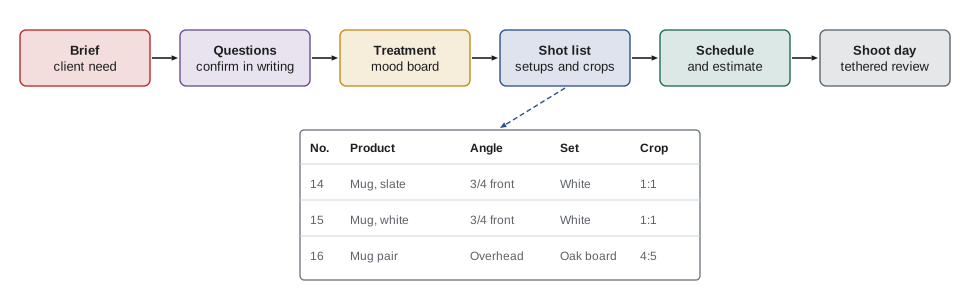
A shot list breaks the brief into individual images, each with the information needed to set it up and check it off. It is the photographer's main planning tool and the client's checklist on the shoot day.
| Field | Example entry | Why it matters |
|---|---|---|
| Shot number | 14 | Unique reference for files and approvals |
| Product and SKU | Ceramic mug, slate gray, SKU 2207-SL | Avoids photographing the wrong variant |
| Angle and view | Front three-quarter, camera 15° above | Matches the style guide or layout |
| Background and set | Seamless white, soft drop shadow | Defines the set before lighting |
| Props and styling | Steam added in post, oak board | Lets the prop stylist prepare |
| Crop and format | 1:1 for web, 4:5 alternate | Ensures enough space for all crops |
| Special notes | Handle on right, logo sharp | Captures client requirements |
| Estimated time | 20 minutes | Feeds the schedule |
Group shots that share a set and lighting so that you light once and photograph several products before changing the set. For e-commerce, this means grouping by product size, color or material: all small white items under one setup, all dark glossy items under another. For advertising, where each shot may have its own set, order the day so that the most complex or important shot happens when the team is fresh, and so that perishable items such as food or ice are photographed at the right moment.
Scheduling the shoot day
A realistic schedule depends on knowing how long each kind of shot takes. Time per shot varies enormously: an e-commerce studio with a locked lighting template may photograph a simple product in two or three minutes, while an advertising hero shot of a perfume bottle may take a whole day. Build a schedule from realistic estimates for setup, lighting, styling, shooting, client review and set changes, then add contingency.
Worked problem
Scheduling an e-commerce day
A homeware retailer needs 60 products photographed on white, each with 3 angles. Products fall into two groups needing different lighting: 40 matte items and 20 glossy items. You estimate 45 minutes to set up each lighting template, 4 minutes per angle for matte items and 7 minutes per angle for glossy items, plus 1.5 minutes per product to unpack and position. Can this be done in a 9-hour day with a 45-minute lunch?
Show solution
- Lighting setups: 2 × 45 = 90 minutes.
- Matte items: 40 × (3 × 4 + 1.5) = 40 × 13.5 = 540 minutes.
- Glossy items: 20 × (3 × 7 + 1.5) = 20 × 22.5 = 450 minutes.
- Total working time: 90 + 540 + 450 = 1,080 minutes = 18 hours.
- Available time: 9 hours − 0.75 hours = 8.25 hours = 495 minutes.
Answer: No. The work needs about 18 hours, more than two full days. Either schedule two to two and a half days, add a second set and photographer, or reduce angles for some products. Telling the client now prevents a failed shoot day.
Contingency matters because things go wrong: products arrive late or damaged, a client requests extra angles, or a difficult reflection takes an hour to solve. Many photographers add 15 to 25 percent to the estimated time and plan which shots can be dropped or moved if the day runs late. The schedule should also include time for the client to review images, especially on the first shot of each setup, because early approval of a template prevents reshoots.
Planning for crops and layouts
Images are used in many formats, and planning for them on the shoot saves expensive reshoots or awkward retouching. A product photographed in a 3:2 camera frame may need to work as a 1:1 marketplace tile, a 4:5 social post, a 9:16 vertical story, a 16:9 website banner and a 2:3 print page. If text will be placed over an image, the art director will specify where. Shoot loose enough to allow every crop, and use overlays in tethering software showing the crop lines so that everyone can see whether the composition works in every format.
Worked problem
Pixels available for a crop
A camera produces 8,256 × 5,504 pixel images (3:2). The product fills the center. What is the largest 4:5 vertical crop available, and does it meet a client requirement of at least 3,000 pixels on the long edge?
Show solution
- A 4:5 vertical crop is limited by the image height of 5,504 pixels, which becomes the long edge.
- Width = 5,504 × 4 / 5 ≈ 4,403 pixels.
- The crop is 4,403 × 5,504 pixels, about 24.2 megapixels.
- The long edge of 5,504 pixels exceeds the 3,000-pixel requirement.
Answer: About 4,403 × 5,504 pixels, comfortably above the requirement, provided the product sits within the central part of the frame.
For e-commerce, crop and placement are often specified by the retailer or marketplace: the product may need to fill a set percentage of the frame, sit at a set position, or have a consistent margin. Lesson 7 deals with these standards in detail. For advertising, the layout determines placement, and the photographer may shoot additional plates (separate frames of background or elements) to give the retoucher flexibility for extending the image to different formats.
Confirming everything in writing
Before the shoot, send the client a package that confirms the brief, shot list, schedule, estimate, usage license, delivery specifications, approval process and terms. This might be a single PDF or a set of documents, but it should be specific. When the client signs or approves the estimate and confirmation, both sides know what is included. Changes requested later, such as extra shots, additional usage or extra retouching rounds, can then be handled as change orders with additional fees, rather than as arguments.
Pre-production meetings, sometimes called pre-pro or PPM, bring together the client, agency and photographer before larger shoots to review the shot list, props, sets, casting and schedule. A good PPM ends with clear decisions and a list of open items with owners and deadlines. For smaller jobs, a short call or email exchange can do the same work.
Common mistakes
MistakeAccepting a vague brief and hoping for the best.
InsteadAsk questions and confirm the brief, deliverables and usage in writing.
MistakeShooting tight in landscape when vertical and square crops are needed.
InsteadPlan for every format and use crop overlays while shooting.
MistakeScheduling without time for client review and set changes.
InsteadBuild realistic times and add 15 to 25 percent contingency.
MistakeCopying a reference image closely.
InsteadUse references for qualities such as light and palette, not as templates to reproduce.
MistakeAgreeing to extra shots on set without discussing fees.
InsteadHandle additions as change orders with agreed costs.
Summary and key terms
- A brief defines product, purpose, look, deliverables, usage, schedule, budget and approvals.
- Good questions uncover crops, text placement, color standards, sample quality and brand rules.
- Agencies usually provide layouts; direct clients often need the photographer to direct creatively.
- Treatments, mood boards and test shots align expectations and reduce risk.
- Shot lists break the job into individual setups and group shots by lighting and set.
- Schedules use realistic times per shot and include contingency and review time.
- Confirm brief, schedule, estimate, usage and approvals in writing before shooting.
- Brief
- The client's statement of what the images must achieve.
- SKU
- Stock-keeping unit, a unique product variant.
- Layout
- An art director's plan of image placement with text and logos.
- Treatment
- A proposal explaining the photographer's creative and production approach.
- Mood board
- A collection of references communicating look and feel.
- Pre-light
- A test or setup day before the main shoot.
- Shot list
- A detailed list of every image to be produced.
- Plate
- A separate frame of background or elements for compositing.
- Change order
- A written agreement to change scope and fees.
- PPM
- Pre-production meeting to review plans before a shoot.
Practice problems
Work each problem on paper first, then reveal the answer to check.
Name five things a brief should state.
Show answer
Product, purpose, look, deliverables, usage, schedule, budget, approvals.
Why ask about text placement?
Show answer
To leave enough negative space in the composition.
What is a comp?
Show answer
A comprehensive layout showing the planned image and text.
Why do pre-production samples cause problems?
Show answer
They may have flaws, wrong colors or missing labels.
How should shots be grouped?
Show answer
By shared lighting and set.
40 products × 3 angles × 4 min, plus 1.5 min each?
Show answer
540 minutes.
Largest 1:1 crop from 6,000 × 4,000 px?
Show answer
4,000 × 4,000 px.
What contingency is typical?
Show answer
About 15 to 25 percent.
What is the purpose of a PPM?
Show answer
To agree shot list, props, casting and schedule before shooting.
Why confirm the brief in writing?
Show answer
It becomes the reference if expectations change.
Lesson quiz · 5 questions
Score 60% or more to complete this lesson.
Create a free account to save your progress, take quizzes and earn a certificate.