
PHOT-310 · Lesson 9 of 12 · 27 min
Lifestyle and in-context shoots with talent
Lifestyle product photography shows products as part of real life: a coffee maker on a sunny kitchen counter with someone pouring a cup, a backpack on a hiker at a mountain lake, a sofa in a styled living room with a family reading, a phone in the hand of a cyclist checking a route. These images help customers imagine owning and using the product, show its scale and function, and connect it to a lifestyle or set of values the brand wants to express. Lifestyle shoots combine the precision of product photography with the unpredictability of people, locations and weather, and they bring legal and logistical requirements that studio product work avoids: casting and directing talent, model releases, property and location permissions, union agreements, minors, safety and insurance. This lesson covers planning and executing lifestyle shoots and the rights you must secure to use people and places in commercial images.
What lifestyle images must achieve
A lifestyle image has two jobs at once. It must create an attractive, believable moment, and it must show the product clearly enough that the viewer knows what is being sold. These goals can conflict: a natural candid moment may hide the product's logo or turn it at an awkward angle, while a perfectly presented product can make the scene look staged. Experienced lifestyle photographers plan scenes in which the product is naturally prominent: hands holding it toward the light, a person interacting with it at the center of the frame, or a composition that leads the eye to it.
Authenticity matters. Audiences have become skilled at recognizing artificial, stock-photo moments, and many brands now ask for images that feel real: genuine interactions, diverse casting that reflects the brand's customers, realistic homes and locations, and natural light. This does not mean unplanned; most authentic-feeling lifestyle images are carefully planned and directed so that the moment can happen naturally within a controlled setting.
Planning a lifestyle shoot
Lifestyle shoots need more pre-production than studio product work. Typical planning tasks include:
- Concept and storyboard: a list of scenes and moments, each with the product, action, people, location and mood.
- Casting: choosing models, actors or real people who suit the brand and the story. Casting may involve modeling agencies, talent agencies, street casting or real customers.
- Locations: homes, offices, cafés, outdoor spaces or studio sets built to look like real rooms. Location scouting checks light direction at different times of day, space for equipment, power, noise, parking and access.
- Wardrobe, hair and makeup: stylists ensure that clothing supports the story and does not show competing brand logos.
- Props and set dressing: real-looking objects that make the scene believable without clutter.
- Schedule: built around light, talent availability, location access and the time needed to change scenes.
- Permissions and paperwork: model releases, property releases, location agreements, permits, insurance certificates and, where applicable, union contracts and minor work permits.
- Safety: risk assessment for locations, equipment, weather, water, roads and any physical activity performed by talent.
Hero product samples must be protected. A lifestyle shoot may have only one or two samples of a pre-release product, so assign someone to care for them, keep backups clean, and schedule product close-ups early in case of damage.
Directing talent
Most lifestyle talent are not professional actors, and even experienced models may be unused to interacting naturally with a product. Direction should be clear, encouraging and specific. Give people tasks rather than poses: 'pour the coffee and look up at your partner when she laughs' produces more natural images than 'smile and hold the cup'. Run the action several times, shoot continuously, and adjust small things between takes: the angle of the product, the position of hands, where people look.
Hands are the most important body part in many product images. They must look clean and relaxed, with nails groomed and no distracting jewelry unless intended, and they must hold the product in a way that shows it clearly without hiding the logo or key features. Hand models specialize in this work. Watch for awkward grips, tension and fingers covering key details.
Keep the product's appearance in mind throughout. Between takes, check the product for fingerprints, smudges or misplaced parts, and reset props to the same position for continuity. A digital technician or assistant can compare frames on the tethered screen to keep continuity across a scene.
Light on location
Lifestyle shoots often use available light, supplemented with flash or LED to control contrast and to light the product. Large windows provide soft, directional light for interior scenes; outdoor scenes depend on time of day and weather. The hour after sunrise and before sunset gives warm, low light that flatters people and places, while midday sun creates harsh shadows that usually need diffusion with scrims or fill.
Flash on location can balance a bright exterior with an interior scene, add sparkle to products, and freeze motion. When using flash outdoors at wide apertures, the camera's maximum flash sync speed often limits exposure: with a sync speed of 1/250 s, bright sun may require apertures smaller than the photographer wants. Solutions include high-speed sync (which reduces flash power considerably), neutral density (ND) filters or leaf-shutter lenses that sync at higher speeds.
Worked problem
Neutral density for shallow depth of field in sun
In bright sun, the correct exposure at ISO 100 is about 1/125 s at f/16 (the sunny 16 rule). The photographer wants f/4 for shallow depth of field and must keep the shutter at the 1/250 s flash sync speed. What strength of ND filter is needed?
Show solution
- From f/16 to f/4 is four stops more light.
- From 1/125 s to 1/250 s is one stop less light.
- Net: 4 − 1 = 3 stops too much light.
- A 3-stop ND filter (ND 0.9, transmitting 1/8 of the light) is needed.
Answer: A 3-stop ND filter (ND 0.9). The flash must then also deliver its light through the filter, so it needs three stops more power than without the filter.
Model releases
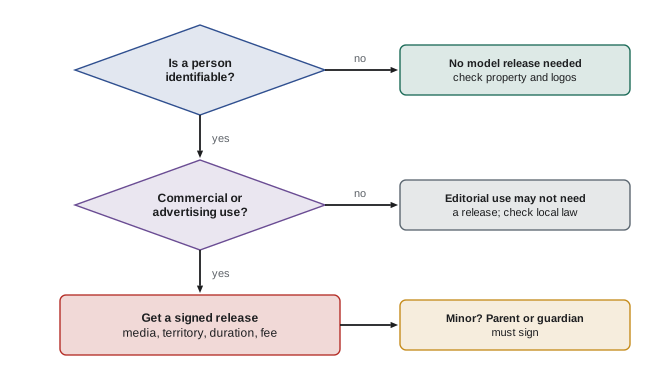
A model release is a written agreement in which a person grants permission to use their image, name or likeness in specified ways, usually in exchange for payment or other consideration. For commercial and advertising use, a release from every identifiable person is essential. Stock agencies, advertising agencies, broadcasters and most clients will not accept images of people for commercial use without releases.
A good release identifies the parties and the shoot, describes the permitted uses (media, territory, duration), states the consideration, includes any restrictions agreed with the talent, is signed and dated, and, for minors, is signed by a parent or legal guardian. Releases tied to talent agency bookings are often part of the booking terms, which may limit usage to specific media and periods, with additional fees for extended use.
In the United States, the right of publicity is governed mainly by state law and varies from state to state. New York's Civil Rights Law sections 50 and 51 prohibit using a living person's name, portrait or picture for advertising or trade purposes without written consent, and California's Civil Code section 3344 provides damages for knowing commercial use of a person's name, voice, signature, photograph or likeness without consent, with section 3344.1 protecting deceased personalities. Many other states have statutes or common-law rights of publicity. Union talent in commercials are engaged under SAG-AFTRA's commercials contracts, which set session fees and use payments.
Releases must match the actual use. A release signed for a brand's website does not automatically cover a national television campaign or packaging. If the use expands, the release and the talent's fees must be updated. Keep signed releases securely and link them to image files in metadata or a release database, so that anyone using the images later can confirm that releases exist.
Property, location and trademark issues
Locations and property bring their own permissions:
- Location agreements: written permission from the owner or manager of a home, business or private site, specifying dates, times, areas to be used, fees, insurance, restoration of the site and permitted uses of images. Homes used for shoots are often found through location agencies.
- Property releases: permission to use images of recognizable private property, such as distinctive buildings, interiors or artworks, in commercial images. Some clients require property releases for any recognizable private property.
- Public spaces and permits: shooting commercially in public parks, streets and transit may require municipal or agency permits, insurance certificates and sometimes police or traffic control. Cities with active film industries have film offices that manage permits for commercial still and motion shoots.
- Artwork and design: paintings, sculptures, murals and distinctive designs that appear prominently may be protected by copyright, and their use in an advertisement may need permission.
- Trademarks and competing brands: logos and branded products visible in a scene can imply endorsement or confuse viewers and may conflict with the client's brand. Remove, cover or retouch other brands' logos unless they are cleared for use.
Minors, unions and talent fees
Working with children requires extra care. Children must be supervised by a parent or guardian, work only limited hours with frequent breaks, and be kept safe from hazards on set. Many jurisdictions have rules about child performers, including work permits, maximum hours and trust accounts for earnings, and talent agencies will advise on local requirements. Releases for minors must be signed by a parent or guardian, and some jurisdictions allow minors to disaffirm contracts unless they are court-approved.
Professional talent, especially union members, are paid a session fee for the shoot plus usage fees depending on media, territory and duration. Non-union talent booked through modeling agencies are usually paid a day or half-day rate with a usage buyout, plus an agency fee, often around 20 percent, added to the talent fee.
Worked problem
Estimating talent costs
A lifestyle shoot needs two models for one day at $1,200 each, plus a usage buyout for one year of web and social use at 50 percent of the day rate, and an agency fee of 20 percent on all talent fees. What is the total talent cost?
Show solution
- Day rates: 2 × $1,200 = $2,400.
- Usage: 50% × $2,400 = $1,200.
- Talent fees subtotal: $2,400 + $1,200 = $3,600.
- Agency fee: 20% × $3,600 = $720.
Answer: $3,600 + $720 = $4,320. If the client later wants the images on packaging or for a second year, additional usage fees will be due, so the estimate should state the licensed use clearly.
Room sets and staged homes
Many furniture, appliance and home goods brands photograph lifestyle images on built room sets in large studios rather than in real homes. Room sets give complete control over light, layout and timing, can be repainted and redressed for different scenes, and avoid the restrictions of real locations. Set builders construct walls, windows and floors; prop stylists dress the room; and the photographer lights it to resemble natural daylight through windows, often using large sources outside fake windows. CGI has replaced many room sets for catalogs, but photographed sets remain common when real products, textures and people are central.
| Permission | When needed | Key contents |
|---|---|---|
| Model release | Identifiable people in commercial use | Parties, uses, territory, duration, consideration, signatures |
| Minor release | People under the age of majority | Parent or guardian signature, supervision terms |
| Location agreement | Private homes, businesses, sites | Dates, areas, fees, insurance, restoration |
| Property release | Recognizable private property | Permission for commercial use of the property's image |
| Permit | Commercial shooting in public spaces | Dates, areas, insurance certificates, conditions |
| Talent agreement or union contract | Agency or union talent | Fees, usage periods, working conditions |
Keep a talent log on set that records each person's name, agency, release status and the scenes they appear in, so that images can be matched to the correct releases and usage periods after the shoot.
Common mistakes
MistakeShooting identifiable people without releases for commercial use.
InsteadObtain signed releases that cover the intended media, territory and duration.
MistakeAssuming a website release covers packaging or television.
InsteadMatch releases and fees to the actual use and update them if it expands.
MistakeDirecting talent with poses only.
InsteadGive tasks and actions that create natural moments.
MistakeLeaving competing brand logos visible.
InsteadRemove, cover or retouch uncleared logos.
MistakeIgnoring sync speed limits outdoors.
InsteadUse ND filters, high-speed sync or leaf shutters.
Summary and key terms
- Lifestyle images show products in believable moments while keeping the product clear.
- Planning covers concepts, casting, locations, styling, schedule, permissions and safety.
- Direct talent with tasks and actions; pay special attention to hands and continuity.
- Location light is balanced with flash or LED, with ND filters or high-speed sync for wide apertures.
- Commercial use of identifiable people requires model releases matching the use.
- Locations, property, permits, artwork and trademarks need their own permissions.
- Minors, union talent and agency fees add rules and costs to lifestyle shoots.
- Lifestyle photography
- Images showing products in use in real-life settings.
- Model release
- Written permission to use a person's likeness.
- Right of publicity
- The right to control commercial use of one's identity.
- Appropriation of personality
- A tort for unauthorized commercial use of a likeness.
- Property release
- Permission to use images of private property.
- Location agreement
- A contract to use a private site for a shoot.
- Usage buyout
- A fee paid to talent for specified use of images.
- Hand model
- Talent specializing in hands for product images.
- ND filter
- A neutral filter reducing light by a set number of stops.
- Room set
- A studio-built room for lifestyle photography.
Practice problems
Work each problem on paper first, then reveal the answer to check.
What two jobs does a lifestyle image have?
Show answer
Create a believable moment and show the product clearly.
Why give talent tasks instead of poses?
Show answer
Tasks produce natural actions and expressions.
ND strength for 5 stops?
Show answer
ND 1.5.
Who signs a release for a child?
Show answer
A parent or legal guardian.
Does a web release cover packaging?
Show answer
Not unless it states that use.
Name a document needed to shoot in a private home.
Show answer
A location agreement.
What should you do with competing logos?
Show answer
Remove, cover or retouch them.
Agency fee of 20% on $2,000 in talent fees?
Show answer
$400.
Why schedule product close-ups early?
Show answer
Samples may be damaged later in the day.
Why use room sets?
Show answer
Complete control of light, layout and timing.
Lesson quiz · 5 questions
Score 60% or more to complete this lesson.
Create a free account to save your progress, take quizzes and earn a certificate.