
PHOT-440 · Lesson 12 of 12 · 27 min
Capstone: a hybrid photo-and-video client package
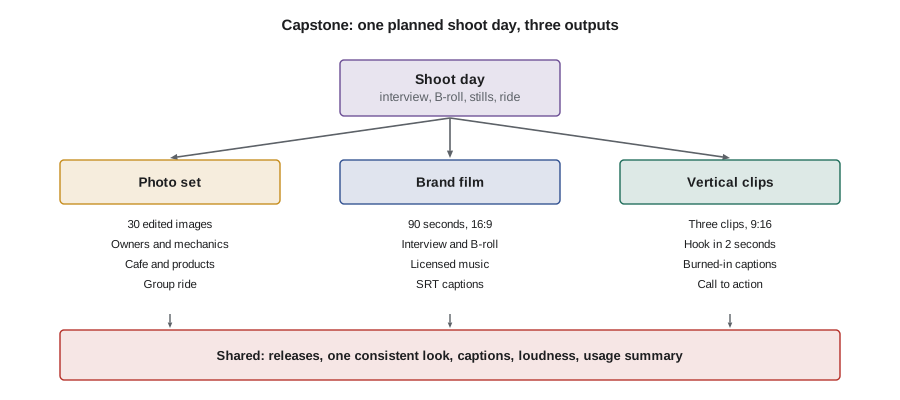
The capstone brings the course together in a complete hybrid package for a client. You will scope a job, write a treatment, plan coverage, light and sound, staff and schedule the shoot, budget and quote it, shoot photographs and video, edit a short film and vertical cutdowns, finish color and sound, caption and export to specification, run quality control and deliver with a usage summary. The capstone can use a real client with their agreement or the invented client described below. Either way, treat it as a professional job: written agreements, releases, deadlines and a reflection at the end. The worked examples use an invented business, Ridgeline Cycle Works, a bicycle repair shop with a small café in a mid-sized city.
The brief
Ridgeline Cycle Works has repaired bicycles for twelve years and recently added a café counter and a weekly group ride. The owners, two former bike couriers, want to attract new customers aged 25 to 45 who commute by bicycle and to promote a winter servicing package. They ask for photographs for their website and social media, a short brand film for the website and a set of vertical clips for social media. They have a budget of about $5,000 to $7,000 before tax, want everything delivered within three weeks of the shoot, and need captions because their social posts autoplay without sound. The shop is narrow, has large front windows and fluorescent ceiling lights, and is noisy when the espresso machine and air compressor run.
Deliverables and success criteria
A capstone deliverables set that matches the brief and the course might be: 30 edited photographs (portraits of the owners, mechanics at work, café details, the group ride and product shots of the winter package); one 90-second 16:9 brand film built around a short interview with the owners; three vertical 9:16 clips of 15 to 30 seconds (the winter service in 20 seconds, a mechanic's tip, the group ride); captions for every version, burned in for social clips and as SRT files for the web film; web loudness around −14 LUFS; graded stills and video with a consistent look; a usage summary and music license information.
Define success with the client before shooting: for example, the brand film should explain who they are and what makes them different within the first 20 seconds, the vertical clips should hook viewers in the first two seconds, and the winter package clip should end with a clear call to action. These criteria guide the edit and give you a basis for discussing feedback.
Pre-production plan
Your pre-production package should include: a scoping summary; a one-page treatment; a shot list organized by sequence; interview questions; a schedule and call sheet; a lighting and sound plan; a staffing decision; a gear and power list; release forms for owners, staff and customers; a location note covering the shop and the group-ride route; and a budget and quote. The plan should show how you will resolve the shop's problems: mixed window daylight and fluorescent light, flicker at 60 Hz, a narrow space and machine noise.
| Problem | Effect | Planned solution |
|---|---|---|
| Fluorescent ceiling lights | Flicker and green tint | Switch off for interviews; shoot B-roll at 1/60 s; use LED key |
| Large windows | Exposure changes with clouds | Use window as soft side light with LED key dominant |
| Espresso machine and compressor | Noise in dialogue | Schedule interview before opening; ask owners to switch off machines |
| Narrow shop | Limited camera positions | Use wider lenses, one gimbal, small LED; shoot from doorway for wides |
| Group ride outdoors | Wind and moving subjects | Furry windshields, lav on ride leader, gimbal and follow vehicle only with safety plan |
Treatment and structure
Ridgeline's treatment might describe the film as warm, practical and slightly playful, built around the owners' voices, the sound of tools and the city's morning commute. A possible structure: hook (2 to 5 seconds) with a close-up of a wheel spinning true and the line "We fix bikes so you can keep riding all winter"; context (15 seconds) with the owners introducing the shop; development (40 seconds) showing repairs, the café and the group ride; turning point (15 seconds) with a mechanic explaining why winter servicing matters; resolution (15 seconds) with the winter package and an invitation to visit. Vertical clips reuse footage but are cut for silent viewing with large captions and immediate hooks.
Schedule and staffing
For Ridgeline, a single long day with a second shooter for video is a reasonable plan, because the interview, the café, the repairs and the group ride happen at different times and the photos and video can be separated by block. The second shooter could be a classmate or a hired video operator.
Worked problem
Planning the shoot day
The shop opens at 10:00 and the group ride leaves at 18:00. Interviews need a quiet shop. Plan a day that captures the interview, B-roll, stills and the ride, with a lunch break.
Show solution
- 07:30 to 08:15: arrive, load in, set up interview lighting and sound while the shop is closed (45 minutes).
- 08:15 to 09:00: interview with both owners, two cameras, machines off (45 minutes including resets).
- 09:00 to 10:00: stills portraits of the owners and staff using the interview light and the window; video B-roll of the empty shop and details by the second shooter.
- 10:00 to 12:30: open shop: repairs and café B-roll using five-shot sequences; stills of mechanics, customers (with releases) and products; vertical shots for social.
- 12:30 to 13:15: lunch and data offload with checksum verification.
- 13:15 to 16:00: winter package product shots and a 20-second clip; mechanic's tip clip with a lavalier; pickup shots.
- 16:00 to 17:30: break, recharge batteries, second offload, prepare the ride kit.
- 17:30 to 19:00: group ride: stills and gimbal video at the meeting point and along a safe stretch; lavalier on the ride leader; never film from moving vehicles without a safety plan.
Answer: The day runs from 07:30 to 19:00 with two offloads and a lunch break. It is long, so plan rest, food and water, and confirm overtime terms with the second shooter.
Budget and quote
Build the quote from your cost of doing business and tracked editing times (lesson 11 and PHOT-410). Present it to the client as a package with clear deliverables, revision rounds, delivery dates and usage terms, and offer paid-advertising use as an option.
Worked problem
Budget for the Ridgeline package
Illustrative figures: your hybrid shoot day (long day) $2,000; second shooter $1,000; video editing 24 hours and photo editing 6 hours at $85 per hour; music license $150; captions in English $0 (done in-house, included in editing hours); gear rental (extra LED and lavalier) $120; mileage and parking $60; 10 percent contingency on costs paid to others. Usage: website and organic social for three years included. What is the quote before tax?
Show solution
- Shoot: \( 2000 + 1000 = 3000 \).
- Editing: \( (24 + 6) \times 85 = 2550 \).
- Expenses: \( 150 + 120 + 60 = 330 \).
- Contingency on costs paid to others (second shooter and expenses): \( 0.10 \times (1000 + 330) = 133 \).
- Total: \( 3000 + 2550 + 330 + 133 = 6013 \).
Answer: About $6,000 before tax, within the client's range. A paid-advertising option at 25 percent of creative fees, \( 0.25 \times (3000 + 2550) \approx 1388 \), could be offered separately.
items = {'shoot fees': 3000, 'editing': 30 * 85, 'music': 150, 'gear rental': 120, 'mileage and parking': 60}
paid_to_others = 1000 + 150 + 120 + 60
items['contingency'] = round(0.10 * paid_to_others)
total = sum(items.values())
for k, v in items.items():
    print(f'{k:20s} {v:6d}')
print(f'{"total before tax":20s} {total:6d}')
minutes = {'interview A': 40, 'interview B': 40, 'B-roll': 90, 'slow motion': 10, 'ride': 30}
gb = sum(m * 60 * 150 / 8000 for m in minutes.values())
print(f'Video at 150 Mb/s: {gb:.0f} GB; with three copies: {3 * gb:.0f} GB')shoot fees 3000 editing 2550 music 150 gear rental 120 mileage and parking 60 contingency 133 total before tax 6013 Video at 150 Mb/s: 236 GB; with three copies: 709 GB
Shooting and post-production
On the day, follow the plan but stay alert for unplanned moments, which often become the best shots. Keep a simple log of cards, sequences and releases. In post-production, cull and grade the stills first to establish the look, then sync, organize and select video, build string-outs and a paper edit from the interview, and cut the film to a licensed track. Share a rough cut with the client focused on story and a fine cut focused on details, within the agreed rounds. Finish color to match the stills, mix the audio with dialogue clear above music and natural sound, measure loudness, caption every version, export masters and delivery files to the deliverables list, and run QC on every exported file.
| Deliverable | Specification | Captions and audio |
|---|---|---|
| Brand film, 90 s | 16:9, 1920 x 1080 web file and 4K master | SRT file; −14 LUFS, −1 dBTP |
| Winter package clip, 20 s | 9:16, 1080 x 1920 | Burned in; −14 LUFS |
| Mechanic's tip clip, 30 s | 9:16, 1080 x 1920 | Burned in; −14 LUFS |
| Group ride clip, 15 s | 9:16, 1080 x 1920 | Burned in; music only or natural sound |
| Photo set, 30 images | JPEG, sRGB, 3000 px long edge, plus web versions | Not applicable |
| Usage summary and licenses | Lists media, term, music license identifiers |
Releases, ethics and accessibility in the capstone
Get signed releases from the owners and staff before the interview and from customers who appear recognizably, or film customers so they are not identifiable. Use a sign at the counter on the shoot day explaining that filming is taking place. Do not use AI to alter anyone's face or voice. Caption every version and check names and technical terms such as "derailleur" and "hydraulic disc brake". If the client operates in Quebec or wants bilingual reach, discuss French captions or versions.
Assessment criteria
A capstone of this kind might be assessed on: scoping and treatment (clarity, fit with the brief); pre-production (completeness of shot list, schedule, lighting and sound plans, releases and budget); stills quality (technical and creative, consistency with the brand); video craft (exposure, focus, stability, composition, coverage and sequences); sound (clean dialogue, natural sound, loudness and mix balance); editing (structure, pacing, hook, use of music and J and L cuts); finishing (color consistency between stills and video, captions, exports to specification, QC); and professionalism (communication, contracts, delivery, reflection).
Reflection
Finish with a written reflection of 500 to 800 words. Compare your planned and actual schedule and editing hours, and use the difference to adjust your future pricing. Identify the shots you wish you had captured, the sound problems you met and how you solved them, the feedback that most changed the film, and one skill to develop next, whether that is lighting, sound, editing or the business side. Include a short note on what you would charge for a similar job now, with your reasoning. Many students find their editing hours were 30 to 50 percent higher than planned on their first hybrid package, which is exactly the kind of data that makes future quotes accurate.
Common mistakes
MistakePromising more deliverables than the budget and schedule can support
InsteadMatch deliverables to budget and tracked editing times, and offer options.
MistakePlanning interviews during opening hours next to noisy machines
InsteadSchedule interviews when the location is quiet and machines can be switched off.
MistakeFilming customers without releases or notice
InsteadUse signage, get releases for recognizable people or keep them unidentifiable.
MistakeGrading video separately from the stills set
InsteadGrade a hero still first and match video to it for a consistent look.
MistakeSkipping the reflection or the comparison of planned and actual hours
InsteadRecord actual hours and use them to refine future pricing.
Summary and key terms
- The capstone delivers a complete hybrid package: stills, a brand film, vertical clips and captions.
- Scoping, success criteria and a treatment align you and the client before shooting.
- Pre-production solves location problems such as flicker, mixed light, noise and tight spaces.
- A long, well-structured shoot day separates interviews, B-roll, stills and events into blocks.
- Quotes combine shoot fees, editing, expenses, contingency and usage options.
- Post-production follows selects, paper edit, cuts, review rounds, finishing, captions, exports and QC.
- Reflection on planned versus actual hours improves future quotes and skills.
- Capstone
- A final project that integrates the skills of a course.
- Success criteria
- Agreed measures of whether a deliverable meets its purpose.
- Contingency
- An allowance added to a budget for unexpected costs.
- Deliverables list
- A list of every file to be delivered with its specifications.
- Pickup shots
- Extra shots captured later to fill gaps in coverage.
- Call to action
- An invitation to the viewer to do something, such as visit or book.
- Hero still
- A key photograph used as the reference for a project's look.
- Usage summary
- A document summarizing the licensed media, term and territory.
- Reflection
- A written review of a project's process, results and lessons.
- Offload
- Copying media from cards to drives, ideally with verification.
Practice problems
Work each problem on paper first, then reveal the answer to check.
Name three location problems at Ridgeline and a solution for each.
Show answer
Flicker (1/60 s or LEDs), window exposure changes (dominant LED key), machine noise (interview before opening).
Why schedule the interview before the shop opens?
Show answer
The shop is quiet and machines can be switched off.
In the budget example, what is 10 percent contingency on $1,330?
Show answer
$133.
What hook might open Ridgeline's brand film?
Show answer
A close-up of a wheel spinning true with a line about riding all winter.
How many offloads are in the example schedule?
Show answer
Two, at lunch and in the late-afternoon break.
What loudness target applies to Ridgeline's web deliverables?
Show answer
About −14 LUFS integrated with −1 dBTP true peak.
How should customers be handled on the shoot day?
Show answer
Use signage, get releases for recognizable people or keep them unidentifiable.
What is the paid-advertising option in the example?
Show answer
About $1,388, 25 percent of creative fees.
Give two items in the assessment criteria.
Show answer
Scoping and treatment; sound; editing; finishing; professionalism.
Why compare planned and actual editing hours?
Show answer
To refine future pricing with real data.
Lesson quiz · 5 questions
Score 60% or more to complete this lesson.
Create a free account to save your progress, take quizzes and earn a certificate.