
PHOT-440 · Lesson 6 of 12 · 30 min
Light for video
Many photographers build their lighting around flash. Flash is powerful, portable and freezes motion, but it is useless for video, which needs light that stays on continuously and stays consistent for the length of a shot and a scene. Moving to continuous light changes how you think about power, color quality, batteries, heat and flicker, and it changes how you work with daylight that shifts during a long interview. This lesson covers continuous light for hybrid shooters: choosing LED fixtures, measuring how much light you need, mixing color temperatures, avoiding flicker, lighting interviews and keeping light consistent. CINE-220 covers fixtures, photometrics and the electric department in depth, and CINE-221 covers motivated and naturalistic lighting for drama; this lesson stays with the small kits that one or two people can carry and set up quickly.
From flash to continuous light
What you know about light quality transfers fully: a large source close to the subject is soft, a small or distant source is hard, light falls off with distance, and direction shapes the face. What changes is power and convenience. A 600-watt-second strobe produces a burst of light far brighter than a portable LED can sustain; a typical 60-watt LED panel gives roughly the light of a modeling lamp. In return, continuous light is what-you-see-is-what-you-get, which makes it easy to judge shadows and ratios on the monitor, and it works for both stills and video. Many hybrid shooters now light stills with LEDs too when the subject is static, accepting higher ISO in exchange for a single setup.
Because continuous sources are weaker, you will usually work closer, use the sun or windows as your main source more often, and rely on reflectors and negative fill (black surfaces that absorb light) to shape it. Modern cameras' clean high-ISO performance makes this practical.
How much light do you need?
Incident light is measured in lux. You can estimate the illuminance needed for a given exposure using the incident-meter equation, with a calibration constant of about 250 for flat-receptor incident meters.
Here \( E \) is illuminance in lux, \( N \) the f-number, \( t \) the shutter time in seconds, \( S \) the ISO and \( C \) the calibration constant. The equation shows why video lighting is gentler than many photographers expect: at ISO 800 and 1/50 second, you need only a little over 100 lux on a face for f/2.8.
Worked problem
Is a small LED panel enough for an interview?
You will shoot an interview at f/2.8, 1/50 second, ISO 800. Your LED panel produces 2,000 lux at 1 m with its diffuser fitted. How much light do you need, and where can you place the light?
Show solution
- Required illuminance: \( E = 2.8^2 \times 250 / (1/50 \times 800) = 7.84 \times 250 \times 50 / 800 \approx 123 \) lux.
- Inverse square law: illuminance falls with the square of distance, so at distance \( d \) the panel gives \( 2000 / d^2 \) lux (approximately, for a small source).
- Solve \( 2000 / d^2 = 123 \): \( d = \sqrt{2000/123} \approx 4.0 \) m.
- In practice you will add a softbox, which may cost about one stop (halving output), and you want the light close for softness: at 1.5 m with a softbox the panel gives about \( 1000 / 1.5^2 \approx 444 \) lux, about 1.9 stops more than needed, so dim it or stop down.
Answer: About 120 lux is needed. The panel is more than powerful enough; you can place it close in a softbox for soft light and dim it, or stop down to f/4 or f/5.6.
def lux_needed(f, shutter, iso, c=250):
    return f ** 2 * c / (shutter * iso)
for f, shutter, iso in [(2.8, 1/50, 800), (4, 1/50, 800), (2.8, 1/50, 3200), (5.6, 1/60, 400)]:
print(f'f/{f} 1/{round(1 / shutter)} ISO {iso}: about {lux_needed(f, shutter, iso):.0f} lux')f/2.8 1/50 ISO 800: about 122 lux f/4 1/50 ISO 800: about 250 lux f/2.8 1/50 ISO 3200: about 31 lux f/5.6 1/60 ISO 400: about 1176 lux
Choosing LED fixtures
LED fixtures come as panels, which are flat and fairly soft on their own; point-source lights (often called COB fixtures) that take Bowens-mount softboxes and reflectors, much like strobes; tubes, which are good for practicals, accents and tight spaces; and small on-camera lights, which are useful for run-and-gun but flatten faces. Bi-color fixtures blend warm and cool LEDs to give a range such as 2700 K to 6500 K. RGB or full-color fixtures can produce any hue and often have better color accuracy across the range, plus effects and gel emulation.
Color quality matters more for video than many photographers expect, because grading cannot easily fix spiky light spectra across a whole scene. The Color Rendering Index (CRI) is the familiar measure, but it was designed for architectural lighting. The Television Lighting Consistency Index (TLCI) was designed for cameras; values above about 90 need little correction. TM-30 and the Spectral Similarity Index (SSI) give more detail. Look for independent measurements, not just marketing claims.
| Type | Strengths | Limits | Typical use |
|---|---|---|---|
| Bi-color panel | Soft-ish, simple, light | Less punch, can be bulky | Fill, small interviews |
| Point source with softbox | Powerful, shapeable, modifiers like strobes | Fan noise in some models | Key light for interviews and products |
| RGB tube | Color effects, slim, battery powered | Lower output | Background accents, practical looks |
| On-camera mini LED | Fast, portable | Flat, small source | Run-and-gun fill, events |
| Large soft panel or mat | Very soft, lightweight | Needs frame and power | Key light in small rooms |
Color temperature and mixing sources
Every location has its own mix of light: daylight through windows at roughly 5000 to 6500 K, warm tungsten or LED practicals at 2700 to 3200 K, fluorescent or cheap LED ceiling lights with a green tint. In stills you can often correct a single frame globally; in video, mixed light across a face or between shots becomes very obvious and hard to fix. Decide what the main source in the scene is and match your lights to it, or change the room.
Color correction gels are measured in mireds, a unit that makes color temperature shifts additive. The mired value of a source is one million divided by its Kelvin temperature. A gel shifts the mired value by a fixed amount regardless of starting point.
Worked problem
Matching a window and a tungsten-balanced lamp
An interview takes place next to a window lit by overcast daylight at about 6000 K. A practical lamp in the background has a warm 3000 K bulb. You want the lamp to look warm but not orange, and your LED key light is bi-color. What do you do?
Show solution
- Set the camera's white balance to the main source. If the window is the key, set about 5600 to 6000 K and set the bi-color LED to the same value as fill.
- The lamp's shift relative to the window is \( 10^6/3000 - 10^6/6000 = 333 - 167 = 166 \) mireds, a strong orange.
- To make it warm but natural, replace the bulb with a 4000 K bulb (shift \( 250 - 167 = 83 \) mireds) or dim it, so it reads as a warm accent rather than an orange blob.
Answer: Balance the camera and key light to the window and reduce the lamp's warmth with a different bulb or dimming. Alternatively close the curtains, light with tungsten-balanced LEDs and let the window go cool blue as a deliberate background accent.
Flicker and shutter speed
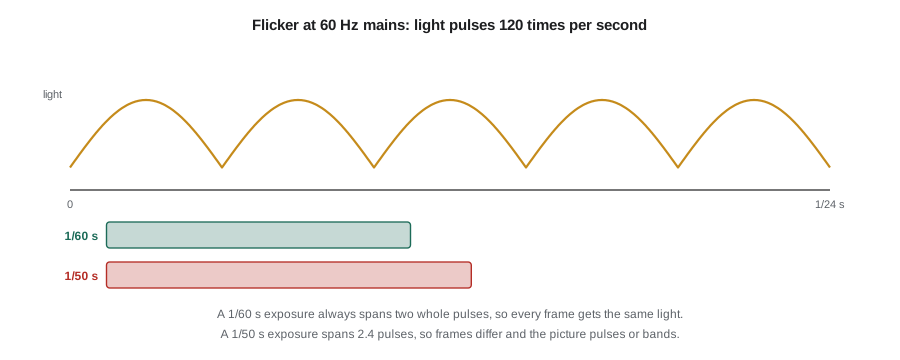
Lights powered by alternating current flicker at twice the mains frequency. Canada and the United States use 60 Hz mains, so fluorescent tubes, discharge lamps and many cheap LEDs pulse 120 times per second. If the camera's shutter is not a multiple of the flicker period, successive frames catch different points in the cycle and the image pulses or shows rolling dark bands. At 60 Hz, shutter speeds of 1/60 and 1/120 second (and 1/30, 1/40 and other multiples of 1/120) avoid flicker from mains lights; the 1/50 second that suits 24 fps can show banding.
LEDs and screens add other flicker sources. Many LED fixtures and bulbs dim using pulse width modulation (PWM), switching on and off rapidly; at low dimming levels this can flicker at frequencies unrelated to the mains. Computer monitors and LED video walls have their own refresh rates. Use the camera's flicker reduction or synchro scan feature, which allows fine shutter adjustments such as 1/50.3, to remove banding, and choose fixtures marketed as flicker-free at all dimming levels for your own kit.
| Frame rate | 180-degree shutter | Flicker-safe alternative |
|---|---|---|
| 24 fps | 1/50 | 1/60 (144 degrees) or 1/40 |
| 30 fps | 1/60 | 1/60 already safe |
| 60 fps | 1/120 or 1/125 | 1/120 exactly |
| 120 fps | 1/250 | 1/240 or 1/120 with care |
Lighting an interview with a small kit
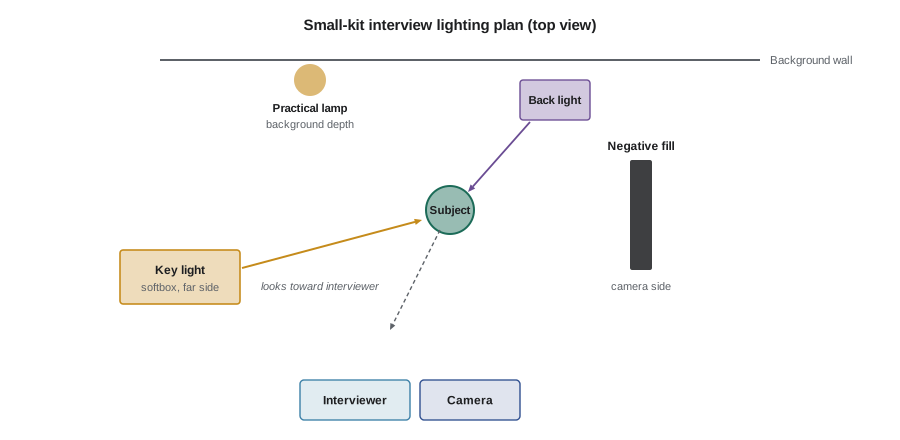
The classic interview setup uses three roles. The key light is the main source, usually placed 30 to 45 degrees to one side of the camera and slightly above eye level, often on the side the subject faces (short-side or far-side lighting, which places the key on the side of the face away from the camera and gives more shape). Fill light softens shadows on the other side; in a small kit, fill often comes from a reflector, a dimmed panel or the room itself, and many interviews use negative fill instead to deepen shadows. A back light or hair light separates the subject from the background. A background light or practical lamp adds depth.
A window can be the key: place the subject so the window is to one side and slightly in front, the camera on the shadow side looking across, and add a little fill or negative fill. Watch out for changing daylight. Clouds can change window light by two or three stops within a minute, and an interview may last half an hour; editors cannot cut between answers lit at different brightness without it showing. If daylight is unstable, use your LED key strongly enough to dominate, or diffuse the window and accept a smaller contribution from it.
Ratios and mood
The lighting ratio compares the light on the key side of the face with the fill side. A 2:1 ratio (one stop) looks bright and open, suiting corporate and educational pieces; 4:1 (two stops) looks more dramatic and suits documentary and brand storytelling; 8:1 or more looks moody and theatrical. Measure ratios with a light meter, the camera's waveform or false color, or simply by switching each light off and on and noting the change in exposure. Agree the look with the client in advance; a bank's annual report video and a craft distillery's story film call for different moods.
Power, batteries and heat
Continuous light needs continuous power. Most small LEDs run from mains, from batteries in the fixture or from external batteries such as V-mount packs. Runtime is approximately the battery's watt-hours divided by the fixture's power draw, reduced for conversion losses and cold temperatures.
Worked problem
Battery runtime for an outdoor interview
A 60 W LED runs from a 98 Wh V-mount battery. Assume 85 percent efficiency. How long does one battery last at full power and at 50 percent dimming (about 30 W)? How many batteries for a two-hour shoot at full power?
Show solution
- Full power: \( 98 \times 0.85 / 60 \approx 1.4 \) h.
- Half power: \( 98 \times 0.85 / 30 \approx 2.8 \) h.
- Two hours at full power: \( 2 / 1.4 \approx 1.4 \), so two batteries, and three for safety in cold weather.
Answer: About 1.4 hours at full power and 2.8 at half power; bring three batteries for a two-hour outdoor shoot.
Battery travel rules matter for photographers who fly. Under the aviation rules applied by Transport Canada and by the US Federal Aviation Administration, both based on international standards, spare lithium-ion batteries must travel in carry-on baggage; batteries up to 100 Wh are generally allowed without airline approval, and those between 100 and 160 Wh need airline approval and are usually limited to two spares per passenger. This is why 98 Wh V-mount batteries are popular. Check the current rules with your airline before each trip. LED fixtures run much cooler than tungsten, but point sources and their power supplies still get hot; keep modifiers clear of hot surfaces and secure stands with sandbags, especially in public spaces (CINE-340 covers set safety).
Common mistakes
MistakeBringing only flash to a hybrid job
InsteadPack continuous LEDs or plan to use windows and reflectors for video.
MistakeMixing window daylight and warm bulbs on the same face
InsteadChoose a main source, match the other lights to it, or change the bulbs.
MistakeRecording at 1/50 second under 60 Hz fluorescent or LED lights without testing
InsteadUse 1/60, 1/120 or flicker reduction, and test before the take.
MistakeRelying on window light during a long interview on a cloudy day
InsteadMake an LED key dominant or diffuse the window so exposure stays consistent.
MistakeTrusting color-quality claims without independent data
InsteadLook for measured TLCI, TM-30 or SSI figures.
Summary and key terms
- Continuous light is weaker than flash, so work closer, use windows and rely on high ISO.
- The incident-meter equation shows that about 120 lux is enough for f/2.8, 1/50 s, ISO 800.
- Choose LEDs with good measured color quality; TLCI was designed for cameras.
- Mireds make color-temperature shifts additive: one million divided by Kelvin.
- At 60 Hz mains, shutter speeds that are multiples of 1/120 second avoid flicker.
- Key, fill, back and background roles still apply; negative fill and windows are powerful tools.
- Plan battery runtime and follow airline rules for lithium-ion batteries.
- Continuous light
- Light that stays on, as opposed to flash.
- Lux
- The SI unit of illuminance, one lumen per square meter.
- TLCI
- The Television Lighting Consistency Index, a measure of color quality for cameras.
- Mired
- A unit of color temperature equal to one million divided by kelvins.
- Bi-color LED
- A fixture that mixes warm and cool LEDs to vary color temperature.
- Flicker
- Periodic variation in light output that can cause pulsing or banding on video.
- PWM dimming
- Dimming by switching LEDs on and off rapidly.
- Negative fill
- Black surfaces that absorb light to deepen shadows.
- Lighting ratio
- The ratio of light on the key side to the fill side of a subject.
- V-mount
- A common battery mount for cameras and lights.
Practice problems
Work each problem on paper first, then reveal the answer to check.
How much light is needed for f/4, 1/50 s, ISO 800?
Show answer
About 250 lux.
A light gives 1,600 lux at 1 m. About how much at 2 m?
Show answer
400 lux.
What is the mired value of 4000 K?
Show answer
250 mireds.
Which shutter speeds avoid flicker from 60 Hz mains lights?
Show answer
Multiples of 1/120 s, such as 1/60 and 1/120.
Why can 1/50 second show banding in North America?
Show answer
It is not a multiple of the 1/120 s flicker period of 60 Hz lighting.
What ratio is a one-stop difference between key and fill?
Show answer
2:1.
How long does a 98 Wh battery run a 40 W light at 85 percent efficiency?
Show answer
About 2.1 hours.
What color-quality index was designed for television cameras?
Show answer
TLCI.
Name a risk of using a window as the key light for a long interview.
Show answer
Changing daylight alters exposure between answers.
What do aviation rules generally require for spare lithium batteries?
Show answer
Carry-on only; up to 100 Wh without approval, 100 to 160 Wh with airline approval.
Lesson quiz · 5 questions
Score 60% or more to complete this lesson.
Create a free account to save your progress, take quizzes and earn a certificate.