
PHOT-440 · Lesson 8 of 12 · 27 min
Interviews and short documentary-style pieces
The interview-driven short is the backbone of commissioned video. Businesses want customer testimonials and staff profiles, non-profits want stories of the people they serve, universities want researchers explaining their work, and couples want heartfelt words from their families. These pieces combine skills photographers already have, such as putting people at ease, reading light and making flattering portraits, with new ones: asking questions that produce usable answers, recording clean sound, setting up two cameras and building a story from a conversation. This lesson covers planning, setup, interviewing technique, B-roll for interviews, structuring a short piece, and the releases and rights that interviews require. CINE-320 covers documentary cinematography, observational shooting and documentary ethics in more depth; here the focus is on commissioned pieces of one to five minutes.
Kinds of interview-driven pieces
A testimonial features a customer or client speaking about their experience with a business; it must sound genuine, and advertising rules require that testimonials reflect real experiences. A profile introduces a person, such as a founder, a staff member or an artist, through their own words and their work. An explainer uses an expert to make an idea understandable. A mini-documentary tells a small true story with a beginning, a turning point and a resolution, often using several voices. Each needs different questions and different B-roll, but all share the same production basics.
Agree the piece's purpose, audience and length before booking. A 60-second testimonial for an online advertisement, a 3-minute profile for a website and a 90-second social version cut from the same interview are different products with different editing time, captions and usage terms (lesson 11).
Pre-interview research and questions
Good answers come from good preparation. Talk to the subject before the shoot, by phone or video, to learn their story, find what they care about and hear how they speak. Share the topics in advance, but not usually the exact questions, so answers stay fresh rather than rehearsed. Write questions that invite stories rather than yes-or-no answers: "Tell me about the day you decided to open the shop" produces more than "Was opening the shop hard?" Plan the order to move from easy, factual questions to more reflective ones, and finish with "Is there anything I haven't asked that you'd like to say?", which often produces the best line of the day.
Because interviewers' questions are usually cut out of short pieces, ask subjects to include the question in their answer: "Instead of saying 'it was in 2015', try 'We opened the bakery in 2015'." Demonstrate once, then let them talk naturally; reminders every question make people self-conscious. Stay silent for a beat after each answer; people often add their most honest thought into the pause. Avoid saying "mm-hm" over their words, which spoils the audio; nod and smile instead.
Off-axis and direct-to-camera interviews
In most commissioned interviews the subject looks slightly off camera at the interviewer, who sits beside the lens. This off-axis style feels like overhearing a conversation and is the default for testimonials and profiles. Place the interviewer's head close to the lens and at the subject's eye level so the eyeline is only slightly off axis; the farther away the interviewer sits, the more the subject appears to look away. Frame the subject on one third, looking across the frame toward the empty two thirds.
Direct-to-camera interviews, where the subject looks straight into the lens, feel more intimate and confrontational, and suit presenters, explainers and some social content. They are hard for non-professionals, who tend to freeze when talking to glass. A device that projects the interviewer's face onto a teleprompter-style mirror in front of the lens lets the subject make eye contact with a person while looking into the lens. A simpler alternative is to sit very close to the lens and ask the subject to talk to you, then glance into the lens for key lines.
Two-camera setups
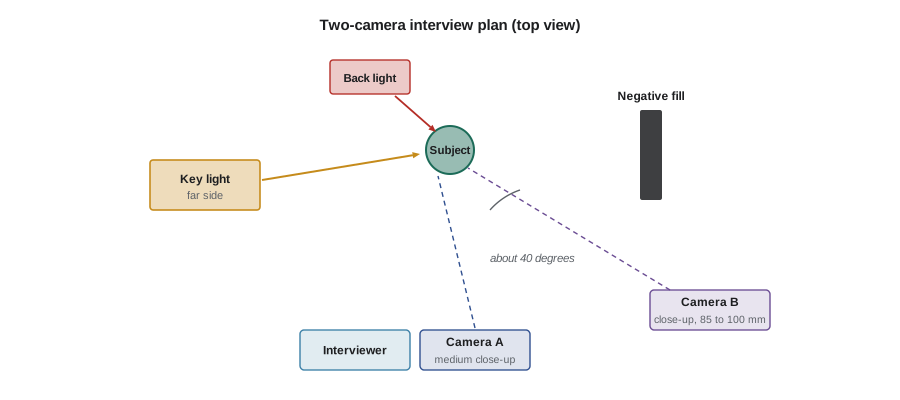
A second camera transforms interview editing. Cutting between a medium shot and a close-up hides edits within answers, lets the editor remove ums and repetitions without jump cuts, and adds visual rhythm. Place the main camera beside the interviewer for a medium close-up and the second camera at a different angle and size, typically a tighter close-up or a wider profile shot at least 30 degrees from the first. Matching lenses, white balance and picture profiles makes cutting smoother; record audio to both cameras for synchronization.
Worked problem
Choosing focal lengths for a two-camera interview
Camera A uses a 50 mm lens on full frame at 2 m for a medium close-up. You want camera B to give a close-up at about 1.6 times the magnification, placed at 40 degrees from camera A at a distance of 2.4 m so it stays out of the shot. What focal length should camera B use?
Show solution
- Magnification scales approximately with focal length divided by distance. Camera A: \( 50 / 2 = 25 \) mm per meter.
- Camera B needs \( 1.6 \times 25 = 40 \) mm per meter, so at 2.4 m it needs \( 40 \times 2.4 = 96 \) mm.
- An 85 mm prime gives about 1.4 times; a 70 to 200 mm zoom set near 95 mm gives the target.
Answer: About 95 mm. An 85 mm lens is a practical compromise if a zoom is not available; it gives a slightly looser close-up.
Making people comfortable
Most interviewees are nervous. Small things help: set up lights and cameras before they arrive, so they do not wait through technical work; offer water; explain what will happen and roughly how long it will take; tell them they can stop, repeat or rephrase anything; and start recording before the first "real" question so they relax into it. Photographers' instinct to chat while working is an advantage here. Keep the crew small and quiet, and ask anyone not needed to leave the room. If the subject is speaking about something painful, such as illness, loss or hardship, let them set the pace, tell them they can skip any question, and never pressure someone to cry on camera; CINE-320 discusses documentary ethics and trauma-informed practice.
B-roll that supports the interview
An interview without B-roll is a talking head. Plan B-roll from the pre-interview: list the places, actions and objects the subject will talk about, and schedule time to film them using the five-shot sequence (lesson 4). Capture the subject at work or in their environment, details of objects mentioned in their story, and reactions or interactions with other people. Archival photographs or documents, such as old family pictures or the shop's first receipt, can be filmed or scanned; make sure the client or subject has the right to use them.
As a rough guide, plan at least three to four times as much B-roll as interview time in the finished piece. A 2-minute profile with 75 seconds of interview on screen might use 45 seconds of B-roll covering the interview, plus moments of B-roll alone with music or natural sound, so you need perhaps 20 to 30 minutes of good B-roll footage.
Building a short piece from an interview
Short interview pieces need structure. A simple shape is: a hook that grabs attention in the first five seconds, often a strong line or striking image; context that tells the viewer who and where; a development that shows what happened or what matters; a turning point or key insight; and a resolution or call to action. Transcribe interviews and build a paper edit, a text document arranging chosen lines in story order, before cutting. Speech runs at about 130 to 160 words per minute, so a word budget helps.
Worked problem
A word budget for a 90-second testimonial
A 90-second testimonial will use interview audio for about 60 seconds, with 30 seconds of B-roll alone at the start and end. The subject speaks at about 150 words per minute and the 25-minute interview produced about 3,500 words of transcript. How many words will the edit use, and what share of the transcript is that?
Show solution
- Words used: \( 150 \times 1 = 150 \) words.
- Share of transcript: \( 150 / 3500 \approx 4.3 \) percent.
- That is about eight to twelve short soundbites, each one to three sentences.
Answer: About 150 words, roughly 4 percent of the transcript. Most of the interview is cut, which is why careful selection and a paper edit save time.
def budget(finished_s, interview_share, wpm=150, avg_bite_words=15):
    words = finished_s * interview_share / 60 * wpm
    return words, words / avg_bite_words
for piece, secs, share in [('social testimonial', 45, 0.8), ('web testimonial', 90, 0.67), ('profile', 180, 0.6)]:
    w, b = budget(secs, share)
print(f'{piece:18s} {secs:3d} s: about {w:.0f} words, {b:.0f} soundbites')social testimonial 45 s: about 90 words, 6 soundbites web testimonial 90 s: about 151 words, 10 soundbites profile 180 s: about 270 words, 18 soundbites
Releases for interviews
An interview release should cover the subject's name, image, likeness and voice, their recorded words and the editing of those words, the media and territories where the piece may appear, the duration of use, and who may use it (the photographer, the client or both). Releases should be signed before the interview, or at least on the same day. Editing must not change the meaning of what people said; cutting answers so that a person appears to endorse something they did not is both unethical and a legal risk. For minors, get written consent from a parent or guardian and the minor's agreement. Location releases may be needed for private property, and organizations often have their own media consent forms. PHOT-410 discusses contracts and releases in a photography business; the specific legal background differs between the two countries.
In the United States, the right of publicity is a matter of state law. Many states protect name and likeness by statute or common law, for example New York's Civil Rights Law and California's Civil Code section 3344, and some protect voice specifically; Tennessee's ELVIS Act of 2024 addresses voice and AI imitation. At the time of writing in October 2026, a federal NO FAKES Act addressing unauthorized AI digital replicas had been advanced by the Senate Judiciary Committee in June 2026 but had not become law. Commercial use of a person's identity generally needs consent, while news and documentary uses have broader protection. Written consent is the safest basis for any commissioned interview.
AI tools add a new consideration. Do not clone a subject's voice, generate synthetic lines or alter their face without specific written consent and disclosure, even to fix a stumble. Content credentials and disclosure practices are covered in PHOT-420.
Vox pops and street interviews
Vox pops are short interviews with members of the public, popular for event recaps and social content. Use a handheld dynamic microphone or a shotgun on a short boom close to the speaker; carry release forms or a quick digital release; frame consistently so answers cut together; and alternate the direction people look (left of frame, right of frame) to create a back-and-forth rhythm. Never imply that people represent the client's views unless they agree.
Common mistakes
MistakeAsking yes-or-no questions
InsteadAsk open questions that invite stories, such as "Tell me about...".
MistakeSeating the interviewer far from the lens
InsteadPut the interviewer's head beside the lens at eye level for a natural eyeline.
MistakeTalking over answers with "mm-hm"
InsteadNod silently and leave a pause after each answer.
MistakeShooting interviews without planning B-roll
InsteadList places, actions and objects from the pre-interview and schedule B-roll time.
MistakeEditing answers so they change meaning, or cloning voices to fix lines without consent
InsteadKeep meaning intact and get specific written consent for any synthetic alteration.
Summary and key terms
- Testimonials, profiles, explainers and mini-documentaries are the main interview-driven products.
- Pre-interviews and open, story-seeking questions produce usable answers.
- Off-axis interviews are the default; direct-to-camera suits presenters and intimate pieces.
- A second camera at a different angle and size hides edits and adds rhythm.
- Plan B-roll from what the subject will talk about, using the five-shot sequence.
- Paper edits and word budgets help shape short pieces from long interviews.
- Releases must cover voice, words and editing; publicity and privacy law differ between Canada and US states.
- Testimonial
- A customer or client describing their real experience with a business.
- Off-axis interview
- An interview in which the subject looks at an interviewer beside the camera.
- Eyeline
- The direction a subject looks relative to the camera.
- Paper edit
- A text plan of selected interview lines in story order.
- Soundbite
- A short, usable excerpt from an interview.
- Vox pop
- A short interview with a member of the public.
- Pre-interview
- A conversation before the shoot to learn the subject's story.
- Talking head
- A shot of a person speaking with no supporting visuals.
- Right of publicity
- A legal right to control commercial use of one's name, likeness or voice.
- Appropriation of personality
- A Canadian tort covering unauthorized commercial use of a person's identity.
Practice problems
Work each problem on paper first, then reveal the answer to check.
Why ask subjects to include the question in their answer?
Show answer
The interviewer's question is usually cut, so answers must stand alone.
Where should the interviewer sit for an off-axis interview?
Show answer
Beside the lens at the subject's eye level.
Camera A is 50 mm at 2 m. What focal length gives the same framing at 3 m?
Show answer
75 mm.
How many words fill 45 seconds at 140 words per minute?
Show answer
105 words.
What should an interview release cover?
Show answer
Name, likeness, voice, words and editing, media, territory, duration and users.
Name a Canadian province with a privacy statute covering use of likeness in advertising.
Show answer
British Columbia (also Saskatchewan, Manitoba, Newfoundland and Labrador).
Which US state law addresses voice and AI imitation specifically?
Show answer
Tennessee's ELVIS Act.
Why leave a pause after each answer?
Show answer
Subjects often add their most honest thoughts in the silence.
Give the five parts of the simple story shape in this lesson.
Show answer
Hook, context, development, turning point, resolution or call to action.
Why alternate looking direction in vox pops?
Show answer
To create a back-and-forth rhythm when answers are cut together.
Lesson quiz · 5 questions
Score 60% or more to complete this lesson.
Create a free account to save your progress, take quizzes and earn a certificate.