
PRIN-110 · Lesson 1 of 12 · 27 min
What principles are and why PRINCE2 has them
This is an independent course. PRINCE2 is a registered trade mark of the PeopleCert group. The scenarios, questions and examples in this course are original and are not taken from any PeopleCert exam. Amounts in the examples are in US dollars unless stated otherwise.
In PRIN-101 you met the seven PRINCE2 principles in a single overview lesson. This course studies them in depth. Each principle gets its own lesson, with scenarios, failure modes, worked numbers and the links between the principle and the practices and processes that put it into effect. By the end you should be able to look at any project, healthy or troubled, and say which principles are being honored, which are being neglected and what to do about it. That skill matters for the Practitioner exam, where many questions describe a situation on a scenario project and ask which principle applies, but it matters far more on real projects.
This first lesson asks a simpler question: what is a principle, and why does PRINCE2 build itself on seven of them rather than on a set of rules or a fixed procedure?
Where principles sit in PRINCE2
PRINCE2 7, published in 2023 and renamed PRINCE2 Project Management in early 2026, is organized around five integrated elements. The principles are the foundation. The people element recognizes that projects are delivered by people and that leadership, communication and culture shape every outcome. The practices, formerly called themes, are the aspects of project management that must be addressed continually: business case, organizing, plans, quality, risk, issues and progress. The processes describe the journey from starting up to closing a project. The project context element reminds us that every project sits inside an organization, a sector and a set of constraints, and that the method must be tailored to fit.
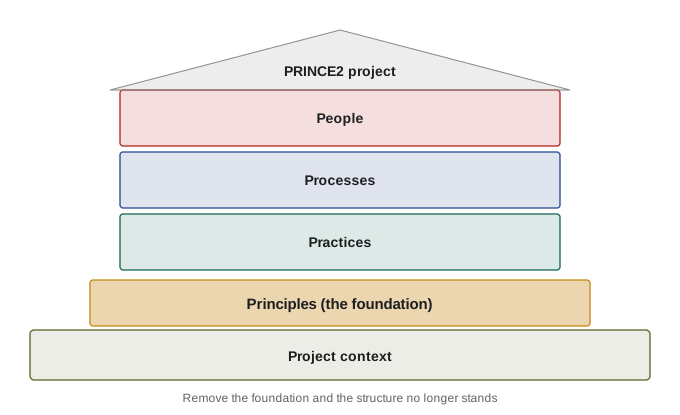
The relationship between the elements is not symmetrical. You can tailor the practices heavily: a small project may combine its risk and issue registers into one log, write a two-page business case and hold stage boundaries as short meetings. You can tailor the processes: a simple project may combine starting up and initiating into a single short activity. But the principles are not tailored away. A project that ignores a principle is, by the method's own definition, not a PRINCE2 project, however many PRINCE2 templates it fills in.
What makes something a principle
The PRINCE2 manual describes its principles as having three characteristics. They are universal, self-validating and empowering. Each word repays attention.
- Universal means that every principle applies to every project, whatever its size, sector, culture, geography or delivery approach. A two-month office move and a ten-year transit line both need a reason to exist, both benefit from lessons, both need clear roles and both need decision points.
- Self-validating means the principles have been proven in practice over many years and many projects. They are not theories invented for the method; they are distilled from what worked and what failed on real projects since the 1970s.
- Empowering means that the principles give people confidence and the ability to shape and manage the project. A team member who understands manage by exception knows what they may decide alone. A board member who understands continued business justification knows they are allowed, and expected, to stop a project that no longer makes sense.
Principles differ from rules. A rule says exactly what to do: produce a highlight report every two weeks using this template. A principle says what must be true: the right level of management must be informed and must stay in control without being swamped by detail. A rule can be followed mechanically while its purpose is defeated, for example by sending a highlight report that hides a growing problem. A principle cannot be satisfied without achieving its purpose.
| Feature | Principle | Rule or procedure |
|---|---|---|
| Scope | Applies to every project | Applies where it was designed for |
| Flexibility | Says what must be true, not exactly how | Says exactly what to do |
| Tailoring | Never removed; its application is adapted | May be removed, merged or replaced |
| Test of compliance | Is the purpose achieved? | Was the step performed? |
| Example | Manage by exception | Send a highlight report every Friday |
The seven principles at a glance
Here are the seven principles in the order the manual presents them. Each has its own lesson later in this course.
| Principle | In one sentence | Lesson |
|---|---|---|
| Ensure continued business justification | The project must have, and keep, a justifiable reason to exist. | 2 |
| Learn from experience | Lessons are sought, recorded and acted on throughout. | 3 |
| Define roles, responsibilities and relationships | The right people are engaged with agreed authority and working relationships. | 4 |
| Manage by stages | The project is planned, monitored and controlled stage by stage. | 5 |
| Manage by exception | Tolerances set limits of delegated authority for each level. | 6 |
| Focus on products | Work is defined and judged by the products it delivers. | 7 |
| Tailor to suit the project | The method is adapted to the project's context. | 8 |
A good way to remember the set is to notice what each principle protects against. Continued business justification protects against projects that should never have started or should have stopped. Learn from experience protects against repeating old mistakes. Defined roles protect against confusion over who decides. Manage by stages protects against planning too far ahead and losing control. Manage by exception protects against micromanagement on one side and loss of control on the other. Focus on products protects against activity without outcomes and against scope creep. Tailoring protects against bureaucracy and against a method that does not fit.
Why a method needs principles at all
Early project methods were often criticized for being heavy and procedural. Teams produced documents because the method listed them, not because the documents helped. When PRINCE2 was revised in 2009, the authors made the principles explicit for the first time. The aim was to make clear what was essential and what was adaptable. A project manager facing a small project with a tight budget no longer needed to choose between doing all of PRINCE2 or none of it. They could ask which practices and products to scale down, as long as the principles still held.
Principles also provide a common language. When a board member says "this is outside tolerance, so it is an exception", everyone who knows PRINCE2 understands what has happened, who must decide and what information is needed. When a reviewer says "this project is not focusing on products", the team knows to look at whether product descriptions exist and whether acceptance criteria are clear. Shared principles make conversations shorter and decisions faster.
Finally, principles are what make PRINCE2 compatible with other ways of working. An agile delivery team can work in sprints with daily stand-ups and still sit inside a project that applies all seven principles. A public-sector project can follow its government's own gating process and still apply them. Because principles describe outcomes rather than steps, they can be satisfied in many different ways.
Principles apply to everyone
It is a common misunderstanding that the principles are the project manager's job. They are obligations on everyone involved. The executive applies continued business justification when deciding whether to authorize each stage. The senior user applies focus on products when confirming that the specified products will deliver the expected benefits. Team managers apply manage by exception when they escalate a work package that is forecast to exceed its tolerance. Team members apply learn from experience when they raise a lesson. Project assurance checks that all of this is happening.
How the exam treats principles
At Foundation level, questions usually ask you to identify a principle from a description, recognize its purpose or spot an option that is not a principle. At Practitioner level, questions describe events on a scenario project and ask which principle is being applied, which is being neglected or what action best honors a principle. The skill being tested is not recall of the list but recognition of the principle in action. Throughout this course, quizzes use original scenario-style items to build that skill.
Distractors often sound plausible. "Manage by milestones", "focus on activities", "ensure stakeholder satisfaction", "plan in detail before starting" and "minimize documentation" are not PRINCE2 principles, though each is close to something real. Observe that each distractor either describes a technique rather than an obligation or distorts a real principle. Focus on products is about outputs, not activities. Manage by stages is about decision points, not milestones. Tailoring is about fitting the method to the project, not about minimizing documents for their own sake.
Worked problem
Spotting principles in a short scenario
A regional health authority is replacing its appointment booking system. The project board has an executive from finance, a senior user from clinic operations and a senior supplier from the software vendor. The project manager has split the work into an initiation stage and three delivery stages, each ending with a board review. Tolerances of ±10 % on cost and ±2 weeks on time are set for each stage. Before planning, the project manager read the closure reports of two earlier system projects. Which principles are visible?
Show solution
- Board with executive, senior user and senior supplier: define roles, responsibilities and relationships.
- Initiation plus three delivery stages with board reviews: manage by stages.
- Stage tolerances of ±10 % cost and ±2 weeks: manage by exception.
- Reading earlier closure reports: learn from experience.
- Not yet visible: continued business justification, focus on products and tailoring. You would look for a business case reviewed at each stage end, product descriptions with quality criteria and recorded tailoring decisions.
Answer: Four principles are visible; three need evidence before you can say the project is applying all seven.
A first look at a principles health check
Throughout the course you will practice assessing projects against the principles. A simple scoring scheme makes the assessment repeatable. For each principle, score the evidence from 0 to 3: 0 means no evidence, 1 means the principle is named but not practiced, 2 means it is practiced inconsistently and 3 means it is practiced consistently with evidence. The total out of 21 gives a rough health indicator, but the individual scores matter more. A single 0 means the project is not, strictly, a PRINCE2 project.
Worked problem
Scoring a project against the principles
An assurance reviewer scores a project as follows: business justification 2, learn from experience 1, roles 3, stages 3, exception 2, products 0, tailoring 1. What is the total, and what is the most urgent finding?
Show solution
- Total: 2 + 1 + 3 + 3 + 2 + 0 + 1 = 12 out of 21.
- As a percentage: 12 ÷ 21 ≈ 57 %.
- Focus on products scores 0: there is no evidence of product descriptions or acceptance criteria.
- A zero means a principle is not being applied, so this is the first finding to address regardless of the total.
Answer: 12 of 21 (about 57 %), with focus on products as the urgent gap.
Lesson 12 develops this health check into a full capstone. For now, notice that the score is only as good as the evidence. A reviewer who scores from what people say rather than from documents, decisions and behavior will overrate most projects.
Common mistakes
MistakeTreating the principles as optional on small or simple projects.
InsteadApply all seven and tailor how they are applied.
MistakeAssuming the principles are the project manager's responsibility alone.
InsteadRecognize that every role, including the board and team managers, applies the principles.
MistakeConfusing principles with procedures, and judging compliance by whether steps were performed.
InsteadJudge compliance by whether the purpose of each principle is achieved.
MistakeChoosing a distractor such as "manage by milestones" in an exam because it sounds familiar.
InsteadLearn the exact seven principles and what each protects against.
MistakeClaiming a project is PRINCE2 because it uses PRINCE2 templates.
InsteadCheck for evidence that each principle is actually being applied.
Summary and key terms
- The principles are the foundation of the five integrated elements of PRINCE2 7.
- They are universal, self-validating and empowering.
- Principles say what must be true; rules and procedures say exactly what to do.
- All seven principles must be applied for a project to be a PRINCE2 project.
- Practices, processes and products can be tailored; the principles cannot be tailored away.
- Every role applies the principles, not just the project manager.
- A 0 to 3 evidence score per principle gives a simple, repeatable health check.
- Principle
- A guiding obligation and good practice that determines whether a project is genuinely managed using PRINCE2.
- Universal
- Applying to every project regardless of size, sector or approach.
- Self-validating
- Proven in practice over many years and projects.
- Empowering
- Giving people confidence and the ability to shape how the project is managed.
- Integrated elements
- Principles, people, practices, processes and project context.
- Practice
- An aspect of project management addressed continually; formerly called a theme.
- Project context
- The organizational, commercial and social setting that the method is tailored to.
- Project assurance
- Independent checking, on behalf of the board, that the project is being run properly.
- Health check
- A structured review of a project against criteria such as the principles.
- Distractor
- A plausible but incorrect option in a multiple-choice question.
Practice problems
Work each problem on paper first, then reveal the answer to check.
Name the three characteristics of the PRINCE2 principles.
Show answer
Universal, self-validating and empowering.
Which integrated element is described as the foundation?
Show answer
The principles.
Is "manage by milestones" a PRINCE2 principle?
Show answer
No; the related principle is manage by stages.
Can a project combine the risk and issue registers and still be PRINCE2?
Show answer
Yes, if the principles are still applied; that is tailoring a practice.
Scores 3, 3, 2, 2, 2, 1, 1. Total out of 21?
Show answer
14.
Which principle protects against micromanagement?
Show answer
Manage by exception.
Who applies continued business justification at stage ends?
Show answer
Mainly the executive, supported by the board.
What did the 2009 edition make explicit for the first time?
Show answer
The principles.
A project has one principle scored 0. Is it a PRINCE2 project?
Show answer
Strictly no; all seven must be applied.
Why do principles make PRINCE2 compatible with agile delivery?
Show answer
They describe outcomes rather than steps, so they can be satisfied in many ways.
Lesson quiz · 5 questions
Score 60% or more to complete this lesson.
Create a free account to save your progress, take quizzes and earn a certificate.