
PRIN-110 · Lesson 12 of 12 · 28 min
Capstone: a principles health check of a troubled project
This capstone brings the course together. You will carry out a principles health check of a fictional troubled project, score the evidence for each principle, identify the most urgent gaps, connect them to the symptoms the project is experiencing and recommend actions. The method is the same one you would use as an assurance reviewer, an incoming project manager or a Practitioner exam candidate analyzing a scenario. Work through each step before reading the model answer.
The project: Riverbend Fare Card
Riverbend Regional Transit, a public transit agency serving three municipalities, launched a project 14 months ago to replace paper tickets with a contactless fare card and mobile app. The approved budget was 8.5 million dollars over 18 months, funded partly by a state grant that requires the system to be live before a fixed date. You have been asked by the agency's chief executive to review the project against the PRINCE2 principles, which the agency adopted as its standard two years ago.
Your interviews and document review find the following:
- The business case was approved at the start and has not been updated. Since then, a neighboring agency has offered to share its fare system, which might cost far less, but this option has not been assessed.
- The project manager found a lessons report from a previous ticketing upgrade warning about integration with the legacy accounting system. It is filed in the project folder but no action was taken. Integration is now the main source of delay.
- The project board consists of the chief operating officer as executive, the IT director, the head of finance, the vendor's account manager and three municipal representatives. The board has met four times in 14 months. Nobody represents frontline customer service staff or riders.
- The project plan was a single stage after initiation, covering all 18 months. There have been no stage boundary reviews.
- No tolerances were set. The vendor has reported a forecast overrun of 1.3 million dollars and four months, which the project manager has been "working to recover" for three months without telling the board.
- Requirements are a 200-line spreadsheet of features with no acceptance criteria. Testers and the vendor disagree about whether several features are complete.
- The agency's PRINCE2-based method requires full documentation for all projects over 1 million dollars. The project manager produced every template at initiation, but most have not been touched since.
Step 1: score the evidence
Use the 0 to 3 evidence scale from Lesson 1: 0 means no evidence, 1 means named but not practiced, 2 means practiced inconsistently and 3 means practiced consistently.
Worked problem
Scoring Riverbend against the principles
Score each principle from the findings and calculate the total.
Show solution
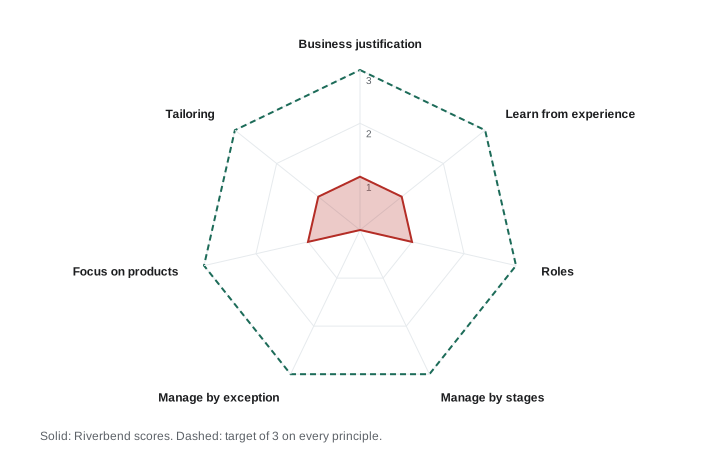
- Continued business justification: a business case exists but has never been reviewed, and a major alternative has been ignored. Score 1.
- Learn from experience: a relevant lesson was found but not acted on. Score 1.
- Defined roles, responsibilities and relationships: an executive exists, but the board is large, rarely meets, includes the vendor's salesperson and lacks any user voice. Score 1.
- Manage by stages: one stage for 18 months; no boundaries. Score 0.
- Manage by exception: no tolerances; a known overrun hidden from the board. Score 0.
- Focus on products: a feature list without acceptance criteria. Score 1.
- Tailor to suit the project: templates produced for compliance and not used; the organization's method applied mechanically. Score 1.
- Total: 1 + 1 + 1 + 0 + 0 + 1 + 1 = 5 out of 21, about 24 %.
Answer: 5 of 21, with two principles scoring 0. On this evidence the project is PRINCE2 in name only.
Step 2: connect symptoms to principles
Scores alone do not tell the chief executive what to do. The next step links the project's visible problems to the principles that would have prevented them.
| Symptom | Principles involved | Explanation |
|---|---|---|
| Integration delays | Learn from experience; focus on products | A known lesson was ignored, and the integration product had no description or criteria |
| Hidden 1.3 million overrun | Manage by exception; manage by stages; roles | No tolerances, no stage boundary to surface the problem, and a board too remote to ask |
| Disputes over completed features | Focus on products; roles | No acceptance criteria and no senior user to accept products |
| Unassessed cheaper option | Continued business justification; manage by stages | No reviews of the business case and no decision point to consider alternatives |
| Paper compliance | Tailor to suit the project | The method was applied as paperwork rather than fitted to the project |
Step 3: assess the current position
Before recommending actions, the reviewer needs an honest forecast. The agency's finance team confirms that 5.9 million has been spent.
Worked problem
Forward-looking justification
The original budget was 8.5 million. Spent to date: 5.9 million. The vendor's revised estimate to complete is 3.9 million (the original 2.6 million remaining plus the 1.3 million overrun). Annual benefits in the business case were 1.4 million a year for 8 years. The neighboring agency's shared system would cost 1.8 million to join, plus 0.3 million a year in service fees, and would deliver about 90 % of the benefits. The grant requires live service in 7 months; the current plan forecasts 8 months. Compare the two options on simple undiscounted 8-year figures, treating the 5.9 million as sunk.
Show solution
- Option A, complete current project: remaining cost 3.9 million. Benefits 1.4 × 8 = 11.2 million. Net: 11.2 − 3.9 = 7.3 million. Risk: forecast misses the grant date by a month.
- Option B, join shared system: cost 1.8 + (0.3 × 8) = 4.2 million. Benefits 11.2 × 0.9 = 10.08 million. Net: 10.08 − 4.2 = 5.88 million. Timing and grant eligibility unknown.
- On these simple figures, Option A has the higher net value by about 1.4 million, but it carries schedule risk against the grant deadline.
- A proper comparison needs discounting, the grant implications, the cost of writing off any reusable work, and the quality of each option.
Answer: Completing the current project looks better on simple figures (7.3 million versus 5.88 million net), but the decision depends on the grant deadline and risks. The board must make it with an updated business case, which is exactly what the principle requires.
Step 4: recommend actions
Good recommendations are specific, prioritized and tied to principles. They should restore control first, then fix the foundations.
| Priority | Action | Principle |
|---|---|---|
| 1 (immediately) | Project manager raises an exception report on the 1.3 million and four-month overrun, with options | Manage by exception |
| 1 | Board treats the current point as a stage boundary: update the business case, assess the shared-system option and decide | Continued business justification; manage by stages |
| 2 (within a month) | Reconstitute the board: one executive, a senior user from customer service with a rider advisory group, and a senior supplier from the agency (not the vendor's salesperson); municipal representatives move to a stakeholder group | Defined roles and relationships |
| 2 | Set tolerances for the remaining work on all relevant targets, including a zero time tolerance against the grant deadline and a scope tolerance based on must-have features | Manage by exception; focus on products |
| 2 | Replace the remaining work with two or three management stages, with a boundary before the decision to go live | Manage by stages |
| 3 (within six weeks) | Write product descriptions with acceptance criteria for the remaining features, starting with integration | Focus on products |
| 3 | Act on the integration lesson: add an integration specialist and an end-to-end test stage | Learn from experience |
| 3 | Retire unused templates; keep a tailored, lighter set that the team will use | Tailor to suit the project |
Observe that the first two actions restore the board's ability to decide. The overrun cannot be fixed by the project manager alone, and the business case question cannot be answered without the board. Everything else improves the project's chances once a decision has been made.
Step 5: report the findings
A health check report for a senior audience should be short. A useful structure is: purpose and scope; overall assessment with the score and a one-line verdict; the three to five most important findings, each linked to a principle and a consequence; recommendations with owners and dates; and an appendix with the detailed evidence. Avoid blame. The aim is to restore control and give the project its best chance, not to criticize individuals. Many of Riverbend's problems came from an organization that required paperwork but did not require decisions.
Worked problem
Re-scoring after recovery
Three months after the review, the reviewer returns. The business case has been updated and reviewed, and the board chose to continue. Lessons are being acted on. The new board meets monthly and includes a user voice. There are three stages with tolerances. Most remaining products have acceptance criteria, though a few minor ones do not. Tailoring has been documented. Assume scores of 3, 2, 3, 3, 3, 2 and 3. What is the new total, and what has changed?
Show solution
- New total: 3 + 2 + 3 + 3 + 3 + 2 + 3 = 19 out of 21, about 90 %.
- Improvement: from 5 to 19, an increase of 14 points.
- No principle now scores 0, so the project is genuinely applying PRINCE2.
- Remaining gaps: lessons (2) and products (2) should be brought to 3.
Answer: 19 of 21, with no zeros. The project is back under control, though two principles still need strengthening.
What the capstone teaches
Troubled projects rarely fail because of one bad decision. They drift because several principles weaken at once and nobody notices until the symptoms are serious. A principles health check makes the drift visible. It can be used at any time, not only in a crisis: at initiation to check that the foundations are in place, at stage boundaries as part of assurance, and at closure as part of learning from experience. The seven principles give a compact, shared language for asking whether a project is being managed well.
Running your own health check
You can apply the same method to any project you know: one you work on, one you have read about, or a case study. Gather evidence from three sources: documents (business case, plans, registers, reports), decisions (board minutes, approvals, exception records) and behavior (how people talk about problems, who decides, whether reports are read). Score each principle from 0 to 3, link the weakest scores to visible symptoms, and draft three to five prioritized recommendations. Keep the report to two pages plus an evidence appendix. Practicing on several projects builds the pattern recognition that both Practitioner exam questions and real assurance work demand.
The capstone also shows that the principles are diagnostic as well as prescriptive. They tell you how to set up a project, but they are equally useful for finding out why a project is struggling. When something goes wrong, asking which principle has weakened is often the fastest route to the real cause and to a fix that lasts.
Common mistakes
MistakeScoring from interviews alone.
InsteadBase scores on documents, decisions and observed behavior.
MistakeReporting a total score without linking gaps to symptoms.
InsteadShow how each neglected principle causes visible problems.
MistakeTreating sunk costs as a reason to continue.
InsteadCompare options on remaining costs, benefits and risks.
MistakeRecommending more templates as the fix.
InsteadRestore decisions first, then tailor the management products.
MistakeWriting a report that blames individuals.
InsteadFocus on restoring control and improving the system.
Summary and key terms
- A principles health check scores evidence for each principle from 0 to 3.
- A zero on any principle means the project is not genuinely PRINCE2.
- Symptoms usually trace back to more than one neglected principle.
- Forward-looking appraisal compares options while ignoring sunk costs.
- Recommendations restore the board's ability to decide before fixing foundations.
- Reports should be short, prioritized and free of blame.
- Health checks are useful at initiation, stage boundaries and closure, not only in crises.
- Health check
- A structured review of a project against defined criteria.
- Evidence score
- A rating of how consistently a principle is practiced, based on evidence.
- Recovery plan
- A prioritized set of actions to restore control of a troubled project.
- Stakeholder group
- A forum for interested parties who do not sit on the project board.
- Rider advisory group
- A group of service users who advise the senior user.
- Write-off
- The loss recognized when work or assets cannot be used.
- Grant condition
- A requirement attached to funding, such as a deadline.
- Verdict
- A short overall conclusion in a review report.
- Re-baseline
- Replacing a plan baseline after an approved change or exception.
- Drift
- Gradual weakening of control that goes unnoticed until symptoms are serious.
Practice problems
Work each problem on paper first, then reveal the answer to check.
What does a score of 0 on a principle mean?
Show answer
No evidence that it is applied; the project is not genuinely PRINCE2.
Scores 2, 2, 1, 1, 0, 2, 1. Total?
Show answer
9 out of 21.
Which principle covers the hidden overrun most directly?
Show answer
Manage by exception.
Why was the vendor's account manager a poor senior supplier choice?
Show answer
They represent the vendor's commercial interest, not the agency's supplier accountability, and lack independence.
Remaining cost 2 million, benefits 5 million. Net?
Show answer
3 million.
Should the 5.9 million spent influence the choice of option?
Show answer
No; it is sunk.
What are the first two recovery actions?
Show answer
Raise an exception report and hold a stage boundary decision with an updated business case.
Name one time other than a crisis to run a health check.
Show answer
At initiation, at a stage boundary or at closure.
Re-score: 3, 3, 3, 3, 3, 2, 3. Total?
Show answer
20 out of 21.
What should a health check report avoid?
Show answer
Blaming individuals.
Lesson quiz · 5 questions
Score 60% or more to complete this lesson.
Create a free account to save your progress, take quizzes and earn a certificate.