
PRIN-110 · Lesson 9 of 12 · 29 min
The principles applied together
The previous seven lessons studied each principle on its own. Real projects do not work like that. The principles reinforce each other, and a weakness in one usually shows up as trouble in another. A business case cannot be reviewed at stage boundaries if there are no stages. Tolerances mean little if nobody has the authority to decide on exceptions. Products cannot be accepted if no senior user represents the users. This lesson follows one fictional project through its life and shows all seven principles working together.
The scenario: Northgate Library Hub
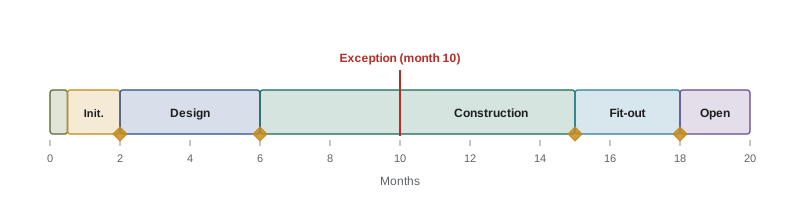
Northgate is a mid-sized US city. Its council has approved a project to convert a disused school into a community library hub with study rooms, a makerspace and a digital services desk. The project mandate sets a budget of 4.2 million dollars, a target opening in 20 months, and expected benefits of higher library use, room-booking revenue and the closure of two older branch leases. The council requires a gated approval at each major commitment under its capital policy.
Starting up: justification, lessons and roles
The chief librarian is appointed executive by the city manager. In starting up the project, the executive and the appointed project manager prepare an outline business case comparing three options: renovating the school, building new on a vacant lot, and doing nothing while extending the two old leases. Renovation has the best net present value over 25 years, though it carries more risk of hidden conditions in an old building. This is continued business justification at the very start: the project exists because, on current figures, it is the best of the available options.
The project manager searches the city's lessons library and finds two relevant closure reports: a recreation center renovation that overran because asbestos was found late, and an IT project that struggled because frontline staff were not involved. Both lessons go into the lessons log and directly shape the project approach: an early hazardous materials survey, and frontline staff representation on the project board. That is learn from experience.
The board is formed: the chief librarian as executive; the head of branch services as senior user, supported by a user group of frontline staff and two community representatives; and the city's capital projects director as senior supplier, representing the design firm and contractor who will be procured. Assurance is provided by the finance department for the business interest and by an accessibility specialist for the user interest. That is define roles, responsibilities and relationships.
Initiation: stages, tolerances, products and tailoring
During initiation the project manager produces the project initiation documentation. Five management stages after initiation are proposed, with boundaries before each big commitment: before awarding the design contract, before awarding the construction contract, before ordering long-lead equipment, and before opening. Stage boundaries align with the council's capital gates. That is manage by stages.
The council sets project tolerances: cost +5 % / −10 %, time +6 weeks, benefits no lower than 90 % of the business case, and a sustainability tolerance that the building must still meet the energy performance target in the council's green building policy. The board sets stage tolerances for each stage, and the project manager sets work package tolerances for the design firm and contractor. That is manage by exception.
The project product description defines the opened library hub, with acceptance criteria covering accessibility, energy performance, room capacities, digital services and opening-day readiness. A product breakdown structure lists over 60 products, from the hazardous materials survey to staff training. Product descriptions with measurable quality criteria are written for the significant ones. That is focus on products.
Finally, the project initiation documentation records tailoring decisions: the city's capital gating terms are used instead of PRINCE2's names; the risk register uses the city's standard 5 × 5 scoring; highlight reports are monthly to the board and fortnightly to the executive; and the contractor uses its own construction management method, interfaced through work packages. That is tailor to suit the project.
The exception in construction
Halfway through the construction stage, structural repairs to the old gym floor turn out to be far worse than the survey suggested. The contractor's estimate for the extra work is 210,000 and four weeks. The project manager checks the stage forecast against tolerance.
Worked problem
Testing the construction exception
The construction stage budget is 2,600,000 with a stage cost tolerance of +4 %. Before the discovery, the stage was forecast to finish at 2,620,000. Time tolerance for the stage is +3 weeks. The repair adds 210,000 and 4 weeks. Is the stage in exception, and is the project as a whole still within project tolerance of +5 % on 4,200,000 if other stages hold?
Show solution
- Stage cost limit: 2,600,000 × 1.04 = 2,704,000.
- New stage forecast: 2,620,000 + 210,000 = 2,830,000. This exceeds 2,704,000 by 126,000.
- Stage time: +4 weeks against a +3 week tolerance. Also exceeded.
- Project cost limit: 4,200,000 × 1.05 = 4,410,000. If the project was forecast at 4,230,000 before, it is now 4,440,000, which exceeds the project limit by 30,000.
Answer: The stage is in exception on cost and time, and the project is forecast to exceed project tolerance too. The project manager raises an exception report to the board, which must in turn escalate to council because project tolerance is breached.
Now watch the principles interact. The exception report (manage by exception) sets out options with their effect on the business case (continued business justification): accept the cost and delay; reduce scope by deferring the makerspace fit-out to a later phase (focus on products, using scope tolerance); or use a cheaper floor solution with lower quality criteria. The board, with its senior user and senior supplier present (defined roles), recommends deferring the makerspace fit-out. That brings the project back within project tolerance on cost, at a modest cost to benefits that stays above the 90 % floor. Council approves an exception plan, which replaces the construction stage plan (manage by stages). A lesson is recorded about survey methods for old buildings (learn from experience). The tailoring record is updated to note the phased makerspace (tailor to suit the project).
Worked problem
Checking benefits tolerance after the change
The business case expected annual benefits of 520,000. Deferring the makerspace removes an estimated 35,000 of annual room and program revenue for the first two years. Benefits tolerance requires at least 90 % of the expected annual figure. Is the deferral within benefits tolerance?
Show solution
- Minimum allowed: 520,000 × 0.90 = 468,000.
- Revised annual benefits for the first two years: 520,000 − 35,000 = 485,000.
- 485,000 is above 468,000.
Answer: Yes: annual benefits of 485,000 remain within tolerance, so the business case is still justified with the deferral.
Closing the project
The hub opens in month 20, three weeks later than the original target but within the revised plan. In closing the project, the project manager confirms that the products meet their acceptance criteria, hands over to library operations, and updates the business case. The benefits management approach schedules reviews of library use and revenue at 6 and 18 months after opening, owned by the head of branch services. The end project report and a lessons report go to the city's project office. The makerspace fit-out becomes a separate small project the following year.
How the principles depend on each other
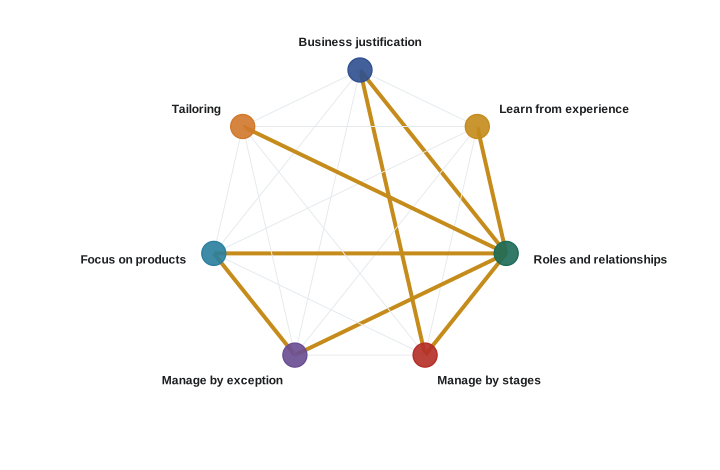
| Principle | Depends on | Because |
|---|---|---|
| Continued business justification | Manage by stages; defined roles | Stage boundaries provide review points; the executive decides |
| Learn from experience | Defined roles; tailoring | Everyone raises lessons; lessons shape tailoring |
| Defined roles and relationships | Manage by exception | Tolerances define what each role may decide |
| Manage by stages | Continued business justification | Each boundary is a justification decision |
| Manage by exception | Focus on products; defined roles | Scope tolerance needs defined products; someone must decide on exceptions |
| Focus on products | Defined roles | Senior users specify and accept products |
| Tailor to suit the project | All the others | Tailoring must keep every other principle intact |
What would have happened without the principles?
It is instructive to replay the Northgate exception on a project that did not apply the principles. Without stages, there would have been no boundary before the construction contract, so the council would have committed to the whole build before the design was approved. Without tolerances, the project manager might have tried to absorb the extra 210,000 quietly, hoping to recover it, and the board would have heard about it months later. Without a senior user on the board, nobody would have been empowered to agree that the makerspace could be deferred. Without an up-to-date business case, the council would not have known whether the reduced benefits still justified the project. Without the lessons from the recreation center, the survey might not have happened at all, and the problem would have appeared even later.
Each of these failures is common on real projects, and each is prevented by a principle. That is the strongest argument for applying all seven: they protect against different failure modes, and a project that applies only some of them remains exposed to the rest.
Reading a Practitioner-style scenario
Practitioner exam questions often describe events like the Northgate exception and ask which principle a particular action applies, or which action best applies a given principle. A useful technique is to underline the verb in each event. "The project manager forecasts" points to manage by exception. "The board reviews the business case" points to continued business justification. "The senior user confirms that the reduced scope still meets user needs" points to focus on products and defined roles. "The project manager records that surveys of old buildings should use intrusive testing" points to learn from experience. "The project initiation documentation is updated to note phased delivery" points to tailoring. Matching verbs to principles turns a long scenario into a series of quick decisions.
Worked problem
Matching events to principles
Match each event to the principle it best illustrates: (a) the executive asks for the shared-cost option to be assessed before authorizing the next stage; (b) a team manager reports that a work package will exceed its time tolerance by a week; (c) the board agrees that the design firm's lead architect will attend board meetings as adviser to the senior supplier; (d) the project manager writes acceptance criteria for the digital services desk.
Show solution
- (a) Assessing options before authorizing a stage: ensure continued business justification, at a stage boundary.
- (b) Escalating a forecast work package breach: manage by exception.
- (c) Clarifying who advises whom on the board: define roles, responsibilities and relationships.
- (d) Writing acceptance criteria: focus on products.
Answer: (a) business justification, (b) exception, (c) roles and relationships, (d) products.
Some events, you will see, touch more than one principle. Event (a) also applies manage by stages, because it happens at a boundary. In an exam, choose the principle the question emphasizes; on a real project, recognize that several principles are working together.
A final point about the scenario: the principles did not prevent the problem with the gym floor. Old buildings hide surprises, and no method can eliminate uncertainty. What the principles did was make sure the problem was surfaced early, decided by the right people with the right information, and absorbed in a way that kept the project justified. That is what good project governance can realistically promise.
Common mistakes
MistakeAssessing each principle in isolation.
InsteadLook for how weaknesses in one principle cause problems in others.
MistakeTreating an exception only as a cost problem.
InsteadAssess its effect on all tolerances, the business case and the products.
MistakeForgetting to escalate further when project tolerance is breached.
InsteadEscalate to corporate or business management when project tolerance is forecast to be exceeded.
MistakeIgnoring scope tolerance as a recovery option.
InsteadUse product priorities to recover cost or time where benefits allow.
MistakeClosing the project without planning benefits reviews.
InsteadHand on benefits reviews with named owners.
Summary and key terms
- The seven principles work as a system rather than a checklist.
- Starting up shows business justification, lessons and roles in action.
- Initiation sets up stages, tolerances, product descriptions and tailoring.
- An exception engages almost every principle at once.
- Scope tolerance, defined through products, is often the best recovery lever.
- Breaching project tolerance means escalating beyond the board.
- Closure hands on benefits reviews and lessons.
- Project mandate
- The trigger for a project, provided by corporate or business management.
- Outline business case
- The early justification prepared in starting up.
- User group
- Representatives who advise the senior user.
- Capital gate
- An organizational approval point for capital spending.
- Exception plan
- A replacement plan approved after an exception.
- Scope tolerance
- Permitted variation in the products to be delivered.
- Phasing
- Splitting delivery into later parts or separate projects.
- End project report
- The project manager's report at closure.
- Benefits review
- An assessment of whether expected benefits have been realized.
- Hidden conditions
- Unknown site conditions, common in renovation projects.
Practice problems
Work each problem on paper first, then reveal the answer to check.
In the scenario, which principle explains the early hazardous materials survey?
Show answer
Learn from experience.
Stage budget 1,000,000, tolerance +5 %. Limit?
Show answer
1,050,000.
Forecast 1,080,000 against that limit. Action?
Show answer
Raise an exception report to the board.
If project tolerance is also breached, who decides?
Show answer
Corporate or business management, after the board escalates.
Benefits 400,000, tolerance 90 %. Minimum?
Show answer
360,000.
Which principle allowed deferring the makerspace?
Show answer
Focus on products, through scope tolerance.
Why were stage boundaries placed before contract awards?
Show answer
So the board decides before committing money.
Which principle links to all the others most directly?
Show answer
Define roles, responsibilities and relationships.
Who owns post-project benefits reviews in the scenario?
Show answer
The head of branch services, as senior user.
What replaces the construction stage plan after the exception?
Show answer
An exception plan.
Lesson quiz · 5 questions
Score 60% or more to complete this lesson.
Create a free account to save your progress, take quizzes and earn a certificate.