
PRIN-110 · Lesson 7 of 12 · 29 min
Focus on products
The sixth principle states that a PRINCE2 project focuses on the definition and delivery of products, in particular their quality requirements. A product is any input or output, tangible or intangible, that can be described in advance, created and tested. A new building, a trained workforce, a policy document, a software release and a signed contract are all products. Focusing on products means agreeing what will be delivered, and to what standard, before planning the activities to create it. It is the principle that turns a project from a set of busy people into a set of delivered results.
Why products come before activities
Many plans start with a list of tasks. Tasks are easy to list and easy to track: "hold workshops", "write code", "run tests". The trouble is that completing tasks does not guarantee delivering anything useful. A team can hold every planned workshop and still have no agreed requirements. A product focus asks a different first question: what exactly do we need to have at the end, what must it contain, and how will we know it is good enough? Activities are then planned to create those products.
Product focus also makes progress measurable. A task that is "80 % done" is notoriously hard to verify. A product either meets its quality criteria and has been approved, or it has not. PRINCE2 progress reporting is therefore based on products completed and approved, not on effort spent.
Product-based planning
PRINCE2 recommends a product-based planning technique, described in the plans practice. It has four main steps.
1. Write the project product description: what the project as a whole must deliver, its composition, the customer's quality expectations and the acceptance criteria.
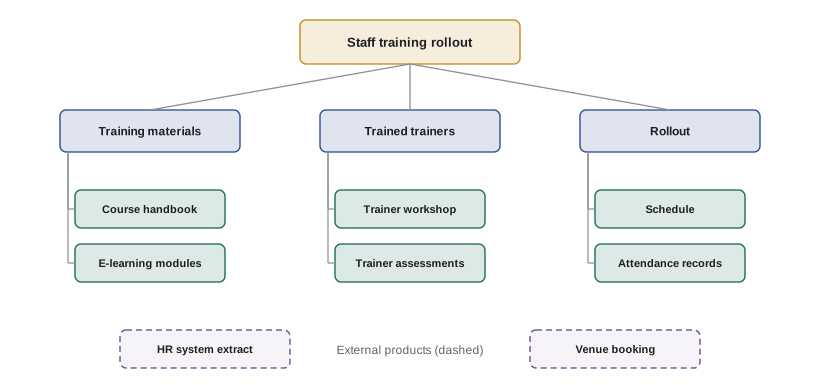
2. Create a product breakdown structure: a hierarchy of all the products the plan must deliver, including external products that come from outside the project.
3. Write product descriptions for the significant products: purpose, composition, derivation, format, quality criteria, quality tolerance, quality method and quality responsibilities.
4. Create a product flow diagram: the sequence in which products must be created and their dependencies.
Only after these steps does the planner identify the activities and dependencies needed to create each product, estimate effort and build a schedule. The order is deliberate. If you start with activities, you plan what people will do; if you start with products, you plan what the customer will get.
Counting and checking products
Worked problem
Counting products in a breakdown structure
A product breakdown structure for a clinic renovation has one top-level product. It has four intermediate products: design, building works, equipment and handover. Design contains three products; building works contains five; equipment contains four; handover contains three. Two of the equipment products are supplied by an external vendor. How many lowest-level products are there, how many are external, and how many product descriptions would you write if you write one for each lowest-level product plus the project product?
Show solution
- Lowest-level products: 3 + 5 + 4 + 3 = 15.
- External products: 2 (still shown in the structure, but created outside the project).
- Product descriptions for products the project creates: 15 − 2 = 13.
- Plus the project product description: 13 + 1 = 14.
- External products are usually not given full product descriptions by the project, but their expected quality and delivery date should be recorded.
Answer: 15 lowest-level products, 2 external, and about 14 product descriptions including the project product description.
On a small project, product descriptions may be a few lines each. On a large or high-risk project they can be detailed specifications. The principle does not demand a particular level of detail; it demands that the product, and especially its quality criteria, is understood and agreed before the work starts.
Quality criteria and acceptance criteria
Quality criteria describe how a product will be judged. They should be measurable or at least checkable: "the handbook covers all 12 procedures in the policy, has been reviewed by two clinical leads and scores at least 60 on a plain-language readability test" is far better than "a good handbook". Acceptance criteria apply to the project product as a whole and describe what the users and other stakeholders need before they accept the project's output. Typical acceptance criteria cover functionality, performance, reliability, security, usability, maintainability and, increasingly, sustainability.
| Weak quality criterion | Measurable quality criterion |
|---|---|
| The app is fast | Screens load in 2 seconds or less for 95 % of requests in testing |
| The building is energy efficient | Modeled energy use intensity at or below the target in the energy code compliance report |
| Training is effective | At least 90 % of attendees pass the post-course assessment |
| The report is readable | Plain-language score of 60 or more and approved by two reviewers |
The quality practice then plans how products will be checked: by inspection, testing, review or audit, and by whom. A quality register records the planned and actual quality activities. Product status accounts, produced through configuration management, show where each product is in its life cycle.
Products and scope control
Focusing on products is one of the strongest defenses against scope creep. When the scope is defined as an agreed set of products with agreed quality criteria, any request for something extra is visible as a change: a new product, or a change to an existing product's description. It goes through issue and change control, with its impact on cost, time, risk and benefits assessed. Without product descriptions, scope expands silently because nobody can point to what was agreed.
Worked problem
Assessing a scope change against products
The agreed product description for an online form lists eight fields and a confirmation email. Midway through the stage, a senior user asks for two extra fields and a PDF receipt. The supplier estimates 6 days for the fields and 9 days for the receipt at 900 a day. The stage has a cost tolerance of 15,000 remaining and the change authority can approve changes up to 10,000. What should happen?
Show solution
- Cost of fields: 6 × 900 = 5,400.
- Cost of receipt: 9 × 900 = 8,100.
- Total: 13,500. This is within the 15,000 remaining tolerance, but above the 10,000 change authority limit.
- Option: approve the fields (5,400) through the change authority and refer the receipt (8,100) as a separate request, or refer the combined change of 13,500 to the board.
Answer: The request is a change to an agreed product. Because 13,500 exceeds the change authority limit, the combined change goes to the board, or it is split so the change authority approves what is within its limit.
Products in agile delivery
Agile teams often express products as user stories, epics and a product backlog, with a definition of done that functions like quality criteria. This is compatible with the principle. What matters is that the outputs are defined in terms the users understand, that quality expectations are explicit, and that completion is judged against them. In agile settings, scope is often the main tolerance: the team commits to a fixed time and cost and delivers the highest-priority products within them.
Outputs, outcomes and benefits
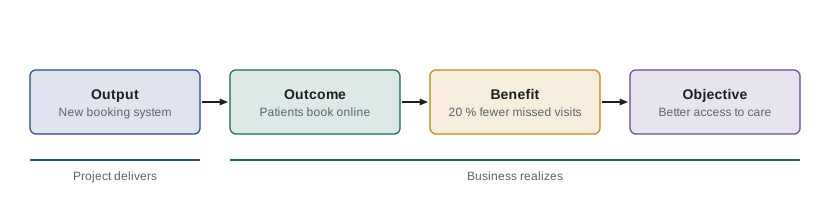
PRINCE2 distinguishes between outputs, outcomes and benefits. Outputs are the specialist products the project delivers. Outcomes are the changes that result when people use the outputs. Benefits are the measurable improvements that result from outcomes and that someone values. A new booking system is an output; clinics booking appointments online is an outcome; fewer missed appointments and lower call-center costs are benefits. Focus on products concentrates on outputs, but the product descriptions should be written with the intended outcomes and benefits in mind, which links this principle to continued business justification.
Failure modes
| Failure | Symptom | Remedy |
|---|---|---|
| Activity-based plans | Tasks complete but nothing usable is delivered | Plan from products, then activities |
| Vague quality criteria | Endless arguments at acceptance | Write measurable criteria in product descriptions |
| Silent scope creep | Cost and time grow without decisions | Treat requests as changes to agreed products |
| Ignoring external products | Surprise dependencies on other teams or vendors | Show external products in the breakdown and track them |
| Progress by effort | "90 % complete" for months | Report progress by approved products |
Writing a good product description
A product description is a short document with a standard set of headings. Not every heading is needed for every product, but the core ones are: identifier and title; purpose, which explains why the product is needed and who will use it; composition, which lists its parts; derivation, which lists the sources it is built from; format and presentation; quality criteria and quality tolerance; quality method, which says how the product will be checked; and quality responsibilities, which name who produces, reviews and approves it. The skills needed to create it may also be listed.
Worked problem
A short product description
Write the key elements of a product description for a staff training handbook on a new booking system.
Show solution
- Purpose: to give clinic staff a reference for booking, rescheduling and canceling appointments in the new system.
- Composition: introduction, 12 procedures with screenshots, troubleshooting section, glossary.
- Derivation: approved system screens, booking policy, user feedback from the pilot.
- Quality criteria: covers all 12 procedures in the policy; every screenshot matches the released version; plain-language score of at least 60; approved by two clinic supervisors.
- Quality method: review by two clinic supervisors and a walkthrough by three new users.
- Responsibilities: produced by the training lead; reviewed by clinic supervisors; approved by the senior user.
Answer: A one-page description that tells the producer what to build and the reviewers how to judge it.
The product flow diagram
The product flow diagram shows the order in which products must be created and which products depend on others. It is drawn from the product breakdown structure and often reveals dependencies that a task list would hide. For example, training materials depend on the final system screens, which depend on the completed design, which depends on agreed requirements. If requirements slip, the diagram shows immediately which later products are affected. External products appear in the flow diagram too, so a dependency on another team or supplier is visible and can be tracked as a risk.
Products and configuration management
Once products exist, they need to be controlled. Configuration management records the versions, status and relationships of products, so that everyone works on the right version and changes are traceable. A product status account shows the current state of products at a point in time. On a small project, configuration management may simply be a shared folder with a version naming rule and a simple register; on a large project it may involve dedicated tools and a configuration librarian. Either way, it supports this principle by making sure the products being reviewed, approved and handed over are the agreed ones.
Products beyond the specialist work
PRINCE2 distinguishes specialist products, which the project exists to deliver, from management products, such as the business case, plans, reports and registers, which exist to manage the project. Both kinds are products in the sense of this principle and can be described, created and checked. Treating management products this way is a useful discipline: a highlight report has a purpose, an audience and quality criteria, such as including forecasts against every tolerance, and a report that fails those criteria is not fit for purpose however neatly it is formatted.
Common mistakes
MistakeStarting the plan with a list of tasks.
InsteadStart with the project product description and product breakdown.
MistakeWriting quality criteria such as "user-friendly" or "fast".
InsteadWrite measurable or checkable criteria.
MistakeAccepting extra features informally because they seem small.
InsteadTreat them as changes to agreed products and assess their impact.
MistakeLeaving external products out of the plan.
InsteadInclude them in the product breakdown structure and track their delivery.
MistakeReporting progress as hours spent.
InsteadReport products completed and approved.
Summary and key terms
- A product is any input or output that can be described, created and tested.
- Products and their quality requirements are agreed before activities are planned.
- Product-based planning: project product description, breakdown structure, product descriptions, flow diagram.
- Measurable quality and acceptance criteria make completion objective.
- Defining scope as products makes changes visible and controllable.
- Progress is measured by products completed and approved.
- Outputs enable outcomes, which produce benefits; this links products to the business case.
- Product
- An input or output that can be described in advance, created and tested.
- Project product description
- A description of the overall product the project must deliver.
- Product breakdown structure
- A hierarchy of all the products a plan must deliver.
- Product description
- A description of a product's purpose, composition and quality criteria.
- Product flow diagram
- A diagram of the sequence and dependencies of products.
- External product
- A product supplied from outside the project that the project depends on.
- Quality criteria
- The measures a product must meet to be judged complete.
- Acceptance criteria
- The criteria the project product must meet to be accepted.
- Output
- A specialist product delivered by the project.
- Outcome
- The result of change brought about by using outputs.
Practice problems
Work each problem on paper first, then reveal the answer to check.
Name the four steps of product-based planning.
Show answer
Project product description, product breakdown structure, product descriptions, product flow diagram.
Is a trained workforce a product?
Show answer
Yes; it can be described, created and tested.
Branches with 4, 6 and 2 lowest-level products. Total?
Show answer
12.
Rewrite "fast website" as a quality criterion.
Show answer
For example, pages load in 2 seconds or less for 95 % of requests.
What defends against scope creep in this principle?
Show answer
Agreed product descriptions plus change control.
Change of 7 days at 800 a day; authority limit 5,000. Who approves?
Show answer
The board, because 5,600 exceeds 5,000.
How is progress measured under this principle?
Show answer
By products completed and approved.
Output, outcome or benefit: lower call-center costs?
Show answer
Benefit.
Which register records quality activities?
Show answer
The quality register.
What agile artifact works like quality criteria?
Show answer
The definition of done.
Lesson quiz · 5 questions
Score 60% or more to complete this lesson.
Create a free account to save your progress, take quizzes and earn a certificate.