
PRIN-110 · Lesson 5 of 12 · 29 min
Manage by stages
The fourth principle states that a PRINCE2 project is planned, monitored and controlled on a stage-by-stage basis. Management stages are sections of the project that the project manager manages on behalf of the project board, with a decision point at the end of each. At that decision point the board reviews what has been achieved, checks the business case and the plans for the next stage, and decides whether to continue. Manage by stages gives senior management control points without requiring them to manage the detail, and it gives everyone a realistic planning horizon.
The planning horizon problem
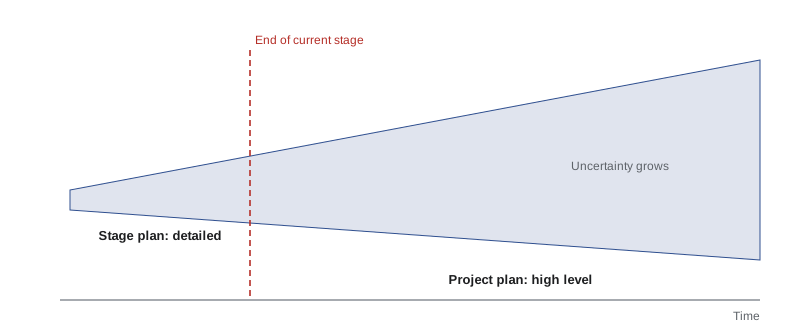
Nobody can plan a long project in detail at the start. The further ahead you plan, the less accurate the plan becomes, because requirements change, risks materialize, suppliers perform differently than expected and assumptions turn out to be wrong. A plan with daily tasks for the next three years is not more controlled than a high-level plan; it is less honest. PRINCE2 deals with this by planning at two levels. The project plan covers the whole project at a high level and is used by the board. Each stage plan covers one management stage in enough detail for day-to-day control by the project manager. The next stage plan is produced near the end of the current stage, when much more is known.
Minimum stages and stage boundaries
Every PRINCE2 project has at least two management stages: an initiation stage, in which the project is planned and set up, and one or more delivery stages. Starting up a project happens before the initiation stage and is not a management stage itself. The end of each management stage is a stage boundary. In the managing a stage boundary process, the project manager prepares the end stage report, updates the project plan and business case, reviews risks and issues, records lessons and produces the plan for the next stage. In the directing a project process, the board reviews all of this and authorizes the next stage, or asks for changes, or decides to close the project.
| At the stage boundary | Who | Main products |
|---|---|---|
| Report on the stage just ending | Project manager | End stage report |
| Plan the next stage | Project manager | Stage plan for the next stage |
| Update the whole-project view | Project manager | Updated project plan, business case, risk register |
| Pass on lessons | Project manager | Lessons log, possibly a lessons report |
| Decide | Project board | Authorization to proceed, or instruction to change or close |
Management stages versus technical stages
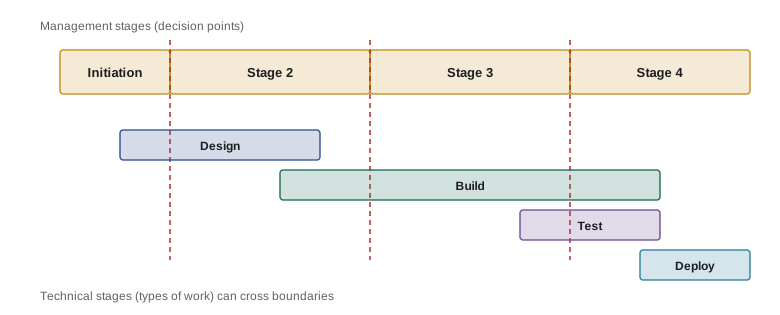
A common source of confusion is the difference between management stages and technical stages. Technical stages are groupings of specialist work by type: design, build, test, deploy. Management stages are groupings of work by decision point, chosen so that the board can review progress and commit resources one section at a time. The two often do not line up. A management stage might cover the end of design and the start of build. Technical work can overlap management stages, and that is normal.
How long should a stage be?
PRINCE2 does not fix stage length. The right length depends on several factors, and choosing it is one of the most important tailoring decisions at initiation.
- Planning horizon: how far ahead can the work be planned with reasonable confidence?
- Risk: higher risk calls for shorter stages so the board can intervene sooner.
- Key decision points: natural points where the board must commit significant money, sign a contract or choose between options.
- Technical milestones: the end of a design, the completion of a pilot or a regulatory approval.
- Board capacity: very short stages create frequent board decisions, which can overload senior people.
- Funding cycles: stages may align with budget approvals or fiscal years.
Worked problem
Choosing stage boundaries
A 14-month project to open a new distribution warehouse has these key events: design approval at month 3, a 40 % deposit on racking at month 4, construction complete at month 9, systems testing complete at month 11, go-live at month 13 and handover at month 14. Initiation takes the first month. The organization's risk appetite is low. Propose management stages.
Show solution
- Stage 1: initiation, months 0 to 1.
- Stage 2: design, months 1 to 3, ending with design approval before the racking deposit is committed.
- Stage 3: procurement and construction, months 3 to 9, ending at construction complete. Six months is long for low risk appetite, so consider splitting at month 6.
- Stage 4: fit-out and systems testing, months 9 to 11.
- Stage 5: go-live and handover, months 11 to 14.
Answer: Five or six management stages, with boundaries placed before big commitments (the racking deposit) and at natural decision points. The long construction stage could be split to match the low risk appetite.
Observe that the stage boundaries are placed before the big financial commitment, not after it. A board that only reviews progress after money is committed has lost the main benefit of the principle.
Stages and tolerance
Manage by stages works hand in hand with manage by exception. The board sets tolerances for each stage. If a stage is forecast to exceed its tolerance, the project manager raises an exception report, and the board may ask for an exception plan, which replaces the current stage plan. An exception plan is produced in the managing a stage boundary process, and the board approves it in the same way as a new stage plan. In this sense stage boundaries can happen early, when an exception forces a new decision.
Worked problem
Stage cost forecast against tolerance
Stage 3 has a budget of 480,000 with a cost tolerance of ±8 %. Halfway through, 260,000 has been spent and the project manager forecasts that the remaining work will cost 270,000. Is the stage within tolerance?
Show solution
- Tolerance band: 480,000 × 0.08 = 38,400, so the band is 441,600 to 518,400.
- Forecast stage cost: 260,000 + 270,000 = 530,000.
- 530,000 is above the upper limit of 518,400 by 11,600.
- The project manager must raise an exception report to the board.
Answer: No: the forecast of 530,000 exceeds the 518,400 limit, so an exception exists.
Manage by stages in agile delivery
In agile delivery, work is organized in short timeboxes such as sprints of one to four weeks. These are not the same as PRINCE2 management stages. A management stage typically contains several sprints or releases, and the stage boundary is where the board reviews the cumulative product, the backlog and the business case. Some organizations align management stages with releases. The principle is satisfied as long as there are planned decision points at which the board reviews progress and justification and authorizes the next commitment.
Why stages give control
Stages give the board three kinds of control. First, commitment control: the board commits resources one stage at a time, so it is never committed to more than one stage of spending without a fresh decision. Second, information control: the end stage report and updated business case give the board a clear, regular picture. Third, change control: the next stage plan can incorporate changes, lessons and new risks, rather than following a plan written months earlier.
Stages also help the project manager. A stage plan that has been approved by the board is a clear mandate. Within it, and within tolerances, the project manager can act without asking permission. That clarity is one reason why well-run PRINCE2 projects often feel calmer than projects without clear decision points.
Failure modes
| Failure | Symptom | Remedy |
|---|---|---|
| One giant stage | The board approves everything at once and loses control | Split delivery into stages at key decision points |
| Stage boundaries as rubber stamps | The board approves the next stage without reviewing the business case | Make the boundary a genuine go, change or stop decision |
| Boundaries after commitments | Money is spent before the board can review | Place boundaries before major commitments |
| Detailed plan for the whole project | False precision and constant re-planning | Keep the project plan high level; detail stage by stage |
| Too many tiny stages | Board overload and slow progress | Balance stage length against board capacity and risk |
The end stage report and the board decision
The end stage report is the board's main input at a stage boundary. A good report is short and decision-focused. It compares the stage's performance against its plan and tolerances, summarizes products completed and approved, reviews the business case and the main risks, notes lessons, and sets out the request for the next stage. Alongside it, the board receives the next stage plan and the updated project plan and business case. The board then has three main options: authorize the next stage, ask for changes before authorizing, or prematurely close the project.
A board that simply signs the authorization without reading the updated business case is not applying the principle. The value of a stage boundary lies in the decision. Some organizations require the executive to record, in a sentence or two, why the project remains justified before the next stage is authorized. That small discipline makes the decision visible and auditable.
Stage boundaries and organizational gates
Many organizations have their own approval gates, often tied to funding. A capital project may need approval at concept, design, procurement and construction. A technology project may need approval before architecture sign-off and before go-live. PRINCE2 stage boundaries can be aligned with these gates, so that the board's decision and the organization's approval happen together. Where gates and stages do not align, the tailoring record should explain how they relate, so nobody is confused about who must approve what.
Initiation as a stage
The initiation stage deserves special mention because it is often rushed. During initiation the project manager produces the project initiation documentation: the business case, project plan, risk, quality, configuration and communication management approaches, the project controls and the tailoring decisions. Initiation is itself a management stage, with its own plan and tolerances, and it ends with a board decision to authorize the project and the first delivery stage. Skipping or compressing initiation saves a little time at the start and often costs much more later, because the project starts delivery without agreed products, tolerances or controls.
Worked problem
Cost of skipping initiation
A project of 2 million skips a planned six-week initiation that would have cost 60,000. Later, unclear requirements cause rework estimated at 8 % of the delivery budget of 1.9 million. Compare the saving with the rework cost.
Show solution
- Saving from skipping initiation: 60,000.
- Rework: 1,900,000 × 0.08 = 152,000.
- Net loss: 152,000 − 60,000 = 92,000.
Answer: Skipping initiation saved 60,000 but cost 152,000 in rework, a net loss of 92,000, before counting delay.
Common mistakes
MistakeCounting starting up a project as a management stage.
InsteadRemember that the first management stage is initiation.
MistakeEquating management stages with technical stages such as design and build.
InsteadChoose management stages by decision points; technical work may overlap them.
MistakePlanning the whole project in daily detail at the start.
InsteadPlan the next stage in detail and keep the project plan high level.
MistakePlacing a stage boundary after a large financial commitment.
InsteadPut the decision point before the commitment.
MistakeTreating stage boundary reviews as formalities.
InsteadUse each boundary to decide whether to continue, change or stop.
Summary and key terms
- Projects are planned, monitored and controlled stage by stage.
- Every project has at least two management stages: initiation and at least one delivery stage.
- The project plan is high level; stage plans are detailed and produced near the end of the previous stage.
- Management stages are decision points; technical stages are types of work.
- Stage length depends on planning horizon, risk, decision points, board capacity and funding.
- Exceptions can force an early stage boundary through an exception plan.
- Stages give the board commitment control, information control and change control.
- Management stage
- A section of a project managed by the project manager, ending with a board decision.
- Stage boundary
- The end of a management stage, where the board decides whether to continue.
- Initiation stage
- The first management stage, in which the project is planned and set up.
- Delivery stage
- A management stage in which specialist products are created.
- Technical stage
- A grouping of work by type, such as design, build or test.
- Project plan
- A high-level plan for the whole project, used mainly by the board.
- Stage plan
- A detailed plan for one management stage.
- End stage report
- The project manager's report to the board at a stage boundary.
- Exception plan
- A plan that replaces a stage or project plan after an exception.
- Planning horizon
- The period over which work can be planned with reasonable accuracy.
Practice problems
Work each problem on paper first, then reveal the answer to check.
What is the minimum number of management stages?
Show answer
Two.
Is starting up a project a management stage?
Show answer
No.
When is the next stage plan produced?
Show answer
Near the end of the current stage, in managing a stage boundary.
Budget 200,000, tolerance ±5 %. Upper limit?
Show answer
210,000.
Spent 150,000, forecast remaining 70,000, upper limit 210,000. Exception?
Show answer
Yes; 220,000 exceeds 210,000.
Where should a boundary sit relative to a big contract signature?
Show answer
Before it.
Name two factors in choosing stage length.
Show answer
Any two of planning horizon, risk, decision points, technical milestones, board capacity and funding cycles.
What replaces a stage plan after an exception?
Show answer
An exception plan.
Are sprints the same as management stages?
Show answer
No; a stage usually contains several sprints or releases.
Which report does the board review at a stage end?
Show answer
The end stage report.
Lesson quiz · 5 questions
Score 60% or more to complete this lesson.
Create a free account to save your progress, take quizzes and earn a certificate.