
SLS-221 · Lesson 12 of 12 · 22 min
Lab: an inside sales day
▶ Video coming soon A video version of this lesson is on the way.
On Monday, November 9, 2026, Maya spent a full working day as a member of Ridgeline's inside team. Darnell had arranged it as the lab for this course. She sat at a spare desk in the team's corner, with a headset, the CRM, the dialler, the chat console and a Sales Navigator license. Owen gave her a plan for the day, a small set of targets and a scorecard he would complete with her at the end. This lesson follows her day hour by hour, with the decisions she made and the numbers she produced, and finishes with the scorecard and what each part of the course contributed.
A lab like this is useful for any seller, not only for people planning an inside career. Field AEs who have worked an inside day understand what their SDR colleagues need from them, write better hand-off feedback and use inside methods themselves when they cannot visit a customer. Owen's aim for the day was not that Maya would book many meetings, but that she would practice each motion once, with feedback.
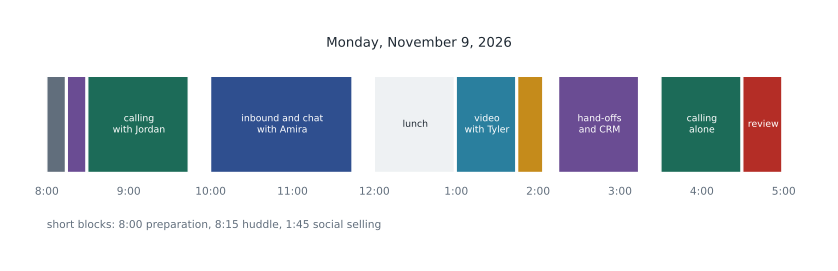
8:00 to 8:30: preparation and huddle
Maya arrived at 8:00 and spent fifteen minutes preparing her calling list. Owen had given her 30 tier B contacts at professional firms and clinics in her own territory, already in the standard cadence and due for a day 3 or day 8 call. For each, she wrote the one-line reason for calling in the CRM, using the trigger that had put the contact on the list, and checked what the cadence had already sent. At the 8:15 huddle, she said her target for the day, "two booked meetings and one good video," and her blocker: she had never used the dialler. Jordan showed her the three buttons she needed after the huddle.
8:30 to 9:45: the first calling block
Maya called with Jordan listening on a second headset, as she had listened to him in lesson 5. Her first two calls went to voicemail, and she left 20-second messages that pointed to the email the cadence had sent. On the third call, an office manager answered and said, "We're all set," and Maya, a little flustered, said goodbye before asking any question. Jordan muted his microphone and suggested she try the timing question next time. On the eleventh call she did: the office manager at a law firm said they were all set, Maya asked when their current printer agreement ended, and the answer, "March, actually," turned into a ten-minute conversation and a meeting booked for the following Tuesday.
| Measure | Morning block | Afternoon block | Day |
|---|---|---|---|
| Dials | 19 | 15 | 34 |
| Connects | 3 | 2 | 5 |
| Conversations | 2 | 2 | 4 |
| Meetings booked | 1 | 1 | 2 |
| Voicemails left | 11 | 9 | 20 |
| Asked not to be called | 0 | 1 | 1 |
The one person who asked not to be called, during the afternoon block, was the owner of a small accounting practice who said firmly that he did not take sales calls. Maya thanked him, ended the call and added the number to the internal do-not-call list before dialing again, as lesson 5 required.
10:00 to 11:45: inbound and chat
Maya then sat with Amira for inbound work. At 10:22, a quote request arrived from a dental office wanting two printers for a new location. Maya read it twice, called within 14 minutes, reached the office manager, answered her question about whether a lease was required, gave a price range and booked a 15-minute video call for Wednesday. Her follow-up email went out at 10:51 with the call time, two short product links and one question about monthly page volume. Amira's only correction was that Maya had promised delivery "in two weeks" without checking stock; Amira showed her how to check it in the system before making any promise, as Ridgeline's chat and inbound rules required.
Maya also handled two website chats with Amira watching. One was a RoomFlow question that she answered from the approved snippets, adapting them to the visitor's words. The other was an existing customer asking about toner delivery, which she passed to the service desk with a note in the CRM. She learned to send a short holding message, "one minute while I check," rather than leaving the visitor waiting in silence.
Worked problem
Did the dental quote meet the targets?
The dental office's quote request arrived at 10:22. Maya's first personal response, the phone call, was at 10:36, and her follow-up email went out at 10:51. Ridgeline's target is a personal response within one business hour. How long did the first response take, and by how much did it beat the target?
Show solution
- Time from 10:22 to 10:36.
- \[36 - 22 = 14 \text{ minutes}\]
- Margin against a 60-minute target.
- \[60 - 14 = 46 \text{ minutes}\]
- Time from request to written follow-up, from 10:22 to 10:51.
- \[51 - 22 = 29 \text{ minutes}\]
Answer: Maya's first personal response came 14 minutes after the request, 46 minutes inside the target, and her written follow-up 29 minutes after it, well within the lesson 3 guidance of fast, then right, then complete. Her only slip, promising delivery without checking stock, was about being right rather than fast.
1:00 to 2:05: video and social selling
After lunch, Tyler helped Maya record prospecting videos for three tier A accounts in her territory: Harvest Valley Credit Union, Bellmont Seniors Residence and a regional engineering firm. She wrote the email for each first, then recorded a video of about 70 seconds following the structure in lesson 6. Her first take for Harvest Valley ran 2 minutes 10 seconds, because she explained RoomFlow in detail; Tyler asked her to cut it to one idea, the branch's single meeting room and how bookings could be shared with head office. The second take ran 72 seconds. She checked the automatic captions, which had turned "RoomFlow" into "room flow" and "Bellmont" into "bell mount," fixed them and sent the three emails.
She then spent twenty minutes on social selling. She commented on a post by Gord Frey at Harvest Valley about the new branch's opening date, congratulated a contact at Northfield Family Clinic on a new physician joining, and drafted a short original post about three questions offices should ask before signing a printer lease. Owen asked her to run the post past marketing before publishing, because it compared lease terms in general and he wanted to be sure the wording matched approved claims.
2:15 to 3:15: hand-offs and records
Maya spent an hour on records, which Owen considered as important as anything else in the day. She wrote hand-off notes in the five-part format from lesson 2 for both meetings she had booked, even though one was in her own territory and she would run it herself, because the notes would help Darnell review her pipeline. She logged every call disposition and checked that the do-not-call request was recorded. And she accepted or rejected the two inside-team meetings on her own calendar that week, giving a reason for the one she rejected: the prospect had told the SDR they were a two-person home office, below Ridgeline's ideal customer profile.
| Hand-off note field | Maya's note for the law firm meeting |
|---|---|
| Who | Office manager, 14-person law firm in the south end; handles printers and supplies |
| Trigger | Current printer agreement with a competitor ends in March 2027 |
| What they want | Fewer jams at month-end billing; unsure whether to lease again or buy |
| Not yet known | Who signs; current monthly cost; how many devices |
| Avoid | Pushing RoomFlow: she said they book rooms on a whiteboard and like it |
3:30 to 4:30: the second calling block
In the afternoon block, Maya called the remaining 15 contacts on her list without Jordan listening. She noticed she was calmer and talked less in the first minute. She reached two people, had two conversations, booked one meeting, with a clinic whose office manager had seen her video from the morning in her inbox and said, "Oh, you're the one who held up our floor plan," and received the one do-not-call request described earlier. By 4:30 she had made 34 dials in the day.
Worked problem
Maya's day in numbers
Across the day Maya made 34 dials, reached 5 people, had 4 conversations and booked 2 meetings. Jordan's September averages (lesson 5) were a connect rate of about 10 in 100, a conversation rate of about 62 in 100 of connects and a meeting rate of about 32 in 100 of conversations. How did Maya's rates compare, and how much weight should she put on them?
Show solution
- Maya's connect rate.
- \[\frac{5}{34} = 0.147 \approx 15 \text{ in } 100\]
- Conversation rate.
- \[\frac{4}{5} = 0.80 = 80 \text{ in } 100\]
- Meeting rate.
- \[\frac{2}{4} = 0.50 = 50 \text{ in } 100\]
- Dials per meeting.
- \[\frac{34}{2} = 17\]
Answer: Maya's rates were all higher than Jordan's September averages, at 17 dials per meeting against his 51. But they rest on 34 dials and 2 meetings, a sample far too small to mean much: one more or one fewer meeting would change her meeting rate from 50 to 75 or 25 in 100. Owen pointed out that her list had been carefully prepared and partly warmed by earlier cadence touches, which helps explain the results. The day showed she could do the work, not what her long-run rates would be.
4:30 to 5:00: the end-of-day review
Owen and Maya sat down with his scorecard. It had ten items, each scored 0, 1 or 2, for a maximum of 20.
| Item | What Owen looked for | Score |
|---|---|---|
| Call preparation | A one-line reason for every contact | 2 |
| Openings | Name, company and a specific reason, then a question | 2 |
| First objections | Acknowledge, one question, accept a second no | 1 |
| Voicemails | Under 30 seconds, pointing to the email | 2 |
| Inbound response | Personal response within an hour, right and complete | 1 |
| Chat | Short replies, holding messages, correct hand-off | 2 |
| Video | Under 90 seconds, one idea, captions checked | 2 |
| Social selling | Thoughtful comments; post checked before publishing | 2 |
| Records | Dispositions, hand-off notes, do-not-call request logged | 2 |
| Compliance | No promises without checking; contact rules followed | 1 |
Worked problem
The final score
Using the scores in the table, what was Maya's total out of 20, and what share is that?
Show solution
- Add the scores.
- \[2 + 2 + 1 + 2 + 1 + 2 + 2 + 2 + 2 + 1 = 17\]
- Share of the maximum.
- \[\frac{17}{20} = 0.85 = 85 \text{ in } 100\]
Answer: Maya scored 17 of 20, or 85 in 100. She lost single points for the first objection she gave up on, the delivery promise in the dental call and, linked to it, compliance, because promising a delivery date without checking stock could mislead a customer.
Owen's summary was short. Maya's strengths were preparation, records and video; she wrote better hand-off notes than most new SDRs. Her development points were staying in the conversation after a first brush-off and checking facts before promising them. Darnell, reading the scorecard the next morning, added one point of his own: the two meetings she had booked were exactly the kind the field team wanted, because she had asked about timing.
Bringing the course together
The day used every lesson in the course. The hybrid model and inside motions from lesson 1 shaped which work Maya did at the inside desks. The roles and hand-offs in lesson 2 showed up in her notes and in the meetings she accepted and rejected. Inbound response (lesson 3) and chat (lesson 9) filled her morning with Amira; cadences (lesson 4) supplied her calling list; phone skills (lesson 5) carried both calling blocks; video (lesson 6) and her online presence and social selling (lessons 7 and 8) filled the early afternoon. The metrics in lesson 10 measured her day, and the rhythm and habits of lesson 11 framed it with a huddle and a review. In December, when Tyler began working as Maya's paired SDR, the plan was for the two of them to meet every Thursday to choose target accounts, and Maya planned to keep one calling block a week of her own.
Common mistakes
MistakeTreating an inside day as a numbers contest.
InsteadUse it to practice each motion once and get feedback; the sample is too small for rates to mean much.
MistakePromising delivery or prices without checking.
InsteadCheck stock, schedules and approved ranges before making any commitment.
MistakeGiving up after the first brush-off.
InsteadAsk one relevant question, such as when the current agreement ends, before accepting a no.
MistakeSkipping records at the end of a busy day.
InsteadLog dispositions, write hand-off notes and record do-not-call requests the same day.
MistakePublishing comparative posts without review.
InsteadCheck posts that make claims about products or terms with marketing first.
Summary and key terms
- Maya's lab day practiced each inside-sales motion once: a prepared calling block with feedback, inbound response and chat, video prospecting with checked captions, social selling, careful records and a second calling block on her own.
- She made 34 dials, reached 5 people and booked 2 meetings, and answered a quote request in 14 minutes, but a sample this small says little about long-run rates.
- Owen's scorecard gave her 17 of 20, with strengths in preparation, records and video and development points in staying with a first objection and checking facts before promising.
- Every lesson in the course contributed to the day.
- Lab day
- A structured day of practice with a target set and a scorecard review.
- Scorecard
- A list of observable behaviors, each scored, used to give structured feedback.
- Holding message
- A short chat message telling a visitor that the seller is checking something.
- Warmed contact
- A contact who has already received earlier touches, such as emails, in a cadence.
- Development point
- A specific skill a person agrees to work on next.
Practice problems
Work each problem on paper first, then reveal the answer to check.
A rep made 40 dials, reached 6 people, had 4 conversations and booked 1 meeting. What were the connect rate and dials per meeting?
Show answer
Connect rate 6 ÷ 40 = 15 in 100; 40 dials per meeting.
A quote request arrives at 2:40 p.m. and the rep calls at 3:25 p.m. Did the rep meet a one-hour target?
Show answer
Yes: 45 minutes, 15 minutes inside the target.
Why did Owen score Maya down on compliance?
Show answer
Because she promised a delivery date without checking stock, which could mislead the customer.
Lesson quiz · 5 questions
Score 60% or more to complete this lesson.
Create a free account to save your progress, take quizzes and earn a certificate.