
SLS-221 · Lesson 3 of 12 · 21 min
Responding to inbound leads
▶ Video coming soon A video version of this lesson is on the way.
On Monday, September 28, Maya arrived for her session to find Amira Nassar on a call, typing as she talked. A facilities coordinator at a dental office had filled in the website's quote form eleven minutes earlier, asking about a printer for a new front desk. By the time Amira hung up, she had confirmed the office's size, learned that the current printer was a borrowed home model, booked a fifteen-minute video call for Wednesday and sent a confirmation email with a short video of the printer she had in mind. "That's the job," Amira said. "Someone raised their hand. The faster and more helpful we are, the more likely they buy from us and not the next company they emailed."
This lesson is about inbound leads: prospects who contact the company first, by filling in a form, starting a chat, calling, replying to marketing, or visiting a booth. Inbound leads are usually the warmest leads a team gets, because the prospect has a need and has chosen to reach out. They are also easy to waste. A slow reply, a generic email or a seller who asks the same questions the form already answered can turn a willing buyer into someone who goes elsewhere.
Kinds of inbound interest
Not every inbound lead means the same thing. A person who asks for a quote is close to buying. A person who downloads a guide may be months away, or only curious. Ridgeline's marketing team sorted inbound interest into two broad groups. Hand-raisers asked to talk to someone: quote requests, demo requests, phone calls and chats that asked for a person. Content leads engaged with marketing without asking for contact: guide downloads, webinar sign-ups and newsletter subscriptions. Hand-raisers went straight to the inside team. Content leads were scored, using Grace Liu's lead-scoring model from SLS-210, and passed to the inside team only when their score showed they were ready.
| Inbound source | Group | How Ridgeline handled it |
|---|---|---|
| Quote request form | Hand-raiser | Personal response within one business hour |
| Demo request for RoomFlow | Hand-raiser | Personal response within one business hour; demo offered within three business days |
| Phone call to the sales line | Hand-raiser | Answered live in business hours; voicemail returned within one business hour |
| Website chat asking for a person | Hand-raiser | Handled live by the inside team in business hours (lesson 9) |
| Guide download or webinar sign-up | Content lead | Scored; passed to the inside team when sales-ready (score 60 or more) |
| Booth badge scan at an event | Depends | Hand-raiser if a meeting was requested; otherwise a content lead |
Why speed matters
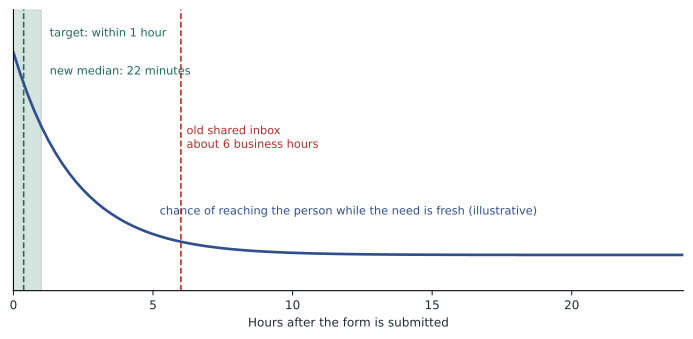
The most consistent finding about inbound leads is that response time matters. An often-cited study by James Oldroyd, Kristina McElheran and David Elkington, published in the *Harvard Business Review* in 2011, analyzed web leads at more than two thousand companies. It found that companies that tried to contact a lead within an hour were several times more likely to have a meaningful conversation with a decision-maker than those that waited longer, and that many companies took more than a day to respond at all. Later vendor studies have reported similar patterns, though their methods vary and their exact figures should be treated with caution.
The reasons are easy to see. A person who has just filled in a form is still thinking about the problem and is probably still at their desk. An hour later they are in a meeting; a day later they have heard from two competitors. Fast response also signals how the company will behave as a supplier. A buyer who waits three days for a reply to a quote request reasonably wonders how long they would wait for a service call.
Speed is not the only thing that matters, though. A fast reply that ignores what the prospect wrote is worse than a slightly slower one that answers their question. Amira's rule was: "Fast, then right, then complete." Reply quickly, make sure the reply speaks to what the person actually asked, and give them everything they need for the next step.
Ridgeline changed its inbound routing in July 2026. Before that, quote requests went into a shared email inbox that the inside team checked between other tasks, and the average first reply took most of a working day. After the change, each request was assigned automatically to an inside rep in the CRM, the rep received an alert on screen and on their phone, and the target became a personal response, by phone or a written reply from a named person, within one business hour. Business hours were 8:00 a.m. to 5:00 p.m. Central Time.
Worked problem
Measuring response time
In one week of October, Ridgeline received 9 quote requests during business hours. The times from submission to first personal response, in minutes, were: 6, 11, 14, 19, 22, 31, 48, 75 and 190. What is the median response time, what share met the one-hour target, and what does the average hide?
Show solution
- Sort the times (they are already sorted). With 9 values, the median is the 5th.
- Median = 22 minutes.
- Count the responses within 60 minutes: 6, 11, 14, 19, 22, 31 and 48.
- \[\frac{7}{9} = 0.778 \approx 78 \text{ in } 100\]
- Calculate the mean for comparison.
- \[\frac{6 + 11 + 14 + 19 + 22 + 31 + 48 + 75 + 190}{9} = \frac{416}{9} \approx 46.2 \text{ minutes}\]
Answer: The median response was 22 minutes, and 7 of 9 requests, about 78 in 100, met the one-hour target. The mean of about 46 minutes is pulled up by one request that waited 190 minutes, which arrived while Amira was on a long demo and nobody covered her alerts. Reporting the share within target, and looking at the slowest cases, tells the team more than an average.
The 190-minute case led to a small but useful change. If an alert was not accepted within fifteen minutes, it now passed to the next rep in the rotation, and Owen saw a notice on his own screen. Grace called this an escalation rule. It cost nothing and, in the following weeks, no quote request waited more than about ninety minutes.
Routing: who gets the lead
Lead routing is the set of rules that decides which person receives each inbound lead. Common approaches include round robin, where leads are assigned in turn to each available rep; territory routing, where a lead goes to the rep who covers that region or industry; and account-based routing, where a lead from an existing customer or a targeted account goes to the person who already owns that account. Most teams combine them. At Ridgeline, a lead from an existing customer went to the account owner's inside partner; a lead from a target account on a field AE's list went to the BDR who was already working that account; everything else went round robin among the reps on inbound duty that day.
Routing rules need a few safety features. The system must know who is out of the office, so leads do not sit with someone on holiday. It must have a fallback when the first choice does not respond. And it should send a short note to the field AE when a lead arrives from one of their accounts, so the AE is never surprised by a customer who says, "I already talked to your colleague."
The first response
A good first response does four things. It shows the prospect that a real person read their request. It answers any direct question they asked, or says when it will be answered. It asks only the few questions needed to take the next step, rather than a full qualification interview. And it proposes a clear, easy next step, usually a short call at a specific time.
| Weak first response | Stronger first response |
|---|---|
| "Thank you for your interest in Ridgeline. A representative will contact you." | "Hi Priya, I'm Amira at Ridgeline. You asked about a printer for your front desk." |
| Ignores the question about whether a lease is required | "Yes, we can sell outright or lease; for one printer most offices buy outright, and I'll show both." |
| Asks for budget, timeline, decision-maker and company size in one email | Asks one thing: "How many pages does the front desk print in a typical day?" |
| "Let me know a good time to talk." | "Could we take fifteen minutes on Wednesday at 10:00 or 2:30? Here's my calendar link if neither works." |
Phone first or email first? Amira usually called first for quote and demo requests, because a short conversation could answer questions that would take several emails. If the prospect did not answer, she left a brief voicemail and immediately sent an email, so the person had a written message with her name and number. For content leads, she usually started with email, because the person had not asked for a call and might find one intrusive. The legal rules for calling and emailing are covered in lessons 4 and 5; inbound leads usually make contact easier, because the person has asked to hear from the company.
Under the CAN-SPAM Act, commercial emails to a person who has submitted a quote request must still identify the sender, include a valid postal address and offer a working way to opt out, but no prior consent is needed for email. Calls and texts are different: the TCPA rules for calls and texts to mobile phones are covered in lessons 5 and 9. Ridgeline's form included a separate, unticked box asking for consent to receive text messages.
Qualifying inbound leads
Inbound leads need qualification just as outbound ones do, but the emphasis is different. An inbound prospect has already shown interest, so the main questions are whether Ridgeline is a good fit for them and how serious and immediate the need is. Amira used a light version of the BANT questions from SLS-210, asked in conversation rather than as a checklist: what prompted the request, what they are using now, when they need a solution, and who else is involved. She avoided asking about budget directly on the first call, because many small-office buyers had no budget figure in mind; instead she gave a price range early and watched the reaction.
Some inbound leads are not real prospects at all: students doing research, job seekers, competitors checking prices, or people who meant to contact a different company. The team marked these as disqualified with a reason, rather than deleting them, so that marketing could see which sources produced poor leads. In the first half of 2026, about one in eight of Ridgeline's form submissions was disqualified in this way.
Worked problem
How many inbound leads can one rep handle?
Ridgeline received 180 quote requests in the first half of 2026, about 26 weeks. Amira estimated that each request took about 45 minutes of work on average, including the first call, the follow-up email, a short demo or second call where needed, and CRM notes. She spent about 60 in 100 of her week on inbound work, in a 40-hour week. How much of her inbound time did quote requests use, and how much was left for demo requests, chats and content leads?
Show solution
- Quote requests per week.
- \[\frac{180}{26} \approx 6.9\]
- Hours per week on quote requests.
- \[6.9 \times 0.75 \approx 5.2 \text{ hours}\]
- Amira's inbound hours per week.
- \[0.60 \times 40 = 24 \text{ hours}\]
- Hours left for other inbound work.
- \[24 - 5.2 = 18.8 \text{ hours}\]
Answer: Quote requests used only about 5 hours of Amira's 24 inbound hours a week, leaving almost 19 hours for demos, chats and content leads. When marketing planned a spring campaign expected to triple quote requests, Owen used the same arithmetic to show that Amira could absorb the increase, about 16 hours a week, but would then have little time for the RoomFlow demos she also ran.
When inbound leads go cold
Some prospects respond enthusiastically and then disappear. Amira's approach was to follow up several times over about two weeks, with each message adding something new, such as an answer to a question they had not asked, a short video or a relevant example, rather than simply asking whether they had seen the last email. After that, she sent a polite closing message saying she would stop following up and how to reach her, and moved the lead into a long-term nurture campaign run by marketing. The closing message often brought a reply, because it gave the person permission to say "not now" without awkwardness.
Common mistakes
MistakeReplying to an inbound lead the next day.
InsteadAim for a personal response within one business hour, with an escalation rule when a rep cannot respond.
MistakeSending a generic acknowledgment.
InsteadShow that a person read the request, answer the question asked and propose a specific next step.
MistakeAsking every qualification question in the first email.
InsteadAsk only what you need for the next step, and qualify further in conversation.
MistakeReporting only the average response time.
InsteadReport the median and the share within target, and look at the slowest cases.
MistakeDeleting junk leads.
InsteadDisqualify them with a reason so marketing can see which sources produce poor leads.
Summary and key terms
- Inbound leads are prospects who contact the company first.
- Hand-raisers, such as quote and demo requests, go straight to sellers; content leads are scored and passed on when ready.
- Response time matters: research and practice show that contact within an hour makes a useful conversation much more likely.
- Ridgeline's target is a personal response within one business hour, with automatic routing and an escalation rule.
- In one week, the median response was 22 minutes and about 78 in 100 met the target.
- Lead routing combines round robin, territory and account rules.
- A good first response is personal, answers the question, asks little and proposes a clear next step.
- Inbound lead
- A prospect who contacts the company first, for example through a form, chat or call.
- Hand-raiser
- An inbound lead who has asked to talk to someone, such as a quote or demo request.
- Content lead
- An inbound lead who engaged with marketing content without asking for contact.
- Speed to lead
- The time between an inbound lead arriving and the first personal response.
- Lead routing
- The rules that decide which person receives each inbound lead.
- Round robin
- A routing method that assigns leads in turn to each available rep.
- Escalation rule
- A rule that passes an unanswered lead to someone else after a set time.
Practice problems
Work each problem on paper first, then reveal the answer to check.
Response times in minutes were 8, 15, 21, 40, 55, 70 and 120. What is the median, and what share met a 60-minute target?
Show answer
Median 40 minutes; 5 of 7, about 71 in 100, within 60 minutes.
Name three common lead-routing approaches.
Show answer
Round robin, territory routing and account-based routing.
Why should a first response ask only one or two questions?
Show answer
Because the goal is the next step; a long questionnaire slows the reply and feels like a form, not a conversation.
Lesson quiz · 5 questions
Score 60% or more to complete this lesson.
Create a free account to save your progress, take quizzes and earn a certificate.