
SLS-221 · Lesson 9 of 12 · 23 min
Selling through chat and messaging
▶ Video coming soon A video version of this lesson is on the way.
On November 2, after the social selling discussion, Amira showed Maya the chat console on her left-hand screen. Three conversations were open. A visitor on the RoomFlow pricing page was asking whether RoomFlow worked with their calendar system. A customer wanted to know when a technician would arrive. And someone had typed "do you sell office chairs" into the chat window and then left the page. "Chat is fast, short and in writing," Amira said. "People treat it like texting. If you answer like an email, they leave."
This lesson covers selling through written, real-time channels: website chat, where visitors talk to the company from a window on its website; text messaging (SMS) with prospects and customers; and messaging apps and shared workspaces, such as business messaging channels some customers use. These channels have grown because many buyers prefer them to phone calls for quick questions. They also bring automation into selling, through chatbots and AI agents, which raises questions about accuracy, honesty and the law.
Website chat
Most B2B websites now offer a chat window. Visitors use it to ask quick questions before they are ready to fill in a form or call: whether a product works with something they already have, roughly what it costs, how soon it could be delivered. For the seller, chat is a chance to help at the moment of interest and to turn an anonymous visitor into a named lead.
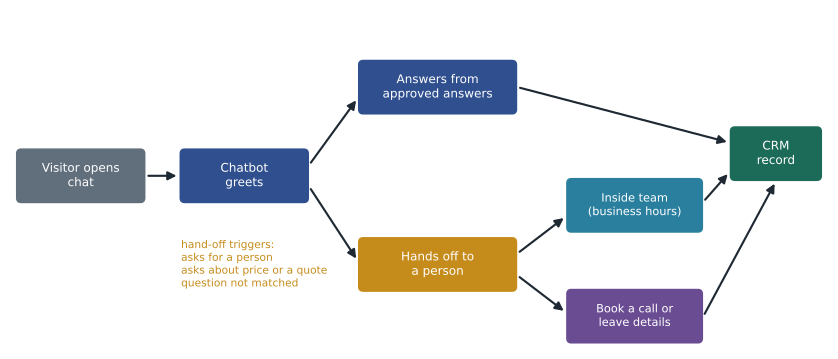
Ridgeline's chat ran in two layers. Outside business hours, and for the first exchange at any time, an automated chatbot greeted visitors, answered a short list of approved frequently asked questions and offered to connect them with a person. During business hours, 8:00 a.m. to 5:00 p.m. Central Time, a member of the inside team took over any conversation in which the visitor asked for a person, asked about price or a quote, or wrote anything the bot could not match to an approved answer. Out of hours, the bot offered to book a call or collect contact details for a reply the next morning.
Writing in chat
Chat has its own style. Messages are short, one idea each, and arrive quickly; a reply that takes three minutes to write feels slow. Amira kept a small library of approved snippets, such as a two-line description of managed print, but she always adapted them, because visitors can tell when they are being pasted a block of marketing text. She asked one question at a time, used the visitor's own words, and moved to a call or a video meeting when the conversation needed more than a few exchanges.
| Weak chat reply | Stronger chat reply |
|---|---|
| A 120-word paragraph about RoomFlow's features | "Yes, RoomFlow works with the two most common office calendar systems. Which one do you use?" |
| "Please fill in our contact form and a representative will reach out." | "I can answer that now. How many meeting rooms do you have?" |
| "Pricing depends on many factors." | "For an office your size it's usually between 60 and 120 dollars a month. Want me to work out a figure for you?" |
| No reply for six minutes while looking something up | "Good question; give me one minute to check the delivery schedule." |
Giving a price range in chat was a deliberate choice. Ridgeline's earlier chat script had refused to discuss price, and many visitors left as soon as they asked. After the inside team began giving honest ranges for standard products, more chats turned into calls, because visitors who could not afford the range left early and those who could stayed to talk. Every range came from an approved list that marketing and Grace updated each quarter, so nobody quoted an outdated figure.
Chatbots and AI agents
Chatbots range from simple menus of buttons to AI systems that generate answers in natural language. AI chat agents can handle a wider range of questions, but they can also produce confident, wrong answers, a problem often called hallucination. A company is generally responsible for what its chatbot tells customers, just as it is responsible for what its staff say.
Courts and regulators in the United States have also made clear that companies cannot avoid responsibility for what their automated tools tell customers. The FTC has warned businesses that claims made by AI chatbots are subject to the same truth-in-advertising rules as any other marketing, and SLS-130 described a widely reported Canadian tribunal decision in 2024 that held an airline responsible for its chatbot's wrong answer.
Ridgeline's rules for its chatbot followed from this. The bot could answer only from a list of approved answers that marketing, legal and the inside team had reviewed. It told visitors they were talking to an automated assistant, and offered a person at any time. It could not quote prices outside the approved ranges, promise delivery dates, discuss contract terms or describe product features that were not on the approved list. Every conversation was logged in the CRM, and Owen reviewed a sample of bot conversations each week, looking for wrong or unhelpful answers to fix.
Text messaging
Text messages have very high open rates, which is exactly why they are tightly regulated and why careless use annoys people. In B2B selling, texts work best for short, practical messages to people who have agreed to receive them: confirming a meeting time, sending a link the person asked for, or a quick question during an active deal. They work badly for cold prospecting, where a text from an unknown seller feels intrusive.
In the United States, text messages count as calls under the TCPA, so texts sent with automated systems to mobile numbers need the person's prior express consent, and prior express written consent for marketing texts. Since April 11, 2025, under FCC rules, people can revoke consent by any reasonable means, such as replying "stop" or "no more," and the sender must honor the revocation within 10 business days. A further FCC rule that would have treated a revocation of one kind of message as revoking all kinds was delayed and then replaced by an order adopted on September 30, 2026, which lets callers limit a revocation to the category of informational messages it addresses while treating telemarketing as a single category. Ridgeline's texting policy allowed reps to text a prospect or customer only if the person had given express written consent, for example through the unticked box on the quote form, or had texted the rep first about a specific request; texts were sent only during business hours, and any opt-out was recorded in the CRM at once.
A practical rule went with the legal one: reps texted from Ridgeline's business texting system, not their personal phones, so that messages were logged in the CRM, opt-outs were honored automatically and conversations stayed with the company if a rep left.
Messaging apps and shared channels
Some customers, especially larger ones, prefer to work in shared messaging channels, such as shared workspaces in collaboration tools, during an active project. These channels make quick questions easy, but they blur the line between formal and informal communication. Ridgeline's guidance was that anything that changed a commitment, such as a price, a delivery date or a contract term, had to be confirmed by email or in the CRM, and that reps should not discuss confidential matters in shared channels where people from other organizations might be present.
Staffing chat
Chat needs to be staffed at the times visitors use it, and one person can handle more than one chat at a time, because visitors take time to read and type. The number of chats one person can handle at once is called concurrency.
Worked problem
How many people does chat need?
On a typical weekday, Ridgeline's chat receives about 4 chats an hour that need a person between 10:00 a.m. and noon, its busiest period. A person-handled chat takes about 9 minutes on average from hand-off to close. Amira can handle up to 2 chats at once without slowing her replies. How many chat-hours of work arrive each hour, and how many people need to be on chat in that period?
Show solution
- Minutes of chat work arriving each hour.
- \[4 \times 9 = 36 \text{ minutes}\]
- With a concurrency of 2, one person can handle up to 120 chat-minutes in an hour.
- \[60 \times 2 = 120 \text{ chat-minutes per hour}\]
- Share of one person's chat capacity used.
- \[\frac{36}{120} = 0.30 = 30 \text{ in } 100\]
Answer: About 36 minutes of chat work arrive each hour, which uses only about 30 in 100 of one person's capacity at a concurrency of 2. One person on chat is enough, with time left for other inbound work. Chats do not arrive evenly, though, so the team also named a backup who would take chats whenever two were already open.
Worked problem
From chat to meeting
In October 2026, 212 visitors started a chat on Ridgeline's website. The bot fully answered 96 of them. Of the 116 handed to a person, 71 gave contact details, 28 agreed to a call or video meeting and 22 of those meetings were held. What share of all chats led to a held meeting, and what share of person-handled chats did?
Show solution
- Held meetings as a share of all chats.
- \[\frac{22}{212} = 0.104 \approx 10 \text{ in } 100\]
- Held meetings as a share of person-handled chats.
- \[\frac{22}{116} = 0.190 \approx 19 \text{ in } 100\]
Answer: About 10 in 100 of all chats, and about 19 in 100 of those handled by a person, led to a held meeting. The 96 chats the bot answered fully were not wasted: most were existing customers with service questions, and answering them quickly kept the inside team free for sales conversations.
From chat to the field team
Many chats about larger needs start small. A visitor asks whether RoomFlow supports more than one building, and the answer reveals a school division with fourteen sites. When a chat showed signs of a larger opportunity, such as several locations, many staff or a formal purchasing process, the inside rep's job was to qualify it lightly, book a call and hand it to the right field AE with a hand-off note in the five-part format from lesson 2. The chat transcript was attached to the CRM record, so the AE could read exactly what the visitor had asked in their own words, which often revealed more than any summary.
Owen also asked the team to watch for chats that should not be sales conversations at all. Existing customers with service problems were passed to the service desk with a note, and the rep checked the next day that the problem had been handled. A customer who opens a chat to complain and is offered a product is unlikely to buy anything, while a customer whose problem is solved quickly through chat often becomes the easiest renewal of the year.
Measuring chat quality
Chat produces a written record of every conversation, which makes quality easier to review than on the phone. Each week Owen read a small sample of person-handled chats, usually five, and scored them on four points: the first reply came within one minute of the hand-off, replies were short and answered what was asked, any price or date given matched approved figures, and the conversation ended with a clear next step or a proper hand-off. He shared one good example with the team each week. Ridgeline also asked visitors to rate the chat at the end, though only a small share did, so the ratings were treated as a rough signal rather than a measure of performance.
Worked problem
First-reply time in chat
In one week, the first person-handled replies after a hand-off took 20, 35, 40, 50, 55, 65, 90 and 240 seconds. What was the median, and what share met a one-minute target?
Show solution
- Sort the times (already sorted). With 8 values, the median is halfway between the 4th and 5th.
- \[\frac{50 + 55}{2} = 52.5 \text{ seconds}\]
- Count replies within 60 seconds: 20, 35, 40, 50 and 55.
- \[\frac{5}{8} = 0.625 \approx 63 \text{ in } 100\]
Answer: The median first reply was 52.5 seconds, and 5 of 8, about 63 in 100, met the one-minute target. The 240-second reply came while the rep was on a phone call, which led Owen to name a chat backup during calling blocks.
Common mistakes
MistakeReplying to chat in long paragraphs.
InsteadWrite short messages, one idea and one question at a time.
MistakeLetting a chatbot answer anything it can generate.
InsteadLimit the bot to approved answers, say it is automated and hand off to a person easily.
MistakeRefusing to discuss price in chat.
InsteadGive an honest, approved range and offer to work out a figure.
MistakeTexting prospects without consent.
InsteadText only people who have given the required consent or texted first, and honor opt-outs at once.
MistakeAgreeing changes to price or dates in a shared messaging channel.
InsteadConfirm any change to a commitment by email or in the CRM.
Summary and key terms
- Website chat, text messaging and shared messaging channels let buyers ask quick questions in writing.
- Chat replies should be short and specific, and honest price ranges keep good prospects talking.
- Companies are responsible for what their chatbots say, so Ridgeline's bot answers only from approved answers, says it is automated and hands off to people.
- Texts are tightly regulated, need the right consent and must stop promptly when a person opts out.
- Commitments made in messaging channels must be confirmed formally.
- At a concurrency of 2, one person easily handles Ridgeline's peak chat load; about 19 in 100 person-handled chats led to a held meeting.
- Website chat
- A window on a company's website where visitors can exchange messages with the company in real time.
- Chatbot
- Software that answers chat messages automatically.
- Hallucination
- A confident but wrong answer generated by an AI system.
- Hand-off (chat)
- Passing a chat from a bot to a person.
- Concurrency
- The number of chats one person handles at the same time.
- Opt-out
- A person's request to stop receiving messages, such as replying STOP to a text.
Practice problems
Work each problem on paper first, then reveal the answer to check.
Chats arrive at 6 an hour and take 10 minutes each. With a concurrency of 2, what share of one person's capacity do they use?
Show answer
60 chat-minutes of 120, so 50 in 100.
A visitor asks the bot whether a printer can be delivered by Friday. What should the bot do?
Show answer
Hand off to a person, because the bot cannot promise delivery dates.
Why should reps text from the company system rather than personal phones?
Show answer
So messages are logged, opt-outs are handled automatically and conversations stay with the company.
Lesson quiz · 5 questions
Score 60% or more to complete this lesson.
Create a free account to save your progress, take quizzes and earn a certificate.