
SLS-221 · Lesson 2 of 12 · 20 min
SDR, BDR and account executive roles
▶ Video coming soon A video version of this lesson is on the way.
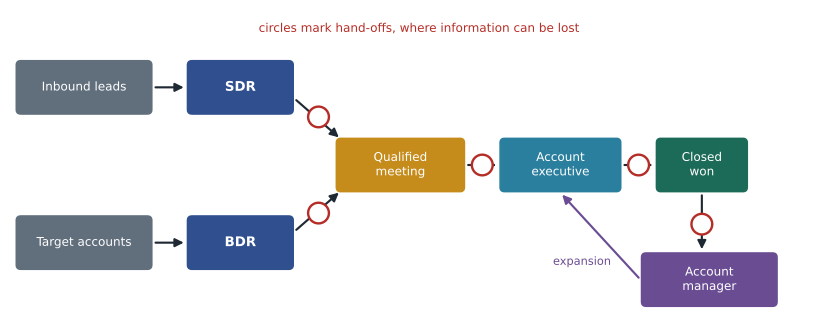
On September 21, Owen drew four boxes on the whiteboard beside the inside team's desks and joined them with arrows. "Every company names these jobs differently," he said, "so don't get attached to the letters. What matters is who owns which part of the deal, and what happens at each hand-off." Maya copied the boxes into her notebook. Over the next hour Owen walked her through the jobs in a modern B2B sales team, how Ridgeline used them and where things tended to go wrong between them.
Specialization in sales teams
For most of the twentieth century, a B2B salesperson did everything: found prospects, qualified them, ran meetings, wrote proposals, negotiated, closed and looked after the account afterward. Many small companies still work that way, and Maya's job at Ridgeline still includes most of those tasks. But as companies grew, many split the work into specialized roles. The idea, popularized by Aaron Ross and Marylou Tyler in the 2011 book *Predictable Revenue*, based on Ross's work building an outbound team at Salesforce, was that prospecting and closing need different skills and different daily rhythms, and that a seller who does both tends to neglect prospecting whenever there are deals to close.
Splitting the roles creates a kind of assembly line: one group creates qualified meetings, another turns them into deals, and a third keeps and grows customers. The approach has clear benefits. Each person can focus and get very good at one part of the job. Managers can see exactly where a pipeline is weak. New hires can start in a narrower role and learn the business before taking on bigger deals. But it also has costs, mainly at the hand-offs, where information and goodwill can be lost.
The main roles
Sales development representatives (SDRs) qualify interest and book meetings. In many companies the term is used specifically for people who handle inbound leads, prospects who have filled in a form, started a chat or downloaded a guide. Business development representatives (BDRs) do similar work for outbound prospecting, reaching people in target accounts who have not asked to hear from the company. Some companies use the two titles the other way round, and many use one title for both. At Ridgeline, everyone on Owen's team had the title "inside sales representative," but Owen used SDR and BDR informally to describe what each person was doing on a given day.
Account executives (AEs) own opportunities from qualification to signature. They run discovery, design solutions, present, write proposals, negotiate and close. AEs may work in the field, like Maya, or entirely from inside, often called inside account executives. Account managers look after existing customers: renewals, service issues, expansions and the relationship over time. At some companies, account managers also carry a quota for growth within their accounts; at others, a separate customer success team handles adoption and satisfaction, while account managers focus on commercial matters.
| Role | Main job | Typical measures | At Ridgeline |
|---|---|---|---|
| SDR (often inbound) | Respond to and qualify inbound interest; book meetings | Response time, leads worked, meetings booked and held | Amira, mostly |
| BDR (often outbound) | Prospect into target accounts; book meetings | Accounts and contacts worked, conversations, meetings held, meetings accepted | Tyler and Jordan |
| Inside account executive | Close smaller deals remotely from start to finish | Bookings against quota, win rate, cycle length | Owen, part of his time |
| Field account executive | Own and close larger or complex opportunities | Bookings against quota, pipeline, win rate | Maya and five colleagues |
| Account manager | Retain and grow existing customers | Renewal rate, expansion bookings, satisfaction | Farida and one colleague |
Hand-offs: where deals leak
Every arrow on Owen's whiteboard was a hand-off, a moment when responsibility for a prospect or customer passes from one person to another. Hand-offs are where specialized teams most often fail. The SDR knows why the prospect called, what they said about their budget and which colleague they mentioned. If that knowledge does not reach the AE, the AE asks the same questions again, and the prospect feels they are starting over with a company that does not listen.
Ridgeline used three practices to protect its hand-offs. First, every meeting booked by the inside team came with a short written hand-off note in the CRM, in a fixed format: who the person is, what prompted the meeting, what they said they want, what was not yet known, and anything to avoid. Second, for larger opportunities, the inside rep joined the first five minutes of the AE's meeting to introduce the AE, a practice sometimes called a warm hand-off. Third, Owen and Darnell agreed a written definition of a qualified meeting, so that SDRs and AEs judged meetings the same way.
| Hand-off note field | Example from a real Ridgeline note |
|---|---|
| Who | Gord Frey, facilities manager, Harvest Valley Credit Union; 18 staff at the new branch |
| Trigger | Downloaded the office move guide in September; visited the pricing page on October 28 |
| What they want | Furniture and printing set up before the new branch opens; worried about the move date |
| Not yet known | Budget owner; whether head office must approve; current printer contract end date |
| Avoid | Leading with RoomFlow: he said the branch has only one meeting room |
What counts as a qualified meeting
Before the agreed definition, Owen's team counted a meeting as booked when it appeared on an AE's calendar, and the AEs complained that many were with people who could not buy. The definition Owen and Darnell agreed in July 2026 was short. A meeting is accepted if, after it is held, the AE agrees that the prospect fits Ridgeline's ideal customer profile from SLS-210, has a problem Ridgeline can solve, and has a plausible path to a decision within six months, and that the person in the meeting either decides or can bring the decision-maker in. The AE marks each meeting as accepted or not within one business day, with a reason if not.
The definition did two things. It gave the inside team a target that matched what the field team actually needed: not calendar entries, but conversations worth an AE's time. And it created a feedback loop. When an AE rejected a meeting, the reason told the SDR what to check next time. Over the summer, the most common rejection reason changed from "not the decision-maker" to "no timeline," a sign that the inside team had learned to ask who decided but still needed to ask better questions about timing.
Worked problem
From meetings booked to meetings accepted
In September 2026, Ridgeline's inside team booked 52 meetings for the field team. Of these, 44 were held (the rest were canceled or the prospect did not attend), and the AEs accepted 31 of the 44 as qualified. What are the show rate, the acceptance rate and the overall rate from booked to accepted?
Show solution
- Show rate: meetings held divided by meetings booked.
- \[\frac{44}{52} = 0.846 \approx 85 \text{ in } 100\]
- Acceptance rate: meetings accepted divided by meetings held.
- \[\frac{31}{44} = 0.705 \approx 70 \text{ in } 100\]
- Overall rate: meetings accepted divided by meetings booked.
- \[\frac{31}{52} = 0.596 \approx 60 \text{ in } 100\]
- Check: the overall rate is the product of the other two.
- \[0.846 \times 0.705 = 0.596\]
Answer: About 85 in 100 of booked meetings were held, about 70 in 100 of held meetings were accepted, and about 60 in 100 of all booked meetings became accepted, qualified meetings. Counting only bookings would overstate the inside team's contribution by about two-thirds.
How inside reps are paid
Inside reps usually have a higher share of base salary than AEs, with a smaller variable part. A common structure for SDRs and BDRs pays a bonus or commission for each accepted meeting, sometimes with an extra amount when a meeting turns into a qualified opportunity or a closed deal. Paying only for meetings booked encourages low-quality bookings; paying only for closed deals makes the SDR's income depend on an AE's skill and on cycles that can last months. Most companies pay mainly on accepted meetings with a smaller share tied to pipeline or revenue, so that SDRs care about quality without waiting months to be paid.
Ridgeline's plan for its development reps in 2026 was a base salary, 75 dollars for each accepted meeting, and 1 in 100 of the first-year revenue of any deal that came from a meeting they had booked, paid when the deal closed. Owen also had a small quota of his own for the inside deals he closed. The plan was illustrative of common practice rather than a standard, and SLS-230 looks at sales compensation design in more depth.
Worked problem
An SDR's variable pay for a month
In October, Tyler had 9 accepted meetings. Two deals from meetings he had booked in the summer closed in October, with first-year revenue of 12,400 dollars and 21,616 dollars. Under Ridgeline's illustrative plan, what variable pay did he earn for October?
Show solution
- Meeting pay.
- \[9 \times 75 = 675 \text{ dollars}\]
- Revenue share on the two closed deals.
- \[0.01 \times (12{,}400 + 21{,}616) = 0.01 \times 34{,}016 = 340.16 \text{ dollars}\]
- Add the two parts.
- \[675 + 340.16 = 1{,}015.16 \text{ dollars}\]
Answer: Tyler earned about 1,015 dollars of variable pay in October, about two-thirds of it from accepted meetings. The revenue share is smaller but keeps him interested in whether his meetings turn into business.
Other common team designs
Not every company separates roles the same way. In a pod model, an SDR, an AE and sometimes an account manager work together on one territory or set of accounts, sharing goals and meeting daily. Pods reduce hand-off losses because the same small group sees the account from start to finish. In a full-cycle model, every seller does all the work for their accounts; this suits small teams and complex sales where the relationship matters more than volume. Many companies mix models: full-cycle for large strategic accounts, specialized roles for the broad mid-market, and a purely inside motion for small customers.
Ridgeline was moving toward a light version of pods. From December 2026, Owen planned to pair Tyler with Maya and Kevin Moreau, whose territories both included many clinics, and Jordan with Lisa Tran and Andrew Ferguson, who covered professional firms and manufacturers. The pairs would meet for fifteen minutes each Monday to choose target accounts for the week. That change was a plan, agreed in November; this course shows how the team worked in the fall of 2026, before it took effect.
Getting the relationship right
The hardest part of the SDR and AE relationship is not process but respect. SDRs are often early in their careers and do the least glamorous work. AEs depend on them but sometimes treat them as a booking service. Owen's advice to Maya was practical. Read the hand-off note before every meeting. Mark meetings accepted or rejected the next day, with a specific reason. Tell the SDR when a meeting they booked turns into a deal. And when a prospect asks why the AE does not already know something, take the blame rather than blaming the SDR in front of the customer.
Maya tried this in her first month. When a meeting Tyler had booked with Eastgate Physiotherapy turned into a proposal, she sent him a two-line message telling him so and thanking him for noting that the office manager, Carla Bennett, approved purchases only up to 5,000 dollars. "That one line saved me twenty minutes," she wrote. Owen said it was the first such message any new AE had sent his team in a year.
Common mistakes
MistakeCounting meetings booked as the inside team's main output.
InsteadTrack meetings held and accepted; bookings alone overstate results.
MistakeStarting an AE meeting without reading the hand-off note.
InsteadRead the note and build on what the prospect already told the SDR.
MistakePaying SDRs only on closed revenue.
InsteadPay mainly on accepted meetings, with a smaller share tied to pipeline or revenue.
MistakeRejecting a meeting without a reason.
InsteadGive a specific reason within a day so the SDR can learn from it.
MistakeAssuming everyone means the same thing by SDR and BDR.
InsteadCheck how each company uses the titles; focus on who owns which part of the sale.
Summary and key terms
- Many B2B teams split sales work into specialized roles: SDRs and BDRs qualify interest and book meetings, account executives own opportunities to signature, and account managers retain and grow customers.
- Specialization brings focus but creates hand-offs where information is lost, so good teams use structured hand-off notes, warm introductions and an agreed definition of a qualified meeting.
- Of 52 meetings booked at Ridgeline in September, 44 were held and 31 accepted, about 60 in 100 overall.
- Inside reps are usually paid mainly on accepted meetings, with a smaller share tied to revenue.
- Pods and full-cycle models reduce hand-offs.
- Sales development representative (SDR)
- A seller who qualifies interest, often inbound, and books meetings for account executives.
- Business development representative (BDR)
- A seller who prospects into target accounts, often outbound, and books meetings.
- Account executive (AE)
- A seller who owns an opportunity from qualification to signature.
- Account manager
- A seller who looks after and grows existing customers.
- Hand-off
- The point at which responsibility for a prospect or customer passes from one person to another.
- Accepted meeting
- A held meeting that the AE agrees meets the agreed definition of a qualified meeting.
- Pod
- A small team of SDR, AE and sometimes account manager sharing a territory and goals.
Practice problems
Work each problem on paper first, then reveal the answer to check.
An SDR booked 40 meetings; 34 were held and 24 accepted. What are the show and acceptance rates?
Show answer
Show rate 34 ÷ 40 = 85 in 100; acceptance rate 24 ÷ 34 ≈ 71 in 100.
Under Ridgeline's plan, what does an SDR earn for 12 accepted meetings and one closed deal of 18,000 dollars first-year revenue?
Show answer
12 × 75 = 900, plus 0.01 × 18,000 = 180, for 1,080 dollars.
List the five parts of Ridgeline's hand-off note.
Show answer
Who, trigger, what they want, not yet known, and avoid.
Lesson quiz · 5 questions
Score 60% or more to complete this lesson.
Create a free account to save your progress, take quizzes and earn a certificate.