
CINE-221 · Lesson 10 of 12 · 24 min
Lighting large spaces
Warehouses, churches, gymnasiums, ballrooms, factories, airport terminals, concert halls and stadiums present a particular challenge. Their size means that ordinary fixtures on stands cannot reach across them, that wide shots reveal floors, walls and ceilings where lights might otherwise hide, and that power and rigging needs are large. Yet audiences expect these spaces to be lit by their own sources: skylights, high windows, rows of industrial fixtures, chandeliers. This lesson covers the logic of large spaces, overhead soft sources and space lights, lighting through high windows and from outside, using and replacing existing fixtures, ballooning and lift-mounted sources, rigging and grids, layering light in depth, wide shots versus coverage, power planning, and safety at height.
The logic of large spaces
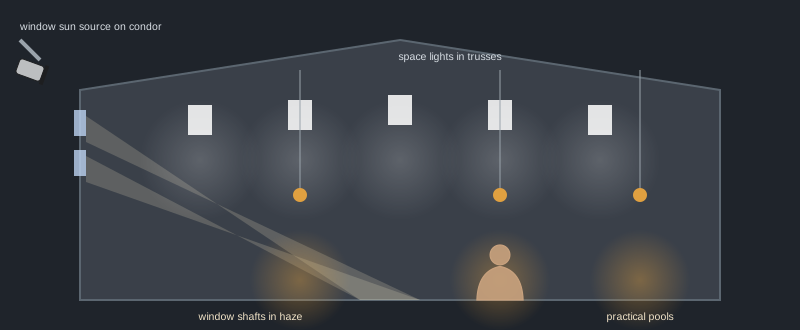
Large interiors are usually lit by sources high above the floor: skylights and clerestory windows in daytime, rows of fixtures hanging from the roof at night, chandeliers in ballrooms and churches. Their light falls from above and from the sides, creating overall ambience with gradients from bright under or near sources to darker between them, and long shafts through high windows. Naturalistic lighting of these spaces imitates this logic: broad overhead ambience, accents and pools under fixtures, shafts or washes from windows, and practicals visible in frame. Because the space is so large, lighting the background, the far walls and ceiling, is as important as lighting the actors, since the background fills much of a wide frame.
Overhead soft sources and space lights
The most common tool for lighting large spaces is a broad, soft overhead source. Options include:
- Space lights: cylindrical silk or diffusion bags containing several tungsten or LED sources, hung from trusses or a grid, each producing soft, downward light; arrays of space lights give even ambience over large areas. Skirts of black fabric around them control spill to walls.
- Chimera-style soft boxes or lanterns hung overhead.
- Large overhead frames of diffusion lit from above or bounce surfaces lit from below.
- LED panels and tubes rigged in arrays to create a soft ceiling.
Overhead ambience provides base light everywhere the camera looks, motivating the general glow of skylights or ceiling fixtures. Its level is usually set a stop or two below the key light on actors, with keys and accents added. Too much overhead light flattens the space; skirts, flags and selective switching restore shape and contrast. Wireless control allows rows of space lights to be dimmed individually, shaping light across the space.
Lighting through high windows and from outside
Daytime large spaces often feature high windows, skylights or glass walls. Lighting them from outside with large HMIs or LEDs on condors, scaffolding or rooftops creates consistent sun shafts and window washes. Haze in the air makes the shafts visible, a classic image in industrial spaces, churches and gyms. Large windows can also be covered outside with diffusion and lit to create soft daylight inside. Because these sources are distant, they need high output: 18K HMIs or large LED fixtures, often several. Planning lift positions, access, permits and power is a major part of prep.
Worked problem
Sizing a window sun source
A church scene needs a hard sun shaft through a high window onto an actor 25 m from a light placed outside. The cinematographer wants about 2,000 lux in the shaft, with the camera at EI 800 and T4. An 18K HMI Fresnel at full spot delivers about 120,000 lux at 10 m (manufacturer data). Will it be enough?
Show solution
- Inverse square: at 25 m, 120,000 × (10/25)² = 120,000 × 0.16 = 19,200 lux at spot.
- This is far above 2,000 lux, so the light can be flooded, scrimmed or placed farther away to widen the shaft.
- At flood, output drops substantially, perhaps by a factor of 5 to 10, giving roughly 2,000 to 4,000 lux, close to the target.
- The window glass, any diffusion and haze will absorb some light; check with a meter on the day.
Answer: Yes; an 18K at 25 m gives about 19,000 lux at spot, so it can be flooded or scrimmed to around 2,000–4,000 lux for a broad shaft.
Using and replacing existing fixtures
Large spaces often have their own lighting: rows of industrial high-bay fixtures, sports lighting in gymnasiums, chandeliers, fluorescent troffers. These can be used as practicals and even as working light, but they frequently have problems on camera: poor colour rendering, green or magenta casts, flicker with certain frame rates and shutter angles, uneven output, and inability to dim. Productions may test them, gel them, adjust camera settings to avoid flicker, or replace their lamps with film-friendly LED sources. Fluorescent fixtures may be relamped with film LED tubes that look the same in frame but are controllable. Sports lighting can be powerful enough to provide most of the light but may need colour correction and flicker testing. Chandeliers and decorative fixtures are usually dimmed to keep them from clipping and supplemented with hidden sources.
Balloons and lift-mounted sources
Where trusses or grids are not available, light can be raised on lifts, cranes or balloons. Balloon lights, helium-filled diffused envelopes containing HMI or LED sources, can float in large interiors such as hangars, providing soft, even overhead light without visible rigging, as long as the ceiling is high enough and there is no wind. Condors and scissor lifts inside large spaces can hold fixtures or large bounce frames, though they must stay out of frame for wides. Cranes can suspend large soft boxes. Each option has load, power and safety considerations that the gaffer and key grip plan together.
Rigging and grids
Large spaces often have structures that can support rigging: roof trusses, beams, catwalks or theatrical grids. Riggers attach chain motors, truss and pipe to these structures to hang fixtures safely above the set. Rigging must be designed and installed by qualified riggers, with load calculations and engineering approval where required, since failures at height are catastrophic. Pre-rigging, installing lights days before the shoot, saves time on the shooting day and allows the gaffer to programme lighting control (CINE-220). Studio stages are designed for this, with grids and power distribution overhead; locations require surveys of what the structure can bear.
Layering light in depth
The depth of large spaces is one of their visual assets, and lighting can emphasize it by layering: foreground, midground and background each lit to distinct levels and sometimes colours. Pools of light at intervals along a corridor or aisle create rhythm and depth; dark gaps between them emphasize distance. Backlight and haze reveal the volume of air. Practicals receding into the distance draw the eye. A common approach is to keep the foreground slightly darker, the actors in the midground well lit, and the background glowing with window light or practicals, so that the frame reads from front to back. Aerial perspective, created naturally by haze, softens distant elements and increases depth.
Wide shots versus coverage
Lighting for a wide shot of a large space differs from lighting for close coverage. The wide must show the space convincingly with all its sources and depth, while hiding fixtures; close-ups can use smaller, closer sources to refine faces, as long as they match the logic established in the wide. Shooting wides first, while the large-scale lighting is fresh, and then adding refinements for close-ups is common. On very large sets, multiple cameras may shoot simultaneously, requiring lighting that works from several angles. Prioritizing which shots need the most care, typically the faces in key moments, helps allocate the limited time available.
Power planning
Lighting large spaces requires substantial power. A setup with twenty space lights, several 18K HMIs and many LEDs can draw hundreds of amps. The gaffer and best boy plan generators or tie-ins, calculate loads, balance phases and run feeder cable to distribution throughout the space (CINE-220). LED fixtures have reduced power requirements dramatically compared with tungsten and HMI, allowing large spaces to be lit with smaller generators, but large outdoor sources still demand heavy power. Cable runs must be planned to avoid frame and walkways.
Safety at height
Lighting large spaces involves extensive work at height: rigging from trusses, operating lifts, climbing ladders and catwalks. Fall protection, trained lift operators, secured fixtures with safety cables, controlled zones beneath work overhead, and inspection of rigging are essential. Haze and smoke used to show shafts must be safe for cast and crew and compatible with fire alarms and venue rules. Production safety officers and venue staff coordinate these measures, and union and provincial or state regulations apply (CINE-340).
Lighting stadiums and arenas
Sports venues and concert arenas have their own powerful lighting systems, often LED fixtures designed for broadcast, providing high, even illuminance across the field or stage. For productions filming in such venues, the existing lighting may provide the main light, supplemented by fixtures for close-ups and specific effects. Concert and event lighting, with moving heads, colour washes and haze, can be integrated into narrative scenes, programmed by a lighting designer in coordination with the cinematographer. Flicker from venue lighting must be tested at the production's frame rates and shutter angles, and the colour of the lights must suit the camera.
Churches, halls and heritage buildings
Historic buildings such as churches, ballrooms and civic halls often have restrictions on rigging, heat, power and fire safety, as well as fragile surfaces that cannot be touched. Lighting them may require freestanding towers, lifts and balloons instead of rigging from the structure, low-heat LED fixtures, and careful protection of floors and walls. Their tall windows offer beautiful light shafts, and their chandeliers and candles provide practicals. Working with venue managers and heritage officers early in prep ensures that the lighting plan respects the building.
Moving through large spaces
Camera movement through large spaces, such as a Steadicam shot following a character through a factory, requires lighting that works along the entire path. Lights hidden on the ceiling, in the structure, behind pillars and in practicals can provide continuous light; overhead ambience ensures that the actor never falls into complete darkness; and pools and accents along the path create rhythm. Rehearsing the move and walking it with a meter or monitoring the camera feed reveals dark spots and visible lights to fix.
Scaling down for small productions
Not every production can afford large rigs. Smaller productions can light large spaces convincingly by choosing locations with good existing light, such as warehouses with skylights or halls with large windows, shooting at times when that light is best, using a few powerful LED fixtures in key positions, embracing darkness in parts of the frame, and concentrating light on the actors' area while letting distant areas fall away. Haze can make even modest sources feel expansive. Careful framing can suggest a large space while lighting only part of it.
Lighting control in large spaces
Because large spaces contain many fixtures spread over a wide area, wireless and networked control is especially valuable. Dimming rows of space lights, adjusting window sources, changing practical levels and recalling presets from a console allows the gaffer to reshape the light for each setup without crew climbing to every fixture. Programming the space during pre-rig, with presets for each scene and time of day, saves hours. Backup control and manual overrides are important in case of wireless interference, which can be common in large metal buildings.
Common mistakes
MistakeLighting actors but leaving the space dead.
InsteadLight backgrounds, walls and depth.
MistakeEven overhead light everywhere.
InsteadShape it with skirts, flags and selective dimming.
MistakeUsing existing fixtures without testing.
InsteadTest for colour and flicker; relamp if needed.
MistakeRigging without qualified riggers.
InsteadUse qualified riggers with load calculations.
MistakeUnderestimating power needs.
InsteadPlan loads, generators and distribution early.
Summary and key terms
- Large spaces are lit from above and from high windows; light their backgrounds.
- Space lights and overhead soft sources provide ambience.
- Large distant sources through windows create shafts made visible by haze.
- Existing fixtures may need testing, gels or relamping.
- Balloons, lifts, rigging and grids raise lights safely.
- Layer foreground, midground and background for depth.
- Plan power and work safely at height.
- Space light
- Cylindrical diffused overhead fixture.
- Skirt
- Black fabric around a space light to control spill.
- Clerestory
- High windows near the roof.
- High-bay fixture
- Industrial light hung high above a floor.
- Relamping
- Replacing lamps with film-friendly sources.
- Chain motor
- Motorized hoist used in rigging.
- Truss
- Structural framework for hanging equipment.
- Pre-rig
- Installing lighting before the shooting day.
- Layering
- Lighting planes in depth at different levels.
- Haze
- Fine particles in the air that reveal light beams.
Practice problems
Work each problem on paper first, then reveal the answer to check.
Where do large spaces usually get their light?
Show answer
From above and high windows.
What are space lights?
Show answer
Cylindrical diffused overhead fixtures.
What do skirts do?
Show answer
Control spill from space lights.
Illuminance at 20 m if 120,000 lux at 10 m?
Show answer
30,000 lux.
Why add haze?
Show answer
To make light shafts visible.
Name two problems with existing fixtures.
Show answer
Poor colour, flicker, no dimming, uneven output.
What is relamping?
Show answer
Replacing lamps with film-friendly sources.
Why pre-rig?
Show answer
Saves shooting time and allows programming.
How does layering add depth?
Show answer
Different levels for foreground, midground, background.
Name two safety measures for height work.
Show answer
Fall protection, trained operators, safety cables, controlled zones.
Lesson quiz · 5 questions
Score 60% or more to complete this lesson.
Create a free account to save your progress, take quizzes and earn a certificate.