
CINE-221 · Lesson 9 of 12 · 25 min
Dusk, magic hour and continuity of light
Some of the most beautiful light in cinema lasts only minutes. The low, warm sun before sunset, the glowing afterglow, and the deep blue twilight that follows have a quality no lighting crew can fully reproduce, and filmmakers go to great lengths to capture them. At the same time, the transience of this light makes it one of the hardest to use, because a scene with many shots may take longer to film than the light lasts. More broadly, all naturalistic lighting must remain consistent across shots filmed hours or days apart. This lesson covers the phases of dusk and dawn, shooting in magic hour, extending and imitating magic hour, blue hour and the transition to night, matching shots across time, continuity of light in general, weather changes, and working with the colourist to maintain continuity.
The phases of dusk and dawn
Evening light passes through recognizable phases. In the hour or so before sunset, the sun is low and warm, shadows are long and faces are lit with soft, golden light: the period photographers call golden hour. At and just after sunset, the sun disappears, but the sky near the horizon glows orange, pink and red, while the sky overhead remains blue; light becomes soft and directional from the western sky. During civil twilight, when the sun is up to 6° below the horizon, there is still enough skylight to see clearly and the sky deepens to blue; this is often called blue hour. Nautical twilight (6° to 12° below) brings darker skies, with city lights becoming dominant, and astronomical twilight (12° to 18°) leads to full night. Dawn passes through the same phases in reverse. Filmmakers often use "magic hour" loosely for the whole period of soft, colourful light around sunset or sunrise.
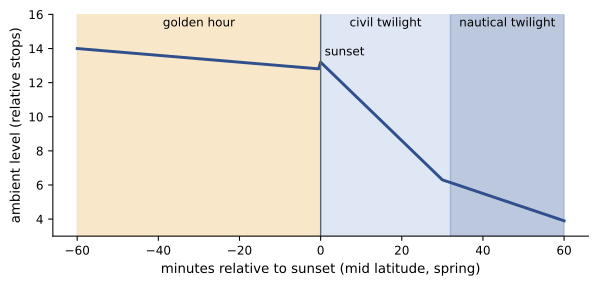
How long magic hour lasts
The duration of each phase depends on latitude and season. At mid latitudes, such as southern Canada and the northern United States, civil twilight lasts about 30 to 40 minutes in spring and autumn and longer in midsummer, when the sun sets at a shallow angle; near the equator, it may last only about 20 minutes. Farther north, in summer, twilight can last for hours and may never fully end. During this time, light levels fall quickly: in the first half hour after sunset, ambient light can drop by several stops, so exposure must be adjusted continually. Productions plan magic-hour scenes using sun and twilight calculators, rehearse thoroughly, and limit the number of setups to what can be achieved in the available minutes.
Shooting in magic hour
Strategies for capturing real magic hour include:
- Shooting only one or two setups per evening, often across several days, rather than an entire scene at once.
- Preparing everything in advance: camera positions marked, lenses chosen, actors rehearsed, lights pre-rigged and tested.
- Shooting the widest shots, which show the sky, at the peak of colour, and closer shots, where the sky is less visible, a little earlier or later with supplementary light.
- Using multiple cameras to capture several angles at once.
- Adjusting exposure smoothly as light falls, often by opening the iris remotely or raising EI between takes, and accepting a gradual change within a sequence that the colourist can smooth.
- Keeping warm, soft supplementary sources ready to add to faces as the natural light fades.
Terrence Malick's Days of Heaven, shot by Néstor Almendros, famously shot many scenes in the brief period after sunset, giving the film its luminous look; modern productions continue this practice for key moments.
Extending and imitating magic hour
When magic hour cannot be captured in time, cinematographers extend or imitate it. Extending involves adding warm, low-angled sources, such as HMIs or LEDs gelled with full CTO or set to about 2,500 to 3,200 K, placed far away to imitate the setting sun, and soft, cool fill to imitate skylight, so that shots can continue after the real sun has gone, while the sky still has colour. Imitating involves recreating the whole look at another time: shooting in shade or under a large overhead in the afternoon, with a warm, low, hard source as the sun and cool fill as the sky, and grading to warm and soften the image. On stages, magic hour is built with a warm, low hard key and a coloured backing or LED wall showing a sunset sky. Imitation is rarely as rich as the real thing, but it allows control and longer shooting days.
Worked problem
Planning a sunset scene with two setups
A two-page scene on a beach at sunset requires a wide shot with the sunset sky and two close-ups. Sunset is at 8:40 p.m., and civil twilight ends at about 9:15 p.m. How might the cinematographer schedule it?
Show solution
- Rehearse the scene earlier in the afternoon and pre-rig a warm, low source on the actors' faces for the close-ups.
- Shoot the close-ups first, from about 8:00 to 8:30 p.m., in golden-hour sun with supplementary warm fill as needed.
- Reset quickly for the wide shot and shoot it from about 8:40 to 9:05 p.m., when the sky colour peaks.
- If more coverage is needed, return the next evening for the same period, matching the sun's position.
Answer: Shoot close-ups in golden hour before sunset with supplementary warm light, then the wide during peak afterglow, and plan a second evening if needed.
Blue hour and the transition to night
Blue hour, the period of civil twilight when the sky is deep blue but still bright enough to show detail, is ideal for scenes that need to feel like night while keeping the sky, buildings and landscape visible. City lights, windows and car lights glow warmly against the blue, creating strong colour contrast. Many night exteriors are shot partly or entirely in blue hour, sometimes called dusk-for-night, because the sky gives a natural ambience that is difficult to recreate. Exposure falls rapidly, so practicals and supplementary lights must be balanced continually against the sky: early in blue hour, practicals barely register; later, they dominate. The window of balance, when sky, practicals and faces sit comfortably together, may last only 10 to 20 minutes.
Matching shots across time
Scenes are rarely shot in order or in one session, so light must match across shots filmed at different times. Key aspects to match include the direction of the key light and shadows; the quality of light, hard or soft; the colour temperature and tint; the overall exposure and contrast; and the background brightness and colour. Techniques for matching include photographing every setup with the same reference, such as a grey card and chart; recording lighting diagrams, fixture positions, gels and dimmer levels; taking reference stills on set; using sun apps to recreate sun angles; and noting exterior conditions, such as cloud and sun, for each shot. The camera assistant's reports and the DIT's notes support continuity (CINE-202).
Continuity of light in general
Continuity of light is about more than matching measurements. Within a scene, the audience expects consistent sources: if a lamp is on in the wide shot, it must be on in the close-up; if sun is coming through the window, it must still be there in the reverse. Across scenes, light can change deliberately to show time passing, such as from afternoon sun to evening lamps. Continuity errors in light are often noticed subconsciously: viewers feel that something is wrong without knowing why. Cinematographers watch for changes in sun angle through windows, practical lamps switched off between setups, coloured light from set dressing that moves, and differences between cameras in multi-camera shoots.
| Continuity element | What to record or check |
|---|---|
| Key direction | Fixture positions, sun angle and time |
| Quality | Diffusion type and frame size |
| Colour | Gels, LED settings, camera white balance |
| Exposure | T-stop, EI, ND, light levels at key positions |
| Practicals | Which are on, their levels and bulbs |
| Background | Brightness and colour of backgrounds and windows |
Weather changes
Exterior weather changes are a major continuity challenge. A scene that starts in sun may end in cloud, or rain may begin halfway through. Strategies include controlling the light with overheads, so that the actors are in consistent shade regardless of the sky; supplementing with lights to recreate sun when clouds pass; shooting in consistent conditions and pausing when they change; choosing camera angles that avoid the sky; and planning cover sets, interior scenes that can be shot if the weather turns. When weather changes are unavoidable, writers and directors sometimes incorporate them into the story. Grading can match some differences, such as small exposure and colour changes, but cannot turn hard sun into overcast or add shadows that were never there.
Working with the colourist
The colourist is the final guardian of light continuity. Shots that drift in exposure and colour during a magic-hour sequence can be matched, warmed or cooled so that the sequence flows; sky colour can be enhanced or darkened; and small differences between cameras corrected. Cinematographers help the colourist by shooting consistent references, noting intentions, keeping lighting differences within a manageable range, and attending the grade. They also discuss which changes in light are intended, such as the progression from golden hour to dusk across a scene, and which should be smoothed. A good relationship with the colourist turns the inevitable imperfections of natural light into a coherent visual flow.
Dawn shoots
Dawn offers the same magic-hour qualities as dusk, often with calmer weather, clearer air and empty streets, but it requires crews and actors to start in the middle of the night and be ready before first light. The order of light is reversed: the sky lightens from deep blue, practicals become less important, colour builds toward sunrise, and then the sun appears. Planning dawn shoots involves the same twilight calculations, with the added need to prepare everything in darkness. Dawn scenes are sometimes shot at dusk and reversed in editing order, or vice versa, though the direction of light and the position of the sun must then be considered, since the sun rises and sets in different directions.
Weather and long shooting days
On long exterior shooting days, the weather may change several times. Keeping a log of conditions for each shot, with time, sun and cloud notes and reference photographs, helps the editor and colourist match shots, and helps the cinematographer recreate conditions for pickups. Some productions assign a crew member to monitor weather radar and forecasts throughout the day, warning of approaching cloud, rain or wind so that the schedule can be adjusted. Flexible scheduling, with interior scenes ready as cover, protects the production from losing a day to weather.
Continuity in multi-camera shooting
When several cameras film the same scene simultaneously, from different angles, lighting must work for all of them at once, and continuity is automatically maintained between them in time, but not necessarily in look. Cameras facing different directions see different relationships between key and fill, and lights hidden for one camera may be visible to another. Matching the cameras technically, with the same settings and LUTs, and lighting so that each angle has acceptable key, fill and background, is essential. Compromises are common: one camera may get the best light, while others are acceptable. Many television dramas use two or three cameras routinely, and their lighting styles have adapted, favouring broad, soft sources and practicals that work from many directions.
Reverse shots at dusk
When shooting coverage at dusk, the reverse shot faces the opposite direction from the setting sun, toward a darker, bluer sky. The two sides of a conversation can therefore look very different. Strategies include shooting the side facing the sunset at the peak and the reverse slightly earlier, adding warm light to faces on the dark side to suggest the sunset, and choosing angles that keep similar parts of the sky in frame.
Common mistakes
MistakePlanning too many setups for magic hour.
InsteadLimit setups and spread them over several evenings.
MistakeArriving at sunset unprepared.
InsteadRehearse and pre-rig before the light arrives.
MistakeIgnoring rapidly falling light levels.
InsteadAdjust exposure and supplement faces continuously.
MistakeNo records of lighting for continuity.
InsteadKeep diagrams, stills, gel and level notes.
MistakeRelying on grading to fix weather changes.
InsteadControl light with overheads and cover sets.
Summary and key terms
- Evening light passes from golden hour through sunset and twilight to night.
- Civil twilight lasts about 30–40 minutes at mid latitudes and longer in summer.
- Magic-hour scenes need preparation, few setups and continual exposure changes.
- Warm low sources and cool fill extend or imitate magic hour.
- Blue hour balances sky, practicals and faces for a short window.
- Match direction, quality, colour, exposure and background across shots.
- Plan for weather and work with the colourist for continuity.
- Golden hour
- Period of warm, low sun before sunset or after sunrise.
- Magic hour
- Soft, colourful light around sunrise and sunset.
- Civil twilight
- Sun 0–6° below the horizon.
- Nautical twilight
- Sun 6–12° below the horizon.
- Blue hour
- Twilight period with deep blue sky.
- Afterglow
- Coloured sky glow after sunset.
- Dusk-for-night
- Shooting at dusk to represent night.
- Continuity of light
- Consistency of light across shots.
- Cover set
- Alternative location used if weather fails.
- Reference still
- Photograph recording a lighting setup.
Practice problems
Work each problem on paper first, then reveal the answer to check.
What is civil twilight?
Show answer
Sun 0–6° below the horizon.
How long is civil twilight at mid latitudes?
Show answer
About 30–40 minutes, longer in summer.
Why limit setups in magic hour?
Show answer
The light lasts only minutes.
Which film is famous for magic-hour cinematography?
Show answer
Days of Heaven.
How can magic hour be extended?
Show answer
Warm low sources and cool fill.
Why shoot night scenes in blue hour?
Show answer
The sky provides natural ambience and detail.
How long might the blue-hour balance window last?
Show answer
About 10–20 minutes.
Name four continuity elements.
Show answer
Direction, quality, colour, exposure, practicals, background.
What is a cover set?
Show answer
An alternative location for bad weather.
How can the colourist help continuity?
Show answer
Match exposure and colour across shots.
Lesson quiz · 5 questions
Score 60% or more to complete this lesson.
Create a free account to save your progress, take quizzes and earn a certificate.