
CINE-221 · Lesson 4 of 12 · 25 min
Day exteriors and sun control
Day exteriors seem the easiest scenes to light, since the sun provides more light than any fixture. In practice they are among the hardest to control. The sun moves, clouds come and go, contrast is extreme, and the light that looks beautiful at nine in the morning is harsh by noon. Exterior lighting is mostly about modifying the sun: diffusing it, blocking it, bouncing it, adding to it and choosing when and where to shoot. This lesson covers the cinematographer's strategies for day exteriors: choosing the sun's position relative to camera and actors, backlighting, diffusing sun with silks and overheads, bounce and reflectors, adding fill with HMIs and LEDs, negative fill, managing changing light and clouds, scheduling and blocking around the sun, and coverage strategies for long scenes.
Front, side and back sun
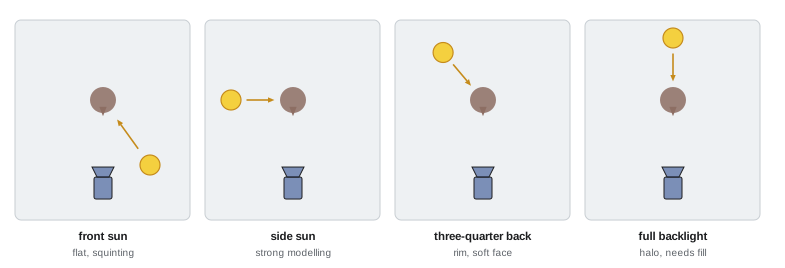
The direction of the sun relative to the camera and actors is the most important decision for a day exterior:
- Front sun, coming from behind the camera, lights faces fully but flatly, makes actors squint, and gives a postcard look with saturated colours and little modelling.
- Side sun, from 90° to the camera, models faces strongly, half bright and half in shadow, with high contrast that usually needs fill.
- Three-quarter back sun, from behind and to one side of the actor, gives a rim of light on hair and shoulders, separates actors from backgrounds and leaves faces in the softer skylight, with fill added from the front.
- Full backlight, sun directly behind the actor, creates halos and silhouettes, with faces lit by bounce or fill.
Many cinematographers prefer back or three-quarter back sun for close-ups, because faces are lit by soft skylight and bounce rather than hard sun, contrast is manageable, the background is often in shadow or lit from the side for depth, and actors do not squint. The challenge is that the reverse shot, looking the other way, then faces into the sun; coverage must be planned so that both directions work (see below).
Diffusing the sun: silks and overheads
When the sun falls directly on actors and a hard look is not wanted, grips fly a large frame of diffusion overhead, called an overhead or butterfly, between the sun and the actors. Frames range from 6 × 6 ft (about 1.8 m) to 12 × 12, 20 × 20 and even 30 × 30 ft or larger, held on heavy stands or, for the largest, on cranes or lifts. The material determines the effect: full silk softens the sun and reduces it by about 2 stops; lighter diffusions, such as quarter or half grid cloth, soften it less and lose less light; solid black fabric blocks it entirely, creating shade. Nets reduce intensity without softening. Placing an overhead turns hard sun into a large soft source with direction, wrapping around faces and lowering contrast, while the background remains in sun, so the actors may then be darker than the background and need fill or the background needs to be controlled.
| Overhead material | Effect on sun | Approximate loss |
|---|---|---|
| Solid (black) | Blocks sun, creates shade | Total (actors lit by skylight) |
| Full silk | Strong softening | About 2 stops |
| Full grid cloth | Strong softening, some direction | About 2 stops |
| Half grid or half silk | Moderate softening | About 1 stop |
| Quarter grid | Light softening | About ⅓–½ stop |
| Single net | Reduces intensity, no softening | About ½ stop |
| Double net | Reduces intensity more | About 1 stop |
Large overheads act as sails in wind and must be rigged and weighted carefully, with experienced grips, sandbags and tie-downs, and lowered when wind rises. Wind limits are a safety decision for the key grip. Smaller frames on stands, or hand-held flex diffusers, serve close-ups and moving shots.
Bounce and reflectors
Bounce redirects sunlight into shadows, filling faces with light that matches the sun's colour and the day's feel. Common bounce materials include white surfaces such as foam core, beadboard, muslin and ultrabounce, which give soft fill; silver reflectors and lame, which give brighter, harder fill that can travel further; gold or sunburst reflectors, which warm the fill; and mirrors, which redirect hard sunlight like a light, to create a sun effect where the real sun cannot reach. A 12 × 12 ultrabounce frame placed to catch the sun and reflect it onto actors from the front can provide most of the fill for a backlit scene. Bounce is quiet, needs no power and moves with the sun, but its effect changes as the sun moves and clouds pass, and it can dazzle actors, so its angle must be adjusted continually.
Adding light: HMIs and LEDs
When bounce is not enough, or when the sun is obscured, electric lights add or replace sunlight. Daylight-balanced HMIs, from 1.2K to 18K and larger, and powerful LED fixtures can fill faces in backlit scenes, supplement a weak sun, or recreate a sun direction under clouds. Matching the sun's intensity requires very large fixtures: direct sun is about 100,000 lux, while an 18K HMI Fresnel at spot might deliver tens of thousands of lux at a few metres and much less at flood or at greater distances, so electric lights are usually used for fill, for close-ups or within the shade of an overhead rather than to compete with the sun across a wide shot. Generators and cable runs must be planned, and fixtures must be weatherproofed or protected.
Worked problem
Filling a backlit two-shot
Two actors sit at a café table with the late-afternoon sun behind them. Their faces, lit only by skylight, read 3 stops below their sunlit hair, and the cinematographer wants faces about 1.5 stops under the rim. What options are available?
Show solution
- The faces need about 1.5 stops more light (from 3 stops under to 1.5 stops under).
- A 12 × 12 ultrabounce in front of the actors, angled to catch the sun, can add soft fill; adjust its distance and angle to reach the desired level.
- If bounce cannot reach far enough, an HMI or LED through a 6 × 6 or 8 × 8 diffusion frame can add the needed light, matched to the sun's colour or slightly warmer.
- Check the level with a meter or false colour and watch for squinting from bounce glare.
Answer: Raise the faces about 1.5 stops with a large ultrabounce, or with a diffused HMI or LED if bounce is insufficient, while keeping the sun as the rim.
Negative fill
Outdoors, skylight and bounce from surroundings often fill shadows so much that faces look flat, especially under overcast or in open shade. Negative fill, black flags, solids or large black frames placed on the shadow side of an actor, absorbs ambient light and restores contrast and shape. Under an overcast sky, a large solid placed to one side and a black overhead above can turn flat, shadowless light into directional, modelled light coming from the open side. Negative fill is one of the most powerful and least expensive tools for exterior work.
Managing changing light
The sun moves about 15° per hour across the sky, so lighting and shadows change continuously, and passing clouds can change exposure by several stops in seconds. Strategies for coping include:
- Scheduling: shooting wides when the light is best and the most light-sensitive shots, such as close-ups, under overheads or in shade, where changes matter less.
- Shooting all coverage that faces one direction together, then turning around, so that each direction is shot in similar sun.
- Using overheads and solids to create a controlled environment that is less affected by the sun's movement.
- Watching clouds with cloud glasses or apps, and waiting for gaps or for full cover, rather than shooting in partly cloudy conditions where the light changes mid-take.
- Adjusting ND or iris during takes when necessary, ideally with remote iris control, though visible changes must be avoided.
- Keeping a record of sun conditions for each shot, for continuity and grading.
Blocking and scheduling around the sun
Before shooting, the cinematographer, director and first assistant director plan the schedule around the sun: which direction actors will face, which scenes need morning or afternoon light, and when to shoot each setup. Blocking can often be adjusted, such as turning a conversation so that both actors are cross-backlit, or moving a scene to the other side of a street that is in shade. For long dialogue scenes, cross-backlight, where both actors are backlit by the sun from opposite sides of the frame, is a popular approach: placing the actors so that the sun is behind one at three-quarters and side-back on the other allows both singles to have rim light and soft faces.
Coverage strategies for long scenes
A dialogue scene with wides, two-shots and singles may take several hours to shoot, during which the sun moves 45° or more. Strategies include shooting the wide shots first, when the light matches the establishing look, then moving under overheads for singles; shooting in shade for the whole scene, adding controlled sun effects; choosing a location with consistent shade from buildings or trees; or shooting the scene across two days at the same time of day. When the light inevitably changes, cinematographers and colourists can match shots to some extent in grading, but matching hard sun and shade is difficult, so it is better to plan for consistency.
Exterior safety
Exterior lighting brings particular hazards: large frames and overheads in wind, heavy lights on high stands, generators and cable runs across public spaces, wet conditions around electricity, and heat and sun exposure for crew. Following grip and electric safety practices (CINE-220), checking forecasts for wind, using sandbags, guy lines and tie-downs, protecting cables with ramps and covers, and planning breaks, shade and water for crew are part of the job.
Working with large frames safely
Large overheads and bounce frames are among the most hazardous equipment on an exterior set. A 20 × 20 ft frame has a surface area of about 37 square metres, and even a moderate wind can create forces of hundreds of kilograms on it. Key grips assess wind, choose appropriate stands and rigging, use guy lines anchored to heavy weights or ground anchors, and assign grips to hold lines. When wind exceeds safe limits, frames are lowered, rolled up or replaced with nets or smaller frames, regardless of the shot. Cinematographers should plan exterior scenes with this possibility in mind, choosing backup approaches such as shooting in natural shade or adjusting blocking.
Reflections from the environment
The surroundings of an exterior location affect the light on actors. Light concrete, sand, snow and water reflect sunlight upward, filling shadows and sometimes adding unflattering under-lighting; dark asphalt, grass and forests absorb it, creating deeper shadows; coloured walls tint the bounce, such as green from grass or red from brick. Recognizing these effects helps the cinematographer decide whether to add bounce, negative fill or colour correction. On beaches and in snow, the strong upward bounce may need to be reduced with black material on the ground out of frame, or by moving actors.
Using natural shade
Shooting in natural shade, under trees, beside buildings or under covered areas, can provide soft, consistent light for long scenes, with the sunlit background adding depth. Natural shade is cooler and dimmer than sunlight, so the background may be 2 to 4 stops brighter than actors, which can be balanced with fill or by choosing backgrounds also in shade. Dappled shade under trees creates moving patches of sun, beautiful in wides but distracting on faces; a light diffusion frame overhead can soften the patches.
Matching inserts and pickups
Exterior inserts and pickups, such as close-ups of hands or objects shot later, must match the light of the main scene. Recording the sun direction relative to the camera, the overheads and bounce used, and the time of day allows the light to be recreated, sometimes in a different location or with electric sources standing in for the sun. Reference stills from the original setup are invaluable.
Common mistakes
MistakeShooting close-ups in hard front sun.
InsteadBacklight actors and fill with bounce or soft sources.
MistakeFlying large overheads in rising wind.
InsteadFollow the key grip's wind limits.
MistakeForgetting that overheads darken actors relative to background.
InsteadAdd fill or control the background.
MistakeShooting in partly cloudy light mid-take.
InsteadWait for consistent conditions or control the light.
MistakeIgnoring flat overcast light.
InsteadUse negative fill to restore shape.
Summary and key terms
- The sun's direction relative to camera and actors is the key decision.
- Back or three-quarter back sun gives rim light and soft faces.
- Overheads of silk or grid cloth soften the sun by about 1–2 stops.
- Bounce from ultrabounce, silver or mirrors fills shadows with sunlight.
- HMIs and LEDs add fill and replace the sun under clouds.
- Negative fill restores contrast in flat light.
- Schedule and block around the sun and plan coverage for consistency.
- Overhead
- Large diffusion or solid frame above the action.
- Butterfly
- Large frame used to modify sun over actors.
- Full silk
- Diffusion that softens sun strongly.
- Grid cloth
- Woven diffusion fabric in various densities.
- Ultrabounce
- White bounce fabric used outdoors.
- Negative fill
- Black material that absorbs light to add contrast.
- Cross-backlight
- Backlighting two actors from opposite sides.
- Cloud glasses
- Dark glasses for watching clouds near the sun.
- Mirror board
- Mirror used to redirect sunlight.
- Solid
- Opaque black fabric frame.
Practice problems
Work each problem on paper first, then reveal the answer to check.
Why prefer back sun for close-ups?
Show answer
Soft faces, rim light, no squinting.
What does front sun produce?
Show answer
Flat light and squinting.
Approximate loss through full silk?
Show answer
About 2 stops.
What does a double net do?
Show answer
Reduces intensity about 1 stop without softening.
Name three bounce materials.
Show answer
Ultrabounce, foam core, silver, gold, mirrors.
Why are electric lights rarely used to compete with sun on wides?
Show answer
The sun is far brighter.
What is negative fill used for outdoors?
Show answer
Restoring contrast in flat light.
How fast does the sun move across the sky?
Show answer
About 15° per hour.
What is cross-backlight?
Show answer
Both actors backlit from opposite sides.
Name two exterior safety concerns.
Show answer
Wind on frames, cables, wet electrics, heat.
Lesson quiz · 5 questions
Score 60% or more to complete this lesson.
Create a free account to save your progress, take quizzes and earn a certificate.