
CINE-221 · Lesson 3 of 12 · 25 min
Sun, sky and time of day
Daylight is the most important source in cinematography. Even scenes shot entirely in studios often imitate it, and exterior scenes depend on it completely. Daylight is not one source but two: the sun, a small, hard, intense source whose direction and colour change through the day, and the sky, a huge, soft source whose brightness and colour depend on weather, time and the sun's position. Understanding how they combine, and how they change with time, season and latitude, lets cinematographers plan schedules, predict looks and reproduce daylight convincingly on stages. This lesson covers sunlight and skylight, the sun's path and elevation, shadows and their lengths, colour through the day, weather and atmosphere, latitude and season, planning tools, and imitating daylight on a stage.
Sunlight and skylight
Direct sunlight comes from a source that subtends only about half a degree in the sky, so it produces hard light with crisp shadows. On a clear day at midday, it delivers about 100,000 lux, enormous compared with any film light. Skylight, the light scattered by the atmosphere, comes from the whole dome of the sky, so it is very soft and fills the shadows that the sun casts. Because blue light scatters more than red, clear skylight is cooler than sunlight, often 8,000 to 12,000 K or more, while direct midday sun is around 5,000 to 5,600 K. In open shade on a sunny day, lit only by skylight, the light level may be around 10,000 to 20,000 lux, roughly 2.5 to 3.5 stops below direct sun, and noticeably blue. The combination of hard, warm sun and soft, cool sky fill is the signature of a clear day; under overcast skies, the sun disappears and the sky becomes a single, soft, nearly neutral source.
| Daylight condition | Approximate illuminance | Approximate colour temperature |
|---|---|---|
| Direct sun, clear midday | About 100,000 lux | 5,000–5,600 K (sun alone) |
| Open shade, clear sky | 10,000–20,000 lux | 8,000–12,000 K |
| Bright overcast | 5,000–20,000 lux | 6,000–7,000 K |
| Heavy overcast | 1,000–5,000 lux | 6,500–8,000 K |
| Sun near horizon | Highly variable | 2,000–3,500 K |
| Twilight (blue hour) | Under 100 lux and falling | Very blue sky, 10,000 K or more |
The sun's path and elevation
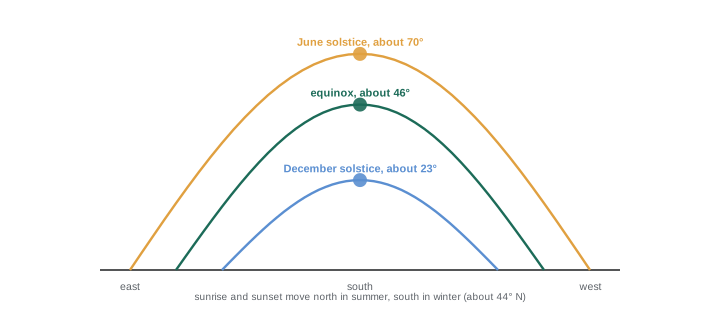
The sun rises in the east, crosses the southern sky (in the northern hemisphere) and sets in the west, but the exact directions and heights change with season and latitude. Its elevation above the horizon determines the angle and length of shadows and the hardness of shadows under brows and noses. At local solar noon, the sun's elevation is approximately:
Here \(\phi\) is the latitude and \(\delta\) the solar declination, which varies from about \(+23.4^\circ\) at the June solstice to \(-23.4^\circ\) at the December solstice, and is close to zero at the equinoxes. In Toronto, at about 43.7° north, the noon sun reaches about 70° in late June but only about 23° in late December. In Vancouver, at about 49.3° north, it reaches about 64° and 17°. In Los Angeles, at about 34° north, it reaches about 79° and 33°. Sunrise and sunset directions also swing: in midsummer the sun rises well north of east and sets well north of west, while in midwinter it rises and sets well south. These variations matter for choosing locations, scheduling and continuity.
Shadows and their lengths
The length of a shadow cast by an object of height \(h\) on level ground depends on the sun's elevation \(\alpha\):
At an elevation of 45°, shadows are as long as objects are tall; at 20°, nearly three times longer; at 70°, about a third as long. Low sun creates long, dramatic shadows across landscapes and streets and rakes across textures, revealing form; high sun creates short shadows directly beneath people and objects and harsh shadows in eye sockets. Low sun also lights faces more directly from the side or front, which is why mornings and late afternoons are favoured for exterior scenes with people.
Worked problem
Shadow length and scheduling
A scene requires an actor's long shadow to stretch across a parking lot, about four times their height of 1.75 m. At what sun elevation does this happen, and when might it occur?
Show solution
- Required shadow length: 4 × 1.75 = 7 m.
- tan α = h / L = 1.75 / 7 = 0.25, so α ≈ 14°.
- The sun is at about 14° elevation roughly an hour to an hour and a half after sunrise or before sunset at mid latitudes, depending on season.
- Use a sun-position app to find the exact times for the location and date, and schedule the shot accordingly.
Answer: At a sun elevation of about 14°, typically within about 1–1.5 hours of sunrise or sunset; confirm the exact time with a sun app.
Colour through the day
The colour of daylight changes with the sun's height. Near sunrise and sunset, sunlight passes through much more atmosphere, which scatters blue light and leaves warm, orange and red light, at colour temperatures from about 2,000 to 3,500 K, while the sky away from the sun remains blue. The contrast between warm sun and cool shadow is strongest then. As the sun rises, its light becomes whiter and the sky less saturated. After sunset, during twilight, the sky provides cool, soft light that fades quickly, and the warm afterglow near the horizon contrasts with deep blue overhead. These changes are a gift for storytelling, signalling time and mood, and a challenge for continuity, since a scene shot over hours will drift in colour unless managed (Lesson 9).
Weather and atmosphere
Weather transforms daylight. Thin cloud softens the sun while keeping some direction; thick, even overcast creates a soft, nearly shadowless light that flatters faces but can look flat; broken cloud creates rapidly changing light, the bane of continuity; fog and mist scatter light, lowering contrast and adding depth through aerial perspective; haze, pollution and smoke warm the sun and lower its contrast. Rain darkens surfaces and adds reflections. Snow adds enormous bounce from below, filling shadows and raising overall levels, and reflects the blue of the sky into shadows. Cinematographers learn to read weather forecasts for cloud cover, visibility and wind, and to keep backup plans, such as interior scenes, for unsuitable conditions.
Latitude and season
Latitude has a strong effect on daylight. At high latitudes, such as much of Canada in winter, the sun stays low all day, giving long shadows and warm light even at noon, but days are very short, sometimes under eight hours in northern cities, limiting shooting time. In summer, days are long, golden hours are extended and twilight lingers, which is valuable for magic-hour scenes. Near the equator, the sun rises and sets steeply, golden hour is brief and midday sun is nearly overhead. Productions planning exteriors must consider day length, sunrise and sunset times, and the sun's path, and may schedule seasonal sequences carefully or shoot in a different location that matches the story's season and latitude.
Planning tools
Sun-position apps and software, such as Sun Seeker, Sun Surveyor, PhotoPills, Artemis, Helios, Cadrage and similar tools, show the sun's path, elevation and azimuth for any location and date, often with augmented-reality overlays through a phone camera that show where the sun will be at a chosen time. Map-based tools show sun and shadow directions on satellite views. Weather services and specialized forecasts predict cloud cover. Combined with location scouting photographs taken at the intended shooting time, these tools let cinematographers choose camera positions, plan blocking so that actors face the right direction for the light, and schedule scenes for the best sun. Shadows from buildings and hills, which apps may not show, can be checked on scout days or with 3D models of the site.
Imitating daylight on a stage
On a soundstage, daylight is built from its two components. The sun is a hard, intense, small source placed far away, often a large HMI such as an 18K or 20K, or a large LED or arc source, at an angle that matches the intended time of day, sometimes through cutouts that cast window or foliage patterns. The sky is a large, soft source: overhead space lights or softboxes, large bounce surfaces lit from below or the side, or a cyclorama backing lit evenly. The colour balance between them matters: warmer sun and cooler sky fill read as a clear day; matched colour and very soft overall light read as overcast. Translight or painted backings, or LED walls displaying images, show the exterior through windows and must be lit or set to a brightness consistent with daylight outside. Achieving convincing stage daylight requires large lights, ample power and careful attention to the relationship between sun, sky and backing.
Reading the sky
The sky's appearance changes the light dramatically, and learning to read it helps predict how scenes will look. Clear, deep blue skies give strong contrast between sun and shade and cool shadows. Hazy, pale skies soften the sun and warm it, reducing contrast. High, thin cirrus clouds diffuse the sun slightly while keeping shadows. Broken cumulus clouds create rapidly changing light, alternating hard sun and soft shade, the most difficult conditions for continuity. Low, uniform stratus clouds create flat, soft light with little direction. Before storms, the sky can darken dramatically while low sun breaks through underneath, creating a striking, theatrical light. Smoke from wildfires, increasingly common in summers across western Canada and the United States, turns the sun orange and the sky yellow-grey, and can persist for days.
The colour of shadows
In sunny conditions, shadows are lit by skylight and are therefore bluer than sunlit areas. The eye adapts and tends to see shadows as neutral, but the camera records them as blue, especially at high altitude and in snow. On sunny days, this colour contrast between warm sunlit areas and cool shadows is part of what makes the image read as sunny. When it is too strong, for example on skin in open shade, it may be corrected by warming the shade with gels or bounce from warm surfaces, or in grading. Under overcast skies, shadows and lit areas share the same colour, which contributes to the flat look.
Urban canyons and reflected sunlight
In cities, buildings block the sun from streets for much of the day, creating deep shade and narrow bands of sunlight that move along streets as the sun crosses the sky. Glass and light-coloured facades reflect sunlight into shaded streets, creating secondary sun sources that can light actors from unexpected directions. Scouting at the shooting time reveals these effects, which change with the season as the sun's path shifts. A street that is sunlit at noon in June may be in shade all day in December. Sun-position tools that model buildings in three dimensions can help predict these effects.
Daylight on stage revisited
Recreating daylight convincingly on stage is a test of understanding daylight itself. The most common errors are a sun source that is too close, creating diverging shadows and fall-off across the set; a sky fill that is too directional, creating secondary shadows; and colour relationships that do not match the intended weather. Placing the sun source as far away as the stage allows, using large, broad sky sources overhead and around the set, and checking the result against references of real daylight help avoid them.
Altitude and air quality
At high altitude, the atmosphere is thinner, so sunlight is more intense, ultraviolet is stronger, skies are deeper blue and shadows are bluer and darker. Mountain locations therefore produce higher contrast than sea-level locations at the same time of day. Conversely, humid, polluted or smoky air scatters and absorbs light, lowering contrast, warming the sun and reducing visibility. These differences affect exposure, filtration and the amount of fill needed, and they help explain why the same time of day looks different in different places.
Common mistakes
MistakeTreating daylight as a single source.
InsteadConsider hard sun and soft skylight separately.
MistakeScheduling exteriors without checking sun position.
InsteadUse sun apps and scout at the shooting time.
MistakeIgnoring seasonal changes in sun elevation.
InsteadCalculate elevation for the actual date and latitude.
MistakeAssuming overcast light is always flattering.
InsteadAdd contrast or direction when it looks flat.
MistakeLighting stage daylight with only one source.
InsteadBuild sun and sky components with matched colour logic.
Summary and key terms
- Daylight combines hard, warm sun with soft, cool skylight.
- Direct sun gives about 100,000 lux; open shade is about 2.5–3.5 stops less.
- Noon elevation is about 90° minus latitude plus declination.
- Shadow length equals height divided by the tangent of elevation.
- Daylight warms near sunrise and sunset and turns blue in twilight.
- Weather, latitude and season transform daylight.
- Sun apps and stage sun-and-sky setups help plan and recreate daylight.
- Sunlight
- Direct light from the sun.
- Skylight
- Light scattered by the atmosphere.
- Open shade
- Area lit only by skylight.
- Solar elevation
- The sun's angle above the horizon.
- Azimuth
- The sun's compass direction.
- Declination
- The sun's angle north or south of the celestial equator.
- Solar noon
- Time when the sun is highest.
- Aerial perspective
- Loss of contrast and colour with atmospheric distance.
- Translight
- Large backlit photographic backdrop.
- Cyclorama
- Curved backdrop used to represent sky.
Practice problems
Work each problem on paper first, then reveal the answer to check.
Why is skylight cooler than sunlight?
Show answer
Blue light scatters more in the atmosphere.
Approximate illuminance of direct sun?
Show answer
About 100,000 lux.
Noon elevation in Toronto at the June solstice?
Show answer
About 70°.
Noon elevation at 50° N at the equinox?
Show answer
About 40°.
Shadow length of a 2 m object at 45° elevation?
Show answer
2 m.
Shadow length of a 1.8 m person at 30° elevation?
Show answer
About 3.1 m.
Colour temperature of sun near the horizon?
Show answer
About 2,000–3,500 K.
What effect does snow have on light?
Show answer
Strong bounce from below and blue shadows.
Name two sun planning apps.
Show answer
Sun Seeker, Sun Surveyor, PhotoPills, Artemis.
How is stage daylight built?
Show answer
A hard distant sun source plus a large soft sky source.
Lesson quiz · 5 questions
Score 60% or more to complete this lesson.
Create a free account to save your progress, take quizzes and earn a certificate.