
CON-340 · Lesson 12 of 12 · 27 min
Capstone: selecting and structuring a delivery method for a public facility
This capstone applies the whole course to one decision. You are on the owner's advisory team for a new hospital tower, and your job is to recommend a delivery method, explain why, and set out how the chosen method should be structured: how the partner will be selected, how it will be paid, which contracts will be used, how risks will be allocated, and how the owner will govern the project. The project and its numbers are invented, but the process is the one real public owners follow.
The project
Ridgeway Regional Health (an invented public hospital corporation in Ontario) plans a new eight-storey acute care tower on its existing campus, connected to the operating hospital at three levels. The tower will contain 240 inpatient beds, 12 operating rooms, an expanded emergency department and a central energy plant upgrade. The provincial capital funding framework requires a business case, and the province's infrastructure agency must advise on the delivery model. The estimated capital cost is $780 million in 2026 dollars, and the health corporation wants the tower open in 2032.
| Feature | Implication for delivery |
|---|---|
| Construction next to an operating hospital | Phasing, infection control, utility shutdowns and connections; high interface risk |
| Complex clinical program still being refined | Requirements will evolve during design; user group input essential |
| Central energy plant upgrade | Systems integration with existing infrastructure |
| Fixed opening target in 2032 | Schedule pressure; early works desirable |
| Long-term maintenance of a complex building | Life-cycle performance matters |
| Tight regional market for large mechanical and electrical trades | Limited competition on key packages |
Step 1: goals and screens
Workshops with the board, clinical leaders and facilities staff produce this ranking of goals: first, managing complexity and interface risk with the operating hospital; second, meeting the 2032 opening; third, cost certainty before the main construction commitment; fourth, clinical input and control over design; fifth, life-cycle performance. Lowest initial price through open competition ranks last, because the board has seen bid-and-claim cycles on earlier projects.
Screens: the health corporation has authority to use any model with ministry approval; the business case must include a value-for-money analysis if a partnership model is considered; market sounding with general contractors, consortia and major trades is required by the infrastructure agency before the model is fixed. Design-bid-build is not ruled out legally but scores poorly on the top two goals.
Market sounding produces three findings. Large general contractors are reluctant to take fixed-price risk for the connections to the operating hospital and the energy plant without extensive investigation. Two consortia express interest in a DBFM partnership but would price interface risk heavily. Mechanical and electrical trade partners are interested in early involvement because their capacity is limited and they want certainty of work.
Step 2: shortlist and risk analysis
The team shortlists four methods: CM at risk, lump-sum design-build, a DBFM P3, and an alliance or progressive model with early trade partner involvement. Design-bid-build and agency CM are dropped: design-bid-build because of interface risk and schedule, agency CM because the health corporation lacks staff to hold dozens of trade contracts next to an operating hospital.
# Ridgeway tower: expected risk cost by delivery method ($ millions, illustrative)
risks = {"Interfaces with operating hospital": 28.0, "Design development and clinical changes": 22.0,
         "Energy plant integration": 12.0, "Schedule delay": 18.0, "Trade market escalation": 15.0}
methods = {   # (share of each risk transferred to the builder side, premium on transferred risk)
    "CM at risk":       ([0.3, 0.2, 0.4, 0.5, 0.6], 0.25),
    "Lump-sum DB":      ([0.8, 0.6, 0.8, 0.8, 0.9], 0.45),
    "DBFM P3":          ([0.8, 0.5, 0.8, 0.9, 0.9], 0.50),
    "Alliance":         ([0.5, 0.5, 0.5, 0.5, 0.5], 0.10),
}
for m, (tr, prem) in methods.items():
    retained = sum(v * (1 - t) for v, t in zip(risks.values(), tr))
    priced = sum(v * t for v, t in zip(risks.values(), tr)) * (1 + prem)
print(f"{m:12} retained {retained:5.1f} priced {priced:5.1f} total risk cost {retained + priced:6.1f}")CM at risk retained 59.4 priced 44.5 total risk cost 103.9 Lump-sum DB retained 21.9 priced 106.0 total risk cost 127.9 DBFM P3 retained 22.3 priced 109.1 total risk cost 131.4 Alliance retained 47.5 priced 52.3 total risk cost 99.8
The analysis reflects the market sounding: methods that push interface and integration risk onto the builder side attract high premiums, because bidders cannot control those risks well before the site and the existing hospital are investigated. The alliance shows the lowest total risk cost, but only on the assumption that the collaborative model works and shared risks are priced modestly; CM at risk is close behind. The team notes that the DBFM P3 would also bring finance and transaction costs, which a value-for-money test would need to justify.
Worked problem
A quick value-for-money check on the P3
The team estimates the DBFM option would add $46 million of financing cost in present value over conventional funding, plus $9 million of extra transaction costs. Its life-cycle maintenance discipline is valued at $21 million in present value compared with the health corporation's own maintenance record. Using the risk analysis above, does the P3 appear to offer value for money against CM at risk?
Show solution
- From the code: CM at risk total risk cost ≈ $103.9 million; DBFM P3 ≈ $131.4 million, so the P3 costs about $27.5 million more in risk.
- Add finance and transaction: 27.5 + 46 + 9 = $82.5 million more.
- Subtract life-cycle benefit: 82.5 − 21 = $61.5 million more.
Answer: On these assumptions the P3 costs about $62 million more in present value than CM at risk, so it does not show value for money. The main driver is that the market would price interface risk heavily, which the team could not reduce without a development phase.
Step 3: scoring and sensitivity
# Ridgeway tower: weighted scoring with sensitivity (illustrative)
import random
random.seed(1240)
w = {"Complexity and interfaces": 0.30, "2032 opening": 0.25, "Cost certainty": 0.15,
     "Clinical input and control": 0.20, "Life-cycle performance": 0.10}
s = {   # workshop scores, 1 to 5
    "CM at risk":  [4, 4, 3, 5, 2],
    "Lump-sum DB": [2, 4, 4, 2, 3],
    "DBFM P3":     [2, 3, 5, 2, 5],
    "Alliance":    [5, 4, 3, 5, 3],
}
crit = list(w)
def score(m, wt):
    return sum(wt[c] * s[m][i] for i, c in enumerate(crit))
for m in s:
    print(f"{m:12} {score(m, w):.2f}")
wins, lo, hi = {m: 0 for m in s}, {m: 9 for m in s}, {m: 0 for m in s}
for _ in range(3000):
    wt = {c: v * random.uniform(0.6, 1.4) for c, v in w.items()}
    t = sum(wt.values()); wt = {c: v / t for c, v in wt.items()}
    res = {m: score(m, wt) for m in s}
    wins[max(res, key=res.get)] += 1
    for m, v in res.items():
        lo[m], hi[m] = min(lo[m], v), max(hi[m], v)
for m in s:
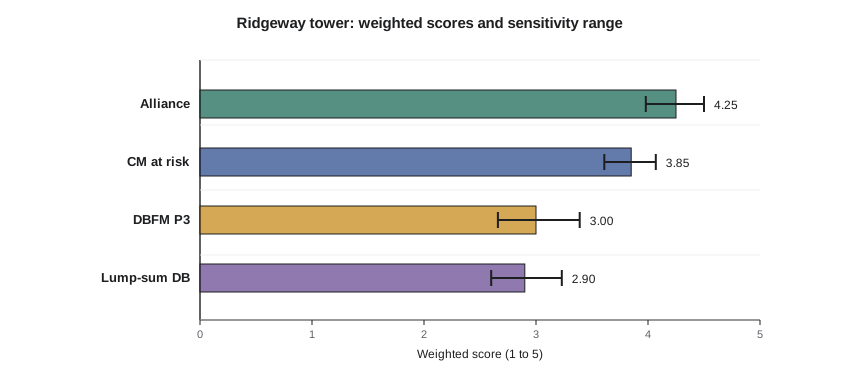
print(f"{m:12} first in {wins[m] / 30:.0f} % of trials; range {lo[m]:.2f} to {hi[m]:.2f}")CM at risk 3.85 Lump-sum DB 2.90 DBFM P3 3.00 Alliance 4.25 CM at risk first in 0 % of trials; range 3.61 to 4.07 Lump-sum DB first in 0 % of trials; range 2.60 to 3.23 DBFM P3 first in 0 % of trials; range 2.66 to 3.39 Alliance first in 100 % of trials; range 3.98 to 4.50
The alliance ranks first and stays first in every sensitivity trial, with CM at risk a clear second; CM at risk's best score in any trial is still below the alliance's typical score. The P3 and lump-sum design-build rank lower under almost any reasonable weights, because they score poorly on the two most important goals for this project. The team concludes that the choice is between a collaborative model and CM at risk, and looks at the owner's capacity and the market to decide.
Step 4: the recommendation
The team recommends an alliance-style delivery with a development phase, following the model Infrastructure Ontario has used for complex hospitals and transit, structured as an alliance development agreement followed by a project alliance agreement. If the province's agency prefers a more established model, the fallback is CM at risk under CCDC 5B-2025 with early trade partner involvement for mechanical and electrical work. The recommendation rests on four reasons: interface and integration risks are too uncertain to price well at a fixed price now; the market sounding showed contractors and trades would engage collaboratively but not take fixed-price interface risk; the health corporation's goals favour managing complexity and clinical input; and value for money for a DBFM partnership is not demonstrated on current information.
Step 5: structuring the chosen method
| Element | Structure |
|---|---|
| Selection | Two stages: qualifications and team capability (60 %), workshops testing collaboration (25 %), development phase fee, markups and labour rates (15 %); key trade partners selected the same way |
| Development or validation phase | About 14 months: design to roughly 60 %, site and existing-building investigations, energy plant study, risk register, schedule and open-book target cost |
| Commercial close | Target outturn cost agreed with independent estimate; off-ramp to CM at risk if not agreed |
| Compensation | Reimbursed actual cost; fee for corporate overhead and profit; pain/gain share against target with profit at risk; KPI adjustment for safety, quality, infection control and milestones |
| Governance | Leadership team of executives from each party; integrated project team in a co-located big room; independent advisers for the owner |
| Early works | Utility relocations, enabling demolition and a temporary connection link released during development under separate authorizations |
| Owner protections | Open book and audit, competitive trade packages for non-partner trades, independent cost estimate, off-ramp, owner decision on unresolved issues |
# Ridgeway tower: target cost and profit at risk outcomes (illustrative, $ millions)
target = 745.0          # target outturn cost after development (cost of work incl. general conditions)
fee = 0.055 * target    # fee for corporate overhead and profit, at risk
gain_share, pain_share = 0.50, 0.50
def result(actual):
    diff = actual - target
    if diff <= 0:
        partner = fee - gain_share * diff
    else:
        partner = max(0.0, fee - pain_share * diff)   # partner risk limited to its fee
    owner = actual + partner
    return partner, owner
for actual in (715, 730, 745, 765, 790, 830):
    p, o = result(actual)
    print(f"actual {actual:4} -> partner fee {p:5.1f}, owner pays {o:6.1f}")
owner_budget = 780 + 0.06 * 780
print(f"Owner capital budget with 6 % owner reserve: {owner_budget:.1f}")actual 715 -> partner fee 56.0, owner pays 771.0 actual 730 -> partner fee 48.5, owner pays 778.5 actual 745 -> partner fee 41.0, owner pays 786.0 actual 765 -> partner fee 31.0, owner pays 796.0 actual 790 -> partner fee 18.5, owner pays 808.5 actual 830 -> partner fee 0.0, owner pays 830.0 Owner capital budget with 6 % owner reserve: 826.8
The model shows that the owner's exposure grows quickly once the partner's fee is exhausted, at an actual cost of about $827 million, so the owner keeps a reserve above the target; here a 6 % reserve on the $780 million estimate, about $827 million in all, covers outcomes up to roughly the point where the partner's fee runs out. A realistic target from the development phase, strong governance and early work on the riskiest interfaces are what keep outcomes in the shared band.
Step 6: timeline
# Ridgeway tower: delivery timeline (months from business case approval; illustrative)
steps = [("Market sounding and model approval", 3), ("Partner selection (two stages)", 5),
         ("Development phase incl. early works", 14), ("Commercial close", 1),
         ("Construction", 40), ("Commissioning and transition", 6)]
t = 0
for name, d in steps:
    print(f"{name:38} months {t:3}-{t + d:3}")
    t += d
start_month = 1        # January 2026 approval assumed
year = 2026 + (start_month - 1 + t) // 12
print(f"Opening around month {t}, i.e. about {year}")Market sounding and model approval months 0- 3 Partner selection (two stages) months 3- 8 Development phase incl. early works months 8- 22 Commercial close months 22- 23 Construction months 23- 63 Commissioning and transition months 63- 69 Opening around month 69, i.e. about 2031
The timeline reaches opening in about 69 months, late 2031, consistent with a 2032 target if the business case is approved early in 2026 and the development phase does not drift. The team flags the development phase as the critical risk to the timeline and recommends a firm schedule with decision gates.
Step 7: risks to the recommendation and their mitigation
| Risk | Mitigation |
|---|---|
| Development phase drifts and costs grow | Fixed development budget and deliverables; monthly reporting; decision gates |
| Target set too high, weakening value for money | Independent estimate; benchmarking against recent hospitals; owner advisers in estimating |
| Collaboration fails under pressure | Partner selection on behaviour; training; leadership team engagement; KPI incentives |
| Off-ramp not credible | Owner owns the design; fallback CM at risk procurement prepared in parallel |
| Trade capacity shortfall | Early commitment of mechanical and electrical partners; prefabrication strategy |
| Public perception of reduced competition | Transparent process, fairness monitor or independent observer, published rationale |
Reflecting on the course
The Ridgeway exercise shows the main lessons of this course. A delivery method is a set of choices about organization, selection, pricing and payment, not a label. Each method trades off control, speed, certainty, collaboration and life-cycle accountability. Public owners work within legal, funding and fairness constraints that limit and shape their choices. Risk should sit with whoever can manage it best, and the market will tell you what it charges for the rest. A structured, documented selection process, tested for sensitivity and grounded in market feedback and an honest view of the owner's capacity, is the best protection against choosing a method by habit or fashion. CON-350 picks up where this course leaves off, with the detailed allocation, insurance and bonding of construction risk.
Common mistakes
MistakeRecommending a method without a fallback.
InsteadIdentify a credible alternative and keep the off-ramp real.
MistakeIgnoring market sounding results in the risk analysis.
InsteadPrice transferred risks using what the market says it will charge.
MistakePresenting a scoring result without sensitivity analysis.
InsteadShow how robust the ranking is to different weights.
MistakeChoosing a collaborative model without governance and owner staffing.
InsteadPlan the leadership team, big room and owner advisers before selection.
MistakeLeaving the owner without a reserve above the target or GMP.
InsteadHold an owner reserve sized to the risks the owner keeps.
Summary and key terms
- A delivery recommendation starts from ranked goals, legal and funding screens and market sounding.
- Shortlisted methods are compared on risk cost, value for money where relevant, and weighted scores with sensitivity tests.
- For a complex hospital next to an operating facility, collaborative or CM at risk models usually outperform fixed-price models.
- The chosen method must be structured: selection, development phase, commercial close, compensation, governance, early works and owner protections.
- Target cost arrangements limit partner risk to profit, so the owner needs a reserve.
- Timelines should flag the development phase as a critical risk with decision gates.
- Documenting the rationale, risks and mitigations supports approvals and public accountability.
- Business case
- The document that justifies a project and its delivery model for approval.
- Shortlist
- The methods carried forward for detailed comparison.
- Risk cost
- The expected cost of risks retained plus the price paid for risks transferred.
- Development phase
- The phase in which design, risks and price are developed jointly before commercial close.
- Target outturn cost
- The agreed estimate of final cost used for pain/gain sharing.
- Owner reserve
- Money the owner holds above the target or GMP for its own risks.
- Decision gate
- A scheduled point at which the owner decides whether to proceed.
- Early works
- Work released before the main construction commitment.
- Fallback method
- The alternative delivery method used if the preferred one cannot proceed.
- Independent observer
- A third party who reports on the fairness of a procurement process.
Practice problems
Work each problem on paper first, then reveal the answer to check.
List the first three steps of the Ridgeway selection process.
Show answer
Rank goals, apply screens, sound the market.
Why were design-bid-build and agency CM dropped?
Show answer
Interface risk and schedule for design-bid-build; owner staffing for agency CM.
Why did fixed-price methods show high risk costs?
Show answer
Bidders would charge large premiums for interface and integration risks they could not control.
A P3 adds $40 million of finance cost and $10 million of transaction cost, saves $20 million of risk and $15 million of life-cycle cost. What is its net cost difference?
Show answer
$15 million more than the comparator.
What does a sensitivity test add to a scoring matrix?
Show answer
It shows how often each method ranks first as the weights change.
Name four elements of structuring a collaborative model.
Show answer
Selection, development phase, commercial close and off-ramp, compensation, governance, early works, owner protections.
Target $500 million, fee 5 %, pain share 50 % capped at fee. At what actual cost is the fee exhausted?
Show answer
At $550 million (overrun $50 million × 50 % = $25 million fee).
Why keep an owner reserve above the target?
Show answer
Once the partner's fee is exhausted, the owner pays all further cost.
What is the critical schedule risk in a progressive model?
Show answer
Drift in the development phase.
Give one way to address public concern about reduced competition.
Show answer
Transparent process, fairness monitor, published rationale.
Lesson quiz · 5 questions
Score 60% or more to complete this lesson.
Create a free account to save your progress, take quizzes and earn a certificate.