
CON-340 · Lesson 7 of 12 · 23 min
Public-private partnerships in Canada
A public-private partnership, or P3, goes further than any other delivery method in handing responsibility to the private sector. Instead of buying construction, the public owner buys a service: a hospital that is available and maintained to a stated standard for thirty years, a highway lane that is open and in good condition, a water plant that treats a given flow to a given quality. A private consortium designs and builds the asset, usually finances much of it, and often maintains or operates it for decades. The public owner pays mainly through performance-based payments once the asset is in service, and deducts money when it falls short.
Canada became one of the world's leading P3 markets in the 2000s and 2010s, particularly for hospitals, courthouses, transit lines and highways. Provincial agencies such as Infrastructure Ontario, which calls its approach alternative financing and procurement (AFP), and Partnerships British Columbia, operating as Infrastructure BC since late 2020, developed standard project agreements, procurement processes and value-for-money methods that other jurisdictions adopted. The federal PPP Canada fund operated from 2009 to 2018, and the Canada Infrastructure Bank, created in 2017, now invests in revenue-generating public infrastructure alongside private and institutional capital.
How a P3 is structured
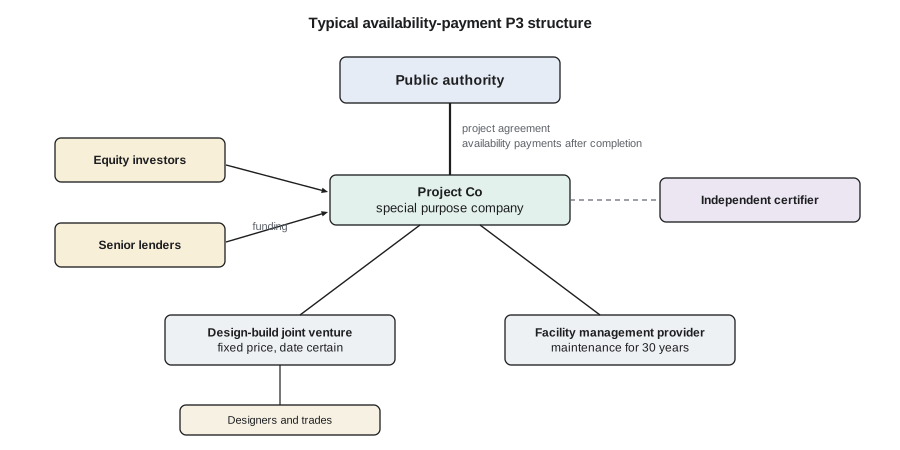
The private side forms a special purpose company, often called Project Co, owned by equity investors, which may include the construction company, the facility manager and infrastructure funds. Project Co signs the project agreement with the public authority and immediately passes most of its obligations down: design and construction to a design-build joint venture under a fixed-price, date-certain contract, and maintenance or operations to a facility management or operations company under a long-term services contract. Project Co borrows senior debt from banks or bond investors to fund construction, together with the equity, and repays both from the payments it receives from the authority over the concession.
| Model | What the private partner does | Typical use |
|---|---|---|
| Design-build-finance (DBF) | Designs, builds and finances construction; repaid at or shortly after completion | Hospitals, courthouses and transit where the owner wants private finance discipline during construction only |
| Design-build-finance-maintain (DBFM) | Adds long-term maintenance and life-cycle renewal, often 30 years | Hospitals, schools, courthouses, highways |
| Design-build-finance-operate-maintain (DBFOM) | Adds operation of the asset | Transit lines, toll roads, water plants |
| Concession (user-pay) | Collects tolls or fees and takes demand risk | Toll roads, bridges, airports, parking |
How the private partner is paid
Most social infrastructure P3s, and many highway and transit P3s, use availability payments. The authority pays nothing, or only milestone payments, during construction. From substantial completion it pays a monthly or annual service payment for the life of the concession, which covers repayment of debt and equity, maintenance and life-cycle costs, and the private partner's return. The payment is reduced by deductions if parts of the asset are unavailable, such as a closed operating room or lane, or if services fall below standard, such as slow repairs or poor cleaning. User-pay concessions instead let the private partner collect tolls or fees, and it bears the risk that demand falls short of forecast.
# Monthly availability payment with deductions for a hospital P3 (illustrative)
monthly_payment = 4_200_000       # full monthly service payment
areas = {  # area: (weight in payment, hours unavailable this month, hours in month)
    "Operating suites":   (0.20, 18, 720),
    "Inpatient units":    (0.35, 0, 720),
    "Emergency":          (0.15, 6, 720),
    "Clinics and offices": (0.30, 40, 720),
}
availability_deduction = 0
for area, (w, hrs, total) in areas.items():
    d = monthly_payment * w * hrs / total * 2.0      # unavailability deducted at twice the pro-rata rate
    availability_deduction += d
    print(f"{area:20} unavailable {hrs:3} h  deduction {d:>10,.0f}")
service_failures = 14 * 1_500                        # 14 late responses at $1,500 each
total_ded = availability_deduction + service_failures
print(f"Service failure deductions {service_failures:,}")
print(f"Payment this month {monthly_payment - total_ded:,.0f} (deductions {total_ded / monthly_payment:.2%})")Operating suites unavailable 18 h deduction 42,000 Inpatient units unavailable 0 h deduction 0 Emergency unavailable 6 h deduction 10,500 Clinics and offices unavailable 40 h deduction 140,000 Service failure deductions 21,000 Payment this month 3,986,500 (deductions 5.08%)
This month the deductions take about 5 % of the payment, mostly for the operating suites and clinics. Deductions are calibrated so that poor performance costs the private partner more than it would save by cutting corners, and repeated failures can lead to default. Because the payment repays the lenders, lenders watch performance closely and can step in to replace a failing contractor or facility manager. That lender oversight is one of the main reasons owners use private finance: the people whose money is at risk have strong reasons to make sure the project is built on time and maintained.
Value for money
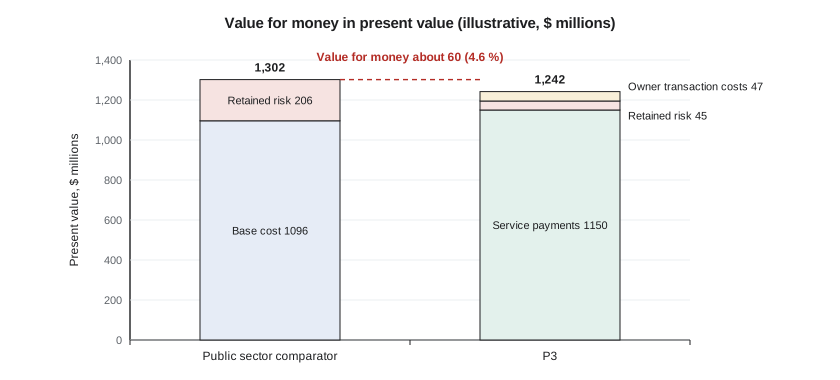
A P3 almost always costs more to finance than public borrowing, because private debt and equity carry higher interest and returns than government bonds. It also has higher transaction costs for lawyers, advisers and bid preparation. P3s are justified, if at all, by transferring risks the public sector would otherwise bear and price poorly: construction cost overruns, delay, poor maintenance and life-cycle neglect. Public agencies test this with a value-for-money assessment that compares two estimates in today's dollars: a public sector comparator, which is the risk-adjusted cost of delivering the project conventionally, and the risk-adjusted cost of the P3.
# Simplified value-for-money comparison in present value (illustrative, $ millions)
def pv(cashflows, r):
    return sum(cf / (1 + r) ** t for t, cf in enumerate(cashflows))
r = 0.045                     # public discount rate used for both options
years = 33                    # 3 years of construction + 30 years of operation
# Public sector comparator: construction paid as built, maintenance paid annually, plus risks retained by the public owner
psc = [350, 350, 300] + [9.0] * 30
psc_risk = [60, 60, 50] + [3.0] * 30      # expected overruns, delay and life-cycle neglect
# P3: nothing during construction; annual service payment covers capital, finance, maintenance and return
p3 = [0, 0, 0] + [80.0] * 30
p3_retained = [5, 5, 5] + [0.8] * 30      # risks the owner keeps under the P3 (changes, some site risks)
p3_transaction = [12, 4, 2] + [0.3] * 30  # owner advisers and contract management
a = pv(psc, r) + pv(psc_risk, r)
b = pv(p3, r) + pv(p3_retained, r) + pv(p3_transaction, r)
print(f"Public sector comparator, risk-adjusted PV: {a:,.0f}")
print(f"P3, risk-adjusted PV:                       {b:,.0f}")
print(f"Value for money: {a - b:,.0f} ({(a - b) / a:.1%} of PSC)")Public sector comparator, risk-adjusted PV: 1,302 P3, risk-adjusted PV: 1,242 Value for money: 60 (4.6% of PSC)
In this invented example the P3 shows value for money of about 4.6 %, less than the transferred risk in the comparator: without that risk adjustment, conventional delivery would look cheaper. That is typical of the method, and also its main point of criticism: the result depends heavily on how the retained risks in the comparator are estimated and on the discount rate chosen. Small changes in either can reverse the conclusion.
Value-for-money assessments have been scrutinized in Canada. Ontario's Auditor General reported in 2014 that 74 AFP projects had cost about $8 billion more than estimated public delivery would have, mostly because of higher private financing costs, and questioned how risks had been valued in the comparators; Infrastructure Ontario responded that the risk transfer justified the cost. Similar debates have followed reports on P3s in British Columbia, Alberta and other provinces. Infrastructure Ontario now publishes value-for-money reports and uses a wider range of models, including progressive and alliance approaches.
Risks transferred and retained
| Risk | Usually transferred to Project Co | Usually retained or shared by the authority |
|---|---|---|
| Design and construction cost | Yes, under a fixed price | Owner changes |
| Completion date | Yes; payments start only at completion | Owner-caused delay, some permits and approvals |
| Site conditions | Often, after investigations | Unknown contamination, archaeology, some utilities |
| Financing and interest rates | Yes, after financial close | Interest rate movements before financial close (often) |
| Maintenance and life-cycle renewal | Yes, for the concession | Changes in service requirements |
| Demand or revenue | Only in user-pay concessions | In availability-payment models |
| Change in law | General changes in law | Discriminatory or project-specific changes in law |
P3 contracts are long and detailed because they must anticipate decades of events. The authority keeps the right to change the asset or the services through a variation procedure, with compensation; it can terminate for convenience at a defined price; and Project Co can be terminated for default, with lenders given time to fix problems first. At the end of the concession the asset is handed back in a defined condition, often verified by surveys in the last years of the term.
The procurement process
P3 procurement is long and expensive. A typical process includes a business case and value-for-money assessment; a request for qualifications to shortlist three teams; a request for proposals lasting six to twelve months, with commercially confidential meetings in which bidders comment on the draft project agreement; evaluation of technical and financial proposals; selection of a preferred proponent; and financial close, when the project agreement and financing are signed and the interest rate is fixed. Owners often pay unsuccessful shortlisted bidders a fee, because bids can cost each team several million dollars.
Canadian P3 procurements typically include a design presentation process, a fairness monitor who reports on the integrity of the process, and payment of a design and bid fee to unsuccessful shortlisted proponents. The Canada Infrastructure Bank, whose capital envelope Ottawa is raising from $35 billion to $45 billion according to an April 2026 interview with its chief legal officer, invests in revenue-generating projects in clean power, trade corridors, broadband and digital infrastructure, enabling infrastructure for housing and Indigenous community infrastructure, alongside private and institutional capital.
Lessons from troubled P3s
P3s promise date-certain, fixed-price delivery, but some of the most visible project failures in both countries have been P3s, which shows the limits of risk transfer.
In Ottawa, the Confederation Line light rail, delivered under a DBFM, opened in 2019 after delays and then suffered repeated breakdowns and two derailments in 2021. A provincial public inquiry reported in 2022 that problems arose from decisions on schedule, systems integration and the relationships between the city, the private partner and its subcontractors, and that risk transfer had not prevented the public from bearing the consequences. In Toronto, the Eglinton Crosstown light rail, also delivered under a DBFM, faced years of delay and litigation before reaching substantial completion. Both experiences influenced Infrastructure Ontario's move toward progressive and alliance models for complex transit.
The common lessons are that complex integration risk, especially for transit systems, is hard for any one party to carry; that bidders price large risks heavily or misprice them; and that when a private partner fails on an essential public service, the public owner cannot simply walk away. Lesson 8 looks at the progressive and collaborative models that grew out of these experiences.
Common mistakes
MistakeAssuming a P3 is cheaper because the government pays nothing during construction.
InsteadCompare full risk-adjusted present costs, including higher finance and transaction costs.
MistakeAccepting a value-for-money result without testing the assumptions.
InsteadTest sensitivity to the discount rate and the retained-risk estimates.
MistakeBelieving all risk is transferred.
InsteadIdentify the risks the authority keeps, including changes, some site conditions and service continuity.
MistakeWriting output specifications that prescribe solutions.
InsteadSpecify outcomes and performance so the private partner can optimize design and life-cycle cost.
MistakeIgnoring contract management after financial close.
InsteadStaff the authority to monitor performance, deductions and variations for decades.
Summary and key terms
- In a P3 the public authority buys a long-term service from a private special purpose company that designs, builds, often finances and maintains the asset.
- Models include DBF, DBFM, DBFOM and user-pay concessions.
- Availability payments start at completion and are reduced by deductions for unavailability and poor service.
- Value for money compares the risk-adjusted present cost of conventional delivery with that of the P3.
- Private finance costs more than public borrowing; P3s are justified by risk transfer and life-cycle discipline.
- P3 procurement is long and expensive and ends at financial close.
- Troubled transit P3s show that integration risk and essential services cannot be fully transferred.
- Public-private partnership (P3)
- Delivery in which a private partner designs, builds and usually finances and maintains an asset for a long term.
- Project Co
- The special purpose company that signs the project agreement on the private side.
- Project agreement
- The contract between the public authority and Project Co.
- DBFM
- Design-build-finance-maintain.
- Availability payment
- A performance-based payment for the asset being available and maintained.
- Deduction
- A reduction in payment for unavailability or service failure.
- Public sector comparator
- The risk-adjusted estimated cost of conventional public delivery.
- Value for money
- The difference between the risk-adjusted costs of conventional delivery and the P3.
- Financial close
- The point at which the project agreement and financing are signed.
- Concession
- The period during which the private partner holds the rights and obligations under the agreement.
Practice problems
Work each problem on paper first, then reveal the answer to check.
What does a P3 authority buy, compared with conventional delivery?
Show answer
A long-term service with performance standards, not just construction.
Name the parties that typically own and fund Project Co.
Show answer
Equity investors (often including the builder and facility manager) and senior lenders.
What is DBFM?
Show answer
Design-build-finance-maintain.
A $3,000,000 monthly payment has availability deductions of $45,000 and service deductions of $15,000. What is paid?
Show answer
$2,940,000.
Why does a P3 cost more to finance than public delivery?
Show answer
Private debt and equity require higher returns than government borrowing.
A public sector comparator is $1,250 million PV and the P3 is $1,190 million PV. What is the value for money?
Show answer
$60 million, 4.8 % of the comparator.
Name two risks the authority usually keeps in an availability-payment P3.
Show answer
Owner changes, demand, some site risks, discriminatory change in law.
Which Ontario agency delivers P3s under the AFP model?
Show answer
Infrastructure Ontario.
What did Ontario's Auditor General report in 2014 about AFP projects?
Show answer
That 74 projects cost about $8 billion more than estimated public delivery, mainly due to financing costs, and that risk valuations were questionable.
What lesson did the Ottawa light rail inquiry draw about risk transfer?
Show answer
That risk transfer did not prevent the public from bearing the consequences of failure on an essential service.
Lesson quiz · 5 questions
Score 60% or more to complete this lesson.
Create a free account to save your progress, take quizzes and earn a certificate.