
CON-340 · Lesson 5 of 12 · 27 min
Design-build, bridging and progressive design-build
In design-build, the owner signs one contract with one entity, the design-builder, which is responsible for both designing and constructing the project. The owner describes what it needs, usually in performance terms; the design-builder decides how to provide it, produces the design, and builds it. When something goes wrong with the design or the construction, there is one party to answer for it. This single point of responsibility is the method's defining feature and the reason it has spread from private industrial work into highways, transit, water treatment, military bases and public buildings in both countries.
How design-build is organized
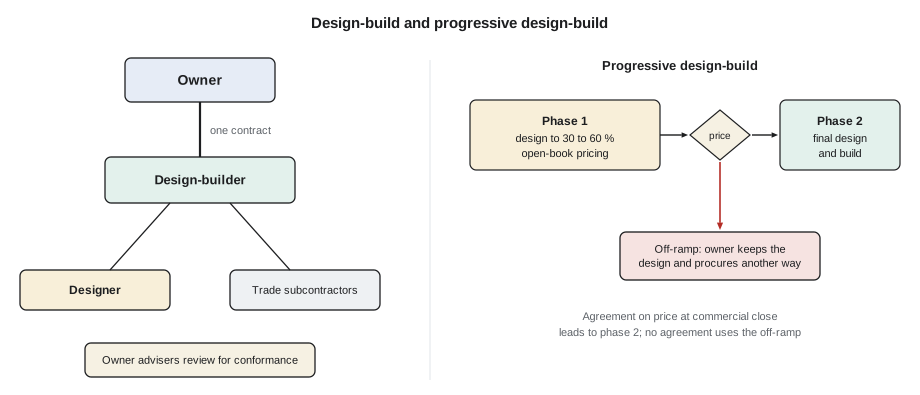
Most design-builders are led by contractors, which hire the architect and engineers as subconsultants. Some are joint ventures between a contractor and a design firm, and a few are led by designers who subcontract the construction. In every arrangement the owner deals with one contracting party. The owner still needs its own professional advisers: someone must write the owner's requirements, review the design-builder's design for compliance, and administer the contract. Owners who skip that step lose control of quality.
| Element | Design-bid-build | Design-build |
|---|---|---|
| Owner contracts for design and construction | Two | One |
| Who completes the design | Owner's designer | Design-builder's designer |
| When the builder joins | After design | Before or early in design |
| Who carries design errors | Owner (then claims against designer) | Design-builder |
| How the owner describes the project | Complete drawings and specifications | Performance requirements and criteria |
| Owner control of design details | High | Lower; owner controls through requirements and review |
The owner's requirements
In design-build, the document that matters most is the one the owner writes before procurement: the owner's statement of requirements, also called the owner's project requirements, design criteria package or request for proposals technical requirements. It describes function, performance, quality, codes and standards, mandatory design elements and the site, without designing the project. Writing it well is hard. Too vague, and the owner receives a building that meets the words but not its needs. Too prescriptive, and the owner loses the innovation and price competition that design-build offers and takes back design risk for the parts it specified.
| Requirement style | Example for a transit station | Effect |
|---|---|---|
| Performance | Platform must handle 6,000 passengers per peak hour with a level-of-service rating of C or better | Design-builder free to choose the layout; owner protected on outcome |
| Prescriptive | Platform shall be 120 m long and 4.5 m wide with escalators at both ends | Owner fixes the solution and carries the risk it is wrong |
| Reference design | A 15 % concept showing one possible layout, issued for information | Helps bidders understand intent; the contract must say whether it is binding |
A useful discipline is to ask, for each requirement, whether the owner truly needs to control the solution, or only the result. Many public owners include a reference design to show that a compliant solution exists, while stating that bidders may propose alternatives and that the reference design carries no warranty.
Bridging
Bridging is a hybrid in which the owner hires a bridging architect or engineer to take the design to about 20 to 35 %, enough to fix the layout, appearance and major systems, and then procures a design-builder to complete the design and build it. The owner gains control over the elements it cares most about while still transferring detailed design and construction to one party. The risk is that the boundary between the owner's design and the design-builder's design becomes the source of claims, because each side can argue the other's documents caused a problem. Clear contract language on who is responsible for errors in the bridging documents is essential.
Selecting a design-builder
Because bidders on a design-build project must design as well as price, proposing is expensive. Public owners usually use two steps: a request for qualifications to shortlist three to five teams, followed by a request for proposals in which the shortlisted teams submit technical proposals and prices. Many owners pay unsuccessful shortlisted teams a stipend, often a fraction of a percent of the contract value, in exchange for the right to use their ideas. Award may go to the lowest price among technically acceptable proposals, to the best value combining price and technical score, or, in a fixed-price best-design approach, to the best design for a stated price.
Canadian public owners use two-stage design-build procurements under their normal procurement policies. Provincial transportation ministries, municipal water utilities and federal departments use design-build for highways, bridges, treatment plants and buildings, and provincial agencies such as Infrastructure Ontario list design-build projects alongside partnership projects in their market updates.
Worked problem
Best-value scoring with an adjusted score
A water utility scores design-build proposals on technical merit (out of 100) and uses an adjusted score: price divided by technical score, lowest wins. Team A: technical 86, price $61.2 million. Team B: technical 78, price $57.9 million. Team C: technical 91, price $66.0 million. Which team wins?
Show solution
- Team A: 61.2 ÷ 86 = 0.712 million per point.
- Team B: 57.9 ÷ 78 = 0.742 million per point.
- Team C: 66.0 ÷ 91 = 0.725 million per point.
- Lowest adjusted score: Team A.
Answer: Team A wins, even though it is not the lowest price, because its technical score buys more per dollar.
# Comparing award rules for three design-build proposals (illustrative)
props = {"A": (86, 61.2), "B": (78, 57.9), "C": (91, 66.0)}   # (technical score out of 100, price $M)
low_price = min(props, key=lambda k: props[k][1])
adjusted = min(props, key=lambda k: props[k][1] / props[k][0])
# weighted: 60 % technical, 40 % price, price points = 40 x lowest price / price
best = min(p for _, p in props.values())
weighted = {k: 0.6 * t + 40 * best / p for k, (t, p) in props.items()}
w_win = max(weighted, key=weighted.get)
print("Lowest price wins:   ", low_price)
print("Adjusted score wins: ", adjusted, {k: round(p / t, 3) for k, (t, p) in props.items()})
print("Weighted score wins: ", w_win, {k: round(v, 1) for k, v in weighted.items()})
stipend = 0.002 * 60_000_000
print(f"Stipend at 0.2 % of a $60M contract: {stipend:,.0f} per unsuccessful team; two teams cost {2 * stipend:,.0f}")Lowest price wins: B
Adjusted score wins: A {'A': 0.712, 'B': 0.742, 'C': 0.725}
Weighted score wins: C {'A': 89.4, 'B': 86.8, 'C': 89.7}
Stipend at 0.2 % of a $60M contract: 120,000 per unsuccessful team; two teams cost 240,000Different award rules can pick different winners from the same proposals, which is why the rule must be published in the request for proposals and applied exactly. Weighted scoring in particular is sensitive to how price points are calculated; small changes in the formula can reverse a result.
Progressive design-build
Traditional design-build fixes the price at award, on the basis of the owner's requirements and the proposer's early design. That works when requirements are clear, but on complex or uncertain projects the design-builder must price a great deal of risk it cannot yet see. Progressive design-build, which has grown rapidly since the 2010s, especially in water, wastewater and complex buildings, splits the contract into two phases.
| Phase | What happens | How the design-builder is paid |
|---|---|---|
| Phase 1: design and preconstruction | Design-builder selected mainly on qualifications; develops the design with the owner, typically to 30 to 60 %, investigates the site, and prices the work open book | Fee or cost reimbursement for design and preconstruction |
| Commercial close | Parties agree a lump sum or a GMP for phase 2 | Negotiated, often checked by an independent estimate |
| Off-ramp (if no agreement) | Owner may end the contract, keep the design and procure construction another way | Phase 1 work paid; design ownership transferred |
| Phase 2: final design and construction | Design-builder completes design and builds | Lump sum or GMP |
Worked problem
Phase 2 pricing in progressive design-build
In phase 1 of a progressive design-build for a wastewater plant upgrade, the design-builder's open-book estimate of the cost of the work is $92.0 million. The agreed general conditions are $6.4 million, the design completion cost is $3.1 million, the design-builder's contingency is 4 % of the cost of the work, and the fee is 7 % of all other costs. What is the phase 2 GMP?
Show solution
- Contingency: 0.04 × 92.0 = $3.68 million.
- Subtotal: 92.0 + 6.4 + 3.1 + 3.68 = $105.18 million.
- Fee: 0.07 × 105.18 = $7.36 million.
- GMP: 105.18 + 7.36 = $112.54 million.
Answer: About $112.5 million. If the owner does not accept it, the off-ramp lets it take the phase 1 design and procure construction separately.
Progressive design-build gives the owner more influence over the design and a price based on much better information, at the cost of losing price competition on the construction phase. It looks a lot like CMAR, with the difference that the design-builder, not the owner, holds the design contract and carries design responsibility. Owners use independent cost estimators and open-book reviews to protect themselves in the negotiation.
Design responsibility
Who carries design risk in design-build depends on the contract. Usually the design-builder warrants that its design will meet the owner's requirements, and it carries the cost of correcting design errors. Its designers, as subconsultants, are typically liable to the design-builder only for failing to meet the professional standard of care. That creates a gap: the design-builder may have promised the owner fitness for purpose while its designer promised only reasonable care. Design-builders manage that gap through design contingency, professional liability insurance, and careful wording of the performance guarantees they give.
| Standard | What it promises | Who usually gives it |
|---|---|---|
| Professional standard of care | Reasonable skill and care of a competent designer; not a guarantee of result | Designers in all methods |
| Compliance with requirements | The design will meet the stated owner requirements | Design-builders |
| Fitness for purpose | The completed work will achieve the stated purpose or performance | Design-builders in some contracts, especially process plants and P3s |
The owner's own reviewers must be careful not to take design risk back. If owner reviewers direct design changes or approve deviations from requirements, the design-builder may argue the owner assumed responsibility for the result. Good design-build contracts say that owner review is for general conformance only and does not relieve the design-builder of its obligations.
Standard contracts
| Purpose | Canada | United States |
|---|---|---|
| Owner and design-builder | CCDC 14-2013 Design-Build Stipulated Price Contract | DBIA 500-series (for example 520/525/530 with 535 general conditions); AIA A141-2014; ConsensusDocs 410 (cost plus with GMP) and 415 (lump sum); EJCDC D-520 with D-700 |
| Design-builder and its designer | CCDC 15-2013 Design Services Contract between Design-Builder and Consultant | AIA B143-2014; DBIA 540; ConsensusDocs 420 |
| Progressive design-build | Owner-specific forms or adapted CCDC 14 | DBIA progressive design-build forms; owner-specific forms |
Owners on large public projects often write their own design-build contracts, especially for highways and transit, rather than using industry forms. The Design-Build Institute of America's forms are widely used in the United States because they were written specifically for design-build, including progressive design-build.
Where design-build works
Design-build works best when the owner can state its needs clearly in performance terms, values speed and single responsibility, and is willing to let the design-builder make design decisions. Highways, bridges, parking structures, warehouses, standard schools, treatment plants and repetitive facilities fit well. It struggles where the owner wants to control design details closely, where requirements are uncertain or likely to change, and where the owner's review process turns into redesign. Progressive design-build addresses some of those weaknesses for complex projects.
Common mistakes
MistakeWriting prescriptive requirements and expecting design-build innovation.
InsteadSpecify performance and results; prescribe only what the owner truly must control.
MistakeLetting owner reviews redirect the design.
InsteadReview for conformance with requirements; direct changes only through the change process.
MistakeIgnoring the gap between a design-builder's guarantee and its designer's standard of care.
InsteadAlign the design subcontract, insurance and guarantees with the prime contract.
MistakeAsking many teams for full proposals without stipends.
InsteadShortlist three to five teams and consider stipends for unsuccessful proposers.
MistakeUsing progressive design-build without an independent cost check.
InsteadUse open-book reviews and an independent estimate before commercial close.
Summary and key terms
- Design-build gives one entity responsibility for design and construction under one owner contract.
- The owner's statement of requirements is the key document; performance requirements preserve innovation and risk transfer.
- Bridging lets the owner fix layout and major systems before handing over detailed design.
- Public owners use two-step selection, best-value or low-price award, and often stipends.
- Progressive design-build adds a collaborative design and pricing phase with an off-ramp before the price is fixed.
- Design-builders usually warrant compliance with requirements, which can exceed their designers' standard of care.
- CCDC 14 and 15 in Canada and DBIA, AIA, ConsensusDocs and EJCDC forms in the United States are used.
- Design-build
- Delivery in which one entity designs and builds under one owner contract.
- Design-builder
- The entity holding the design-build contract.
- Statement of requirements
- The owner's description of what the project must achieve, issued for design-build procurement.
- Performance specification
- A requirement stated as a result to be achieved rather than a method.
- Bridging
- A hybrid in which the owner's designer takes design partway before a design-builder completes it.
- Reference design
- A preliminary design issued to show one possible solution, usually without warranty.
- Stipend
- A payment to unsuccessful shortlisted proposers for their proposal effort and ideas.
- Adjusted score
- A best-value measure such as price divided by technical score.
- Progressive design-build
- Design-build in which the price is fixed after a collaborative design phase, with an off-ramp.
- Fitness for purpose
- A promise that the completed work will achieve its stated purpose.
Practice problems
Work each problem on paper first, then reveal the answer to check.
How many contracts does the owner hold for design and construction in design-build?
Show answer
One.
What is the most important document an owner writes for design-build?
Show answer
The statement of owner requirements (design criteria).
Why might prescriptive requirements reduce risk transfer?
Show answer
The owner fixes the solution and carries the risk that it is wrong.
What is bridging?
Show answer
The owner's designer develops the design to about 20 to 35 % before a design-builder completes and builds it.
Price $48 million, technical score 80: what is the adjusted score?
Show answer
0.60 million per point.
Why do owners pay stipends?
Show answer
To compensate shortlisted teams for expensive proposals and gain rights to use their ideas, encouraging competition.
What is the off-ramp in progressive design-build?
Show answer
The owner's right to end the contract after phase 1 if no acceptable price is agreed, keeping the design.
Cost of work $40 million, general conditions $3 million, contingency 5 % of cost of work, fee 6 % of all else: what is the GMP?
Show answer
Contingency 2.0; subtotal 45.0; fee 2.7; GMP $47.7 million.
What gap can exist between a design-builder and its designer?
Show answer
The design-builder may guarantee results while the designer promises only reasonable care.
Name the CCDC design-build stipulated price contract.
Show answer
CCDC 14-2013.
Lesson quiz · 5 questions
Score 60% or more to complete this lesson.
Create a free account to save your progress, take quizzes and earn a certificate.