
CON-340 · Lesson 4 of 12 · 28 min
Construction management at risk and the guaranteed maximum price
Construction management at risk starts like construction management for fee and ends like general contracting. The owner hires a construction manager early, during design, to provide preconstruction services: estimating, scheduling, constructability review and planning. At a point when the design is developed enough, the construction manager commits to deliver the project for no more than a guaranteed maximum price, or GMP. From then on it holds the trade contracts, manages and coordinates them as a general contractor would, and bears the risk that the cost of the work plus its fee exceeds the GMP. It is the most widely used alternative to design-bid-build for public buildings in the United States and is common on Canadian institutional and private projects.
The method goes by several names. In Canada it is usually called construction management for services and construction, after CCDC 5B, or simply CM at risk; Infrastructure Ontario's market updates use construction management at risk (CMAR). In highway and transit work in both countries, a closely related form is called construction manager/general contractor (CM/GC) or early contractor involvement.
How CM at risk works
The owner selects the construction manager mainly on qualifications, approach and fee, not on a construction price, because there is no design to price yet. The construction manager works with the designer through design, producing estimates at each stage, advising on systems and sequences, and identifying long-lead items. When the design reaches the agreed point, typically between 50 and 100 % construction documents, the construction manager proposes a GMP. If the owner accepts it, the parties sign a GMP amendment and construction proceeds. The construction manager then bids or negotiates the trade packages, usually competitively and with the owner's involvement, and holds those trade contracts itself.
| Component | What it covers | Typical treatment |
|---|---|---|
| Cost of the work | Trade contracts, self-performed work, materials and equipment | Reimbursed at actual cost, open book |
| General conditions | Site staff, temporary facilities, site services and similar | At cost, a fixed sum, or a cap |
| Construction manager contingency | Buyout gaps, errors in the estimate, coordination issues | Inside the GMP; use controlled by the CM with reporting; unused balance shared or returned |
| Allowances | Defined items not yet fully designed, such as signage or hardware | Reconciled against actual cost |
| Insurance and bonds | Builder's risk (if CM provides), liability, performance and payment bonds | Often a percentage of cost |
| Fee | Overhead and profit | Percentage of cost or fixed sum |
| Owner contingency (outside the GMP) | Owner changes and unforeseen conditions | Held and controlled by the owner |
Building a GMP
A GMP is only as good as the design and the pricing behind it. At 60 % construction documents much of the building is defined but much detail is not, so the construction manager prices the known work from trade input and estimates the rest, then adds a contingency to cover what the documents do not yet show. Owners and construction managers negotiate hard over the size and use of that contingency, because it is the construction manager's protection against design development and the owner's potential source of savings.
# GMP build-up for an invented hospital addition at 70 % construction documents (illustrative)
trades = {   # trade package estimates or quotes
    "Site work and utilities":       3_900_000, "Foundations and structure":    14_600_000,
    "Envelope and roofing":          9_800_000, "Interiors and finishes":       10_400_000,
    "Mechanical and plumbing":      15_700_000, "Electrical and low voltage":    9_300_000,
    "Elevators":                     1_450_000, "Medical gas and specialties":   2_150_000,
}
cost_of_work = sum(trades.values())
general_conditions = 4_250_000
allowances = 600_000
cm_contingency = round(0.035 * cost_of_work, -3)          # 3.5 % of trade cost
subtotal = cost_of_work + general_conditions + allowances + cm_contingency
insurance_bonds = round(0.012 * subtotal, -3)               # 1.2 %
fee = round(0.035 * (subtotal + insurance_bonds), -3)       # 3.5 % fee
gmp = subtotal + insurance_bonds + fee
for k, v in [("Cost of the work", cost_of_work), ("General conditions", general_conditions),
             ("Allowances", allowances), ("CM contingency", cm_contingency),
             ("Insurance and bonds", insurance_bonds), ("Fee", fee)]:
    print(f"{k:22} {v:>12,}")
print(f"{'GMP':22} {gmp:>12,}")
owner_contingency = round(0.05 * gmp, -3)
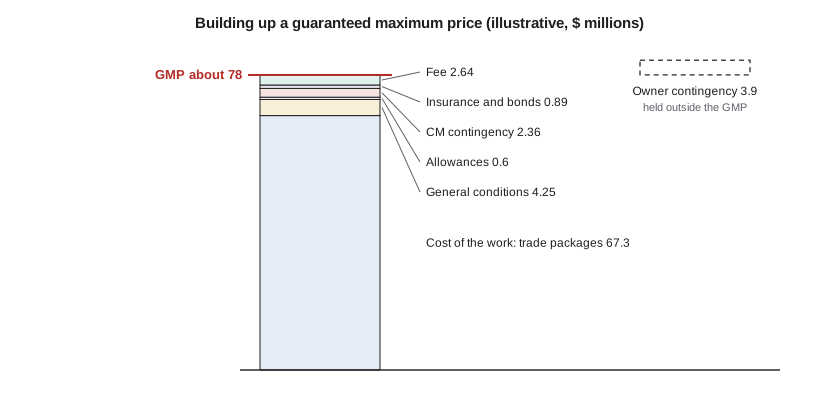
print(f"Owner contingency (outside GMP, 5 %) {owner_contingency:,}; owner budget needed {gmp + owner_contingency:,}")Cost of the work 67,300,000 General conditions 4,250,000 Allowances 600,000 CM contingency 2,356,000.0 Insurance and bonds 894,000.0 Fee 2,639,000.0 GMP 78,039,000.0 Owner contingency (outside GMP, 5 %) 3,902,000.0; owner budget needed 81,941,000.0
In this example the GMP comes to about $78 million and the owner holds a further 5 %, about $3.9 million, outside it. The two contingencies serve different purposes. The construction manager's contingency covers risks the construction manager carries under the GMP, such as buyout misses or coordination problems. The owner's contingency covers risks the owner keeps, such as owner-requested changes and unforeseen conditions. Mixing them up, or allowing the construction manager's contingency to be spent on owner changes, is a common source of disputes.
Shared savings and open books
Because the owner reimburses the actual cost of the work, a CMAR contract is open book: the owner may audit the construction manager's costs, subcontracts and invoices. If the final cost of the work plus fee is below the GMP, the contract usually splits the savings between owner and construction manager, often 75/25 or 50/50 in the owner's favour, or returns them all to the owner. Shared savings give the construction manager a reason to keep costs down after the GMP is set, rather than spending up to the ceiling.
Worked problem
Shared savings at completion
A GMP is $80,000,000. At completion the cost of the work, general conditions, insurance and bonds total $74,900,000 and the fee is a fixed $2,700,000. Any contingency not spent is simply not billed. The contract shares savings 75 % to the owner and 25 % to the construction manager. What does the owner pay, and what does the construction manager earn in total?
Show solution
- Actual cost plus fee: 74,900,000 + 2,700,000 = $77,600,000.
- Savings below GMP: 80,000,000 − 77,600,000 = $2,400,000.
- Construction manager share: 0.25 × 2,400,000 = $600,000; owner share $1,800,000.
- Owner pays 77,600,000 + 600,000 = $78,200,000; construction manager earns fee 2,700,000 + 600,000 = $3,300,000.
Answer: The owner pays $78.2 million, $1.8 million below the GMP, and the construction manager earns $3.3 million.
# What the owner pays under a GMP with shared savings, for different final costs (illustrative)
gmp, fee, cm_share = 80_000_000, 2_700_000, 0.25
for cost in (72_000_000, 74_900_000, 77_300_000, 79_000_000):
    total = cost + fee
    if total <= gmp:
        savings = gmp - total
        owner_pays = total + cm_share * savings
        cm_earns = fee + cm_share * savings
    else:
        owner_pays = gmp                    # CM absorbs the overrun
        cm_earns = fee - (total - gmp)
print(f"cost {cost:>11,}: owner pays {owner_pays:>12,.0f} CM earns {cm_earns:>11,.0f}")cost 72,000,000: owner pays 76,025,000 CM earns 4,025,000 cost 74,900,000: owner pays 78,200,000 CM earns 3,300,000 cost 77,300,000: owner pays 80,000,000 CM earns 2,700,000 cost 79,000,000: owner pays 80,000,000 CM earns 1,000,000
When costs exceed the GMP, the construction manager absorbs the overrun out of its fee and then its own funds, unless the overrun was caused by an owner change or another event that adjusts the GMP. That is the "at risk" in construction management at risk. In practice, much negotiation over a GMP concerns which events adjust it: owner changes always do, design development within the intent of the documents usually does not, and unforeseen site conditions depend on the contract.
When to set the GMP
Setting the GMP early gives the owner price certainty sooner and allows earlier construction, but the less complete the design, the larger the contingencies the construction manager will demand and the more arguments there will be about whether later design detail is a change or merely development. Setting it late reduces those risks but leaves the owner without a committed price for longer, and the method starts to look like design-bid-build with a construction manager attached. Many owners set the GMP at 60 to 90 % construction documents, and some use early GMPs or early work amendments for site work and long-lead packages before the main GMP.
| GMP timing | Advantages | Disadvantages |
|---|---|---|
| Early (schematic or design development) | Earliest price commitment and fast-tracking | Large contingencies; frequent disputes over design development |
| Middle (50 to 70 % construction documents) | Balance of certainty and speed | Some detail still missing; allowances needed |
| Late (90 to 100 % construction documents) | Smallest contingencies; fewest scope disputes | Little time saving; owner waits for price |
Schedule overlap
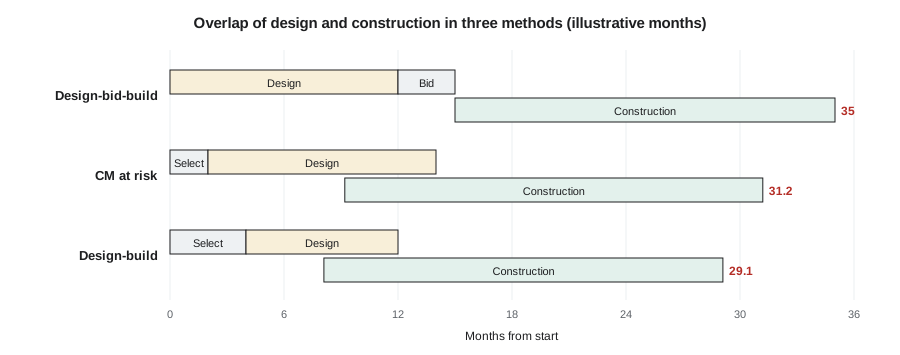
The main schedule advantage of CMAR is overlap. Because the construction manager is on board, it can release early packages, such as demolition, excavation, foundations or long-lead equipment, under early work amendments while the rest of the design continues. The model below compares a sequential design-bid-build schedule with a CMAR schedule that releases packages in stages.
# Staged release under CMAR compared with design-bid-build (months; illustrative)
design, bid, build = 16, 3, 28
dbb_finish = design + bid + build
stages = [  # (package, design month when released, months of work on critical path once started)
    ("Early works: excavation and shoring", 6, 4),
    ("Foundations and structure (early GMP)", 9, 9),
    ("Main GMP: envelope, interiors, MEP", 13, 18),
]
t = 0
for name, release, dur in stages:
    start = max(release + 1, t)          # one month to buy the package after release
    t = start + dur
    print(f"{name:40} starts month {start:3}, critical work to month {t}")
cmar_finish = t + 2                      # commissioning and closeout
print(f"Design-bid-build finish: month {dbb_finish}; CMAR finish: month {cmar_finish}; saving {dbb_finish - cmar_finish} months")Early works: excavation and shoring starts month 7, critical work to month 11 Foundations and structure (early GMP) starts month 11, critical work to month 20 Main GMP: envelope, interiors, MEP starts month 20, critical work to month 38 Design-bid-build finish: month 47; CMAR finish: month 40; saving 7 months
Selecting the construction manager
Public owners usually select a CMAR in two steps: a request for qualifications to shortlist three to five firms, and a request for proposals with interviews, in which firms present their team, approach to preconstruction and buyout, and price only their fee, general conditions and sometimes preconstruction services. Price is typically weighted 10 to 30 % of the score. Because the construction manager will be spending the owner's money on trades, owners look closely at the firm's buyout practices: how it bids trade packages, whether it may self-perform and on what terms, and how it treats savings.
Canadian public owners generally use CMAR under their normal procurement policies, selecting the construction manager by a scored request for proposals and requiring trade packages to be competitively tendered, often through bid depositories where they operate. The trade agreement thresholds discussed in CON-330 lesson 10 apply to the construction manager selection and, on covered public projects, to how trade packages are bought.
Worked problem
Checking a CM/GC price against an independent estimate
A state transportation department uses CM/GC for a bridge replacement. The contractor's price for the construction phase is $38,700,000. The independent cost estimate is $36,900,000 and the designer's estimate is $37,400,000. The department's policy is to accept a price within 10 % of the independent estimate and otherwise negotiate or go to bid. Is the price within the policy limit?
Show solution
- Difference from the independent estimate: 38,700,000 − 36,900,000 = $1,800,000.
- Percentage: 1,800,000 ÷ 36,900,000 ≈ 4.9 %.
- That is within 10 %.
Answer: Yes, the price is about 4.9 % above the independent estimate and within the policy. The department may still negotiate specific items where the estimates differ most.
Standard contracts
| Purpose | Canada | United States |
|---|---|---|
| Owner and construction manager, services and construction with GMP | CCDC 5B-2025 Construction Management Contract for Services and Construction | AIA A133-2019 (owner and CM as constructor, cost plus fee with GMP) with A201-2017; ConsensusDocs 500 |
| Construction manager and trade contractor | CCDC 17-2025 adapted, CCA 1, or contractor forms | AIA A401-2017; ConsensusDocs 750 |
| Early work or GMP amendment | Change or amendment under CCDC 5B | GMP amendment exhibit to A133 |
The 2025 edition of CCDC 5B defines pre-construction services as a separate term with its own fee model and reimbursable expenses, allows the owner to request an agreed execution plan covering methodology, procurement, self-performed work costing and cash flow, and extends the owner's audit window for cost of the work records to one year, according to law firm summaries published when the documents were released in June 2025.
Where CMAR works and where it struggles
CMAR works well for complex buildings, occupied renovations, phased projects and projects where the owner wants to keep its own designer and control of the design while gaining a builder's input and an early price. It struggles when the owner treats the GMP as a fixed price on an unfinished design, when the construction manager's estimates during design are optimistic to keep the project moving, or when the relationship between designer and construction manager breaks down, since they have no contract with each other. It also struggles where trade markets are thin, because the competitive buyout that protects the owner's interest needs enough bidders on each package.
Common mistakes
MistakeTreating a GMP set at 60 % design as a fixed price for any later detail.
InsteadAgree in the contract how design development and changes adjust the GMP.
MistakeSpending the construction manager's contingency on owner changes.
InsteadKeep CM and owner contingencies separate, with clear rules for each.
MistakeSelecting the construction manager mostly on fee.
InsteadWeight qualifications, approach and buyout practices; the fee is a small part of total cost.
MistakeAccepting a GMP without checking the trade pricing.
InsteadReview trade estimates or bids and use an independent estimate where possible.
MistakeForgetting the audit right.
InsteadUse the open-book audit to confirm the cost of the work and savings.
Summary and key terms
- Under CMAR the construction manager provides preconstruction services, then commits to a guaranteed maximum price and holds the trade contracts.
- A GMP combines the cost of the work, general conditions, allowances, CM contingency, insurance and bonds, and a fee; the owner contingency sits outside it.
- The contract is open book, and savings below the GMP are often shared.
- Costs above an unadjusted GMP are absorbed by the construction manager.
- GMP timing trades price certainty and speed against contingency size and scope disputes.
- Early work amendments allow overlap and shorter schedules.
- CCDC 5B-2025 in Canada and AIA A133-2019 and ConsensusDocs 500 in the United States are the main forms.
- Construction management at risk
- Delivery in which a construction manager provides preconstruction services and then builds under a guaranteed maximum price.
- CM/GC
- Construction manager/general contractor, the transportation version of CMAR.
- Guaranteed maximum price (GMP)
- The maximum the owner will pay for the cost of the work and fee, except for adjustments allowed by the contract.
- GMP amendment
- The contract amendment that sets the GMP and authorizes construction.
- Early work amendment
- An amendment authorizing a package to start before the main GMP.
- Construction manager contingency
- A contingency inside the GMP for risks the construction manager carries.
- Owner contingency
- Money the owner holds outside the GMP for its own risks.
- Shared savings
- The split of any amount by which final cost plus fee is below the GMP.
- Open book
- An arrangement in which the owner may see and audit the contractor's actual costs.
- Independent cost estimate
- An estimate prepared by a third party to check a negotiated price.
Practice problems
Work each problem on paper first, then reveal the answer to check.
When does a CMAR construction manager start to bear cost risk?
Show answer
When the GMP is agreed and the GMP amendment signed.
Name four components inside a GMP.
Show answer
Cost of the work, general conditions, CM contingency, allowances, insurance and bonds, fee.
Where does the owner contingency sit?
Show answer
Outside the GMP, controlled by the owner.
A GMP is $50 million; final cost plus fee is $48 million; savings split 75/25. What does the CM receive?
Show answer
25 % of $2 million = $500,000.
Final cost plus fee is $51.2 million against an unadjusted GMP of $50 million. Who pays the $1.2 million?
Show answer
The construction manager.
Why are early GMPs harder to agree?
Show answer
The design is less complete, so contingencies are larger and scope disputes more likely.
What is CM/GC?
Show answer
The transportation form of CMAR, often with the owner keeping the right to bid the construction.
Which CCDC document is used for CM for services and construction?
Show answer
CCDC 5B-2025.
Why weight buyout practices in CMAR selection?
Show answer
The construction manager spends the owner's money buying trades, so its buyout practices affect cost.
A CM/GC price is $21.0 million and the independent estimate is $19.6 million. What is the difference as a percentage?
Show answer
About 7.1 % above.
Lesson quiz · 5 questions
Score 60% or more to complete this lesson.
Create a free account to save your progress, take quizzes and earn a certificate.