
CON-355 · Lesson 11 of 12 · 20 min
Building a safety culture
Two sites can have the same safety plan, the same procedures and the same equipment and still perform very differently. On one, workers point out hazards, stop work when something looks wrong and report near misses because they expect something to be done. On the other, workers keep their heads down, near misses go unreported and the safety rules are something to follow when the superintendent is watching. The difference is culture: the shared beliefs and habits about safety that shape what people do when no one is checking. This lesson covers what supervisors can do to build a strong safety culture, how to measure it with leading indicators, and why preventing serious injuries and fatalities needs a different focus from preventing minor injuries.
What safety culture is, and who shapes it
Safety culture is often described as 'how we do things around here when no one is looking'. It is shaped by many things, including company policy, contracts, schedules and pay, but the strongest influence on most workers is the behaviour of their immediate supervisor. A worker learns what really matters by watching what the foreman notices, praises, tolerates and punishes. If the foreman walks past an open edge to talk about production, the worker learns that production comes first. If the foreman stops to fix the edge before talking about production, the worker learns the opposite.
Dana's view, after twenty years as a superintendent, is that culture changes one conversation at a time. On Larkspur Commons, he set himself three habits from the first week: start every conversation with a crew by asking about safety before schedule; respond to every report of a problem with thanks before anything else; and never let a production push become a reason to skip a control. None of these is in the site safety plan, and all of them shaped the site more than the plan did.
Lagging and leading indicators
Most construction companies have measured safety with lagging indicators, which count harm after it happens: recordable injuries, lost-time injuries, injury rates and claims costs. Lagging indicators matter, but they have three weaknesses. They arrive too late to prevent the harm they count. On a single project they are too few to show a trend, as lesson 8 showed when one injury moved the rate by a full point. And they can be improved by under-reporting, which makes a site look safer while making it less safe.
Leading indicators measure the activities and conditions that prevent harm. Larkspur Commons tracks a small set.
| Leading indicator | What it shows | Larkspur Commons target |
|---|---|---|
| Hazard and near-miss reports per 100 workers per month | Whether people are noticing and speaking up | Rising, then stable at a high level |
| Stop-work calls | Whether the stop-work authority is real | At least a few each month |
| Corrective actions closed on time | Whether findings turn into fixes | 90 percent or more |
| Supervisor field observations per week | Whether supervisors are out with their crews | At least five per supervisor |
| Toolbox talks held with actions closed | Whether talks lead to change | All held; 80 percent of actions closed |
| Orientation and training compliance | Whether people are prepared before they start | 100 percent before work |
| High-potential events investigated within 48 hours | Whether the most serious lessons are learned | 100 percent |
Leading indicators can be gamed too. A target for observations can produce a flood of trivial ones; a target for near-miss reports can produce made-up reports. Priya guards against this by reading a sample of the reports each month and by watching the indicators together rather than one at a time. More near-miss reports with fewer corrective actions closed, for example, suggests that people are reporting but nothing is being done, which will soon stop the reporting.
# Leading-indicator dashboard, months 9-12 (illustrative)
months = ["M9", "M10", "M11", "M12"]
workers = [118, 124, 121, 110]
near_miss = [21, 29, 37, 34]
stop_work = [1, 5, 4, 3]
ca_on_time = [0.78, 0.84, 0.91, 0.93]
observations = [52, 61, 70, 66]
hipo_48h = [(1, 1), (2, 1), (2, 2), (1, 1)]   # (high-potential events, investigated within 48 h)
for i, m in enumerate(months):
    rate = near_miss[i] / workers[i] * 100
    hp, inv = hipo_48h[i]
    print(f"{m}: near misses {rate:4.1f}/100 workers, stop-work {stop_work[i]}, CA on time {ca_on_time[i]:.0%}, "
          f"observations {observations[i]}, high-potential investigated {inv}/{hp}")
trend = (near_miss[-1] / workers[-1]) / (near_miss[0] / workers[0])
print(f"near-miss reporting rate up {trend - 1:.0%} since M9 while on-time closure rose to {ca_on_time[-1]:.0%}")M9: near misses 17.8/100 workers, stop-work 1, CA on time 78%, observations 52, high-potential investigated 1/1 M10: near misses 23.4/100 workers, stop-work 5, CA on time 84%, observations 61, high-potential investigated 1/2 M11: near misses 30.6/100 workers, stop-work 4, CA on time 91%, observations 70, high-potential investigated 2/2 M12: near misses 30.9/100 workers, stop-work 3, CA on time 93%, observations 66, high-potential investigated 1/1 near-miss reporting rate up 74% since M9 while on-time closure rose to 93%
The dashboard tells a consistent story. After the pump truck stop-work event in month 9 and the changes to near-miss reporting from lesson 6, reporting rose by more than half and stayed up, stop-work calls became normal, and corrective actions were closed on time more often. The one gap was month 10, when one of two high-potential events was not investigated within 48 hours because Omar was away; Dana named a backup investigator after that.
Serious injuries and fatalities
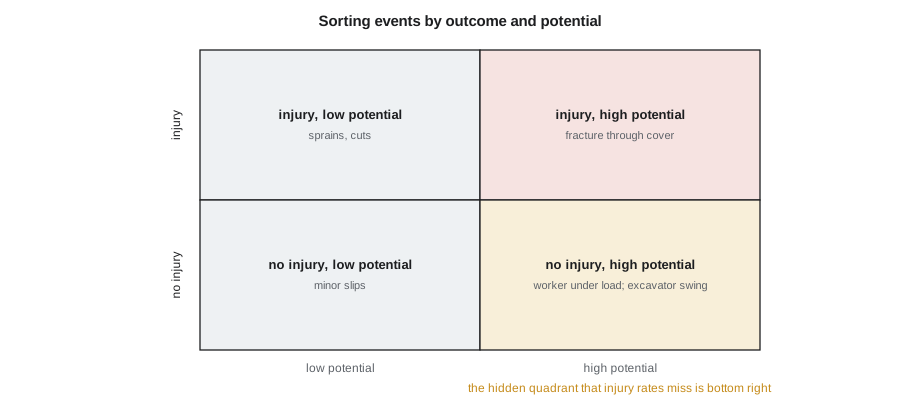
For decades, many companies assumed that if they reduced minor injuries, serious injuries and fatalities would fall in proportion. Research by safety consultancies and industry groups over the past fifteen years has challenged that idea: in many industries total injury rates fell substantially while fatality rates fell much less. The explanation is that serious injuries and fatalities often come from different situations than minor ones. Sprains and cuts come from common, everyday tasks; fatalities come from a smaller set of high-energy situations, such as falls from height, suspended loads, mobile equipment, trench collapse and electrical contact, where the controls fail or are absent.
The SIF approach used on Larkspur Commons has three parts. First, every incident and near miss is classified by its potential, not only its actual outcome: a dropped hammer that hit no one is a high-potential event; a cut finger that needed stitches is not. Second, high-potential events get the deeper investigation from lesson 8, whatever their actual outcome. Third, the high-energy hazards on site have life-saving rules and critical controls that are checked in the field, such as tie-off at leading edges, no one under a load and no entry to an unprotected trench, with zero tolerance for missing critical controls.
# Classify a quarter's incidents and near misses by actual outcome and SIF potential (illustrative)
events = [  # (description, actual outcome, high-energy source present, critical control failed or absent)
    ("cut hand on sheathing edge", "first aid", False, False),
    ("hammer dropped from level 5 into exclusion zone", "none", True, False),
    ("ankle fracture through unsecured cover", "lost time", True, True),
    ("sprained wrist carrying blocking", "medical aid", False, False),
    ("worker under panel during crane lift", "none", True, True),
    ("excavator swung near worker, no contact", "none", True, True),
    ("eye irritation from dust", "first aid", False, False),
]
sif_potential = [e for e in events if e[2] and e[3]]
print(f"{len(events)} events; {len(sif_potential)} with SIF potential (high energy and a failed or absent critical control):")
for d, outcome, _, _ in sif_potential:
    print(f"  {d} (actual outcome: {outcome})")
print("injury-only view would have flagged:", [d for d, o, *_ in events if o in ("lost time", "medical aid")])7 events; 3 with SIF potential (high energy and a failed or absent critical control): ankle fracture through unsecured cover (actual outcome: lost time) worker under panel during crane lift (actual outcome: none) excavator swung near worker, no contact (actual outcome: none) injury-only view would have flagged: ['ankle fracture through unsecured cover', 'sprained wrist carrying blocking']
Two of the three SIF-potential events caused no injury at all. An injury-only view would have flagged the ankle fracture and the sprained wrist, and missed the worker under the panel and the excavator swinging near a worker, either of which could have been a fatality. That is the core of SIF thinking: pay most attention to the events that could kill, whether or not they did.
Psychological safety and just culture
Workers report problems only if they believe it is safe to do so. Psychological safety, a term from research by Amy Edmondson and others, describes a team in which people believe they will not be punished or humiliated for speaking up with concerns, questions or mistakes. On a construction site it shows up in small ways: an apprentice asks the journeyman how the anchor works rather than pretending to know; a framer tells the foreman he dropped a hammer from level 5; a subcontractor foreman admits that his crew is behind and tempted to skip the guardrail.
Psychological safety does not mean that anything goes. A just culture, an idea developed by James Reason and others, distinguishes between honest errors, at-risk choices and reckless behaviour, and responds to each differently.
| Behaviour | Example | Response |
|---|---|---|
| Honest error | A worker misreads a label and picks up the wrong sling, which is caught at the inspection | Console and fix the system: clearer labels, separate storage |
| At-risk choice | A worker skips re-anchoring for a quick reach because it has become normal on the crew | Coach, and find out why the short cut made sense; fix the conditions that encourage it |
| Reckless behaviour | A worker deliberately defeats a lockout or walks under a load after being warned | Discipline, consistently and in proportion |
Most behaviour on a site falls in the first two rows. A supervisor who treats every mistake as reckless will get fewer reports and more hidden problems; a supervisor who never disciplines reckless behaviour will lose the respect of workers who follow the rules. Lesson 2's graduated enforcement fits within this frame.
Human and organizational performance
The ideas above are part of a broader approach known as human and organizational performance (HOP), associated with Todd Conklin and others and covered in HSE-408. Its principles are simple to state: people make mistakes, even good people; blame fixes nothing; context drives behaviour, so the way work is set up shapes what people do; learning from normal work is as important as learning from failures; and how leaders respond to bad news decides whether they hear any more of it. For a superintendent, HOP turns into practical questions: when something goes wrong, what made sense to the people at the time? Where are we relying on people never making a mistake? What would make the right way the easy way?
Dana's 'learning team' sessions are an example. After the dropped-object near misses in lesson 6, instead of a lecture on tool lanyards, he brought six framers together for half an hour and asked them how tools ended up falling. They explained that the scaffold planks had gaps at the building face where tools slid off, that the tool lanyards supplied were too short to use comfortably, and that material was stacked at the edge because there was nowhere else to put it. The fixes, deck boards at the building face, longer lanyards and a material staging area on each floor, came from the people who did the work.
Recognition without hiding injuries
Recognition programs can strengthen a safety culture or quietly damage it. Programs that reward crews for having no reported injuries encourage people not to report them: the worker with a cut hand keeps quiet so the crew does not lose its barbecue. Thornbury does not reward injury-free periods. It recognizes the behaviours that prevent injuries: good catches, stop-work calls, high-quality hazard assessments, crews that close their corrective actions, and workers who mentor new hires.
Safety committees and worker participation
British Columbia requires a joint health and safety committee in workplaces where 20 or more workers are regularly employed, and a worker health and safety representative where there are more than 9 and fewer than 20. The committee has worker and employer members, meets regularly (generally monthly), helps identify hazards, takes part in inspections and investigations, and makes recommendations the employer must answer. On a construction site with many employers, Thornbury also runs a site safety committee that brings together worker and supervisor members from each major trade, because the hazards on site do not respect company boundaries.
The committee is useful only if it has real influence. On Larkspur Commons it takes part in the weekly formal inspection, reviews near misses and investigations, and makes recommendations that Dana answers in writing within two weeks. Its best recommendation of the year was the material landing platforms from lesson 7.
Crews that look out for each other
A strong culture is visible in how workers treat each other: the experienced framer who shows the apprentice how to re-anchor without being asked, the electrician who tells the drywaller that his ladder is on a cord, the crew that waits for the new worker to clip in before moving on. Supervisors can encourage this by making mentoring part of the job for experienced workers (lesson 4), by mixing crews thoughtfully so that new workers are never grouped together, by making sure communication works across languages, and by noticing and thanking it when it happens.
Common mistakes
MistakeMeasuring safety only by injury rates.
InsteadTrack a small set of leading indicators together, and read a sample of the underlying reports.
MistakeAssuming that fewer minor injuries means fewer fatalities.
InsteadClassify events by potential, investigate high-potential events deeply and check critical controls for high-energy hazards.
MistakeTreating every mistake as misconduct.
InsteadUse just culture: console honest errors, coach at-risk choices and fix their causes, discipline reckless behaviour.
MistakeRewarding crews for having no reported injuries.
InsteadRecognize the behaviours that prevent injuries, such as good catches and stop-work calls.
MistakeRunning a safety committee whose recommendations go nowhere.
InsteadAnswer every recommendation in writing within a set time and act on it.
Summary and key terms
- Safety culture is what people do when no one is checking, and the immediate supervisor shapes it most.
- Lagging indicators count harm; leading indicators measure prevention and should be read together.
- SIF prevention classifies events by potential and focuses on high-energy hazards and critical controls.
- Psychological safety lets people speak up; just culture responds differently to honest errors, at-risk choices and reckless behaviour.
- Human and organizational performance asks what made sense at the time and how to make the right way the easy way.
- Recognition should reward preventive behaviours, not injury-free periods.
- BC requires a joint committee at 20 or more workers and a representative for 10 to 19; site committees bring trades together.
- Safety culture
- The shared beliefs and habits about safety that shape what people do when no one is checking.
- Leading indicator
- A measure of activities or conditions that prevent harm, such as near-miss reporting or corrective action closure.
- Serious injury or fatality (SIF) potential
- The potential of an event to cause a fatality or life-altering injury, regardless of its actual outcome.
- Critical control
- A control that must be in place to prevent a high-energy hazard from causing a fatality.
- Psychological safety
- A shared belief in a team that people will not be punished or humiliated for speaking up.
- Just culture
- An approach that responds differently to honest errors, at-risk choices and reckless behaviour.
- Human and organizational performance
- An approach to safety that treats error as normal and focuses on the conditions that shape work.
Practice problems
Work each problem on paper first, then reveal the answer to check.
Name three weaknesses of lagging indicators.
Show answer
They arrive too late, are too few on a single project to show trends, and can be improved by under-reporting.
In the dashboard, what gap appeared in month 10 and how was it fixed?
Show answer
One high-potential event was not investigated within 48 hours because Omar was away; a backup investigator was named.
Which events in the classification had SIF potential but caused no injury?
Show answer
The worker under the panel during a crane lift and the excavator swinging near a worker (and the hammer drop was high energy but had working controls).
A worker skips re-anchoring for a quick reach because the crew always does. Which just-culture category is this, and what is the response?
Show answer
An at-risk choice: coach, and find and fix the conditions that make the short cut seem reasonable.
Why does Thornbury not reward injury-free periods?
Show answer
Because such rewards discourage reporting; it recognizes preventive behaviours instead.
Lesson quiz · 5 questions
Score 60% or more to complete this lesson.
Create a free account to save your progress, take quizzes and earn a certificate.