
CON-355 · Lesson 6 of 12 · 19 min
Toolbox talks, stop-work authority and near-miss reporting
Hazard assessments, plans and inspections are systems. They only work if people talk to each other: if the foreman tells the crew what changed today, if a worker tells the foreman what nearly happened yesterday, and if anyone who sees danger feels able to say stop. This lesson covers three everyday practices that carry that conversation on Larkspur Commons: daily huddles and weekly toolbox talks, the stop-work authority, and near-miss reporting. None of them needs special equipment. All of them depend on how supervisors behave.
Daily huddles and weekly toolbox talks
Thornbury uses two kinds of crew meeting. The daily huddle is a five-to-ten-minute start-of-shift meeting at the work location, led by the foreman, where the crew completes its field-level hazard assessment, hears what is different today and agrees who is doing what. The weekly toolbox talk is a fifteen-to-twenty-minute meeting on a single safety topic, usually held on Monday morning, with attendance recorded.
British Columbia's Regulation requires an occupational health and safety program on larger workplaces, including regular safety meetings, and requires supervisors to make sure workers are informed of the hazards of their work. Most construction employers meet those duties partly through toolbox talks. In Washington, which Thornbury also works in, the construction rules go further and require crew leader and supervisor safety meetings at the start of each job and at least weekly.
The legal minimum is not the point. A crew that meets for five minutes every morning to talk about today's work is a crew whose foreman knows what they are worried about and whose members know what the others are doing.
What makes a toolbox talk work
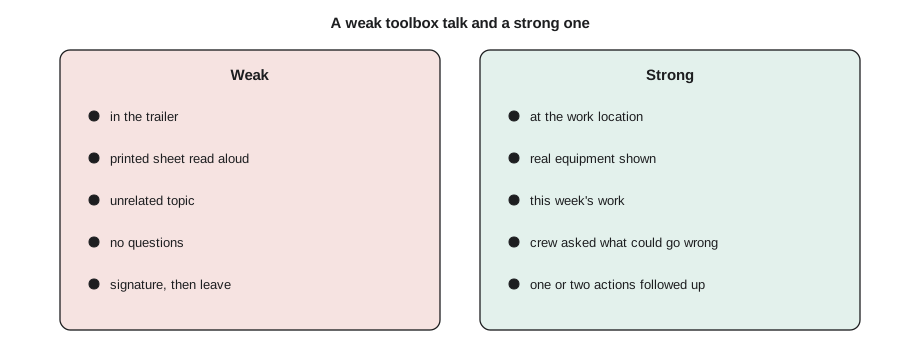
Most construction workers have sat through toolbox talks that were a supervisor reading a printed sheet about a topic unrelated to the work, followed by a signature. Those talks teach workers that safety meetings are something to endure. Priya's coaching for Larkspur Commons foremen boils down to a few rules.
| Do | Instead of |
|---|---|
| Pick a topic from this week's work, the look-ahead or a recent incident | Reading whatever sheet is next in the binder |
| Keep it to one topic and about 15 minutes | Covering five topics quickly |
| Hold it where the work is and show the real thing: the anchor, the guardrail clamp, the damaged sling | Holding it in the trailer with a handout |
| Ask questions and let workers talk: what could go wrong, what have you seen | Lecturing |
| Tell a true story, such as a near miss on this site or an incident report | Reciting regulations |
| End with one or two clear actions and follow up on them | Ending with a signature and nothing else |
| Use the crew's languages and check understanding | Assuming everyone understood |
Topics come from three sources. The look-ahead schedule from CON-335 shows what work is coming: two weeks before the roof-top units are lifted, the talk is about the lift plan and the exclusion zone. The near-miss and observation data show what is going wrong: when three near misses in a week involved unsecured materials at height, the next talk was about dropped objects. And the season brings its own topics: heat stress in July, wildfire smoke in August, slips on ice and cold stress in December.
Thornbury also rotates who leads the talk. Once a month a worker leads it, usually on a topic from their own trade. The best talk on Larkspur Commons in the spring was given by a second-year electrical apprentice, Jas Gill, about the time a coworker on another site was nearly electrocuted by a mislabelled panel. Twenty framers who had never thought much about lockout listened to every word, because the speaker was one of them and the story was real.
Measuring toolbox talks without turning them into paperwork
Attendance is easy to count and says little on its own. Thornbury tracks three things: whether each crew held its talk, the share of workers who attended, and whether the actions raised at the talk were closed. The last one is the most telling.
# Toolbox talk record for a four-week period, by crew (illustrative)
crews = {
    # crew: (talks held, talks scheduled, attendance, workers on crew, actions raised, actions closed)
    "Thornbury carpenters": (4, 4, 34, 36, 5, 5),
    "Ridgeline Framing":    (4, 4, 101, 112, 9, 6),
    "Northgate Mechanical": (3, 4, 30, 40, 2, 1),
    "Ashgrove Electric":    (4, 4, 46, 48, 4, 4),
    "Summit Drywall":       (2, 4, 18, 44, 1, 0),
}
print(f"{'crew':22s} held  attend  actions closed")
for c, (held, sched, att, possible, raised, closed) in crews.items():
    att_rate = att / possible
    closed_rate = closed / raised if raised else 1.0
    flag = "  <- follow up" if held < sched or att_rate < 0.85 or closed_rate < 0.75 else ""
print(f"{c:22s} {held}/{sched} {att_rate:5.0%} {closed}/{raised} ({closed_rate:4.0%}){flag}")crew held attend actions closed Thornbury carpenters 4/4 94% 5/5 (100%) Ridgeline Framing 4/4 90% 6/9 ( 67%) <- follow up Northgate Mechanical 3/4 75% 1/2 ( 50%) <- follow up Ashgrove Electric 4/4 96% 4/4 (100%) Summit Drywall 2/4 41% 0/1 ( 0%) <- follow up
Summit Drywall held only two of its four talks, had low attendance and closed none of the actions raised. Northgate missed a talk and closed half its actions. Ridgeline held every talk but closed only six of nine actions. Dana raised all three at the weekly coordination meeting, and for Summit he asked to attend the next talk himself. A crew that does not hold its talks is often a crew whose foreman is overloaded, and the conversation that follows is about supervision, not paperwork.
Stop-work authority
Every worker on Larkspur Commons, whatever their employer, trade or experience, has the authority to stop any work they believe is unsafe, their own or anyone else's. This goes further than the legal right to refuse described in lesson 1. The right to refuse lets a worker refuse their own unsafe work; the stop-work authority lets an apprentice stop a crane lift by another company if he sees someone walk under the load.
A stop-work authority is easy to write and hard to make real. Workers will use it only if they believe nothing bad will happen to them when they do, and they learn what to believe by watching what happens the first few times. Thornbury's procedure is deliberately simple.
- Say stop. Any clear signal works: 'stop', a raised hand, the crane's all-stop signal.
- Make the area safe. Stop the activity, keep people away from the hazard, and do not restart until it is resolved.
- Tell a supervisor. The worker's own foreman and the foreman of the work that was stopped are informed straight away.
- Resolve it. The supervisors and the worker look at the concern together. Either it is fixed, or it is explained and the worker is satisfied, or the superintendent decides.
- Thank the worker. Always, including when the concern turns out to be unfounded.
- Record it. Every stop is logged with what happened and what was changed, and shared at the next coordination meeting.
The fifth step is the one that decides whether the system works. In month 9, a labourer from the concrete subcontractor stopped a pump truck because he thought the outriggers were set on fill over a recently backfilled trench. The pump operator was annoyed, the concrete trucks were waiting and the pour was delayed by forty minutes while Omar checked the ground and had the outriggers moved onto mats on firm ground. The labourer was right. At the next coordination meeting Dana named him, thanked him in front of every foreman on site, and the concrete subcontractor's owner gave him a gift card. In the following month, stop-work calls on the site went from about one a month to five, and Dana counted that as one of the best results of the year.
Not every stop will be justified. A worker who stops a task over something that turns out to be safe should be thanked just as warmly, and the explanation should be given respectfully. If a stop-work call is ever met with anger, ridicule or a quiet loss of hours, the authority is gone for everyone who saw it.
Near-miss reporting
A near miss is an event that could have caused injury or damage but did not: the hammer that fell from level 5 and landed in the empty exclusion zone, the worker who stepped onto an unsecured opening cover that shifted, the truck that reversed without a spotter and stopped a metre short of a worker. Near misses are free lessons. They show where the controls are weak before someone pays for it.
Construction sites typically report far fewer near misses than actually happen. Workers do not report them because it takes time, because they fear blame for themselves or a coworker, because they think nothing will be done, or because they do not recognize the event as worth reporting. Each reason has a remedy.
| Why near misses go unreported | What Thornbury does about it |
|---|---|
| It takes too long | A QR code on every floor and the hoist opens a three-question form; foremen can also report verbally at the huddle |
| Fear of blame | Near-miss reports are used to fix conditions, never to discipline the reporter; anonymous reporting is allowed |
| Nothing will happen | Every report gets an answer within a week, and fixes are shared at the toolbox talk ("you told us, we did") |
| It did not seem important | Toolbox talks give examples of near misses, and good catches are recognized monthly |
| It was someone else's company | Reports about any employer's work are welcome; the site is shared |
Reports are only useful if someone looks at them. Priya and Omar review near misses weekly, sort them by type and potential severity, and look for patterns. A near miss that could have killed someone, such as a dropped object from height or a load swinging over workers, is investigated like an injury (lesson 8), because the only difference between it and a fatality was luck.
# Near-miss reports for one quarter, sorted by type (Pareto), with high-potential events counted
from collections import Counter
reports = (["dropped object from height"] * 14 + ["unsecured or shifted opening cover"] * 6 +
           ["vehicle reversing without spotter"] * 5 + ["slip or trip on debris"] * 11 +
           ["ladder misuse"] * 4 + ["guardrail removed and not replaced"] * 7 + ["electrical cord damage"] * 3)
high_potential = {"dropped object from height", "unsecured or shifted opening cover",
                  "vehicle reversing without spotter", "guardrail removed and not replaced"}
counts = Counter(reports).most_common()
total = sum(n for _, n in counts)
cum = 0
for kind, n in counts:
    cum += n
    hp = "  high potential" if kind in high_potential else ""
    print(f"{kind:36s} {n:3d}  {cum / total:5.0%}{hp}")
print(f"total {total}; high-potential {sum(n for k, n in counts if k in high_potential)}")dropped object from height 14 28% high potential slip or trip on debris 11 50% guardrail removed and not replaced 7 64% high potential unsecured or shifted opening cover 6 76% high potential vehicle reversing without spotter 5 86% high potential ladder misuse 4 94% electrical cord damage 3 100% total 50; high-potential 32
Dropped objects and slips and trips make up more than half the reports. Slips and trips are the more frequent kind of injury, but dropped objects carry the higher potential: a framing hammer falling five storeys can kill. The response was to add toe boards and debris netting on the scaffold, require tool lanyards above level 3, keep the exclusion zone at the base of the frame marked and patrolled during work hours, and run a toolbox talk on dropped objects. Over the next quarter, dropped-object reports fell from fourteen to five, while total reports rose, a sign that people were still reporting.
What supervisors do that makes the difference
Huddles, toolbox talks, stop-work and near-miss reporting all rest on the same thing: workers believing that speaking up is safe and useful. Supervisors build that belief, or destroy it, in small moments. Dana's habits are worth copying: he asks workers what worries them before he tells them what worries him, he thanks people who raise problems, he follows up on what he is told and reports back, and when something goes wrong he asks what happened before he asks who did it. Lesson 11 develops these ideas into the broader subject of safety culture.
Common mistakes
MistakeReading a generic sheet in the trailer and collecting signatures.
InsteadHold a short, interactive talk at the work location on a topic from this week's work or a recent incident.
MistakeCounting toolbox talk attendance as the measure of success.
InsteadTrack whether talks were held, who attended and whether the actions raised were closed.
MistakeReacting with irritation when a worker stops work over a concern that turns out to be safe.
InsteadThank the worker, explain respectfully and record the stop; every response teaches the whole crew.
MistakeUsing near-miss reports to find someone to blame.
InsteadUse them to fix conditions, answer every report and share what was changed.
MistakeTreating a high-potential near miss as a minor event because no one was hurt.
InsteadInvestigate events that could have killed someone as seriously as injuries.
Summary and key terms
- Daily huddles check today's conditions; weekly toolbox talks cover one safety topic in depth.
- Effective talks are short, local, interactive, tied to this week's work or real events, and end with actions that are followed up.
- Rotating talks to workers, especially with true stories, makes them more credible.
- Toolbox talks are measured by talks held, attendance and actions closed, not signatures.
- Stop-work authority lets anyone stop any unsafe work; it becomes real only when stops are always thanked and never punished.
- Near misses are free lessons; reporting must be easy, blame-free and answered.
- High-potential near misses are investigated like injuries, and Pareto analysis of reports shows where to act.
- Daily huddle
- A short start-of-shift crew meeting at the work location to review the day's hazards and plan.
- Toolbox talk
- A short crew meeting on a single safety topic, usually weekly.
- Stop-work authority
- The authority of any worker to stop any work they believe is unsafe.
- Near miss
- An event that could have caused injury or damage but did not.
- Good catch
- A hazard or near miss identified and reported before anyone was hurt.
- High-potential event
- A near miss or incident that could reasonably have caused a fatality or life-altering injury.
- Pareto analysis
- Ranking categories by frequency to find the few that account for most of the events.
Practice problems
Work each problem on paper first, then reveal the answer to check.
Name three sources of toolbox talk topics on Larkspur Commons.
Show answer
The look-ahead schedule, near-miss and observation data, and the season.
Which crew in the toolbox record most needed follow-up, and why?
Show answer
Summit Drywall: two of four talks held, about 41 percent attendance and no actions closed.
Why did stop-work calls rise after the pump truck event?
Show answer
Because the labourer who stopped the pour was publicly thanked and rewarded, so workers saw that using the authority was safe and valued.
Which near-miss category was most frequent, and which carried the most potential for a fatality?
Show answer
Dropped objects from height were most frequent and also carried high fatality potential; slips and trips were frequent but lower potential.
What two signs showed the dropped-object response was working?
Show answer
Dropped-object reports fell from 14 to 5 while total reports rose, so people were still reporting.
Lesson quiz · 5 questions
Score 60% or more to complete this lesson.
Create a free account to save your progress, take quizzes and earn a certificate.