
CON-355 · Lesson 4 of 12 · 18 min
Orientations, training and subcontractor safety
Workers are most likely to be hurt in their first weeks on a new job or a new site. They do not yet know where the hazards are, how this site does things or who to ask, and they are often reluctant to ask at all. Studies from Canada's Institute for Work and Health and elsewhere have found that workers in their first month on a job have a much higher risk of a lost-time injury than workers who have been there a year or more, and the pattern holds across age groups. On a construction site the problem is constant, because workers move between sites and trades join and leave the project every week. This lesson covers how Larkspur Commons brings new people onto the site, how training is managed, and how Thornbury makes sure that subcontractors, whose workers outnumber Thornbury's by about six to one at the peak, work to the same standard.
The site orientation
Every person who works on Larkspur Commons receives a site orientation before they start work, including subcontractor workers, delivery drivers who will leave their cab, inspectors and consultants. The content follows a checklist that matches the site safety plan.
| Topic | What new workers learn |
|---|---|
| The project and the people | What is being built, who the superintendent, assistant superintendent, safety coordinator and first aid attendants are, and how to reach them |
| Site layout and access | Gates, sign-in, laydown, the crane swing radius, the hoist, pedestrian routes, washrooms, the first aid room |
| Emergency procedures | The alarm signal, muster points, how to call for help and the emergency card |
| Site rules | Personal protective equipment, the fall protection rules, housekeeping, smoking, impairment, working alone, mobile phones while operating equipment |
| Major hazards now | The hazards of the current phase from the hazard register and where they are |
| Reporting and rights | How to report hazards, near misses and injuries; the right to refuse unsafe work and the stop-work authority |
| The worker's own work | Confirmation from the worker's supervisor that they are trained for the tasks they will do |
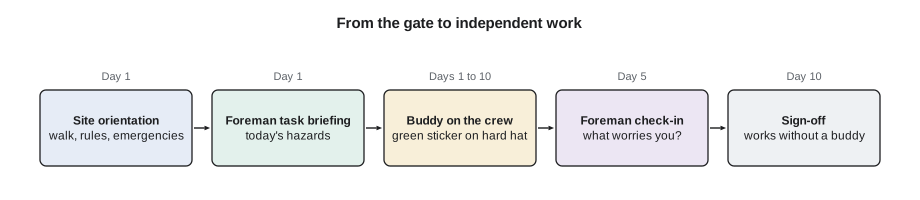
The orientation takes about 45 minutes, includes a walk of the site, and ends with a short quiz and a signature. It is not a video played in the trailer while the new worker looks at their phone. Omar or Priya leads it, and the worker's own foreman is expected to take over immediately afterwards with a task-specific briefing: the hazards of the work they will do today, the procedures, the equipment and who they should ask. A worker who walks out of the orientation to an empty work area with no one to tell them what to do has not been oriented.
Visitors who will not do any work get a shorter briefing and must be escorted. Delivery drivers who stay with their trucks get the traffic rules at the gate.
New, young and inexperienced workers
British Columbia's Regulation requires employers to give young and new workers a health and safety orientation and training specific to the workplace before they start work, and to record it. A young worker is someone under 25 and a new worker is anyone new to the workplace, returning after an absence, or affected by a change in the workplace. The Regulation lists the topics, and the employer must make sure the worker is supervised by a qualified person until they can do the work safely. Thornbury applies the same approach to every worker who is new to the site.
Thornbury's practice for the first two weeks has three parts. Each new worker is paired with an experienced worker on the same crew, who is told that this is part of their job. The foreman checks in with the new worker at the end of the first day and the first week, asking two questions: what is the most dangerous thing you have seen here, and what are you unsure about? And new workers wear a green hard hat sticker for their first two weeks so that everyone on site knows to look out for them. The sticker is not a badge of shame; it is a signal for others to help.
Language is a real barrier on many construction sites. On Larkspur Commons about a fifth of the framing crew speaks Punjabi as a first language, and several drywall workers speak Spanish. Thornbury's orientation materials are translated, Priya has trained bilingual workers on each crew to help with orientation and toolbox talks, and site signs rely on pictograms where possible. The test is not whether the material was translated but whether the worker understood it, which is why the orientation ends with the worker explaining the alarm and the fall protection rules back in their own words.
Training requirements and records
Orientation tells a worker about the site; training gives them the skills for their tasks. Thornbury keeps a training matrix that lists, for each task on site, the training required, who can deliver it and how long it remains current.
| Task | Training required | Renewal |
|---|---|---|
| Working at heights with personal fall protection | Fall protection training to the site's plan, including inspection of equipment and rescue | Company rule: every 3 years, or sooner if practices change |
| Erecting or using frame scaffolds | Scaffold erection or user training | Every 3 years |
| Operating aerial work platforms | Operator training to the manufacturer and CSA standards, with familiarization on the model | Every 3 to 5 years and on new models |
| Rigging and signals | Qualified rigger and signaller training | Company rule: every 3 years |
| Hazardous products | WHMIS 2015 training (HSE-102) | Annual review |
| Silica-generating tasks | Exposure control plan training | Annual review |
| First aid | First aid certificate at the level set by the assessment | As the certificate requires (typically 2 or 3 years) |
Records are what make the matrix useful. Before a worker starts a task that needs training, their foreman checks the record. Priya runs a weekly report of training that will expire in the next 30 days so that renewals can be booked before workers are pulled off the work.
# Training records expiring within 30 days, and workers assigned to tasks without current training (illustrative)
from datetime import date, timedelta
today = date(2026, 6, 1)
records = {  # worker: {training: expiry}
    "G. Sandhu":   {"fall protection": date(2026, 6, 20), "scaffold user": date(2027, 3, 1)},
    "M. Ortega":   {"fall protection": date(2028, 1, 10), "AWP operator": date(2026, 5, 28)},
    "K. Brar":     {"fall protection": date(2027, 9, 2)},
    "D. Tremblay": {"rigging": date(2026, 6, 15), "fall protection": date(2026, 11, 3)},
}
assignments = [("G. Sandhu", "fall protection"), ("M. Ortega", "AWP operator"),
               ("K. Brar", "scaffold user"), ("D. Tremblay", "rigging")]
soon = [(w, t, d) for w, r in records.items() for t, d in r.items() if today <= d <= today + timedelta(days=30)]
print("expiring within 30 days:")
for w, t, d in sorted(soon, key=lambda x: x[2]):
    print(f"  {w:12s} {t:16s} {d}")
print("assigned without current training:")
for w, t in assignments:
    d = records[w].get(t)
    if d is None or d < today:
print(f" {w:12s} {t:16s} {'never trained' if d is None else 'expired ' + str(d)}")expiring within 30 days: D. Tremblay rigging 2026-06-15 G. Sandhu fall protection 2026-06-20 assigned without current training: M. Ortega AWP operator expired 2026-05-28 K. Brar scaffold user never trained
The second list matters more than the first. Ortega's aerial work platform training expired four days ago and Brar has never had scaffold user training, yet both were assigned to those tasks for the coming week. Omar moved Brar to another task until his training was done and had Ortega's renewal booked for the next morning before he went back on the lift.
Choosing safe subcontractors
Thornbury prequalifies every subcontractor whose work involves significant hazards before it is invited to bid. The point is not to collect paperwork but to avoid hiring a company that will bring unsafe practices onto the site and that Thornbury will then have to supervise constantly.
| Item | What it shows |
|---|---|
| WorkSafeBC clearance letter | The firm is registered with WorkSafeBC and its account is in good standing, so the prime contractor will not be liable for its unpaid premiums |
| Certificate of Recognition (COR) status | The firm's safety program has passed an external audit; in BC construction COR is administered by the BC Construction Safety Alliance and earns a financial incentive from WorkSafeBC |
| Injury rate and claims cost history | How often the firm's workers are hurt and how its rates compare with its industry classification |
| Orders and penalties in the last three years | Whether the regulator has found serious problems |
| Safety program documents | Hazard assessments, safe work procedures, training records and supervision for the work it will do |
| Supervisor qualifications | Who will supervise on site and what training and experience they have |
# Prequalification score for three framing bidders (illustrative weighting; scores out of 100)
bidders = {
    # name: (COR, injury rate vs industry, orders 3 yrs, program score 0-10, supervisor score 0-10)
    "Ridgeline Framing": (True, 0.82, 1, 8, 9),
    "Lakeview Builders": (False, 1.35, 4, 5, 6),
    "Summit Frame Co.":  (True, 1.05, 0, 7, 6),
}
def score(cor, rate_ratio, orders, program, supervisor):
    s = 20 if cor else 0
    s += max(0, 25 - 25 * max(0, rate_ratio - 0.6))      # better than industry earns more
    s += max(0, 15 - 5 * orders)
    s += 2.0 * program + 2.0 * supervisor
    return round(s, 1)
for name, v in bidders.items():
    s = score(*v)
print(f"{name:18s} {s:5.1f} {'prequalified' if s >= 60 else 'not prequalified'}")Ridgeline Framing 83.5 prequalified Lakeview Builders 28.2 not prequalified Summit Frame Co. 74.8 prequalified
The weights are Thornbury's own choices and are illustrative. What matters is that the decision is made on evidence and that the supervisor score counts. Thornbury has learned that the person a subcontractor sends to run its crew matters more to safety on site than the binder it submits, which is why the prequalification interview includes the proposed foreman.
Holding subcontractors to the standard
Prequalification is the beginning, not the end. Thornbury's subcontracts require compliance with the site safety plan and site rules, a competent supervisor on site whenever the subcontractor's workers are working, the subcontractor's own hazard assessments and training records, attendance at the site safety committee and the weekly coordination meeting, and prompt correction of hazards. Before each trade mobilizes, Omar holds a start-up meeting with its foreman to go through the site plan, the trade's own safety plan, the interfaces with other trades and the high-risk tasks in its scope.
On site, subcontractor performance is tracked the same way as Thornbury's own: observations, inspection findings, incidents and corrective action closure by trade. When Summit Drywall's crew repeatedly left floor openings uncovered after removing covers to bring in board, Dana raised it first with the Summit foreman, then in writing with Summit's project manager, and finally under the subcontract's safety default clause, which allows Thornbury to correct the hazard at Summit's cost and to require the removal of workers who repeatedly breach site rules. The written step was enough. The point is that the steps exist, are proportionate, and are used.
Common mistakes
MistakePlaying an orientation video and having workers sign without a site walk or a check of understanding.
InsteadLead a live orientation with a walk, finish with the worker explaining key rules back, and hand over to the foreman for a task briefing.
MistakeAssuming an experienced worker new to the site needs no orientation.
InsteadEvery worker new to the site gets the orientation; experience elsewhere does not tell them where this site's hazards are.
MistakeChecking training only at hiring.
InsteadCheck training records before each task assignment and run expiry reports so renewals happen before workers are pulled off the work.
MistakePrequalifying subcontractors on paperwork alone.
InsteadWeigh the evidence, including the injury record, enforcement history and the foreman who will actually supervise.
MistakeLetting subcontractor safety problems slide to avoid conflict.
InsteadUse the subcontract's steps in proportion: foreman, then written notice, then the safety default clause.
Summary and key terms
- Workers are at highest risk in their first weeks on a job or site, so orientation and early supervision matter most.
- The site orientation covers people, layout, emergencies, rules, current hazards, reporting and rights, ends with a check of understanding, and hands over to the foreman's task briefing.
- BC requires workplace-specific orientation and training for young and new workers, with records and supervision.
- Pairing, check-ins and visible markers help new workers through their first two weeks; translation is judged by understanding.
- A training matrix and records, checked before each assignment, keep workers from doing tasks they are not trained for.
- Prequalification uses the clearance letter, COR status, injury and enforcement history, program documents and the proposed supervisor.
- Subcontracts, start-up meetings, tracking by trade and proportionate escalation keep subcontractors to the site standard.
- Site orientation
- The briefing every new person receives before starting work on a site.
- New worker
- A worker new to the workplace, returning after an absence, or affected by a change in the workplace.
- Young worker
- In BC, a worker under 25 years of age.
- Training matrix
- A table of the training each task requires, who delivers it and when it expires.
- Clearance letter
- A WorkSafeBC letter confirming that an employer's account is in good standing.
- Certificate of Recognition
- A certificate showing that an employer's safety program has passed an external audit.
Practice problems
Work each problem on paper first, then reveal the answer to check.
What two questions does the foreman ask a new worker at the end of the first week?
Show answer
What is the most dangerous thing you have seen here, and what are you unsure about?
In the training report, which two assignments needed action, and what did Omar do?
Show answer
Ortega on an AWP with expired training and Brar on scaffolds with no training; Omar reassigned Brar and booked Ortega's renewal before he returned to the lift.
Why does Thornbury interview the subcontractor's proposed foreman during prequalification?
Show answer
Because the person who supervises the crew on site matters more to safety than the written program.
Which framing bidder was not prequalified in the example, and why?
Show answer
Lakeview Builders, because of no COR, a high injury rate and several orders.
What were the escalation steps with Summit Drywall over uncovered floor openings?
Show answer
The foreman first, then written notice to the project manager, then the subcontract's safety default clause if needed.
Lesson quiz · 5 questions
Score 60% or more to complete this lesson.
Create a free account to save your progress, take quizzes and earn a certificate.