
CON-355 · Lesson 7 of 12 · 19 min
Inspections and corrective action
A construction site changes every hour. A guardrail that was complete at 7:00 is missing a section at 10:00 because a trade removed it to land material; a floor cover is lifted to run a pipe; a scaffold plank is moved; a cord is crushed by a pallet jack. Inspections are how supervisors find these changes before they hurt someone, and corrective action is how the findings turn into fixes. This lesson covers the kinds of inspection used on Larkspur Commons, how to inspect well, how to rank what you find, and how to make sure findings are actually closed.
What the rules require
British Columbia's Regulation requires employers to inspect the workplace, including buildings, structures, grounds, excavations, tools, equipment and work methods, at intervals that prevent the development of unsafe working conditions, and to remedy unsafe conditions without delay. Specific parts add specific inspections: scaffolds, cranes, rigging, excavations and fall protection equipment all have their own requirements. The prime contractor's coordination duty means Thornbury's inspections cover the whole site, while each subcontractor still inspects its own equipment and work.
The inspection system on Larkspur Commons
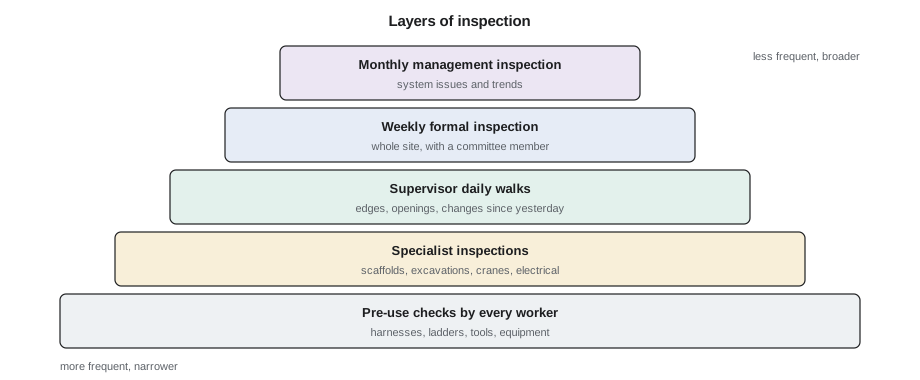
No single inspection catches everything, so Thornbury layers several.
| Inspection | Who | When | Focus |
|---|---|---|---|
| Pre-use equipment check | Each operator or user | Before each use or shift | Ladders, harnesses, lanyards, power tools, mobile equipment, aerial lifts |
| Specialist inspections | Qualified persons | As the rules require (daily, per shift, after changes) | Scaffold tags, excavations, crane logs, rigging, temporary electrical |
| Supervisor daily walk | Superintendent or assistant superintendent | Every morning before crews start, and again at midday | Edges, openings, access, housekeeping, traffic, changes since yesterday |
| Foreman crew check | Each foreman | Start of shift and through the day | Their own crew's work area, equipment and practices |
| Weekly formal inspection | Superintendent with a worker member of the site safety committee | Weekly | The whole site against a checklist, with written findings |
| Monthly management inspection | Project manager, safety coordinator, a subcontractor foreman | Monthly | System issues, trends, the site plan, records |
| Regulator inspection | Regulator's officer | Unannounced | Compliance (lesson 2) |
The layers catch different things. The pre-use check finds a frayed lanyard; the daily walk finds the guardrail removed overnight; the weekly formal inspection finds the slowly growing pile of debris in the level 2 stair; the monthly inspection finds that the same subcontractor keeps appearing in the findings, which is a supervision problem rather than a housekeeping one.
How to inspect well
An inspection is not a stroll with a clipboard. Omar's walk on a typical morning follows a route that covers every level, the perimeter, the laydown, the crane base and the hoist, so that nothing is skipped because it is out of the way. He looks for conditions and for practices: the guardrail and the worker leaning over it, the opening cover and the worker who just moved it. And he talks to people. Asking a framer 'what's changed up here since yesterday?' often finds more than looking.
| Look for | Examples |
|---|---|
| Edges and openings | Guardrails complete and secure, covers fixed and marked, stair and shaft openings protected |
| Access and egress | Stairs and ladders in place and secured, routes clear, lighting adequate |
| Scaffolds and work platforms | Tags current, planks secure, toe boards, ties to the structure, no unauthorized alterations |
| Housekeeping | Debris cleared, materials stacked away from edges, cords off the floor |
| Equipment | Guards on saws, cords undamaged and protected, mobile equipment with working alarms |
| Practices | Tie-off at open edges, no one under loads, spotters for reversing vehicles, dust controls running |
| Changes | New openings, removed guardrails, altered scaffolds, new trades, new materials |
Checklists help with consistency but have a weakness: inspectors find what is on the list. Thornbury's weekly checklist ends with two open questions: what is the most dangerous thing you saw today, and what has changed since last week? Those questions catch hazards the checklist did not anticipate.
The best inspection is one followed by action on the spot. If Omar finds a missing guardrail section, he does not write it down and move on. He stays, or has someone stay, until the area is barricaded or the guardrail replaced. Writing a finding is not fixing it.
Ranking findings
Not every finding is equally urgent. Thornbury ranks findings in three classes so that the most dangerous are fixed first and immediately.
| Class | Definition | Response | Example |
|---|---|---|---|
| A: imminent danger | Could cause death or serious injury at any moment | Stop the work and fix or isolate immediately, before leaving the area | Missing guardrail at a leading edge with workers present; worker under a suspended load |
| B: serious | Could cause serious injury, but not immediately | Fix within the shift; isolate until fixed | Damaged extension cord in use; scaffold tag expired; ladder not secured |
| C: minor | Could cause minor injury or is a housekeeping issue | Fix within a set time, usually 48 hours | Debris in a corridor; sign missing; first aid kit low |
Class A findings are never left for the corrective action log. They are dealt with while the inspector is standing there. Class B and C findings go on the log with a person responsible and a due date.
Corrective action that closes
The weak point of most inspection programs is not finding problems but closing them. A finding written in a weekly inspection, assigned to 'mechanical', with no date, will still be open a month later. Thornbury's corrective action log has five fields that make closure likely.
- What: a specific description, with a location and a photograph.
- Who: a named person, not a company or a department.
- When: a due date set by the class of the finding.
- How we will know: what the fix will look like, so it can be checked.
- Verified: who checked that the fix was done and when.
Open items are reviewed at the weekly coordination meeting by trade, and overdue items are escalated. Priya also tracks the age of open items, because an inspection program with a growing tail of old findings is telling workers that findings do not matter.
# Corrective action log at the end of week 38 (illustrative)
from datetime import date
today = date(2026, 9, 18)
items = [  # (id, class, owner, raised, due, closed or None)
    ("CA-412", "B", "Ashgrove Electric",    date(2026, 9, 14), date(2026, 9, 14), date(2026, 9, 14)),
    ("CA-413", "C", "Summit Drywall",       date(2026, 9, 14), date(2026, 9, 16), None),
    ("CA-414", "B", "Ridgeline Framing",    date(2026, 9, 15), date(2026, 9, 15), date(2026, 9, 15)),
    ("CA-415", "C", "Thornbury carpenters", date(2026, 9, 15), date(2026, 9, 17), date(2026, 9, 16)),
    ("CA-416", "C", "Northgate Mechanical", date(2026, 9, 2),  date(2026, 9, 4),  None),
    ("CA-417", "B", "Summit Drywall",       date(2026, 9, 17), date(2026, 9, 17), None),
    ("CA-418", "C", "Ridgeline Framing",    date(2026, 9, 17), date(2026, 9, 19), None),
]
closed = [i for i in items if i[5]]
on_time = [i for i in closed if i[5] <= i[4]]
print(f"closed {len(closed)} of {len(items)}; on time {len(on_time)} of {len(closed)}")
for i in items:
    if i[5] is None:
        days_over = (today - i[4]).days
        status = f"OVERDUE by {days_over} d" if days_over > 0 else "open, not yet due"
print(f" {i[0]} class {i[1]} {i[2]:22s} raised {i[3]} {status}")closed 3 of 7; on time 3 of 3 CA-413 class C Summit Drywall raised 2026-09-14 OVERDUE by 2 d CA-416 class C Northgate Mechanical raised 2026-09-02 OVERDUE by 14 d CA-417 class B Summit Drywall raised 2026-09-17 OVERDUE by 1 d CA-418 class C Ridgeline Framing raised 2026-09-17 open, not yet due
Three items are overdue. Summit Drywall has a class B item one day overdue, a damaged ladder that should have been fixed within the shift, and a class C item two days overdue. Northgate Mechanical's class C item has been overdue for two weeks. Omar dealt with the Summit ladder that morning by tagging it out and having Summit bring a replacement before its crew started. The Northgate item, materials stored in a stairwell, went to the coordination meeting, where it emerged that Northgate had nowhere else to store its pipe. The real fix was a new laydown area on level 2, which Dana arranged. An overdue item is often a symptom of a problem the inspection did not see.
Observations of work practices
Conditions are only half of what causes incidents; the other half is how people work. Thornbury's supervisors and safety committee members carry out short observations of work practices: watching a crew for a few minutes, noting what is being done safely and what is not, and then talking with the crew about both. The conversation starts with what is going well, asks about anything that looked risky ('I noticed you were reaching out past the guardrail to place that strap; what makes that hard to do from inside?'), and ends with an agreement. The point is to learn why the risky practice made sense to the worker, which often reveals a problem with the equipment, the method or the schedule.
Observations are recorded without workers' names, because their purpose is to find patterns, not to build cases against individuals. Over a quarter, the observations on Larkspur Commons showed that tie-off at leading edges was consistently good, but that workers often removed guardrail sections to land materials and did not replace them. The fix was not more discipline but a material landing platform with a swing gate on each floor, which removed the need to take down guardrails at all.
Using inspection data
Inspection findings and observations add up to useful data. Priya groups them by category and by trade each month and looks for three things: categories that keep recurring, trades whose findings are rising, and findings that are being closed late. Rising findings are not always bad news; a new supervisor who looks harder will find more. Falling findings are not always good news; a site where people have stopped looking will find fewer. The data start conversations; they do not end them. Lesson 11 covers leading indicators, of which inspection and observation data are among the most useful.
Inspecting with the crew, not at the crew
The way an inspection is carried out shapes what workers learn from it. When a supervisor walks the floor with a clipboard, writes quietly and leaves, the crew learns that inspections are about catching people. When the same supervisor stops at each work area, asks the foreman to walk along, and talks through what is found, the crew learns how the supervisor thinks about risk. Dana Whitfield asks each foreman on Larkspur Commons to join the weekly inspection for their own area of the building, and she rotates one worker from a different trade through the walk each week. The worker sees hazards their own trade creates for others, such as a drywall crew's offcuts blocking an exit stair or an electrician's temporary cords running through a doorway that the framers use with loaded carts.
Three habits make a walk with the crew useful. First, ask before telling: 'What would you change here?' often brings out a problem the supervisor had missed. Second, explain the reason behind any correction, so that the worker can apply the same thinking to the next situation. Third, say what is being done well, specifically and in front of the crew, because people repeat what is noticed. A foreman who hears that the guardrail on the east stair opening was rebuilt properly after a delivery is more likely to make sure it happens next time.
- Where the site has a joint health and safety committee or worker representative, involving them in inspections is required as well as useful. Their participation also gives workers a second route to raise concerns they may not bring to their own supervisor.
Finally, an inspection should end with a short conversation, not just a report. Omar Haddad closes each weekly walk with a five-minute huddle at the hoist: the two or three most important findings, who owns each one, and when they will be checked again. The written report follows the same day, but the huddle is what most workers remember.
Common mistakes
MistakeWriting down an imminent danger and moving on.
InsteadStop the work and fix or isolate a class A hazard before leaving the area.
MistakeAssigning corrective actions to a company or department with no date.
InsteadName a person, set a due date by class, describe the fix and verify it.
MistakeInspecting only what is on the checklist.
InsteadFollow a complete route, look at practices as well as conditions, talk to workers, and answer the open questions about the most dangerous thing and what has changed.
MistakeTreating an overdue item as a reluctant subcontractor.
InsteadAsk why it is overdue; often the real cause, such as no storage space, needs a different fix.
MistakeUsing observation records to discipline individuals.
InsteadRecord observations without names and use them to find and fix patterns.
Summary and key terms
- BC requires inspections at intervals that prevent unsafe conditions and prompt remedies; specific parts add specific inspections.
- Layered inspections, from pre-use checks to monthly management reviews, catch different problems.
- Good inspections follow a complete route, look at practices and conditions, ask what has changed and fix hazards on the spot.
- Findings are ranked A (imminent, fix now), B (serious, fix within the shift) and C (minor, fix within a set time).
- Corrective actions need a specific what, a named who, a due date, a description of the fix and verification.
- Overdue items often reveal problems the inspection did not see.
- Observations of work practices, recorded without names, show why risky practices make sense to workers and point to better fixes.
- Workplace inspection
- A planned check of the workplace, equipment and work methods to find unsafe conditions.
- Pre-use inspection
- A check of equipment by the user before each use or shift.
- Class A finding
- An inspection finding that could cause death or serious injury at any moment and is fixed immediately.
- Corrective action log
- A record of inspection findings with the person responsible, due date and verification.
- Work practice observation
- A short observation of a crew working, followed by a conversation about what was seen.
- Qualified person
- A person with the knowledge, training and experience to perform a specific inspection or duty.
Practice problems
Work each problem on paper first, then reveal the answer to check.
What two open questions end Thornbury's weekly checklist, and why?
Show answer
What is the most dangerous thing you saw today, and what has changed since last week? They catch hazards the checklist did not anticipate.
Omar finds a missing guardrail at a leading edge with workers nearby. What class is it and what does he do?
Show answer
Class A: he stops the work and stays until the area is barricaded or the guardrail is replaced.
In the log, why was Northgate's item overdue, and what was the real fix?
Show answer
Northgate had nowhere else to store pipe; the fix was a new laydown area on level 2.
What did the observations reveal about guardrails, and what was the fix?
Show answer
Workers removed guardrail sections to land materials; landing platforms with swing gates removed the need.
Why are rising inspection findings not always bad news?
Show answer
A new or more careful inspector finds more; the data start a conversation rather than give a verdict.
Lesson quiz · 5 questions
Score 60% or more to complete this lesson.
Create a free account to save your progress, take quizzes and earn a certificate.