
CON-355 · Lesson 5 of 12 · 21 min
Hazard assessments and the hierarchy of controls
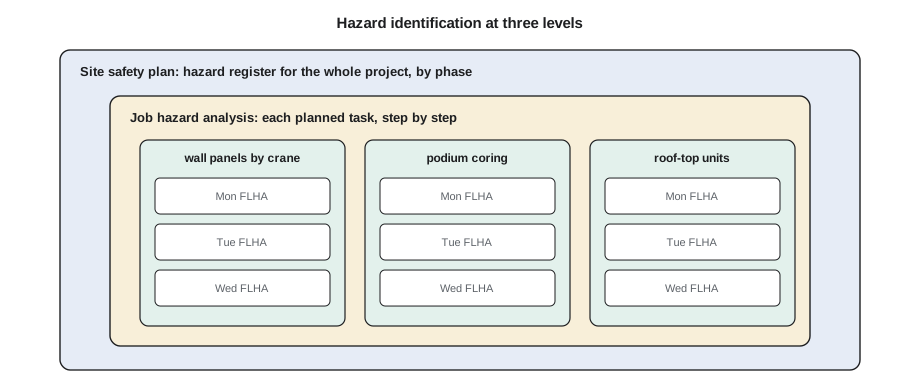
Every safety system on a construction site rests on one skill: looking at a job before it starts and seeing what could hurt someone. The site safety plan from lesson 3 identifies hazards at the level of the whole project and each phase. This lesson works at the level of the task: installing the level 5 wall panels, cutting core holes in the podium slab, setting the roof-top units. It covers the two kinds of task hazard assessment used on Larkspur Commons, a practical way to rate risk, and the hierarchy of controls that tells a supervisor which fixes to reach for first. HSE-103, Hazard Recognition and Risk Assessment, covers the general method in more depth; here the focus is on how a superintendent and foremen use it on a construction site.
Hazard, risk and control
A hazard is anything with the potential to cause harm: an unprotected floor edge, a suspended load, a trench wall, a silica-generating saw. Risk combines how likely harm is and how bad it would be. A control is anything that removes the hazard or reduces the risk. The distinctions matter because they change the conversation. A crew that says 'the edge is a hazard, so we will be careful' has identified a hazard but done nothing about the risk. A crew that says 'the edge is a hazard; with guardrails installed before the floor is loaded, the chance of a fall is very low' has applied a control and judged the remaining risk.
Two levels of task hazard assessment
Larkspur Commons uses two levels of task assessment, matching the way most construction firms work.
| Job hazard analysis (JHA) | Field-level hazard assessment (FLHA) or pre-task plan | |
|---|---|---|
| When | Before a planned task starts for the first time, or when the method changes | At the start of each shift and whenever conditions change |
| Who prepares it | Foreman with the superintendent or engineer, and workers who will do the task | The crew at the work location, led by the foreman |
| Scope | Breaks the task into steps and identifies hazards and controls for each | Today's location, conditions, people and equipment, referring to the JHA |
| Form | Written, reviewed and kept with the procedures | Short form or app entry, signed by the crew |
| Example | Installing level 5 wall panels by crane | Level 5 north, Tuesday: wind gusts, a new crew member, the stair shaft opening |
The JHA is planning; the FLHA is checking. A JHA written in the office cannot know that today the wind is gusting, a new labourer has joined the crew, the scaffold beside the work area was altered overnight or the electrician has opened a section of floor. The FLHA exists to catch exactly those things. HSE-230, Field-Level Hazard Assessment, in the Safety stream covers the FLHA in detail.
Building a job hazard analysis
A JHA has three columns: the steps of the task in order, the hazards in each step, and the controls for each hazard. The skill is in the first column. If the steps are too broad ('install wall panels'), the hazards will be too general to be useful. If they are too fine, the JHA becomes unreadable. Most construction tasks break into eight to fifteen steps.
Worked problem
JHA for installing level 5 wall panels by tower crane
Ridgeline Framing will install the prefabricated exterior wall panels on level 5 using the tower crane. The panels are about 9 m long and weigh up to 1.1 tonnes. Prepare the main steps, hazards and controls.
Show solution
- Plan the lift sequence and check the panels against the lift plan from CON-325: weights, rigging, crane radius and wind limit (crane stops above about 50 km/h gusts on the operator's anemometer).
- Prepare the deck: guardrails in place on all edges not receiving panels that day, floor openings covered and marked, debris cleared.
- Rig the panel at the laydown: qualified rigger, inspected slings and spreader bar, tag lines attached; workers clear of the load path.
- Lift and land: one qualified signal person in radio contact; no one under the load; the receiving crew stays back from the edge until the panel is within reach.
- Set and brace: workers at the open edge are tied off to the engineered anchors installed for that edge; temporary braces fixed before the rigging is released.
- Release the rigging: only after the panel is braced and the foreman confirms; the guardrail section removed for the panel is replaced or the next panel follows immediately.
- Repeat and close: at the end of the shift every open edge has a guardrail or a panel; the foreman walks the deck before leaving.
Answer: The main hazards are falls at the open edge, being struck by or caught under a swinging or dropped panel, rigging failure and wind. The controls combine engineering controls (guardrails, braces, engineered anchors), administrative controls (lift plan, wind limit, exclusion zone, signal person) and personal fall protection where the edge must be open.
A good JHA uses the crew. The framers who will set the panels know where the real problems are: the panel that always catches on the scaffold brace, the corner where the anchor is out of reach, the gust that comes around the building at about two in the afternoon. Thornbury's rule is that at least two workers who will do the task review the JHA before it is used, and that their names are on it.
Rating risk
Thornbury uses a simple five-by-five risk matrix: likelihood from 1 (rare) to 5 (almost certain) and severity from 1 (first aid) to 5 (fatality or permanent disability). The product is the risk score. Scores of 15 or more are high and the task cannot proceed until controls bring the score down; 8 to 14 are medium and need controls and supervision; 7 or less are low.
| Score | Rating | What it means for the supervisor |
|---|---|---|
| 15 to 25 | High | Do not start. Add controls and re-score. If the score cannot be reduced, the superintendent decides with the safety coordinator whether and how the work can proceed. |
| 8 to 14 | Medium | Proceed with the listed controls in place and checked by the foreman. |
| 1 to 7 | Low | Proceed with normal care and the general site rules. |
Two cautions apply to any risk matrix. First, the numbers are judgements, not measurements; two foremen may score the same hazard differently, which is why scoring is done with the crew and reviewed. Second, a matrix can hide serious hazards behind low likelihood. A suspended load falling on someone is unlikely on any given lift, but the severity is fatal, so the score can come out as medium. Thornbury therefore flags any hazard with a severity of 5 as having serious injury and fatality (SIF) potential, whatever its score, and requires at least one control from the top three levels of the hierarchy below. Lesson 11 returns to SIF prevention.
# JHA risk scoring before and after controls, with SIF flag (illustrative scores)
hazards = [
    # (hazard, likelihood, severity, controls, likelihood after, severity after, top-three control?)
    ("fall at open edge while setting panel", 3, 5, "engineered anchors, tie-off, guardrails elsewhere", 1, 5, True),
    ("struck by swinging panel",             3, 4, "tag lines, exclusion zone, signal person", 1, 4, False),
    ("rigging failure",                      2, 5, "inspected slings, spreader bar, qualified rigger", 1, 5, True),
    ("wind gust during lift",                3, 4, "anemometer limit, lift plan", 1, 4, False),
    ("hand caught between panel and plate",  3, 3, "push sticks, gloves, briefing", 2, 2, False),
]
def band(s): return "HIGH" if s >= 15 else "medium" if s >= 8 else "low"
for h, l, s, c, l2, s2, top in hazards:
    before, after = l * s, l2 * s2
    sif = " SIF" if s == 5 else ""
    flag = "" if (s < 5 or top) else "  <- SIF needs a top-three control"
print(f"{h:38s} {before:2d} {band(before):6s} -> {after:2d} {band(after):6s}{sif}{flag}")fall at open edge while setting panel 15 HIGH -> 5 low SIF struck by swinging panel 12 medium -> 4 low rigging failure 10 medium -> 5 low SIF wind gust during lift 12 medium -> 4 low hand caught between panel and plate 9 medium -> 4 low
All five hazards come down to low or medium after controls. The two SIF hazards, the fall at the open edge and rigging failure, both have controls from the top of the hierarchy: engineered anchors and guardrails for the fall, and engineered rigging for the lift. Note that severity rarely changes: controls usually reduce the likelihood of harm, not how bad it would be if it happened. That is why a fatal-severity hazard with a low score still deserves attention.
The hierarchy of controls
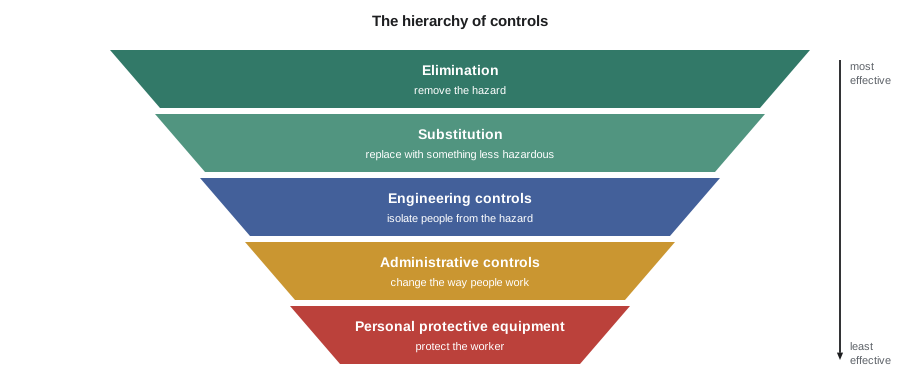
The hierarchy of controls ranks the ways of dealing with a hazard from most to least effective. The higher controls work whether or not anyone remembers to use them; the lower ones depend on people doing the right thing every time.
| Level | What it does | Examples on Larkspur Commons |
|---|---|---|
| Elimination | Removes the hazard completely | Prefabricated wall panels framed at ground level, so most framing happens on the deck rather than at the edge; roof anchors and parapets designed into the building |
| Substitution | Replaces the hazard with a less dangerous one | Water-based sealants instead of solvent-based in the parkade; scissor lifts instead of ladders for ceiling work |
| Engineering controls | Isolates people from the hazard by physical means | Guardrails, floor opening covers, trench boxes, saws with water feed or vacuum shrouds, crane anti-collision systems |
| Administrative controls | Changes the way people work | Lift plans, exclusion zones, wind limits, permits, schedules that keep trades apart, training, signage |
| Personal protective equipment | Protects the individual worker | Harnesses and lanyards, hard hats, safety glasses, respirators, hearing protection, cut-resistant gloves |
Many of the most effective controls are decided long before a foreman writes a JHA. Prefabricating the exterior wall panels, choosing a building design with a parapet that doubles as a guardrail, specifying permanent roof anchors, and sequencing the stairs to be installed early so workers do not climb ladders between floors are all decisions made in design and preconstruction. CON-315's constructability review is a safety review as much as a quality one, and Dana now asks the design team at every constructability meeting a simple question: how will someone build this, and maintain it, without falling? The same thinking is known in the industry as prevention through design.
On site, the hierarchy tells a foreman which fix to reach for first. When the drywall crew needed to work near the level 3 floor opening for the mechanical shaft, the first suggestion was harnesses. Omar asked whether the opening could be covered instead. It could, with a plywood cover screwed down and marked, for the two weeks before the shaft walls closed it in. The cover protected everyone, including the electrician who came through the next day and had not been at the huddle. Personal fall protection would have protected only the people who remembered to use it.
When conditions change
The most dangerous moment in many tasks is when something changes and the crew carries on with the old plan. The wind picks up, a different crane is used, a new worker joins, a delivery arrives early and blocks the exclusion zone, the scaffold beside the work is altered, or the task turns out to be different from what was planned. Thornbury's rule is simple: if the conditions change, stop and re-assess. The FLHA form has a section for changes during the shift, and foremen are expected to use it. A crew that stops for five minutes to re-plan when the wind rises is showing exactly the judgement the system is meant to build.
Keeping hazard assessments honest
The biggest weakness of hazard assessment forms is that they can become a signature exercise. A crew that signs the same pre-filled form every morning, with the same hazards ticked, has not assessed anything. Priya calls this pencil-whipping. Thornbury's foremen are coached to keep FLHAs short, specific and different each day, and the superintendent and safety coordinator check a sample during their site walks by asking a worker at the location what the hazards of their task are and comparing the answer with the form. If the worker cannot describe the hazards on the form they signed, the form is not doing its job.
Common mistakes
MistakeWriting JHAs in the office without the workers who will do the task.
InsteadPrepare or review JHAs with at least two workers who will do the task, and record their names.
MistakeRelying on a risk score alone for hazards that could kill.
InsteadFlag every fatal-severity hazard as SIF potential and require at least one control from the top three levels.
MistakeReaching for PPE first.
InsteadWork down the hierarchy: eliminate, substitute, engineer and organize before relying on personal protective equipment.
MistakeCarrying on with the plan when conditions change.
InsteadStop and re-assess whenever the wind, people, equipment, sequence or task changes.
MistakeSigning the same pre-filled FLHA every day.
InsteadKeep FLHAs short and specific to today's location and conditions, and check them by asking workers what they cover.
Summary and key terms
- A hazard can cause harm; risk combines likelihood and severity; controls remove hazards or reduce risk.
- Job hazard analyses plan a task step by step; field-level hazard assessments check each shift's real conditions.
- Good JHAs use the workers who will do the task.
- A risk matrix helps rank hazards, but scores are judgements and can hide fatal-severity hazards, so SIF hazards are flagged regardless of score.
- The hierarchy ranks controls from elimination through substitution, engineering and administrative controls to PPE.
- Many of the best controls, such as prefabrication and permanent anchors, are decided in design and preconstruction.
- When conditions change, stop and re-assess; FLHAs must stay specific to avoid becoming a signature exercise.
- Hazard
- Anything with the potential to cause harm.
- Risk
- The combination of the likelihood of harm and its severity.
- Job hazard analysis
- A written breakdown of a task into steps, with the hazards and controls for each.
- Field-level hazard assessment
- A short assessment by the crew at the work location at the start of each shift and when conditions change.
- Hierarchy of controls
- The ranking of controls from elimination, substitution and engineering through administrative controls to PPE.
- Residual risk
- The risk that remains after controls are applied.
- Prevention through design
- Eliminating or reducing hazards through decisions made in design and planning.
- Pencil-whipping
- Completing a safety form without actually doing the assessment it records.
Practice problems
Work each problem on paper first, then reveal the answer to check.
Why does a JHA need an FLHA as well?
Show answer
The JHA cannot know today's conditions, such as wind, new workers or changes nearby; the FLHA checks them.
In the scoring example, which hazards were flagged as SIF, and what did both have?
Show answer
The fall at the open edge and rigging failure; both had controls from the top three levels of the hierarchy.
Why does severity rarely change after controls are applied?
Show answer
Most controls reduce how likely harm is, not how bad it would be if it happened.
Omar chose a floor cover instead of harnesses near the level 3 shaft opening. Why was that better?
Show answer
The cover is an engineering control that protects everyone, including workers who were not at the huddle, without relying on each person remembering.
How can a supervisor tell whether an FLHA is real?
Show answer
Ask a worker at the location what the hazards of their task are and compare the answer with the form.
Lesson quiz · 5 questions
Score 60% or more to complete this lesson.
Create a free account to save your progress, take quizzes and earn a certificate.