
CRE-450 · Lesson 1 of 12 · 27 min
Why responsible content matters
Creators have more reach than many newspapers had a generation ago. A family channel with a million subscribers can put a child's face, school uniform and bedtime routine in front of more people than live in most Canadian cities. A wellness creator who talks about weight loss can shape how thousands of teenagers feel about their bodies. A creator who shares a viral claim about a medicine can influence real health decisions. This course is about using that reach responsibly when the content involves children, families, mental health, grief, trauma, misinformation and the needs of audiences with disabilities.
Responsible content is not about avoiding hard subjects. Some of the most valuable work creators do is honest content about depression, disability, loss or parenting. The goal is to cover those subjects in ways that protect the people involved, respect the audience and keep the creator on the right side of the law and platform rules. This first lesson sets out why it matters, who can be harmed, the main sources of rules, and a simple way of thinking about responsibility that the rest of the course builds on.
Before starting, a note on tone and scope. Parts of this course discuss suicide, self-harm, eating disorders, violence and the exploitation of children. These subjects are covered at a protective level: the aim is to help you recognize risks, follow good practice and know where to send people for help. If any of these topics affect you personally, it is fine to pause, and support is available. In Canada you can call or text 9-8-8 at any time; in the US you can call or text 988. CRE-350 covered creator wellbeing in depth, and it is worth revisiting if this material is hard for you.
Who can be harmed
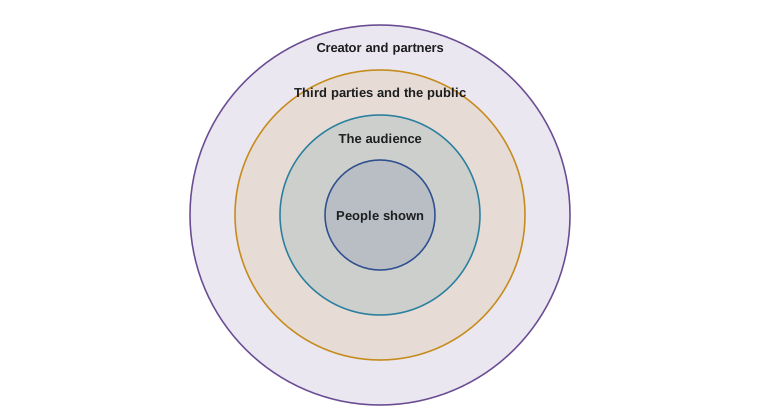
It helps to think about the different groups whose interests are affected by a piece of content. A responsible creator considers all of them before publishing, not only the audience.
- The people shown. Children, family members, friends, strangers in the background, and people in the news all have interests in privacy, dignity and safety. Children cannot meaningfully agree to being filmed for a commercial channel, and their interests may differ from their parents' interests.
- The audience. Viewers, especially young or vulnerable viewers, can be harmed by content that glamorizes self-harm, promotes unhealthy eating, spreads false health claims or exposes them to graphic material without warning.
- Third parties. Schools, neighbours, victims of crimes and bereaved families can be affected by what a creator posts about them, even if they never appear on screen.
- The creator. Irresponsible content can lead to lost sponsorships, platform penalties, legal claims and lasting reputational damage, as CRE-430 showed.
- Partners. Brands, agencies and collaborators share the consequences when content goes wrong, which is why contracts increasingly include responsible-content clauses.
Three sources of rules
Creators who deal with children and sensitive subjects work inside three overlapping sets of rules. Knowing which applies helps you find the right answer quickly.
| Source | Examples | How it is enforced |
|---|---|---|
| Law | Privacy law (PIPEDA, Quebec's Law 25), consumer protection (Quebec's ban on advertising to children), the Competition Act, the Criminal Code | Regulators, courts, prosecutors and private lawsuits |
| Platform rules | Community guidelines, child safety policies, made-for-kids settings, sensitive-content and self-harm policies | Removal, age restriction, demonetization, strikes and bans |
| Professional and ethical codes | Safe-messaging guidelines for suicide, journalism ethics on trauma, advertising codes for children, accessibility standards | Reputation, brand requirements, industry self-regulation |
Law sets the minimum and carries the heaviest penalties, but it moves slowly and differs between places. Platform rules apply worldwide on each platform and change often. Ethical codes go further than either and represent what experienced professionals consider good practice. In practice, a creator who follows good ethical codes will almost always also satisfy platform rules and the law, while a creator who aims only for legal minimums often runs into trouble with platforms, brands and audiences first.
In Canada, there is not yet a law aimed specifically at child influencers like those in several US states. Protection comes instead from privacy law, provincial child performer and employment rules, Quebec's consumer protection law and the general law of negligence and privacy. Lesson 3 covers these in detail.
A duty-of-care mindset
Lawyers use the phrase duty of care to describe an obligation to take reasonable steps to avoid foreseeable harm to others. Creators are not usually under a formal legal duty of care to every viewer, but the idea is a useful way to think. It asks three practical questions about each piece of content.
- Is harm foreseeable? Would a reasonable person expect this content could hurt someone shown or watching?
- How serious and likely is the harm? A mildly embarrassing clip is different from content that could help a stranger locate a child or encourage self-harm.
- What reasonable steps would reduce it? Blurring a face, removing a location, adding a content warning, checking a claim or simply not posting.
This is the same likelihood-and-impact thinking used in the risk register in CRE-430, applied to the people affected rather than to the creator's reputation. Throughout this course you will use simple scoring tools built on it.
Worked problem
Applying the duty-of-care questions
A parenting creator wants to post a video of their seven-year-old having a tantrum in a supermarket, filmed without the child knowing, with the caption "Day 3 of no screen time". Apply the three questions.
Show solution
- Foreseeable harm: yes. The child is identifiable, the moment is private and distressing, and the clip may be shared or mocked indefinitely, including by classmates when the child is older.
- Seriousness and likelihood: moderate to high. Embarrassment and loss of dignity are likely; the clip is also searchable by name if the child is named elsewhere on the channel.
- Reasonable steps: do not post the clip; if the topic matters, discuss it in a talking-head video without footage of the child, or use a re-enactment with an adult.
Answer: The harm is foreseeable and significant, and a simple alternative exists. The responsible choice is not to post the footage.
Why responsibility is also good business
Responsible practice is sometimes presented as a cost. In reality it usually protects income. Brands increasingly screen creators for brand safety before signing deals, and family and parenting brands are among the most cautious. Platforms reduce recommendation or remove monetization from content that breaks child safety or sensitive-content policies. Audiences, especially parents, are more aware than ever of the risks of children being online, and backlash against exploitative family content has grown since the early 2020s, partly because some former child stars of family channels have spoken publicly about how it affected them.
At the same time, demand for honest content about mental health, disability, grief and family life is strong. Creators who handle these subjects carefully often build unusually loyal audiences, because viewers trust them. The aim is not less content about real life; it is better content.
Worked problem
Revenue at risk from a brand-safety failure
A family creator earns $8,000 a month from three sponsors who each require brand-safe content involving children. After a controversy about filming a child in distress, two sponsors pause for six months and the platform limits ads on 20 % of videos, reducing ad income of $3,000 a month by 20 %. Estimate the six-month loss.
Show solution
- Assume each sponsor pays about one-third of $8,000, or about $2,667 a month. Two pausing for six months: \( 2 \times 2{,}667 \times 6 \approx 32{,}000 \).
- Ad income loss: \( 3{,}000 \times 0.20 \times 6 = 3{,}600 \).
- Total: about $35,600, before any longer-term loss of audience trust.
Answer: About $35,600 over six months. The figures are illustrative, but the pattern is real: a single careless decision can cost far more than the time it takes to apply a responsible-content check.
The responsible content check
This course builds toward a written responsible content policy, which you will complete in the capstone. A simple pre-publication check, used on every video that involves children or a sensitive subject, is the heart of that policy. A good check is short enough that you actually use it.
| Question | If the answer is worrying |
|---|---|
| Who is shown, and could they object now or later? | Remove, blur or get informed consent |
| Does anything reveal a location, school, routine or identity? | Edit it out or delay posting |
| Could this content hurt a vulnerable viewer? | Follow safe-messaging guidance and add resources or warnings |
| Is every factual claim accurate and sourced? | Check, correct or cut the claim |
| Can everyone in the audience access it? | Add captions, descriptions and alt text |
| Would I be comfortable if the person shown watched this in ten years? | Reconsider or rework the content |
Each question corresponds to a lesson later in the course: consent and dignity in lessons 2 and 8, privacy and safety in lesson 5, vulnerable viewers in lessons 6 and 7, accuracy in lesson 9 and accessibility in lesson 10. The final question, the ten-year test, is perhaps the most useful single habit for anyone who films children or people in difficult moments.
What this course does and does not cover
Where a decision has legal consequences, such as setting up trust accounts for a child's earnings or responding to a privacy complaint, get advice from a qualified lawyer in your province or state. The course also does not train you as a counsellor or clinician. When you discuss mental health, you can share experience and point people to help, but you should not diagnose or treat.
Making responsibility a habit
Good intentions are easy; consistent practice is harder, especially when a channel posts several times a week and an editor or assistant handles part of the work. The creators who handle these subjects best tend to share a few habits. They decide their standards in advance rather than in the rush before an upload. They write those standards down so that everyone on the team applies them the same way. They review their choices with fresh eyes, often by watching a final cut a day later. And they welcome feedback from the people affected, including their own children as they grow up. The lessons that follow give you the tools to build each of these habits.
Common mistakes
MistakeThinking responsible content means avoiding difficult subjects.
InsteadCover difficult subjects carefully, protecting the people involved and supporting the audience.
MistakeConsidering only the audience when deciding what to post.
InsteadConsider the people shown, the audience, third parties, the creator and partners.
MistakeAiming only for legal minimums.
InsteadFollow good ethical codes; they usually satisfy platform rules and the law as well.
MistakeAssuming parents can always consent on a child's behalf to anything.
InsteadRecognize that children's interests can differ from their parents' and protect the child's dignity and privacy.
MistakeTreating a pre-publication check as optional when busy.
InsteadUse a short, consistent check on every video involving children or sensitive subjects.
Summary and key terms
- Creators' reach means their choices about children and sensitive topics affect many people.
- Responsible content covers hard subjects carefully rather than avoiding them.
- Those who can be harmed include the people shown, the audience, third parties, the creator and partners.
- Rules come from law, platform policies and professional and ethical codes.
- A duty-of-care mindset asks whether harm is foreseeable, how serious it is and what reasonable steps reduce it.
- Responsible practice protects sponsorships, platform standing and audience trust.
- A short pre-publication check, ending with the ten-year test, is the core of a responsible content policy.
- Responsible content
- Content made with reasonable care for the people shown, the audience and third parties.
- Duty of care
- An obligation to take reasonable steps to avoid foreseeable harm to others.
- Foreseeable harm
- Harm a reasonable person would expect could result from an action.
- Brand safety
- A brand's concern that its advertising does not appear alongside harmful or inappropriate content.
- Community guidelines
- A platform's rules on what content and behaviour are allowed.
- Safe-messaging guidelines
- Evidence-based advice on discussing suicide and mental health in ways that reduce risk.
- Third party
- A person affected by content who is neither the creator nor the viewer.
- Ten-year test
- Asking whether the person shown would be comfortable seeing the content in ten years.
- Vulnerable viewer
- A viewer at higher risk of harm, such as a child or someone in crisis.
- Pre-publication check
- A short list of questions applied before posting content.
Practice problems
Work each problem on paper first, then reveal the answer to check.
Name the five groups whose interests a creator should consider.
Show answer
The people shown, the audience, third parties, the creator and partners.
What are the three sources of rules for responsible content?
Show answer
Law, platform rules and professional and ethical codes.
What three questions make up the duty-of-care mindset?
Show answer
Is harm foreseeable, how serious and likely is it, and what reasonable steps reduce it?
Why can a parent's consent be insufficient for a child?
Show answer
The child's interests can differ from the parent's, and the child cannot meaningfully consent to commercial filming.
A sponsor paying $3,000 a month pauses for four months. What is the loss?
Show answer
$12,000.
What is the ten-year test?
Show answer
Asking whether the person shown would be comfortable seeing the content in ten years.
Which lesson topic matches the question "Could this hurt a vulnerable viewer?"
Show answer
Safe messaging on mental health and eating disorders.
Why is following ethical codes usually safer than aiming for legal minimums?
Show answer
Ethical codes go further and usually satisfy platform rules and law too.
Is this course legal advice?
Show answer
No; it is general information, and legal decisions need a qualified lawyer.
Name one way responsible practice protects income.
Show answer
Keeping sponsorships, avoiding platform penalties or keeping audience trust.
Lesson quiz · 5 questions
Score 60% or more to complete this lesson.
Create a free account to save your progress, take quizzes and earn a certificate.