
CRE-450 · Lesson 12 of 12 · 32 min
Capstone: a responsible content policy for a family channel
This capstone brings the course together. You will follow the creation of a written responsible content policy for a fictional family channel, applying the tools from each lesson: the dignity and location scores, consent practices, legal requirements, platform rules, safe messaging, accuracy and accessibility checks, and brand standards. The worked case below shows one complete approach; your own capstone assignment asks you to produce a policy for a channel you choose or invent.
The case: Rivera Family Kitchen
Rivera Family Kitchen is a fictional channel run by two parents, Ana and Marco, who cook simple family meals. Their children, Sofia, aged 13, and Leo, aged 6, appear in about half the videos. The channel has 420,000 subscribers, earns about $11,000 a month from ads and sponsorships, posts three videos a week and has a growing audience of parents and teenagers. Ana has also begun talking about her experience of postpartum depression, which drew a strong response. Recently a viewer pointed out that the house exterior and Leo's school uniform appeared in a back-to-school video, and a snack brand has offered a sponsorship aimed at kids.
The parents want a policy that protects their children, supports their audience and keeps their business sustainable. They agree it should be short enough to use, shared with their editor and any sponsors, and reviewed every six months.
Step 1: Audit the current channel
Before writing rules, Ana and Marco audit their 300 most recent videos using the dignity score from lesson 2 and the location score from lesson 5, and a quick accessibility check from lesson 10.
Worked problem
Summarizing the audit
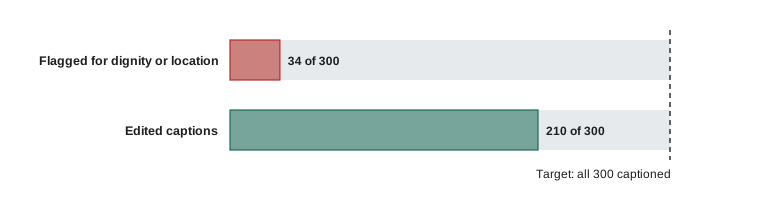
Of 300 videos, 24 score 2 or more on the dignity check, 18 score above 3 on the location check (8 of these are also among the 24), and 210 have edited captions. How many videos need action, and what is the caption rate?
Show solution
- Videos flagged on dignity or location: \( 24 + 18 - 8 = 34 \).
- Caption rate: \( 210 \div 300 = 70 \% \).
- Plan: review the 34 flagged videos first, starting with the most viewed, and caption the remaining 90 videos over three months, about 30 a month.
Answer: 34 videos need review for dignity or location issues, and captions cover 70 % of videos. The audit gives a baseline to measure progress against.
Step 2: Children's section
The children's section is the heart of the policy. Ana and Marco write rules for consent, dignity, workload and money.
- Consent and assent: Sofia, at 13, reviews and can veto every video she appears in, and has a written agreement about what she is comfortable sharing. Leo is asked before filming and again before posting, and any reluctance is treated as a no.
- Dignity: no bath, changing or swimming footage; no tantrums, punishments or tears; no health or school information; the ten-year test applied to every video.
- Workload: no more than 3 hours of filming a week for Leo and 4 for Sofia, never during school hours, with breaks.
- Money: although no Canadian law requires it, a share of income set aside for each child in trust, using the Illinois approach as a benchmark.
- Removal: any video will be taken down if either child asks, now or later.
Worked problem
Calculating the children's set-aside
In a typical month, earnings are $11,000. Across the month's videos, Sofia appears in 30 % of running time and Leo in 20 %. Using half the percentage featured for each child, how much is set aside monthly and yearly?
Show solution
- Sofia: half of 30 % = 15 %; \( 0.15 \times 11{,}000 = 1{,}650 \).
- Leo: half of 20 % = 10 %; \( 0.10 \times 11{,}000 = 1{,}100 \).
- Monthly total: $2,750; yearly: \( 2{,}750 \times 12 = 33{,}000 \).
Answer: $1,650 for Sofia and $1,100 for Leo each month, about $33,000 a year in total. The parents consult a lawyer and an accountant on the trust structure.
Worked problem
Checking Leo's workload
Leo appears in 3 videos a week. Each uses about 4 minutes of his footage at a 10:1 shooting ratio, plus 20 % for setup. Does this fit the 3-hour weekly limit?
Show solution
- Filming: \( 3 \times 4 \times 10 = 120 \) minutes.
- With setup: \( 120 \times 1.2 = 144 \) minutes, or 2.4 hours.
- This is within the 3-hour limit, with about 36 minutes to spare.
Answer: Yes, 2.4 hours fits within 3 hours. If the parents add a fourth video featuring Leo, they would need to cut footage or shooting ratio to stay within the limit.
Step 3: Privacy and safety section
Following lesson 5, the policy sets location and identity rules: no house exterior or street views, no school names or uniforms, first names only, no birthdays, geotags off, posting only after leaving any public place, and a business address for mail. The back-to-school video is re-edited to remove the house and uniform. The policy also sets out how to watch for misuse and where to report it.
| Situation | Action | Responsible person |
|---|---|---|
| Location detail spotted in a video | Re-edit or make private within 24 hours | Marco |
| Concerning comment about a child | Remove, block and report to the platform | Editor or moderator |
| Suspected exploitation of the children's images | Make content private, report to Cybertip.ca and the platform | Ana |
| Child asks for a video to be removed | Remove within 7 days, no questions asked | Ana or Marco |
Step 4: Sensitive topics section
Ana's videos about postpartum depression call for safe-messaging rules from lesson 6. The policy says that mental health videos focus on feelings, support and recovery, avoid detailed descriptions of the worst moments, include crisis resources on screen and in the description, and use the content warning matrix. It includes template replies for viewers in crisis and names who handles them. Because the channel is about food, it also adopts eating-disorder-safe practices from lesson 7: no calorie counts, no labelling foods good or bad, and no body talk.
Worked problem
Applying the warning matrix to Ana's next video
Ana plans a detailed account of her postpartum depression (intensity 2). The audience is mainly adults but about 20 % teenagers (vulnerability 1). Using the lesson 6 rule (3 or more: warning at start plus resources on screen and in the description), what is required?
Show solution
- Score: \( 2 + 1 = 3 \).
- Requirement: a brief warning at the start and crisis resources on screen and in the description.
- The policy also notes she will share from a place of stability, with her own support in place.
Answer: A score of 3 requires a warning and resources in both places.
Step 5: Accuracy and accessibility sections
For accuracy, the policy follows lesson 9: nutrition and health claims checked against official sources, opinion labelled, errors corrected within 24 hours and logged. For accessibility, following lesson 10: edited captions on every new video, cooking steps and measurements spoken aloud, on-screen text with contrast of at least 4.5 to 1, alt text on images and plain-language descriptions.
Step 6: Brand partnerships section
The snack brand offer tests the policy. Applying lesson 11, the parents note that the brand wants content aimed at kids, which triggers children's advertising rules, food marketing restrictions and the need for child-friendly disclosure. Their policy says sponsorships involving the children must follow child welfare standards, set aside part of the fee for the children, keep editorial control with the parents, limit usage of the children's images to the campaign period and include a removal right. Products marketed to children must meet nutrition standards the parents set, and sponsorships never appear on mental health videos.
Because some of their audience is in Quebec, they also check that the campaign does not direct commercial advertising at children under 13 in Quebec, and they decide to make the sponsored video for parents, featuring the family cooking with the product, with spoken disclosure at the start.
Worked problem
Evaluating the snack offer
The brand offers $5,000 for one video. Children would appear for 50 % of the running time combined (30 % Sofia, 20 % Leo). Applying the set-aside formula and a 4-hour on-set limit for Leo, what are the key numbers?
Show solution
- Set-aside: Sofia 15 % = $750; Leo 10 % = $500; total $1,250.
- Remaining for the business: $3,750.
- Leo's on-set time must stay within 4 hours, including breaks, so the shoot may need two short sessions.
Answer: The deal is workable if the brand accepts parent-directed content, child-friendly disclosure, usage limits and the welfare terms. If it insists on content targeting young children, the policy says to decline.
Step 7: Governance and review
A policy only works if it is used. Ana and Marco add the six-question check from lesson 1 to their upload process, share the policy with their editor and moderators, publish a short public version on their website and in their media kit, and set a six-month review date. At each review they repeat the audit, check for new laws and platform rules, and ask Sofia, and later Leo, whether they are comfortable with how they appear.
| Policy section | Key rules | Lesson |
|---|---|---|
| Purpose and values | Protect children, support viewers, stay accurate and accessible | 1 |
| Children | Consent and assent, dignity rules, workload limits, set-asides, removal on request | 2, 3 |
| Platforms | Correct made-for-kids labels, comment settings, livestream rules | 4 |
| Privacy and safety | No location or identity details, delayed posting, reporting misuse | 5 |
| Sensitive topics | Safe messaging, warnings, resources, eating-disorder-safe food content | 6, 7, 8 |
| Accuracy | Verify claims, label opinion, correct and log errors | 9 |
| Accessibility | Captions, spoken steps, contrast, alt text, plain language | 10 |
| Brands | Child welfare terms, set-asides, editorial control, usage limits, opt-outs | 11 |
| Governance | Upload check, team training, public summary, six-month review | 12 |
Your capstone assignment
Write a responsible content policy of about 1,000 to 1,500 words for a family or wellbeing channel you choose or invent. Include an audit summary with at least two calculated measures, a children's section with consent, dignity, workload and money rules, privacy and safety rules with an incident table, a sensitive topics section with safe-messaging practices and resources for your country, accuracy and accessibility standards, brand partnership terms, and a governance and review plan. Explain how each rule connects to the lessons, and note where you would get legal advice.
Remember that a policy is a living document. The Rivera family's first version will not be perfect, and that is fine; what matters is that it is used, reviewed and improved as the children grow, the channel changes and the law develops.
Common mistakes
MistakeWriting a policy without auditing current content.
InsteadAudit first to set a baseline and priorities.
MistakeMaking rules too long or vague to use.
InsteadKeep rules specific, short and built into the upload process.
MistakeLeaving children out of decisions about their appearances.
InsteadInvolve children according to their evolving capacity and honour removal requests.
MistakeTreating the policy as finished once written.
InsteadReview every six months and after legal or platform changes.
MistakeAccepting sponsor terms that conflict with the policy.
InsteadUse the policy to negotiate or decline, and share a public summary with brands.
Summary and key terms
- A responsible content policy turns the course's tools into specific, usable rules.
- An audit of existing content sets a baseline and priorities.
- The children's section covers consent and assent, dignity, workload, money and removal.
- Privacy, safety and incident rules protect children and assign responsibilities.
- Sensitive topics need safe messaging, warnings, resources and eating-disorder-safe practices.
- Accuracy, accessibility and brand standards complete the policy.
- Governance, training and regular review keep the policy working.
- Responsible content policy
- A written set of rules for handling children and sensitive topics.
- Baseline
- Measurements of the current state used to track progress.
- Governance
- The processes and responsibilities for applying and reviewing a policy.
- Upload check
- A short check built into the publishing process.
- Public summary
- A shortened version of a policy shared with audiences and brands.
- Incident response
- Planned actions for specific problems, with named responsibilities.
- Review cycle
- The regular schedule for revisiting a policy.
- Editorial control
- The creator's final say over content.
- Workload limit
- A maximum amount of filming time for a child.
- Set-aside formula
- The rule used to calculate a child's share of earnings.
Practice problems
Work each problem on paper first, then reveal the answer to check.
Why audit before writing a policy?
Show answer
To set a baseline and identify priorities.
24 dignity flags, 18 location flags, 8 overlap. Total needing review?
Show answer
34.
$10,000 earnings; a child appears 40 %. Set-aside using half the percentage?
Show answer
20 %, or $2,000.
A child appears in 2 videos a week, 5 minutes each at 10:1, plus 20 % setup. Hours?
Show answer
2 × 5 × 10 = 100 minutes × 1.2 = 120 minutes, 2 hours.
Name four sections of a responsible content policy.
Show answer
Children, privacy and safety, sensitive topics, accuracy, accessibility, brands, governance.
What does the content warning matrix require for a score of 3?
Show answer
A warning at the start and resources on screen and in the description.
Name two eating-disorder-safe rules for a food channel.
Show answer
No calorie counts, no good or bad food labels, no body talk.
Name three brand terms the Rivera policy requires.
Show answer
Welfare standards, set-asides, editorial control, usage limits, removal rights, no sponsors on mental health videos.
How often should the policy be reviewed?
Show answer
Every six months and after legal or platform changes.
Who should the policy be shared with?
Show answer
The editor, moderators, sponsors, and the public in summary form.
Lesson quiz · 5 questions
Score 60% or more to complete this lesson.
Create a free account to save your progress, take quizzes and earn a certificate.