
CRE-450 · Lesson 9 of 12 · 26 min
Misinformation and responsibility
Creators are now a major source of news and information for many people, especially younger audiences. Surveys in Canada and the US have found that a large share of young adults get news regularly from social video platforms, often from creators rather than news organizations. That trust brings responsibility. A creator who shares a false health claim, a doctored video or a rumour about a disaster can spread it to millions before anyone checks it. This lesson covers the types of false information, why it spreads, how to check claims before sharing, how to correct mistakes, how to help audiences resist misinformation, and the platform and legal context. CRE-410 covered AI-generated content and deepfakes; this lesson focuses on accuracy and responsibility more broadly.
Types of false and misleading information
Researchers commonly distinguish three types, based on whether the information is false and whether there is intent to harm.
| Type | Definition | Creator example |
|---|---|---|
| Misinformation | False or misleading information shared without intent to deceive | Sharing an outdated statistic you believe is accurate |
| Disinformation | False information created or shared deliberately to deceive | Inventing a scandal about a rival for views |
| Malinformation | True information shared to cause harm, often out of context | Publishing someone's real address during a dispute |
Most creators who spread false information do so by mistake, sharing something that looked credible or that fitted what they already believed. The practices in this lesson are mainly about avoiding honest mistakes and fixing them well. Deliberate disinformation is a different matter, and creators who knowingly deceive their audiences risk platform penalties, legal claims and the loss of trust that sustains their careers.
Why false information spreads
A widely cited 2018 study of Twitter, covering more than a decade of news stories, found that false news spread farther, faster and more broadly than true news, partly because false stories were more novel and provoked stronger emotions such as surprise and disgust. Later research has found similar patterns on other platforms. Several features of creator content intensify this.
- Emotional hooks and dramatic thumbnails reward surprising, outrageous claims.
- Speed: being first to comment on a trending story is rewarded, leaving little time to check.
- Parasocial trust: viewers trust creators they feel they know, sometimes more than experts.
- Recommendation systems that amplify engaging content regardless of accuracy.
- Context collapse, as CRE-430 described: clips shared without the context that would show they are misleading.
Checking before you share
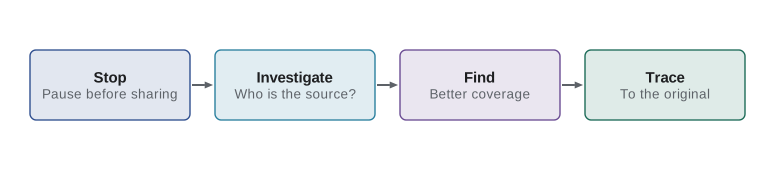
Fact-checking does not need to be slow. Digital literacy researchers recommend quick habits that professional fact-checkers use. One popular framework is SIFT: Stop, Investigate the source, Find better coverage, and Trace claims, quotes and media to the original context. A related technique is lateral reading: rather than studying a website closely to judge it, open new tabs and see what other reliable sources say about the site and the claim.
| Step | What to do | Example |
|---|---|---|
| Stop | Pause before sharing, especially if a claim provokes strong emotion | A shocking claim about a medicine |
| Investigate the source | Who is behind it, and what is their expertise and motive? | Check whether a "study" is from a journal or a product seller |
| Find better coverage | Look for reporting from reliable outlets or official bodies | Search for the claim with the names of health agencies |
| Trace to the original | Find the original study, quote, photo or video and its context | A reverse image search shows a "flood photo" is from 2015 |
For health and science claims, check with official health authorities and peer-reviewed research, and be cautious with single studies, preprints and animal studies, which are often overstated. CRE-420 showed how relative and absolute risk can be confused; the same care applies to any statistic.
Worked problem
Budgeting time for verification
A news-commentary creator makes about 12 factual claims per video and publishes 5 videos a week. Quick SIFT checks take about 3 minutes per claim, and 20 % of claims need a deeper check of 15 minutes. How much verification time is needed each week?
Show solution
- Claims per week: \( 12 \times 5 = 60 \).
- Quick checks: \( 60 \times 3 = 180 \) minutes.
- Deeper checks: \( 0.2 \times 60 = 12 \) claims at 15 minutes = 180 minutes.
- Total: 360 minutes, or 6 hours a week.
Answer: About 6 hours a week. Building this into the production schedule, or hiring a researcher, prevents the far larger cost of a correction or a credibility crisis.
Correcting mistakes
Every creator who makes enough content will eventually get something wrong. How you correct it matters for your credibility and for limiting harm. Research on corrections suggests they can reduce belief in false claims, especially when they come from a trusted source, explain why the original was wrong and provide an accurate alternative explanation.
- Correct quickly and visibly: pin a comment, edit the description, add an on-screen note and, for serious errors, make a correction video.
- State the correct information clearly rather than only repeating the false claim.
- Explain what went wrong, briefly, without excessive self-criticism.
- Consider removing or re-editing the original if it is likely to keep spreading the false claim.
- Keep a corrections log, which helps you spot patterns and shows audiences you take accuracy seriously.
Worked problem
Estimating the reach of a correction
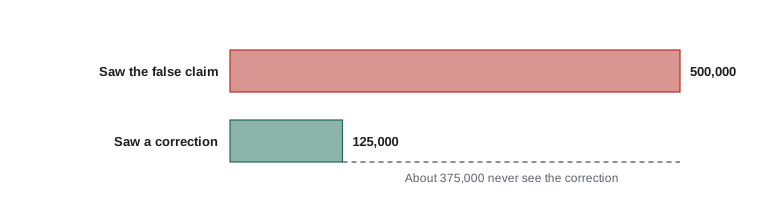
A video containing a false claim reached 400,000 viewers before the error was spotted. The creator pins a comment (seen by about 5 % of later viewers), edits the video description and posts a correction video that gets 30 % of the original video's views. If the original video gets another 100,000 views after the fix, how many people are likely to see some form of correction?
Show solution
- Correction video: \( 0.30 \times 400{,}000 = 120{,}000 \) views.
- Pinned comment on new views: \( 0.05 \times 100{,}000 = 5{,}000 \).
- Total exposed to a correction: roughly 125,000, assuming little overlap.
- Compared with 500,000 who saw the false claim, about one in four see the correction.
Answer: About 125,000 people, roughly one quarter of those who saw the false claim. Corrections rarely reach everyone, which is why checking before publishing matters more than correcting afterwards, and why an on-screen edit to the original is worthwhile.
Prebunking: helping audiences resist misinformation
Prebunking, based on inoculation theory from psychology, means warning people in advance about manipulation techniques so they can recognize them later. Studies, including large experiments with short videos run on YouTube in 2022, found that brief videos explaining techniques such as emotional manipulation, false dichotomies and scapegoating improved viewers' ability to spot them. Creators can include prebunking naturally, for example by explaining how a common scam or misleading statistic works before a related topic trends.
Platform policies
Platforms have policies on misinformation that vary by topic. Most have rules against medical misinformation that contradicts health authorities on topics such as vaccines and treatments, harmful misinformation about elections, manipulated media likely to cause serious harm, and false information during crises. Penalties range from labels and reduced distribution to removal and strikes. Some platforms add context notes written by users or fact-checkers; Meta replaced third-party fact-checking with a community notes approach in the US in 2025, for example. These policies change often and are applied inconsistently, so they are a floor, not a standard to aim for.
The legal context
In Canada, there is no general law against sharing false information, and freedom of expression is protected by the Charter. Specific laws apply in particular situations: defamation, misleading advertising under the Competition Act, and the Canada Elections Act, which prohibits certain false statements about candidates during elections. The proposed Online Harms Act, which would have created duties for platforms on some harmful content, died when Parliament was prorogued in January 2025. The Online News Act of 2023 led Meta to block news links in Canada from August 2023, which some researchers argue increased the share of unreliable information Canadians see on those platforms.
Whatever the law allows, a creator's real constraint is trust. Audiences, platforms and brands increasingly reward creators known for accuracy and penalize those who repeatedly spread false claims.
An accuracy policy
A short written accuracy policy helps creators and teams act consistently. It might include: verifying every factual claim with at least one reliable source and health claims with an official authority; labelling opinion and speculation clearly; not sharing breaking news until confirmed by reliable outlets; correcting errors within 24 hours and logging them; and not using thumbnails or titles that overstate what a video shows.
Health misinformation and family audiences
Family and parenting channels are a common route for health misinformation, because parents seek advice about children's health online and trust creators who feel like peers. Claims about vaccines, fevers, infant sleep, supplements and alternative treatments can affect children's health directly. A responsible family creator who discusses health topics checks claims against national public health agencies and paediatric organizations, distinguishes clearly between their personal experience and medical advice, and encourages viewers to talk to their own health care providers. When sponsors offer health products for children, the claims rules from CRE-420 apply with extra force.
Talking about uncertainty honestly
Some topics are genuinely uncertain, especially in fast-moving situations such as a new outbreak or a developing news story. Being honest about uncertainty builds trust. Phrases such as "Here is what is known so far", "This has not yet been confirmed" and "Experts disagree about this" signal to viewers how much weight to give a claim. When new information emerges, update viewers clearly, explaining what changed and why. Audiences generally respond better to a creator who says "I was wrong, here is the update" than to one who quietly changes their story or never acknowledges errors.
Teaching audiences, especially children, to check
Creators with young audiences can help build media literacy. Simple, repeated messages, such as "Check who made it", "Look for a second source" and "Ask an adult if something seems scary or strange", help children develop healthy habits. Organizations such as MediaSmarts in Canada and the News Literacy Project in the US publish free resources for families and teachers.
Satire, parody and clearly labelled opinion
Satire and parody are valuable forms of expression, but they can be mistaken for real news when shared out of context, especially by audiences who do not know the creator. Labelling satire clearly in titles, thumbnails or on screen reduces the risk that a joke becomes misinformation. The same applies to opinion and speculation: making clear which parts of a video are facts, which are analysis and which are guesses helps viewers judge them correctly.
Common mistakes
MistakeSharing a shocking claim before checking it.
InsteadStop and use SIFT: investigate the source, find better coverage, trace to the original.
MistakeTreating a single study or preprint as settled.
InsteadCheck official health authorities and the wider evidence.
MistakeCorrecting only in a buried comment.
InsteadCorrect visibly with on-screen notes, descriptions and, for serious errors, a correction video.
MistakeRepeating the false claim prominently in a correction.
InsteadLead with the accurate information and explain why the original was wrong.
MistakeRelying on platform policy as the standard.
InsteadAdopt your own accuracy policy that goes beyond platform minimums.
Summary and key terms
- Misinformation is shared by mistake; disinformation deliberately; malinformation is true but harmful.
- False information spreads faster partly because it is novel and emotional.
- SIFT and lateral reading are quick ways to check claims before sharing.
- Corrections should be quick, visible, lead with accurate information and be logged.
- Corrections usually reach far fewer people than the original error.
- Prebunking helps audiences recognize manipulation techniques in advance.
- Canadian law has no general misinformation offence, but defamation, advertising and election laws apply.
- Misinformation
- False or misleading information shared without intent to deceive.
- Disinformation
- False information shared deliberately to deceive.
- Malinformation
- True information shared to cause harm.
- SIFT
- A verification method: stop, investigate the source, find better coverage, trace to the original.
- Lateral reading
- Checking what other sources say about a site or claim.
- Prebunking
- Warning people in advance about manipulation techniques.
- Inoculation theory
- The idea that exposure to weakened forms of persuasion builds resistance.
- Corrections log
- A record of errors and how they were corrected.
- Reverse image search
- Searching for where an image has appeared before.
- Context collapse
- Content reaching audiences without its original context.
Practice problems
Work each problem on paper first, then reveal the answer to check.
Distinguish misinformation from disinformation.
Show answer
Misinformation is shared by mistake; disinformation deliberately.
What does SIFT stand for?
Show answer
Stop, investigate the source, find better coverage, trace to the original.
What is lateral reading?
Show answer
Opening other sources to see what they say about a site or claim.
10 claims per video, 4 videos a week, 3 minutes each. Quick-check time?
Show answer
120 minutes.
A false claim reached 200,000; a correction video gets 25 % of that. Reach?
Show answer
50,000.
Name three features of a good correction.
Show answer
Quick, visible, leads with accurate information, explains the error, logged.
What is prebunking?
Show answer
Warning people about manipulation techniques before they encounter them.
Why are corrections not enough on their own?
Show answer
They usually reach far fewer people than the original.
What happened to the Online Harms Act?
Show answer
It died when Parliament was prorogued in January 2025.
Name two items in an accuracy policy.
Show answer
Verify claims, label opinion, wait for confirmation, correct within 24 hours, honest titles.
Lesson quiz · 5 questions
Score 60% or more to complete this lesson.
Create a free account to save your progress, take quizzes and earn a certificate.