
CRE-450 · Lesson 6 of 12 · 27 min
Mental health, suicide and safe messaging
Creators talking openly about mental health has helped many people feel less alone and more willing to seek help. A creator describing their own anxiety, depression or recovery can reach viewers who would never read a health leaflet. At the same time, research has shown that the way suicide and self-harm are portrayed in media can influence vulnerable people, for better or worse. This lesson explains that evidence, the safe-messaging guidelines developed from it, how to talk about your own mental health, how to use content warnings and resources, and how to respond when a viewer seems to be in crisis. It complements CRE-350, which focused on the creator's own wellbeing.
This lesson discusses suicide and self-harm at a general, protective level. If you are struggling, please reach out.
In Canada, you can call or text 9-8-8, the Suicide Crisis Helpline, at any time, and young people can also contact Kids Help Phone.
Why the way we talk about suicide matters
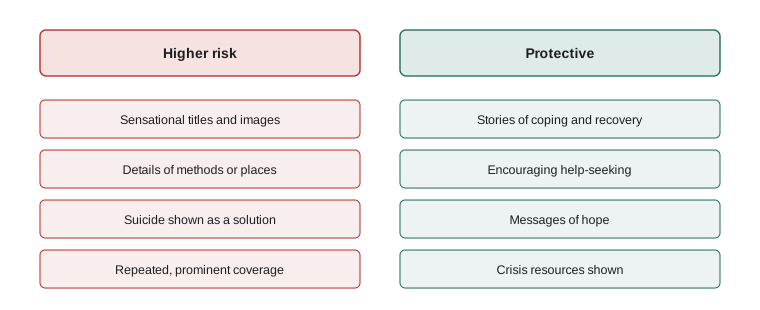
Studies over several decades have found that some kinds of media coverage of suicide are followed by increases in suicides, particularly among young people and people who identify with the person portrayed. This is sometimes called the Werther effect or suicide contagion. The risk is greatest when coverage is sensational, repeated, describes methods or locations, or presents suicide as a solution or a romantic or heroic act. A widely discussed example is a 2019 study that found a rise in suicide rates among US young people aged 10 to 17 in the month after the release of a television series depicting a teenager's suicide; researchers debate the size and cause of the effect, but it prompted changes, including the removal of a graphic scene.
The opposite effect also exists. Stories of people who experienced suicidal thoughts and found ways through, with help, are associated with reduced risk. This is sometimes called the Papageno effect. Safe messaging is therefore not about silence; it is about telling stories in ways that encourage help-seeking and hope.
Safe-messaging guidelines
Several organizations publish guidelines for media and creators. Mindset, a Canadian guide for reporting on mental health produced with journalists and mental health organizations, and the Reporting on Suicide recommendations used widely in the US share the same core advice. #chatsafe, developed for young people who talk about suicide online, adapts it for social media. Platforms have adopted much of this guidance in their self-harm policies.
| Do | Avoid |
|---|---|
| Talk about suicide as a complex issue with many causes | Presenting it as caused by a single event or as inevitable |
| Use language such as "died by suicide" | "Committed suicide" or calling attempts "failed" or "successful" |
| Share stories of coping, help and recovery | Presenting suicide as a solution, romantic or heroic |
| Include crisis resources in the video and description | Leaving viewers with no route to help |
| Keep descriptions general | Describing methods, locations or notes in any detail |
| Use calm, non-sensational images and titles | Dramatic thumbnails, music or titles about suicide |
| Mention warning signs and how to help someone | Sharing graphic images or footage |
These practices apply to self-harm too. Content should not show wounds, scars in a sensational way, or methods, and should focus on support and recovery. Platforms generally remove content that encourages or instructs self-harm and may age-restrict or add crisis panels to content that discusses it, even in a recovery context.
Talking about your own mental health
Self-disclosure, sharing your own experience, can be powerful. It shows that mental illness is common and treatable and that people who struggle can have full lives. A few principles help keep it safe for both you and your audience.
- Share from a place of some stability. Talking about a crisis while you are in it can be risky for you and distressing for viewers. Many creators wait until they have support in place.
- Describe feelings and recovery more than details of the worst moments. Viewers relate to emotions; detailed descriptions of methods or self-harm can harm vulnerable people.
- Be clear that you are sharing experience, not giving medical advice. Encourage viewers to talk to a doctor or counsellor about their own situation.
- Plan for responses. Disclosure can attract supportive messages and also viewers who reach out in crisis. Decide in advance how you will respond and when you will log off.
- Protect others' privacy. Your story may involve family members, partners or friends who have not agreed to be part of it.
Content warnings
A content warning tells viewers at the start of a video, or before a particular segment, that it covers a difficult subject. Research on whether warnings reduce distress is mixed: several studies have found that warnings do little to reduce distress and may increase anticipatory anxiety. Their stronger justification is informed choice. A warning lets viewers who are not in a good place decide to skip the video or watch it later, which respects their autonomy. Good warnings are brief, specific and calm, and point to resources.
Worked problem
A content warning decision matrix
A creator scores segments on two factors from 0 to 2: intensity (0 brief mention, 1 discussion, 2 detailed personal account) and vulnerability of the likely audience (0 adult general, 1 mixed with teens, 2 mainly young or at-risk). The rule is: total 0 to 1, no warning needed; 2, mention resources in the description; 3 or more, warning at the start plus resources on screen and in the description. Score a video in which the creator gives a detailed account of their depression, for an audience that is about one-third teenagers.
Show solution
- Intensity: detailed personal account, 2.
- Audience: mixed with teens, 1.
- Total: 3, which calls for a warning at the start plus resources on screen and in the description.
Answer: Score 3: use a brief warning at the start and show crisis resources on screen and in the description. A matrix like this makes decisions consistent across a team.
Resources and how to include them
Every video that discusses suicide, self-harm or a serious mental health crisis should include crisis resources, ideally on screen near the start or end and in the description. Many platforms automatically show crisis information panels on such content, but creators should not rely on that alone.
| Resource | Canada |
|---|---|
| General crisis line | 9-8-8 Suicide Crisis Helpline, call or text, 24/7 |
| Young people | Kids Help Phone, by phone or text, 24/7 |
| Immediate danger | Call 9-1-1 |
If your audience is international, link to a directory of crisis lines in other countries as well, because 9-8-8 and 988 work only in Canada and the US respectively.
Worked problem
Estimating how many viewers see resources
A video about the creator's recovery from depression gets 200,000 views. About 60 % of viewers reach the point where an on-screen resource card appears, and about 4 % of viewers read the description. How many viewers see the resources at least once, assuming the description readers are among those who reached the card?
Show solution
- Viewers who reach the on-screen card: \( 0.60 \times 200{,}000 = 120{,}000 \).
- Because description readers are assumed to be within that group, the total seeing a resource is about 120,000.
- If the card were placed only at the very end, where retention might be 30 %, only about 60,000 would see it.
Answer: About 120,000 viewers. Placing resources early, as well as in the description, roughly doubles the number of people who see them in this example.
When a viewer seems to be in crisis
Creators who talk about mental health sometimes receive comments or messages from viewers who say they are thinking about suicide. This can be frightening. You are not expected to act as a counsellor, but a calm, kind response that points to help can matter.
- Respond with care and without judgment, for example: "I'm really glad you told me. You deserve support right now."
- Point to immediate help: "Please call or text 9-8-8, any time, day or night. If you are in immediate danger, call 9-1-1."
- If the person shares a specific plan and location and seems at immediate risk, contact emergency services if you can, and use the platform's reporting tool for self-harm, which can connect the person with help.
- Do not promise secrecy, try to solve the problem yourself or engage in long private conversations; connect them to people trained to help.
- Look after yourself afterwards. These conversations are draining; talk to someone you trust. CRE-350 discussed creator support networks.
Prepare template replies in advance, as CRE-350 suggested, so that you or your moderators can respond quickly and consistently. Make sure moderators know the plan and are supported too.
Language and stigma
Words shape how people see mental illness. Avoid using diagnoses casually, such as calling a tidy room "so OCD" or a mood change "bipolar". Avoid describing people as their illness ("a schizophrenic") and prefer person-first or identity-first language that the community concerned prefers. Avoid linking mental illness with violence, which is inaccurate and stigmatizing: people with mental illness are more likely to be victims of violence than perpetrators. Thoughtful language costs nothing and makes your content more welcoming to the many viewers living with mental health conditions.
Mental health content about children and teens
Content about a child's or teenager's mental health raises both safe-messaging concerns and the consent and dignity concerns from lesson 2. A parent's experience of supporting an anxious teenager can be valuable to other parents, but the teenager's diagnosis, therapy and difficult moments are their private health information. Good practice is to talk about your own feelings and what helped you as a parent, keep details of the young person's condition general or absent, and involve them in deciding what is shared, respecting a no. Never film a child or teenager in a mental health crisis. If a young viewer discloses distress, the same response principles apply, and for children it is especially important to point them to youth services and trusted adults.
Moderators and team members
Anyone who reads comments on mental health content will eventually see distressing messages. Moderators need clear guidance on which comments to remove, which to reply to with resources and which to escalate, plus permission to step away and someone to talk to. Rotating difficult moderation tasks, limiting shift length and checking in regularly reduce the risk of burnout and vicarious trauma.
Above all, remember that you do not need to be a mental health professional to make a positive difference. Honest, careful content and a clear route to help are what matter most.
Common mistakes
MistakeDescribing methods or locations when discussing suicide.
InsteadKeep descriptions general and focus on coping, help and hope.
MistakeSaying "committed suicide" or calling attempts "successful".
InsteadUse "died by suicide" and non-judgmental language.
MistakeLeaving viewers without resources.
InsteadInclude crisis resources on screen and in the description, placed early.
MistakeSharing a crisis in real time without support.
InsteadShare from a place of some stability, with support and a response plan.
MistakeTrying to counsel a viewer in crisis privately for hours.
InsteadRespond kindly, point to crisis lines or emergency services and use platform reporting tools.
Summary and key terms
- How suicide is portrayed can increase risk (Werther effect) or support help-seeking (Papageno effect).
- Safe-messaging guidelines such as Mindset, Reporting on Suicide and #chatsafe share core advice.
- Avoid method details, sensationalism and presenting suicide as a solution; share coping and hope.
- Self-disclosure is powerful when shared from stability, focused on recovery and planned.
- Content warnings mainly support informed choice; evidence on reducing distress is mixed.
- Include crisis resources early on screen and in the description.
- Respond to viewers in crisis with care and direct them to crisis lines or emergency services.
- Safe messaging
- Evidence-based practices for discussing suicide and mental health safely.
- Suicide contagion
- An increase in suicidal behaviour following exposure to suicide, including in media.
- Werther effect
- Increased suicides following sensational media portrayals of suicide.
- Papageno effect
- Reduced risk following stories of coping with suicidal crises.
- Self-disclosure
- Sharing personal information, such as one's own mental health experience.
- Content warning
- A brief notice that content covers a difficult subject.
- Crisis line
- A service offering immediate support to people in distress.
- Mindset
- A Canadian guide for reporting on mental health.
- #chatsafe
- Guidelines for young people discussing suicide online.
- Stigma
- Negative attitudes and stereotypes about a group, such as people with mental illness.
Practice problems
Work each problem on paper first, then reveal the answer to check.
What is the Papageno effect?
Show answer
Reduced risk following stories of people coping with suicidal crises.
Name three things to avoid when discussing suicide.
Show answer
Method details, sensationalism, presenting it as a solution, graphic images, "committed".
What crisis line should a Canadian video include?
Show answer
9-8-8, call or text.
What is the main justification for content warnings?
Show answer
Informed choice for viewers.
Intensity 2, audience 2 in the matrix. What is required?
Show answer
Score 4: warning at the start plus resources on screen and in the description.
100,000 views; 50 % reach an early card. How many see it?
Show answer
50,000.
Name two principles for self-disclosure.
Show answer
Share from stability, focus on feelings and recovery, not medical advice, plan responses, protect others' privacy.
What should you not promise a viewer in crisis?
Show answer
Secrecy, or that you will solve the problem yourself.
Why avoid linking mental illness with violence?
Show answer
It is inaccurate and stigmatizing; people with mental illness are more often victims.
Which phrase is preferred: "committed suicide" or "died by suicide"?
Show answer
"Died by suicide".
Lesson quiz · 5 questions
Score 60% or more to complete this lesson.
Create a free account to save your progress, take quizzes and earn a certificate.