
CRE-450 · Lesson 4 of 12 · 26 min
Platform policies for minors and family content
Laws set the outer limits, but for most creators platform policies are the rules that bite first. A video that breaks a platform's child safety policy can be removed within hours, a channel can lose monetization, and repeated breaches can end a channel. Platforms also control features that matter enormously for family content: whether comments are open, whether ads are personalized, whether young users can livestream or message. This lesson explains the main types of platform rules for content involving minors and content aimed at children, how they affect income, and how to stay within them. Policies change often; the details here are accurate at the time of writing (October 2026), and you should always check each platform's current help pages.
Two different questions: who is in it, and who is it for
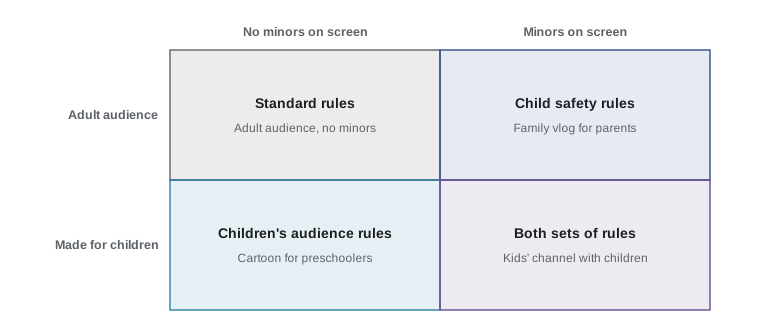
Platform rules about children fall into two groups, and it is important not to confuse them.
- Content featuring minors: videos that show children, whoever the audience is. Rules here focus on the child's safety and dignity, such as banning sexualization, dangerous acts and exploitative situations.
- Content made for children: videos aimed at a child audience, whoever appears in them. Rules here focus on the young viewer, mainly privacy, advertising and interaction features, driven by children's privacy law.
A family vlog aimed at parents may feature children but not be made for children. A cartoon channel may be made for children but feature no children at all. Many family channels are both, which means both sets of rules apply.
Minimum ages for accounts
Most major platforms require users to be at least 13 to have their own account, a limit shaped largely by US children's privacy law. Some services offer supervised experiences for younger children, such as YouTube Kids and supervised accounts linked to a parent. Children under 13 who appear in content should not run public accounts in their own name; parents who manage accounts for them must follow each platform's rules on adult-managed accounts. Several platforms have added teen accounts with extra protections for users aged 13 to 17.
| Platform | Teen protections (at the time of writing) |
|---|---|
| YouTube | Minimum age 13 for own account in most countries; supervised experiences for younger children; YouTube Kids; teen viewing protections such as limits on repeated exposure to some sensitive topics; adult must be present for livestreams by younger minors |
| Teen Accounts introduced in September 2024: private by default, messaging limits, sensitive-content restrictions and overnight sleep mode, with parental permission needed for under-16s to loosen settings | |
| TikTok | Accounts for under-16s private by default with direct messaging off; default daily screen-time prompt for under-18s; livestreaming and gifting limited to adults |
Made for kids on YouTube
In 2019, the US Federal Trade Commission and the New York Attorney General reached a $170 million settlement with Google and YouTube over collecting children's personal information without parental consent. Since January 2020, YouTube has required every creator to tell it whether each video or channel is made for kids. The designation depends on the audience, not on whether children appear. Factors include the subject matter, whether children are the intended audience, the use of child characters, animation, toys, songs or stories popular with children, and the language used.
Marking content as made for kids turns off features that collect data or allow interaction. Personalized ads are disabled, comments are turned off, and features such as notifications, the miniplayer and some end-screen and community features are limited. Because personalized ads earn more, made-for-kids content usually earns a lower revenue per thousand views. Creators sometimes feel tempted to mislabel child-directed content to keep comments and higher ad rates. This is a serious mistake: YouTube can override the setting and penalize channels, and the FTC has said that creators of child-directed content can face civil penalties under COPPA for collecting children's data.
Worked problem
Estimating the income effect of the made-for-kids label
A channel of animated nursery songs gets 2,000,000 views a month. Before marking it correctly as made for kids, it earned an RPM of $3.00. With personalized ads off, the creator estimates RPM falls to $1.20. What is the monthly change in ad income?
Show solution
- Before: \( 2{,}000{,}000 \div 1{,}000 \times 3.00 = 6{,}000 \).
- After: \( 2{,}000{,}000 \div 1{,}000 \times 1.20 = 2{,}400 \).
- Change: \( 6{,}000 - 2{,}400 = 3{,}600 \) a month lower.
Answer: Income falls by about $3,600 a month. The RPM figures are illustrative. The correct response is to build revenue that suits a child audience, such as licensing, books and family-friendly sponsorships that follow children's advertising rules, not to mislabel the content.
Child safety policies for content featuring minors
All major platforms have child safety policies that apply to any content featuring minors. The wording differs, but the core prohibitions are similar.
- Sexualization of minors in any form, including suggestive poses, clothing focus, or content that attracts sexualized comments. Platforms report suspected child sexual abuse material to the authorities.
- Harmful or dangerous acts involving minors, such as dangerous stunts, challenges, or pranks that cause fear or distress.
- Emotional or physical abuse, humiliation or exploitation, including staged punishments and videos of children in distress.
- Content that solicits contact with minors or shares their personal information.
Platforms also take protective actions on content that is allowed. YouTube, for example, has for several years disabled comments on many videos featuring young minors, because comment sections were being misused, and limits recommendations of some family content. Meta has said it reduces recommendations of adult-managed accounts that mainly feature children to adults who show suspicious behaviour. Creators sometimes find these steps frustrating because they reduce engagement, but they exist because of real abuse.
Livestreams, direct messages and gifts
Live and private features carry higher risks for minors because content cannot be reviewed before it is seen and interactions can move quickly into private channels. Platforms therefore restrict livestreaming by minors, often requiring an adult to be present or limiting live features to adults, and they restrict direct messages between adults and minors. Virtual gifts and tipping during livestreams are usually limited to adults. Family creators who livestream with children should keep an adult visibly present and in control, turn off or closely moderate chat, never respond to requests to move to private messages, and end the stream if anything inappropriate happens.
Advertising and sponsorship rules for child audiences
Platform rules on ads and paid promotions add to the law. Paid product placements and endorsements must be disclosed using the platform's tools on all platforms, and several platforms prohibit or restrict paid promotions in content made for kids. YouTube's policies, for example, do not allow paid product placements or endorsements in content made for kids on YouTube Kids. Lesson 11 covers advertising codes for children in more detail.
Managing comments on family content
Where comments stay open, moderation matters. Comments on family content are a common route for predatory behaviour, such as requests for particular kinds of videos, timestamps highlighting innocent moments in sexualized ways, or attempts to start private conversations. Good practice includes keyword filters, holding comments for review, removing and reporting concerning accounts, and turning comments off on videos featuring young children.
Worked problem
Planning comment moderation time
A family channel receives about 3,000 comments a week across videos featuring children. Filters hold 15 % for review, and reviewing a held comment takes about 20 seconds. Spot-checking the rest takes about 1 second per comment. How much moderation time is needed each week?
Show solution
- Held comments: \( 0.15 \times 3{,}000 = 450 \); at 20 seconds each: \( 450 \times 20 = 9{,}000 \) seconds, or 2.5 hours.
- Remaining comments: 2,550; at 1 second each: about 0.7 hours.
- Total: about 3.2 hours a week.
Answer: Roughly 3 hours a week. If that time is not available, turning comments off on videos featuring young children is the safer choice.
Policy changes and staying current
Platform policies on minors have changed many times since 2019, usually becoming stricter. Responsible creators review each platform's child safety and made-for-kids pages at least twice a year, follow official creator channels for announcements, and treat a policy change as a prompt to review older content as well as new uploads. If a video is removed or age-restricted, the appeal process exists, but if the policy concern is genuine, the better long-term response is to change practice.
A platform settings checklist for family channels
Because settings are easy to forget, many family creators keep a short checklist and run through it for every upload. A typical checklist covers the made-for-kids label, the audience and age-restriction settings, whether comments are open, held for review or off, whether the paid promotion box is ticked for sponsored content, and whether the video is eligible for remixing, duets or downloads, which some creators turn off for videos featuring their children so that clips cannot easily be reused by others. It also includes a reminder to check that captions and descriptions contain no identifying details. Running the checklist takes a minute or two and prevents the most common mistakes, such as uploading a child-directed video with comments open or forgetting to disclose a sponsorship. When a platform changes its settings or introduces new features, update the checklist so it stays accurate.
When the platform gets it wrong
Automated systems sometimes misclassify content, for example marking a parenting video as made for kids or age-restricting an educational video about puberty. Creators can usually appeal. When appealing, explain calmly who the intended audience is and why the content fits the policy, and keep a record of the decision. But be honest with yourself first: if the system flagged a concern about a child's safety, take the concern seriously even if you think the classification is wrong.
Finally, remember that platform rules are global but family life is local. A rule that seems overcautious for your family may exist because of patterns platforms see across millions of accounts. Treat the rules as a minimum and your own policy, built in the capstone, as the standard you actually work to.
Platform rules are one layer; your own written standards are another.
Common mistakes
MistakeConfusing content featuring minors with content made for children.
InsteadAsk both questions separately: who appears, and who is the audience?
MistakeMislabelling child-directed content to keep comments and higher ad rates.
InsteadLabel accurately; platforms can override settings and COPPA penalties may apply.
MistakeLetting a child run a public account below the platform's minimum age.
InsteadFollow minimum ages and the rules for adult-managed or supervised accounts.
MistakeLivestreaming with children without an adult in control.
InsteadKeep an adult visibly present, moderate chat and refuse moves to private messages.
MistakeAssuming policies stay the same.
InsteadReview child safety and made-for-kids policies at least twice a year.
Summary and key terms
- Platform rules distinguish content featuring minors from content made for children; both can apply.
- Most platforms require users to be at least 13 and offer teen accounts with extra protections.
- Since 2020, YouTube requires creators to mark made-for-kids content, which disables personalized ads and comments.
- Made-for-kids content usually earns a lower RPM, but mislabelling risks platform penalties and COPPA liability.
- Child safety policies ban sexualization, dangerous acts, abuse and sharing minors' personal information.
- Livestreams, direct messages and gifts are restricted for minors because of higher risks.
- Comment moderation is essential on family content, and comments are often best turned off for young children.
- Made for kids
- YouTube's designation for content whose primary audience is children.
- Teen account
- An account for users aged 13 to 17 with extra default protections.
- Supervised account
- An account for a child that is linked to and managed by a parent.
- Adult-managed account
- An account run by an adult that features a child.
- Personalized ads
- Ads targeted using information about the viewer.
- Child safety policy
- A platform policy protecting minors who appear in content.
- Sexualization
- Presenting a person, especially a child, in a sexual way.
- Override
- A platform changing a creator's setting, such as the made-for-kids label.
- Keyword filter
- A tool that holds or hides comments containing chosen words.
- Age restriction
- Limiting content to viewers above a certain age.
Practice problems
Work each problem on paper first, then reveal the answer to check.
What two questions decide which platform rules apply?
Show answer
Whether minors appear and whether the content is made for children.
What minimum age do most platforms set for accounts?
Show answer
13.
What happened in the 2019 FTC settlement with YouTube?
Show answer
Google and YouTube paid $170 million over children's data, leading to the made-for-kids requirement.
Name two features turned off for made-for-kids content.
Show answer
Personalized ads and comments, plus some notifications and interactive features.
500,000 monthly views; RPM falls from $2.50 to $1.00. Change in income?
Show answer
$1,250 − $500 = $750 lower.
Name three things child safety policies prohibit.
Show answer
Sexualization, dangerous acts, abuse or humiliation, sharing personal information.
When were Instagram Teen Accounts introduced?
Show answer
September 2024.
Name two safety steps for a family livestream.
Show answer
Adult present, moderated or disabled chat, no private messages, end if inappropriate.
2,000 comments a week, 10 % held at 30 seconds each. Review time?
Show answer
200 × 30 = 6,000 seconds, about 1.7 hours.
How often should creators review child policies?
Show answer
At least twice a year and after announcements.
Lesson quiz · 5 questions
Score 60% or more to complete this lesson.
Create a free account to save your progress, take quizzes and earn a certificate.