
HSE-362 · Lesson 10 of 12 · 20 min
Accounting for students and reunification
▶ Video coming soon A video version of this lesson is on the way.
After almost every emergency, the same question comes first: is everyone here? A school that cannot answer it quickly cannot tell firefighters whether to search the building, cannot reassure families, and cannot know whether a student is lying hurt in a stairwell or has simply walked home. And when an emergency closes the school, the next question is how to get every student safely back to a parent or guardian, one at a time, without losing anyone in the crowd. This lesson covers accounting, at the assembly area and afterward, and reunification, the organized release of students to their families.
Accounting at the assembly area
Accounting starts with the teacher. Each teacher takes the class list, or the electronic attendance device, out of the room in every evacuation, and takes attendance at the assembly area as soon as the class arrives. The board uses a simple red and green card system:
- Green card held up: all students on the class list for this period are present, and there are no extra students.
- Red card held up: one or more students are missing, or there are extra students, or there is an injured student or another problem.
Runners from the accounting station collect the cards, or the teachers report to the station in person, depending on the size of the school. For every red card, the teacher writes down the names of missing and extra students and what is known about where they were, such as 'went to the washroom two minutes before the alarm' or 'was in the library with a pass.' The accounting team matches missing and extra students between classes. Many apparent gaps resolve this way: a student who left with the library group or joined a friend's class turns up in the wrong line.
The accounting station also checks other records: the day's attendance, the sign-out log at the office, the late arrivals list, and the visitor log, so that students who left early, arrived late or are away on a field trip are not counted as missing. The result is a short list of people who are still unaccounted for, with their last known locations. The incident commander gives that list to the fire department or police immediately. The list is far more useful to emergency services than a vague statement that 'a few students might be missing.'
Accounting for staff, visitors and contractors
Staff are counted too. Department heads or wing leaders account for staff in their areas, and the office checks the staff sign-in list for supply teachers, itinerant staff and student teachers. Visitors and contractors sign in at the office and wear badges, and the visitor log goes out with the office staff in every evacuation. Contractors working on a roof, in a boiler room or in a closed-off construction area are easy to forget, so the plan names someone to account for them.
When students are not with a class
Accounting is hardest when students are not where the timetable says: at lunch, between classes, in the library, in a spare, in a co-op placement or out on a field trip. Lesson 2 described Pinecrest Secondary School's lunch procedure, which sends students to their period-1 teacher's spot at the assembly area. Other common measures are:
- Students in spares report to a set area and are counted by the guidance staff.
- Library staff, coaches and club supervisors account for the students with them and report to the accounting station.
- Classes away on field trips report in by phone to confirm they are safe.
- Elementary schools account for students in before-school and after-school programs using those programs' own lists.
Practising these situations in drills, as Lesson 2 described, is the only way to know whether they work.
A missing student
If a student is still missing after the accounting team has done its matching, the principal tells the fire department or police at once, with the student's name, description, last known location and any information about why they might be missing, such as a medical condition or a tendency to hide. Staff do not go back into the building to search, unless directed by emergency services. A second, separate procedure covers students who are missing in other circumstances, such as a young child who wanders away from a playground, and it includes an immediate search of the grounds, a call to police and a call to the family.
Reunification: when the school closes
Most evacuations end with everyone going back inside. Some do not. A fire, a gas leak, a flood, a police incident or storm damage may close the school for the rest of the day, and students must be released to their families. Releasing hundreds of students in an emergency is a major task. Done badly, it produces a crowd of anxious parents at the door, students leaving with whoever they see, and no record of who went where. Done well, it is slow but orderly, and every student is released to an authorized adult with a record of the release.
The board uses a structured student release procedure for this. Many Ontario boards have similar procedures, sometimes developed with local police and emergency management.
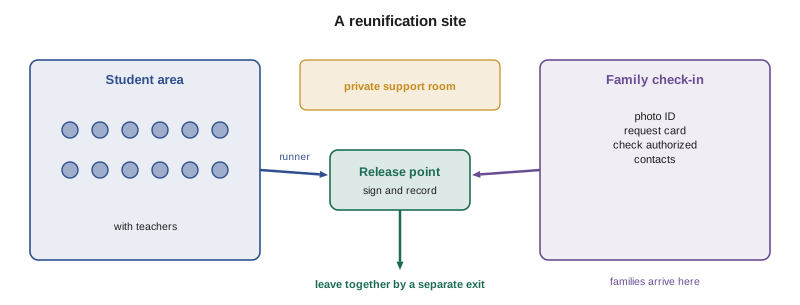
The main features of any good reunification process are:
- A reunification site that is separate from the incident, safe, large enough and easy to reach, such as a nearby school, community centre or place of worship, with agreements in place in advance.
- Separate areas for students and families, so families do not simply walk in and take children.
- A family check-in area where adults show identification and fill in a request card listing each child.
- A check against the student's authorized contacts in the student information system, including any custody orders or restrictions.
- Runners who bring each student from the student area to the release point.
- A release point where the adult and student are brought together, the release is signed and recorded, and they leave.
- A plan for students who cannot be released quickly: those whose authorized adults cannot come, students who need medical care, and students whose families need support or difficult news.
Getting students to the reunification site
If the school cannot be used, students are moved from the assembly area to the reunification site, usually by school bus, sometimes on foot if the site is close and safe to walk to. Teachers stay with their classes, keep their class lists, and take attendance again when they get on and off the bus. Students should not be allowed to leave the group on their own, even if their home is nearby or they have a car in the parking lot. Secondary students who drive may be released at the site, as the board's rules allow, but they are still checked out and recorded.
Communicating with families during reunification
Families must be told quickly and clearly where to go, what to bring and what to expect. A good first message says that students are safe, that they are being moved to a named site, that families should bring photo identification and go to the family entrance, and that release will take time because every student is released only to an authorized adult. It also asks families not to go to the school itself, where they could get in the way of emergency services. Lesson 11 covers this communication in more detail.
Families will arrive before the site is ready, and many will arrive at once. Staff at the family entrance should be calm and visible, explain the process, and keep the line moving. People who are not on the authorized list cannot take a student, even if they are a close relative, unless the parent or guardian confirms it through the process the board has set. This can cause frustration, and staff need support from administrators and, if needed, police.
How long it takes
Reunification is slower than people expect. Each release involves checking identification, looking up the student's record, finding the student and bringing them to the release point. Even with several check-in tables and runners, a large school can take hours to release everyone. The program below estimates the time to release all students from Willow Park, based on the number of check-in tables and the time each release takes.
# Estimate reunification time: families arrive over the first hour; each table
# releases one family every few minutes. Many families collect more than one child.
students = 480
children_per_family = 1.6
families = round(students / children_per_family)
minutes_per_release = 3.0
for tables in (3, 6, 10):
    rate = tables / minutes_per_release              # families released per minute
    # if arrivals are spread over 60 minutes, the line is limited by whichever is slower
    finish = max(60, families / rate)
print(f"{tables:2d} tables: about {families} families, last release after about {finish / 60:.1f} h")3 tables: about 300 families, last release after about 5.0 h 6 tables: about 300 families, last release after about 2.5 h 10 tables: about 300 families, last release after about 1.5 h
With three check-in tables, release takes about five hours; with ten, the process is limited mostly by how quickly families arrive. That is why the board's plan for each site lists how many tables, staff and runners are needed, and why staff from nearby schools and the board office are called in to help.
Students who cannot be released quickly
Some students will still be waiting when most have gone. Their parents may be at work far away, stuck in traffic, or unreachable. Staff stay with them, keep them fed and calm, and keep trying the contacts on file. No student is left alone at a site, and no student is released to an unauthorized adult simply to end the day. If a student has been taken to hospital, the principal makes sure the family is told directly and privately, not through a crowded check-in table, and a staff member may go to the hospital to support the student until the family arrives.
Keeping records
Every release is recorded: the student's name, the adult's name and identification, the time and the staff member who released the student. The records are kept with the incident file. They answer questions later, such as where a particular student went, and they protect staff who followed the process.
Worked problem
A flood closes Willow Park
Show solution
- At 10:15 a.m., a water main breaks under the 1958 wing at Willow Park. Water floods the corridor and the electrical room, and the fire department orders the building closed for the day.
- Classes evacuate to the back playground. The accounting station collects green cards from all but one class; the red card lists a Grade 3 student who was in the resource room. Jenna's card shows him with her group. All are accounted for within ten minutes.
- The principal activates reunification at the community centre across the road, which has an agreement with the board. Staff walk classes over in groups, counting again on arrival.
- Families receive a message at 10:50 with the site, the family entrance and the need for photo identification. Six check-in tables and eight runners are set up with staff from two nearby schools.
- By 1:30 p.m., all but nine students have been released. The last student leaves with his grandmother, an authorized contact, at 3:10. Every release is recorded.
Answer: Account for everyone with red and green cards, activate the pre-arranged reunification site, tell families where to go and what to bring, check every adult against authorized contacts, and record every release.
Common mistakes
MistakeReporting that "a few students might be missing."
InsteadGive emergency services a short list of names and last known locations.
MistakeLetting students walk home from the assembly area on their own.
InsteadKeep students with their classes until they are released through the process.
MistakeReleasing a student to any adult who seems to know them.
InsteadRelease only to authorized contacts, checked against the student record.
MistakeHolding reunification at the school next to the incident.
InsteadUse a separate, pre-arranged reunification site.
MistakeTelling a family about a hospitalized student at a crowded table.
InsteadTell them directly and privately, with support.
Summary and key terms
- Teachers take attendance at the assembly area and show a green or red card.
- The accounting station matches missing and extra students and checks other records to produce a short list for emergency services.
- Staff, visitors and contractors must be accounted for too.
- Lunch, spares, libraries and field trips need their own accounting procedures.
- When a school closes, students are released only through an organized reunification process at a separate site.
- Every adult is checked against authorized contacts, and every release is recorded.
- Reunification takes hours, so sites need enough tables, staff and runners.
- Accounting
- Confirming that every student, staff member and visitor is present and safe after an emergency.
- Red and green card
- A simple signal from a teacher showing whether all students are present (green) or there is a problem (red).
- Accounting station
- The place at the assembly area where class reports are collected and missing people are tracked.
- Reunification
- The organized release of students to authorized adults after an emergency closes the school.
- Authorized contact
- An adult listed in the student record as allowed to pick up the student.
Practice problems
Work each problem on paper first, then reveal the answer to check.
What does a red card mean at the assembly area?
Show answer
One or more students are missing or extra, or there is an injury or another problem.
Why does the accounting station check the sign-out log and visitor log?
Show answer
So students who left early, arrived late or are away are not counted as missing, and visitors are accounted for.
Why are students and families kept in separate areas at a reunification site?
Show answer
So each release can be checked against authorized contacts and recorded before the student leaves.
Why did the reunification estimate drop so much with more check-in tables?
Show answer
Each table releases one family at a time, so more tables release families faster until arrivals become the limit.
What should happen to students whose families cannot come quickly?
Show answer
Staff stay with them, keep them fed and calm, keep trying contacts and never leave them alone or release them to unauthorized adults.
Lesson quiz · 5 questions
Score 60% or more to complete this lesson.
Create a free account to save your progress, take quizzes and earn a certificate.