
HSE-362 · Lesson 4 of 12 · 21 min
Lockdown: protecting students from a threat inside
▶ Video coming soon A video version of this lesson is on the way.
A lockdown is used when there is a threat of violence inside the school or on its grounds, such as a person with a weapon or someone behaving in a way that puts people in immediate danger. The aim is simple: put locked doors and distance between students and the threat, keep everyone out of sight and quiet, and wait for police to resolve the situation and release each room. Lockdowns are rare in real life, and the great majority of schools will never have a real one. They are drilled often because, when one is needed, there is no time to think, and the actions have to be automatic for staff and students alike.
This lesson covers what staff do in a lockdown. It does not discuss attacks themselves in any detail. Its focus is the protective steps that keep students safe, and how to practise them without frightening children.
How a lockdown is called
Anyone who sees or hears a threat inside the building can call a lockdown, usually by phoning the office or 911, or by using the school's alert system if it allows staff to trigger an alert. In the board, the announcement uses plain language, never codes: 'Lockdown. Lockdown. This is not a drill.' Plain language matters because supply teachers, visitors and new students may not know a code, and because there is no time to work out what 'Code Red' means in this particular school.
Staff should not wait for permission or certainty. If a teacher hears what sounds like gunshots or sees a person with a weapon, the teacher locks down the classroom immediately and then tells the office. A lockdown called by mistake costs a few minutes of disruption. A lockdown called too late can cost lives.
What staff do
The steps are the same in every room, and they are practised until they are automatic:
- Bring students in from the hallway nearby, quickly and without leaving the room to search.
- Lock the classroom door. Most board classrooms now have doors that lock from the inside without stepping into the hallway; older rooms may need a key, which is kept on the teacher at all times, not in a desk drawer.
- Turn off the lights and close blinds if it can be done quickly.
- Move everyone out of sight of the door window and any interior windows, into the area of the room that cannot be seen from the hallway.
- Silence phones and devices, and keep everyone quiet.
- Stay put. Do not open the door for anyone, including people claiming to be police or students asking to come in, once the lockdown is in place. Police will unlock the door or use a key.
- Take attendance quietly and note anyone missing or anyone extra.
- Wait for police or an administrator with police to release the room.
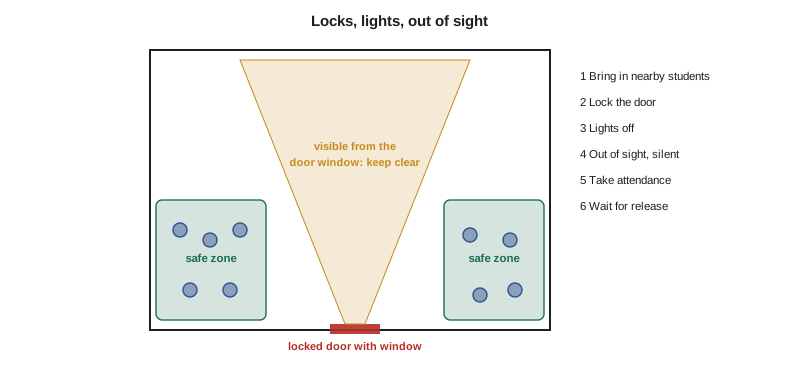
Each classroom has a safe corner or wall, chosen in advance, that cannot be seen through the door window. Teachers identify it at the start of the year and show it to students during the first drill. Some rooms have no good safe area, such as rooms with glass walls or doors that face long corridors, and those rooms need a plan, such as covering the door window with a pull-down blind or moving to a nearby room with better cover.
Rooms that are hard to secure
The gym, the cafeteria, the library, the auditorium, shops, portables and outdoor areas all present problems. They have many doors, large windows, or no lock at all. The plan should set out what happens in each of these spaces:
- Gym: move students into locker rooms or equipment rooms that lock, or leave by the nearest exit away from the threat if that is safer.
- Cafeteria: move students into the kitchen, storage rooms or nearby classrooms that lock.
- Library: use the workroom or offices, or the stacks away from windows.
- Portables: lock the door and stay out of sight; portables are usually treated as classrooms.
- Outside: move away from the building to a pre-set off-site location, such as a nearby church or community centre, and call the office to report the class's location.
- Washrooms and hallways: students go into the nearest classroom or lockable space, and the teacher there accepts them.
Students who are in a washroom when a lockdown is called are told to go to the nearest classroom, or, if that is not possible, to lock themselves in a stall and stay quiet. Teachers near washrooms should check them quickly if they can do so without leaving their own students unsupervised.
Staff judgement
Lockdown is the default action for a threat inside, but it is not the only option, and staff need permission to use judgement. If a class is outside, it should not walk back into the building. If a teacher knows exactly where the threat is and has a safe way to lead students out of the building and away from it, leaving may be safer than staying. Many school systems teach staff that, in addition to locking down, they may evacuate away from danger if they can do so safely, and must then call to report where they are. Students should hear the simple version: follow the adult and stay quiet.
The board's procedure reflects this. It also tells staff that if they become separated from students or find themselves in immediate danger with no locked room available, their first duty is to get themselves and anyone with them to safety and to call 911.
A fire alarm during a lockdown
One of the hardest decisions in a lockdown is what to do if the fire alarm sounds. Fire alarms have been pulled deliberately to draw people out of locked rooms, so the default during a lockdown is to stay put. But a real fire can also start, so the rule cannot be absolute. The board's procedure is:
- Stay in lockdown when the alarm sounds, unless you see or smell smoke or fire in or near your room, or are told to evacuate by an administrator or police over the public address system or radio.
- If there is smoke or fire, evacuate by the safest route away from both the fire and the reported threat, and call to report your location.
This is discussed openly in staff training, because it is a decision staff might have to make alone.
Ending a lockdown
A lockdown ends only when police say it is over. In many cases, police officers go room by room, unlocking doors with keys, checking each room and escorting students out to a safe location, sometimes in groups and sometimes with hands visible. This can take a long time, often hours in a real event. Staff should expect it and prepare students: police officers may enter quickly and give loud instructions, and everyone should follow them, keep their hands empty and visible, and not run toward police officers.
An announcement over the public address system that the lockdown is over is not enough on its own, because an announcement could be made by anyone. The board's rule is that a room stays locked until someone opens it with a key, or an administrator known to the teacher confirms in person or through a pre-agreed method, such as a text to staff phones from the principal, that the lockdown has ended.
Drills
Ontario school boards and local police services work under a protocol modelled on the province's guidance for police and school board cooperation, which expects schools to practise lockdown at least twice each school year, usually with police present for at least one drill. The board holds two lockdown drills a year in every school, one in each term, with the local police service attending one of them to observe and give feedback.
Drills are announced as drills, with plain words: 'Lockdown drill. This is a drill.' The board does not run unannounced drills that simulate an attack, use fake weapons, sound effects or actors playing intruders, or tell students it is real. These practices have been widely criticized for causing fear and distress without making students safer, and child-safety and school-psychology organizations recommend against them. A good lockdown drill teaches the actions, not the fear.
Drills for young children need extra care. Teachers use simple language, such as practising being 'as quiet as mice' in the safe corner. Willow Park's kindergarten teachers read a short story about the drill the day before and talk about it afterward. Students who are anxious are reassured, and students with past trauma may need individual preparation. Families are told when drills happen so they can talk about them at home.
Checking rooms during drills
During a drill, an administrator and often a police police officer walk the halls and check each room: Is the door locked? Can anyone be seen through the window? Can students be heard? Are lights off? The results are recorded room by room. Over time, the records show which rooms have problems with doors, locks, windows or noise. The program below summarizes the checks from Pinecrest Secondary School's two drills last year.
# Lockdown drill room checks: count problems by type across two drills.
checks = [
    # (drill, room, door locked, out of sight, quiet)
    ("Oct", "101", True, True, True), ("Oct", "104", True, False, True), ("Oct", "Gym", False, True, False),
    ("Oct", "Library", True, False, True), ("Oct", "Portable 2", True, True, True), ("Oct", "212", True, True, False),
    ("Apr", "101", True, True, True), ("Apr", "104", True, True, True), ("Apr", "Gym", True, True, True),
    ("Apr", "Library", True, False, True), ("Apr", "Portable 2", False, True, True), ("Apr", "212", True, True, True),
]
problems = {"door not locked": [], "visible from door": [], "noise heard": []}
for drill, room, locked, hidden, quiet in checks:
    if not locked: problems["door not locked"].append(f"{room} ({drill})")
    if not hidden: problems["visible from door"].append(f"{room} ({drill})")
    if not quiet:  problems["noise heard"].append(f"{room} ({drill})")
for k, v in problems.items():
print(f"{k:18} {len(v)}: {', '.join(v)}")door not locked 2: Gym (Oct), Portable 2 (Apr) visible from door 3: 104 (Oct), Library (Oct), Library (Apr) noise heard 2: Gym (Oct), 212 (Oct)
The library appears twice for visibility: its glass wall to the corridor gives no safe zone. The fix was a set of blinds that drop over the glass with one pull and a revised plan moving students into the workroom and stacks. Portable 2's door failed in April because the lock was stiff; it was replaced. Doors that do not lock reliably are one of the most common findings and among the easiest to fix, which is why they should be reported to the custodian the same day.
Physical security that supports lockdown
Lockdown depends on the building as much as on people. Controls that the board has put in place over the last decade include classroom doors that lock from the inside, a single main entrance with a buzzer and camera during the school day, numbered doors and windows that match the floor plans held by police, window film or blinds on door windows, and a public address system that reaches every space, including portables and outdoor areas. Staff help by keeping exterior doors closed and never propped, wearing identification, and asking unfamiliar adults to report to the office.
Worked problem
A lockdown drill debrief at Willow Park
Show solution
- Willow Park holds its first lockdown drill of the year in October, announced to families the week before.
- Priya makes the announcement in plain language and notes the time. An administrator and a police police officer check every room.
- They find that the music room door does not lock from inside, that the Grade 4 class could be heard laughing, and that a lunchroom supervisor in the gym did not know where to take students.
- In the debrief, the principal thanks staff, and the police officer gives brief feedback. Work orders go in for the music room lock, the Grade 4 teacher practises quiet time with her class, and lunch supervisors get a one-page card for each space.
- The second drill in spring shows all three issues fixed.
Answer: Drill in plain language, check every room, debrief calmly, fix the physical and training problems, and confirm in the next drill.
Common mistakes
MistakeWaiting for the office to confirm before locking down.
InsteadLock down immediately if you see or hear a threat, then report it.
MistakeOpening the door for someone who knocks during a lockdown.
InsteadKeep the door shut; police or an administrator will unlock it.
MistakeEvacuating automatically when the fire alarm sounds during a lockdown.
InsteadStay unless you see or smell fire or are directed to leave.
MistakeRunning drills with actors, fake weapons or surprise attacks.
InsteadAnnounce drills clearly and teach the steps without fear.
MistakeTreating a public address announcement alone as the end of lockdown.
InsteadWait for police or a confirmed release from a known administrator.
Summary and key terms
- Lockdown is used for a threat of violence inside the school or on its grounds.
- The steps are: bring in nearby students, lock, lights off, out of sight, silent, stay, take attendance, wait for release.
- Each room needs a safe zone that cannot be seen from the door window; difficult spaces need their own plans.
- Staff may evacuate away from danger when that is clearly safer, and must report their location.
- During a lockdown, stay put when the fire alarm sounds unless there is smoke or fire or you are told to leave.
- Only police or a confirmed administrator can end a lockdown.
- Drills are announced, age-appropriate and free of simulated violence, and room checks show what needs fixing.
- Lockdown
- The response to a threat of violence inside: lock doors, turn off lights, stay out of sight and silent until released.
- Safe zone
- The part of a room that cannot be seen from the door window or hallway.
- Plain language
- Clear words, not codes, used to announce emergency actions.
- Release
- The end of a lockdown for a room, done by police or a confirmed administrator.
- Off-site location
- A pre-arranged place away from the school where classes go if they cannot return to the building.
Practice problems
Work each problem on paper first, then reveal the answer to check.
List the main steps a teacher takes in a lockdown.
Show answer
Bring in nearby students, lock the door, lights off, move out of sight, silence devices, stay, take attendance and wait for release.
Why do schools use plain language instead of codes?
Show answer
Supply staff, visitors and new students may not know the codes, and there is no time to decode them.
What should a class that is outside do when a lockdown is called?
Show answer
Move away from the building to the pre-set off-site location and call to report its location.
What is the rule for a fire alarm during a lockdown?
Show answer
Stay in lockdown unless you see or smell smoke or fire or are told to evacuate by an administrator or police.
Why do schools avoid drills with actors and fake weapons?
Show answer
They cause fear and distress without improving safety; drills should teach the steps calmly.
Lesson quiz · 5 questions
Score 60% or more to complete this lesson.
Create a free account to save your progress, take quizzes and earn a certificate.