
HSE-362 · Lesson 8 of 12 · 21 min
Medical emergencies: first aid, AEDs, anaphylaxis and seizures
▶ Video coming soon A video version of this lesson is on the way.
Of all the emergencies in this course, medical emergencies are the ones a school is most likely to face. A large secondary school will have several serious medical events in a typical year: a student in anaphylaxis after eating something with nuts, a severe asthma attack in physical education, a seizure in a classroom, a head injury on the playground, a staff member with chest pain, or a visitor who collapses at a concert. Most of these events are handled well because staff know the first steps and the right people respond quickly. This lesson covers those steps and the school systems that support them.
The first minutes
Whatever the emergency, the first minutes follow the same pattern:
- Check the scene for danger before approaching, such as electrical hazards, traffic or a fight.
- Check the person: are they responsive, breathing normally, bleeding heavily?
- Call for help. Send a specific person to call 911 and another to bring the first aid kit and the AED. Say exactly what you want: 'You, in the blue shirt, call 911 and tell them a student has collapsed in the second-floor science hallway. Then come back and tell me.'
- Give first aid within your training, such as CPR, using the AED, giving an epinephrine auto-injector, or controlling bleeding.
- Tell the office, which calls the principal, sends the first aid team, calls a hold if the halls need to be clear, and sends someone to meet paramedics at the door.
- Stay with the person until paramedics take over, and pass on what happened, what you saw and what you did.
The person who calls 911 should give the school's address and the exact location inside the building, the nearest entrance, the number of people hurt, what happened and the person's condition. Many school addresses are on one street while the main entrance or the gym is on another, so the plan should list the best entrance for paramedics for each part of the building. At Pinecrest Secondary School, the gym entrance is on the side street, and a custodian is sent to wave in the ambulance whenever a call involves the gym or the field.
Cardiac arrest, CPR and AEDs
Sudden cardiac arrest happens when the heart's electrical system fails and it stops pumping effectively. The person collapses, does not respond and is not breathing normally; they may make gasping sounds, which are not real breathing. Without help, death follows within minutes. With immediate CPR and early defibrillation, many people survive. Sudden cardiac arrest is rare in young people, but it does happen, sometimes during sports, sometimes in students with undiagnosed heart conditions, and it is more common among adult staff, coaches and visitors.
The steps for a layperson are simple:
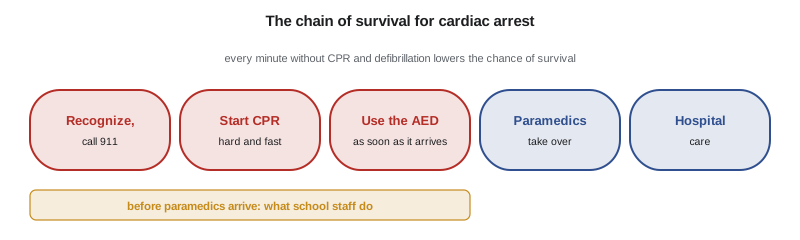
- If the person is unresponsive and not breathing normally, call 911 and send for the AED.
- Start chest compressions right away: push hard and fast in the centre of the chest, at about 100 to 120 compressions per minute. If trained, give rescue breaths; if not, hands-only CPR is better than nothing.
- Turn on the AED as soon as it arrives and follow its spoken instructions. It will analyze the heart rhythm and tell you whether to give a shock.
- Keep going until paramedics take over or the person starts breathing normally.
AEDs are designed for people with no medical training. They will not shock someone who does not need it. The most important thing an AED needs is to arrive quickly, which means placement matters. A common target is that an AED should be reachable within about three minutes there and back from anywhere in the school, including the gym, the field, the pool area and the auditorium during events.
Many Ontario school boards, including the board, have placed AEDs in all secondary schools and many elementary schools, often with help from heart health foundations and community groups. Staff should know where the nearest AED is from every room they work in, and the AEDs should be checked regularly so that batteries and pads are in date.
The program below checks the AED placement at Pinecrest Secondary School by estimating the walking time from several key locations to the nearest AED and back, at a brisk walk of about 1.5 metres per second.
# Round-trip time to the nearest AED from key locations, at a brisk 1.5 m/s.
aeds = {"Main office": (0, 0), "Gym lobby": (120, 40), "Cafeteria": (60, -50)}
places = {
    "Main gym": (130, 60), "Field (far end)": (310, 90), "Science wing 2F": (40, 140),
    "Auditorium": (-70, 20), "Shop wing": (180, -80), "Library": (20, 60),
}
SPEED = 1.5   # m/s, brisk walk
TARGET = 180  # seconds there and back
for name, (x, y) in places.items():
    best = min(aeds.items(), key=lambda a: ((a[1][0] - x) ** 2 + (a[1][1] - y) ** 2) ** 0.5)
    d = ((best[1][0] - x) ** 2 + (best[1][1] - y) ** 2) ** 0.5 * 1.3  # 1.3 = corridors are not straight lines
    t = 2 * d / SPEED
print(f"{name:18} nearest {best[0]:12} round trip {t:4.0f} s {'ok' if t <= TARGET else 'TOO FAR'}")Main gym nearest Gym lobby round trip 39 s ok Field (far end) nearest Gym lobby round trip 341 s TOO FAR Science wing 2F nearest Gym lobby round trip 222 s TOO FAR Auditorium nearest Main office round trip 126 s ok Shop wing nearest Cafeteria round trip 214 s TOO FAR Library nearest Main office round trip 110 s ok
Two places miss the target. The far end of the field is more than 300 metres from any AED, and the second floor of the science wing is reached only by a long corridor. The fixes the school adopted were a portable AED that goes out with every outdoor class and sports team, and a fourth wall-mounted AED in the science wing.
Anaphylaxis
Anaphylaxis is a severe, fast-moving allergic reaction that can cause swelling of the throat, difficulty breathing, a drop in blood pressure, vomiting, hives and collapse. Common triggers in schools are foods, especially peanuts, tree nuts, milk, eggs, fish, shellfish and sesame, and insect stings. A reaction can start within minutes of contact.
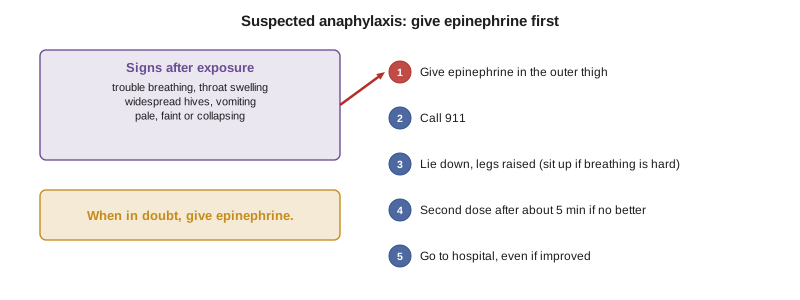
The first treatment is epinephrine, given by auto-injector into the outer thigh, as soon as anaphylaxis is suspected. There is no reason to wait for symptoms to become severe; delay is the main factor in deaths from anaphylaxis. After giving epinephrine, call 911, have the person lie down with legs raised, or sit up if they are having trouble breathing, and give a second dose after about five minutes if symptoms do not improve and a second auto-injector is available. Everyone who receives epinephrine goes to hospital, because symptoms can return.
Ontario's Sabrina's Law, passed in 2005 after the death of a student from anaphylaxis, requires school boards to have anaphylaxis policies, including strategies to reduce exposure to allergens, individual plans for each student at risk, regular training for staff, and arrangements for storing and using epinephrine auto-injectors. It also protects staff who act in good faith to give epinephrine in an emergency. Students at risk usually carry their own auto-injector once they are old enough, and a second one is often kept in the office.
Each student at risk has an individual plan with a photo, the student's allergens, the signs of a reaction, the steps to take, the location of auto-injectors and emergency contacts. Copies are kept in the classroom, the office, the supply teacher folder and on field trips. Every adult who supervises the student, including lunchroom supervisors and coaches, should know the student and the plan.
Asthma
Asthma is the most common chronic condition among school-age children. A severe attack causes wheezing, coughing, chest tightness and difficulty speaking in full sentences. The first treatment is the student's reliever inhaler, usually blue. Ontario's Ryan's Law, passed in 2015, requires school boards to have asthma policies and allows students to carry their reliever inhalers with parental permission. Staff should help the student use the inhaler, with a spacer if available, and call 911 if symptoms do not improve quickly or the student is struggling to breathe, has blue lips or is becoming drowsy.
If a student with a known severe allergy has trouble breathing and it is unclear whether the cause is asthma or anaphylaxis, give epinephrine first. Epinephrine will help in either case; an inhaler will not stop anaphylaxis.
Seizures
Seizures look frightening, but most stop on their own within a few minutes. The aim of first aid is to keep the person safe while the seizure runs its course:
- Stay calm and note the time the seizure started.
- Move hard or sharp objects away and cushion the head.
- Do not restrain the person and do not put anything in their mouth.
- When the jerking stops, roll the person onto their side to keep the airway clear.
- Stay with them, speak calmly and give privacy, for example by calling a hold to clear the hallway.
- Call 911 if the seizure lasts more than five minutes, if another seizure follows, if the person is injured, pregnant, has diabetes, or does not wake up, if it happened in water, or if it is a first seizure. Follow the student's individual plan, which may include rescue medication.
Other emergencies
- Diabetes: a student with low blood sugar may become shaky, sweaty, confused or irritable. Give fast-acting sugar, such as juice or glucose tablets, if the student can swallow, and follow the plan. If the student is unconscious, call 911 and follow the plan, which may include glucagon.
- Severe bleeding: apply firm, direct pressure with a dressing or cloth and keep it there; use a tourniquet only if trained and pressure does not work on a limb.
- Head injuries and concussion: any student with a suspected concussion is removed from activity and not allowed to return that day, and is assessed by a doctor. Call 911 for loss of consciousness, repeated vomiting, worsening headache or confusion.
- Choking: encourage coughing; if the person cannot breathe, cough or speak, give abdominal thrusts or back blows as trained.
- Mental health crises: a student who talks about suicide or self-harm is not left alone, and is supported by trained staff following the board's procedures.
First aid kits, training and records
Under Ontario's workers' compensation rules (Regulation 1101), employers must provide first aid kits and trained first aiders in the workplace. The board goes further for students: each school has a list of staff trained in standard first aid and CPR with AED, spread across shifts and areas, and every staff member is trained in the anaphylaxis, asthma, diabetes and epilepsy procedures each year. Every first aid event is recorded, and serious incidents are reported to the board and, for staff injuries, to the WSIB.
Staff who give first aid may be exposed to blood or other body fluids. They use gloves from the first aid kit, wash hands afterward and report any exposure, following the bloodborne pathogens procedures from HSE-360.
Worked problem
A collapse at basketball practice
Show solution
- During an after-school practice, a 16-year-old player collapses on the court and does not respond. He is making occasional gasping sounds.
- Sam checks him, sees he is not breathing normally, and points at two players: one to call 911 and give the address and the gym entrance, the other to bring the AED from the gym lobby.
- Sam starts chest compressions. The AED arrives in about 90 seconds. Sam's assistant coach attaches the pads; the AED advises a shock, which is given, and compressions resume.
- A custodian meets paramedics at the gym door. Paramedics take over after about seven minutes. The player regains a pulse on the way to hospital.
- The principal notifies the family, the team is supported by guidance staff, and the incident is reported. The AED is restocked with new pads.
Answer: Recognize cardiac arrest, call 911 and get the AED, start CPR immediately, use the AED as soon as it arrives, meet paramedics at the right door, and restock afterward.
Common mistakes
MistakeShouting "someone call 911" to a crowd.
InsteadPoint at a specific person and give a specific task.
MistakeWaiting to see if anaphylaxis symptoms get worse.
InsteadGive epinephrine as soon as anaphylaxis is suspected, then call 911.
MistakeMistaking gasping for normal breathing in a collapsed person.
InsteadTreat gasping as not breathing: start CPR and use the AED.
MistakePutting something in the mouth of a person having a seizure.
InsteadCushion the head, time the seizure and roll them onto their side afterward.
MistakeKeeping AEDs locked in an office far from the gym and field.
InsteadPlace AEDs within about three minutes round trip and take one outdoors.
Summary and key terms
- Medical emergencies are the most common serious emergencies in schools.
- Check for danger, check the person, send specific people to call 911 and get the kit and AED, give first aid and tell the office.
- For cardiac arrest, start CPR immediately and use the AED as soon as it arrives.
- For suspected anaphylaxis, give epinephrine first, then call 911.
- Asthma, seizures, diabetes, bleeding, head injuries and choking each have simple first steps and individual plans.
- AED placement, trained staff, individual plans and records are the systems behind a good response.
- Sudden cardiac arrest
- A sudden failure of the heart to pump, causing collapse and no normal breathing.
- AED
- An automated external defibrillator, a device that analyzes the heart rhythm and gives a shock if needed.
- Anaphylaxis
- A severe, life-threatening allergic reaction that needs epinephrine immediately.
- Epinephrine auto-injector
- A device that injects a set dose of epinephrine into the thigh to treat anaphylaxis.
- Chain of survival
- The sequence of early recognition, CPR, defibrillation and advanced care that improves survival from cardiac arrest.
Practice problems
Work each problem on paper first, then reveal the answer to check.
Why should you point at a specific person when asking someone to call 911?
Show answer
In a crowd, everyone may assume someone else is calling; a specific request makes sure it happens.
What should you do if a collapsed person is gasping but not breathing normally?
Show answer
Treat it as cardiac arrest: call 911, send for the AED and start CPR.
When should epinephrine be given for suspected anaphylaxis?
Show answer
Immediately, as soon as anaphylaxis is suspected, followed by a call to 911.
When should 911 be called for a seizure?
Show answer
If it lasts more than five minutes, repeats, causes injury, happens in water, is a first seizure or the person does not wake up, or as the plan says.
What did the AED placement check show at the school, and what was done?
Show answer
The far field and the science wing were too far; a portable AED goes outdoors and a fourth AED was added in the science wing.
Lesson quiz · 5 questions
Score 60% or more to complete this lesson.
Create a free account to save your progress, take quizzes and earn a certificate.