
HSE-362 · Lesson 11 of 12 · 20 min
Communicating in an emergency: staff, families and the media
▶ Video coming soon A video version of this lesson is on the way.
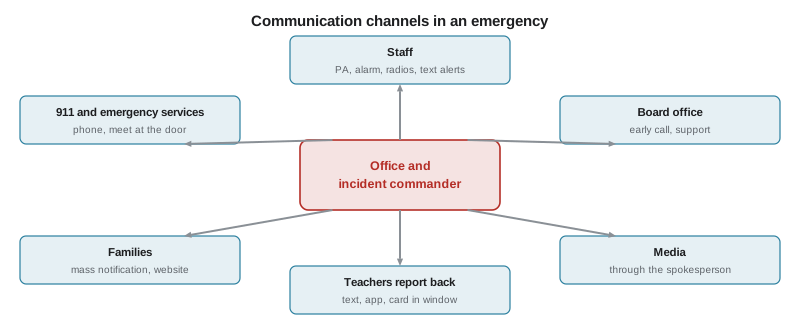
In almost every review of a school emergency, communication comes up as a problem. The announcement could not be heard in the gym. The radio batteries were dead. A teacher in a portable did not know what was happening. Families heard about the event on social media before the school said anything, and the rumours were worse than the truth. A reporter interviewed a student in the parking lot. This lesson covers the communication that happens inside the school during an emergency, with emergency services and the board office, with families, and with the media, and the habits that make it work.
Inside the building
The first job of communication is to tell everyone in the building what action to take. Schools use several channels, because any one of them can fail:
- The public address system, which should reach every room, corridor, washroom, gym, portable and outdoor area.
- The fire alarm, for evacuation.
- Two-way radios carried by administrators, custodians, office staff, yard supervisors and staff in remote areas such as portables and the field.
- Text or app alerts to staff phones, which many boards now use to send the action and updates.
- Panic buttons or alert apps that let any staff member trigger a lockdown or call for help.
- Runners, as a last resort, but never sending students into danger.
Announcements use plain language and a standard form: the action, repeated, and whether it is a drill. 'Lockdown. Lockdown. This is not a drill.' 'Hold and secure. Hold and secure. Bring everyone inside and lock the outside doors.' Updates follow the same pattern and say what has changed. Staff should never have to guess what an announcement means.
Communication also runs the other way. Teachers need to tell the office about missing students, injuries and problems, but in a lockdown they cannot leave the room or make noise. Many schools use a short text message to an office number, an app, or the red and green card in the door window during lockdown drills, so that police and administrators can see which rooms need help.
Redundancy and testing
Each channel has weak points. The public address system may not reach a portable or the far end of the field. Radios run out of battery or have dead spots in basements and stairwells. Mobile phone coverage is poor in some older buildings, and networks may be overloaded in a large event. Power failures can take out phones and the public address system together. The plan should list each channel, its known gaps, and its backup.
Drills are the time to test channels. At Pinecrest Secondary School, the fall drill checks the public address system in every space with a staff member listening and ticking off each room. Radios are checked weekly and kept on chargers in the office. Every portable has a radio and a phone. The program below shows the results of Pinecrest Secondary School's public address check, with spaces marked as clear, faint or not heard.
# Public address system check: list spaces where announcements were faint or not heard.
results = {
    "Classrooms 101-130": "clear", "Classrooms 201-232": "clear", "Main gym": "faint",
    "Small gym": "clear", "Change rooms": "not heard", "Shop wing": "faint", "Portables 1-4": "clear",
    "Library": "clear", "Cafeteria": "clear", "Field": "not heard", "Boiler room": "not heard",
    "Washrooms 1F": "clear", "Washrooms 2F": "faint",
}
for level in ("not heard", "faint"):
    spaces = [k for k, v in results.items() if v == level]
    print(f"{level:9}: {', '.join(spaces)}")
ok = sum(1 for v in results.values() if v == "clear")
print(f"clear in {ok} of {len(results)} spaces checked")not heard: Change rooms, Field, Boiler room faint : Main gym, Shop wing, Washrooms 2F clear in 7 of 13 spaces checked
The check found that the change rooms, field and boiler room could not hear announcements at all, and the main gym and shop wing only faintly over the noise of games and machines. The fixes were a speaker in each change room, a rule that staff on the field carry a radio, visual alert lights in the gym and shop wing, and adding the boiler room to the custodians' radio check.
With emergency services and the board office
The office calls 911 for any real emergency and stays on the line if asked. The person calling gives the school's name and address, the best entrance, what is happening, how many people are affected and any immediate dangers. When emergency services arrive, the principal or a delegate meets them with the floor plans, keys, the accounting list and information about the building.
The principal also calls the board office early, usually the superintendent responsible for the school and the health and safety officer. The board office supports the school: it sends staff, arranges buses, activates reunification sites, handles communication with the media and other schools, and keeps senior leaders and trustees informed. The board office should not have to learn about a school emergency from a reporter.
The written log
Someone in the office, usually the office administrator or a delegate, keeps a written log from the first moment: the time of each action, each call made and received, each decision, and each message sent. Memory is unreliable under stress. The log helps the principal make decisions, helps hand over to emergency services and the board, and is the foundation of the debrief and any later review. A simple paper form on a clipboard works when phones and computers do not.
Families
Families want to know three things as soon as possible: Is my child safe? What is happening? What should I do? The board's emergency messages are built around those questions. They are sent through the mass notification system, which can send texts, emails and phone calls to every family in a school at once, and posted on the school and board websites and social media accounts.
Good messages to families are:
- Quick. A short first message within minutes is better than a perfect one an hour later. Families will hear about the event from students' phones and social media almost immediately.
- Accurate. Say only what is known and confirmed. If something is not known, say so and say when the next update will come.
- Clear about action. Tell families exactly what to do, or not do: do not come to the school, go to this reunification site, bring photo identification, expect a delay.
- Calm. Plain, factual language, no speculation and no blame.
- Private. Do not name injured students or students involved in an incident.
- Followed up. Send updates at set times, even if there is little new, and a final message when the event is over.
The board keeps pre-written templates for common events, such as hold and secure, lockdown, evacuation, shelter in place, weather closure and reunification, so that the first message can be sent within minutes by filling in a few blanks. Templates are translated in advance into the languages most spoken by the board's families. The program below fills a template and checks that the text version fits within a single text message.
# Fill a family message template and check its length for a single SMS (160 characters).
template = ("{school}: Students are safe inside. Doors are locked as a precaution due to police "
            "activity nearby. Please do not come to the school. Update by {time}.")
msg = template.format(school="Willow Park", time="2:45 pm")
print(msg)
print(len(msg), "characters", "- fits one SMS" if len(msg) <= 160 else "- too long for one SMS")
short = msg.replace("as a precaution ", "").replace("Please do not", "Do not")
print(short)
print(len(short), "characters")Willow Park: Students are safe inside. Doors are locked as a precaution due to police activity nearby. Please do not come to the school. Update by 2:45 pm. 155 characters - fits one SMS Willow Park: Students are safe inside. Doors are locked due to police activity nearby. Do not come to the school. Update by 2:45 pm. 132 characters
The first draft is a little too long for a single text, so the template is trimmed by cutting words that add little. A message that splits into two texts may arrive out of order or be cut off, so short, complete messages are better.
Social media and rumours
Students with phones will share what they see and hear, and some of it will be wrong. During a hold and secure, a rumour that there is someone with a weapon in the school can spread across a whole community in minutes. Schools cannot stop this, but they can reduce it by communicating quickly and accurately, so that the official message is out there before or alongside the rumours, and by posting updates in the places families look, including the school's social media accounts.
Staff should not post about an emergency on their personal accounts, share photos or videos of the event, or speculate. During a lockdown, teachers can remind students that posting their location or what they see could put people in danger and that the school will tell families what is happening.
The media
Reporters often arrive quickly at a school emergency, especially in a large event. The board's rule is that only designated spokespeople speak to the media, usually the board's communications manager or a senior leader, sometimes alongside police or fire officials. Principals and staff refer media questions to the board and do not give interviews. This is not about hiding information. It is about making sure that what is said is accurate, consistent with what families have been told, and respectful of the privacy of students and staff.
Staff should know how to respond politely if approached: 'I can't comment, but the board's communications office will have information. Here is the number.' Reporters should be directed to a media area away from students, the reunification site and emergency operations. Students should not be interviewed on school property without permission, and staff should gently steer them away from cameras.
Communication for students and staff who need it
Emergency communication must reach everyone. Students and staff who are deaf or hard of hearing need visual alerts and messages. Students with intellectual disabilities may need simple words and pictures. Families who do not speak English, or who are more comfortable in another language, need translated messages. Assistance plans from Lesson 3 should include how each person gets emergency information, and the board's templates are written in plain language for everyone.
Worked problem
Messages during a shelter in place
Show solution
- At 10:43, Marion announces shelter in place over the public address system and on staff phones, with a reason: a chemical release nearby.
- Priya starts the log, calls the board office and confirms the details with the emergency management office.
- At 10:52, the first family message goes out from a template: students are safe inside, the building is closed up as officials advise, do not come to the school, next update by 11:30.
- Students in several classes see a post claiming the school is being evacuated because of an explosion. Teachers tell students the facts from the staff alert, and the school posts the official message on its social media accounts.
- A television crew arrives and is directed to the board's communications manager, who gives a short statement. Updates go to families at 11:30 and at the all-clear at 12:25.
Answer: Announce clearly inside, log everything, call the board office, send a quick accurate message to families from a template, counter rumours with official updates, and direct media to the designated spokesperson.
Common mistakes
MistakeRelying on the public address system alone.
InsteadUse several channels, test them, and fix gaps such as change rooms and fields.
MistakeWaiting until everything is known before telling families anything.
InsteadSend a short, accurate first message within minutes and promise an update.
MistakeNaming injured students in messages or to the media.
InsteadProtect privacy; families of injured students are told directly.
MistakeStaff giving interviews or posting on personal accounts.
InsteadRefer media to the board's spokesperson and do not post about the event.
MistakeNot keeping a log because everyone is busy.
InsteadAssign one person to log times, calls, decisions and messages from the start.
Summary and key terms
- Inside the building, use plain-language announcements on several channels, each with a backup.
- Teachers need a way to report missing students and problems without leaving the room.
- Test channels in drills and fix the gaps they reveal.
- Call 911 and the board office early, and keep a written log from the first moment.
- Messages to families should be quick, accurate, clear about action, calm, private and followed up.
- Pre-written, translated templates make fast messages possible.
- Only designated spokespeople speak to the media, and staff do not post about events.
- Mass notification system
- A system that sends texts, emails and calls to many families or staff at once.
- Message template
- A pre-written message with blanks to fill in quickly during an emergency.
- Incident log
- A written record of times, actions, calls, decisions and messages during an emergency.
- Spokesperson
- The person designated to speak for the school or board to the media.
- Redundancy
- Having more than one way to send a message, so that one failure does not stop communication.
Practice problems
Work each problem on paper first, then reveal the answer to check.
Why do schools use several communication channels inside the building?
Show answer
Any single channel can fail or have gaps, such as dead spots or power loss.
What three questions do families want answered first?
Show answer
Is my child safe? What is happening? What should I do?
Why should the first message to families go out quickly even if details are missing?
Show answer
Families will hear rumours from social media almost immediately; a quick accurate message reduces fear and confusion.
What should a staff member say if a reporter asks for comment?
Show answer
That they cannot comment and that the board's communications office will have information, with the contact.
What did the public address check find, and how was it fixed?
Show answer
Change rooms, field and boiler room could not hear and the gym and shops were faint; speakers, radios and visual alert lights were added.
Lesson quiz · 5 questions
Score 60% or more to complete this lesson.
Create a free account to save your progress, take quizzes and earn a certificate.