
HSE-362 · Lesson 5 of 12 · 20 min
Hold and secure, and hold: threats outside and clearing the halls
▶ Video coming soon A video version of this lesson is on the way.
Most security events near a school are not threats inside the building. They are things happening nearby: police searching for a suspect in the neighbourhood, a robbery at a nearby store, a dangerous dog loose on the playground, a person behaving erratically in the parking lot, or a large fight just off school property. The right response to these is not a full lockdown, which stops all learning and frightens students. It is to bring everyone inside, lock the outside doors, and carry on with the day inside the building. A second, related action is used for problems inside the building that do not involve a threat, such as a medical emergency in a hallway, where the aim is simply to keep students in their rooms and the halls clear.
In the board, these two actions are called hold and secure, for a threat outside, and hold, for keeping students in classrooms while something is dealt with in the halls. Many Ontario boards use hold and secure in their police protocols; the separate hold instruction is used by Riverbend and a number of other boards. This lesson covers both.
Hold and secure: a threat outside
Hold and secure is called when there is a threat or danger outside the building but not inside. It may be called by the principal on the school's own information, or at the request of police, who often phone the school directly when they are dealing with an incident nearby.
What happens:
- Everyone outside comes in immediately: classes at recess or in physical education, students on the field, staff in the parking lot.
- All exterior doors are locked and monitored. Custodians and assigned staff check each door, including doors that are often left propped, such as the loading dock and portable doors.
- No one enters or leaves the building except as authorized by the principal or police. Visitors are kept in the office or turned away.
- Inside the building, classes continue as normally as possible. Students may move between rooms, and teaching goes on.
- Staff may close blinds on ground-floor windows facing the area of concern.
- The office takes attendance, makes sure every class that was outside is back inside, and checks for students who were out of the building with permission, such as those at a co-op placement or on a walk.
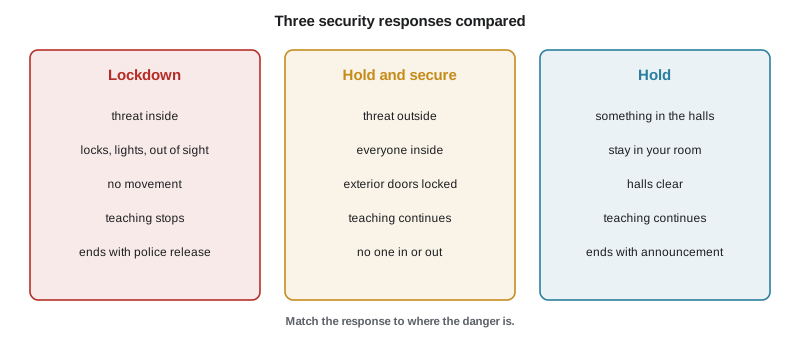
The difference from lockdown is crucial. In hold and secure, the building is the barrier, so life inside can continue. In lockdown, the threat may already be inside, so each room becomes its own barrier and everyone hides. Using the wrong action has costs either way: calling lockdown for a police search three streets away frightens students and disrupts learning for no reason, while calling hold and secure when someone dangerous is already in the building leaves students exposed in classrooms with unlocked doors and visible windows.
Escalating and stepping down
Situations change. Hold and secure may escalate to lockdown if the threat comes onto school grounds or into the building. A lockdown may step down to hold and secure if police confirm the threat has left the building but is still nearby. The plan and the announcements must make each change clear: 'Lockdown. Lockdown. This is not a drill,' or, when stepping down, an announcement from the principal that names the new action.
Staff should also know that a situation that starts as hold and secure can become dangerous for anyone still outside. If a class is on a walking field trip near the school when hold and secure is called, the teacher calls the office, and the school and police decide whether the class should return, wait at a safe public building or go elsewhere.
Dismissal and arrival during hold and secure
Hold and secure events often run into dismissal, and dismissal is where the plan gets tested. Buses arrive, parents line up in the drop-off loop, and students who walk home are ready to leave. The principal, in consultation with police, decides whether to delay dismissal, release students in a controlled way through a single door, hold students until the threat is resolved, or move buses to a different loading area. Families need clear messages, sent quickly, telling them that students are safe inside and that dismissal may be delayed. Lesson 11 covers communication in more detail.
Hold: clearing the halls
Hold is used when the school needs students to stay where they are and keep the hallways clear, but there is no threat of violence. Common reasons include:
- A medical emergency in a hallway or stairwell, where paramedics need room to work and the student needs privacy.
- A student in crisis who needs space and time with staff.
- A spill, a broken water pipe or a maintenance problem in a corridor.
- An unsettled situation, such as a fight that has just been broken up, where staff want to keep crowds from gathering.
What happens:
- Students and staff stay in their classrooms or current areas, and teaching continues.
- Students in the hallways go to the nearest classroom.
- Teachers close their doors, but they do not need to lock them.
- No one moves between rooms until the hold is lifted, unless the office allows it.
- Teachers take attendance and report any student who is missing from the room.
Hold is lifted by an announcement. Because it does not involve a threat, a simple announcement is enough.
Why separate actions matter
Schools used to have only two responses, evacuation and lockdown, and they used lockdown for almost everything. That led to dozens of lockdowns a year in some urban schools for incidents nowhere near the building, with real costs: lost teaching time, anxious students and families, and a gradual loss of urgency among staff when a real lockdown was called. The more graduated set of actions in use now, with hold and secure and hold alongside lockdown, lets the school match the response to the risk. It also reduces fear, because students learn that most security events are handled with a locked front door and an ordinary lesson.
Communicating with police
When police ask a school to hold and secure, they usually phone the office directly. The office should ask a few standard questions and write down the answers, because the principal will need them to make decisions and to tell families:
- What is happening and where, as specifically as possible?
- What do police want the school to do: hold and secure, lockdown, or keep a particular area clear?
- Is it safe for buses to arrive and for students to be dismissed?
- Who is the contact, and on what number?
- When will police update the school?
The office keeps a written log of the time hold and secure was called, the doors checked, the calls made and received, and the time it was lifted. The log is used in the debrief and in any report to the board.
Portables and outside spaces
Portables are a particular weakness in hold and secure, because they sit outside the locked building. The board's plan for portables depends on the situation: if the threat is far away and time allows, portable classes move into the main building through the nearest door, which a staff member holds and then locks. If the threat is close, portable classes stay in their portables with doors locked, as they would in a lockdown. Each portable has a phone or radio so the teacher can hear the announcement and report back.
Outdoor areas, including fields, playgrounds and parking lots, are swept by assigned staff, who bring in any students and adults they find. At Willow Park, the playground supervisors carry radios and whistles, and recess classes practise coming in at a run, with teachers counting heads at the door.
Drills
The board practises hold and secure as part of its yearly drill schedule, often combined with a recess or physical education class outside, so that staff practise bringing students in and checking doors. These drills are short and calm. They also check the less visible parts of the procedure: whether every exterior door actually locks, whether staff can reach the portables by radio, and whether the office can reach students who are off-site.
The program below records the times from a hold and secure drill at Pinecrest Secondary School, when three classes were outside: how long until each class was inside and how long until each exterior door was confirmed locked.
# Secure-the-building drill: minutes from the announcement until each class was in
# and each exterior door was confirmed locked.
classes_in = {"PE on field": 3.5, "Portable 1": 2.0, "Portable 2": 4.5}
doors_locked = {"Main": 0.5, "Gym east": 1.5, "Loading dock": 6.0, "North stair": 2.0,
                "Shop roll-up": 3.0, "Portable walkway": 4.5}
target = 5.0
print("classes inside:")
for k, v in classes_in.items():
    print(f"  {k:16} {v:4.1f} min {'ok' if v <= target else 'SLOW'}")
print("doors locked:")
for k, v in doors_locked.items():
    print(f"  {k:16} {v:4.1f} min {'ok' if v <= target else 'SLOW'}")
print("all secure at", max(max(classes_in.values()), max(doors_locked.values())), "min")classes inside: PE on field 3.5 min ok Portable 1 2.0 min ok Portable 2 4.5 min ok doors locked: Main 0.5 min ok Gym east 1.5 min ok Loading dock 6.0 min SLOW North stair 2.0 min ok Shop roll-up 3.0 min ok Portable walkway 4.5 min ok all secure at 6.0 min
The loading dock took six minutes, because the only staff member assigned to it was the custodian on the far side of the building. The plan was changed to assign the cafeteria supervisor, who is next to the dock, and the next drill confirmed the dock locked in under two minutes.
Talking with students during and after
Students notice when the doors are locked and recess is cut short, and older students often see messages on social media before staff do. A short, calm explanation helps: something is happening outside, the doors are locked to keep everyone safe, and lessons carry on. Teachers should avoid guessing at details or repeating rumours, and should tell students that the office will share more when it can. Younger children may worry about family members who are outside or on their way to pick them up, and a reassuring word that the school is talking to the police and to families is often enough. After the event, a brief explanation from the principal, in age-appropriate language, closes the loop and helps prevent stories from growing overnight.
Worked problem
A police search near Willow Park
Show solution
- At 2:05 p.m., a police dispatcher phones Willow Park: police officers are searching for a suspect who fled a traffic stop on foot, about four blocks away.
- Priya writes down the details and the police officer's call-back number and calls the principal, who announces hold and secure at 2:07.
- Two classes come in from the playground; doors are checked and locked by 2:12. Classes continue inside.
- The principal sends a message to families at 2:20: students are safe inside, doors are locked as a precaution, and dismissal may be delayed. Families are asked not to come to the school.
- At 2:55, police call to say the suspect has been arrested. The principal lifts hold and secure and dismissal goes ahead on time, with a follow-up message to families.
Answer: Bring everyone inside, lock and monitor exterior doors, keep teaching inside, communicate with police and families, and lift the action only when police confirm it is safe.
Common mistakes
MistakeCalling a full lockdown for every incident in the neighbourhood.
InsteadUse hold and secure for threats outside, and save lockdown for threats inside.
MistakeAssuming every exterior door is already locked.
InsteadAssign staff to check every door, especially the ones that are often propped.
MistakeForgetting portables and classes outside.
InsteadInclude them in the plan and give portables a phone or radio.
MistakeReleasing students at dismissal without checking with police.
InsteadDecide on dismissal with police and tell families clearly.
MistakeUsing hold for a situation that might involve a threat.
InsteadIf there is any risk of violence inside, call lockdown.
Summary and key terms
- Most security events are outside the school, and the right response is to bring everyone in and lock the exterior doors.
- During hold and secure, teaching continues inside and no one enters or leaves without permission.
- Hold keeps students in their rooms and the halls clear for a problem inside that is not a threat.
- Actions can escalate to lockdown or step down to hold and secure as the situation changes.
- The office takes standard information from police and keeps a log.
- Portables, outdoor areas and dismissal need specific plans.
- Drills check door locks, radios and response times as well as student movement.
- Securing the building
- The response to a threat outside (hold and secure in Ontario, secure in the Standard Response Protocol): everyone comes in, exterior doors are locked and teaching continues inside.
- Hold
- The response to a non-threatening problem in the halls: students stay in their rooms and the halls stay clear.
- Perimeter
- The outer boundary of the building, made secure by locking and monitoring exterior doors.
- Escalation
- Moving from a lower-level action, such as hold and secure, to a higher one, such as lockdown.
- Controlled dismissal
- Releasing students in a managed way, such as through one door, when a situation is still active nearby.
Practice problems
Work each problem on paper first, then reveal the answer to check.
What is the key difference between lockdown and hold and secure?
Show answer
In lockdown the threat may be inside, so each room hides; in hold and secure the threat is outside, so the building is locked and teaching continues inside.
Give two examples of when hold would be used.
Show answer
A medical emergency in a hallway, a student in crisis, a spill or maintenance problem, or a crowd forming after a fight.
What should the office ask police when they request hold and secure?
Show answer
What and where, what action they want, whether buses and dismissal are safe, the contact number and when they will update.
Why did the loading dock take six minutes to lock in the drill?
Show answer
The only person assigned to it was far away; assigning the nearby cafeteria supervisor fixed it.
Why did schools move away from using lockdown for almost every security event?
Show answer
Frequent unnecessary lockdowns cost teaching time, caused anxiety and reduced urgency for real lockdowns.
Lesson quiz · 5 questions
Score 60% or more to complete this lesson.
Create a free account to save your progress, take quizzes and earn a certificate.