
PHOT-230 · Lesson 1 of 12 · 25 min
The documentary tradition
Documentary photography sets out to show the world as it is: how people live and work, what is happening in a place, what has changed and what deserves attention. Its photographs are meant to be believed, which gives them unusual power to inform, move and persuade, and places unusual responsibilities on the people who make them. This course covers documentary and street photography together, because they share a commitment to real, unstaged life, even though they often differ in purpose and method. Documentary work usually tells a story or examines an issue over time; street photography usually finds meaning in brief, unplanned moments in public space. This first lesson traces the documentary tradition from the nineteenth century to the present, introduces some of the photographers whose work defined it, including photographers working in Canada, and considers what "documentary" means and why its definition has always been contested.
What makes a photograph documentary
There is no single definition of documentary photography, but most uses of the term share several ideas. The photograph records something that existed in front of the camera and was not invented or staged for it. The photographer aims to inform the viewer about the subject, rather than simply to create a beautiful object. The work usually comes from sustained attention: research, time in a place, relationships with people. And the photographs are presented with context, through captions, text, sequencing or accompanying research, so that viewers understand what they are seeing. The word itself was popularized in the 1920s and 1930s by the Scottish filmmaker John Grierson, who described documentary as "the creative treatment of actuality". That phrase captures the central tension of the form: documentary photographs are both records and interpretations, shaped by where the photographer stood, what they chose to include and exclude, when they pressed the shutter and how the images were edited and presented.
| Mode | Typical aim | Typical method | Examples of output |
|---|---|---|---|
| Social documentary | Reveal conditions and encourage change | Long-term, issue-driven projects | Reports, books, campaigns |
| Photojournalism | Report news accurately and quickly | Assignments, deadlines, captions | Newspapers, agencies, websites |
| Street photography | Find meaning in everyday public life | Candid, spontaneous, unplanned | Series, books, exhibitions |
| Personal documentary | Explore the photographer's own life or community | Intimate, long-term, often collaborative | Books, exhibitions, online essays |
| Typological or archival | Record systematically for comparison | Consistent framing and method | Archives, grids, catalogues |
Early documentation
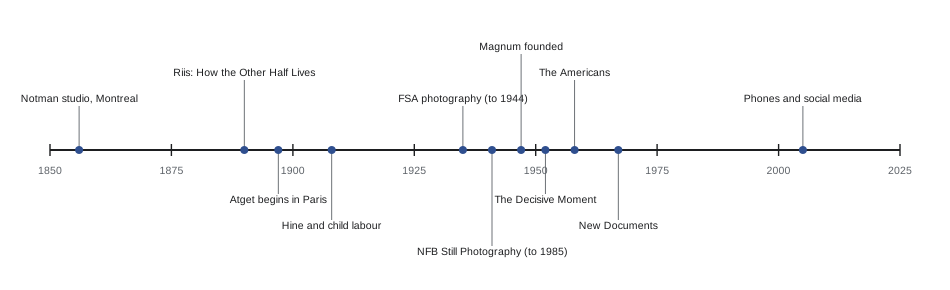
From photography's first decades, photographers recorded places, buildings, people and events for practical and historical purposes. In Paris, Charles Marville photographed the old medieval streets in the 1850s to 1870s before many were demolished in the rebuilding of the city, and Eugène Atget later spent some three decades, from about 1897 until his death in 1927, photographing the city's streets, shopfronts, courtyards and parks, creating an archive that later influenced generations of documentary and street photographers. Photographers accompanied wars, notably Roger Fenton in the Crimean War in 1855 and the photographers working with Mathew Brady's studio in the American Civil War, whose images of the dead at Antietam in 1862 shocked viewers in New York, although some Civil War scenes were later shown to have been arranged. In Montreal, the studio of William Notman, founded in 1856, produced an enormous record of nineteenth-century Canadian life, from portraits to railway construction, now held at the McCord Stewart Museum, and survey photographers documented the Canadian West, sometimes in ways that served colonial expansion and depicted Indigenous peoples through stereotypes. These early records remind us that documentation has never been neutral: who was photographed, how and for whom reflected the interests of the time.
Photography for social reform
In the late nineteenth and early twentieth centuries, photographers began to use images deliberately to expose injustice and argue for reform. Jacob Riis, a Danish-born police reporter in New York, photographed the city's overcrowded tenements and published How the Other Half Lives in 1890. Using early magnesium flash powder, he made images of rooms and alleys that had never been seen by middle-class readers, and his work contributed to housing reform, although historians have also noted that his photographs and texts often treated his subjects with condescension and stereotypes. Lewis Hine, a sociologist and teacher, photographed immigrants at Ellis Island and then, from 1908, worked for the National Child Labor Committee, travelling across the United States to document children working in mills, mines, canneries and fields. Hine often recorded names, ages and heights, sometimes measuring children against machinery, and his carefully captioned images became evidence in the campaign for child labour laws. He described his aim as showing "the things that had to be corrected" and "the things that had to be appreciated", a balance that remains central to documentary work.
The Farm Security Administration
The most influential documentary programme in American history was run by the Resettlement Administration and its successor, the Farm Security Administration (FSA), from 1935 to 1944, under the economist Roy Stryker. During the Great Depression and the Dust Bowl, Stryker sent photographers across the United States to record rural poverty, migration and government relief programmes, partly to build public support for New Deal policies. The project produced roughly 175,000 negatives and employed photographers including Dorothea Lange, Walker Evans, Arthur Rothstein, Ben Shahn, Russell Lee, Marion Post Wolcott, Jack Delano and Gordon Parks. Lange's 1936 photograph of Florence Owens Thompson and her children in a pea pickers' camp in Nipomo, California, later known as Migrant Mother, became one of the most reproduced photographs ever made, although Thompson herself later said she had been given no say in how it was used and received no benefit from it. Evans worked with the writer James Agee on Let Us Now Praise Famous Men (1941), a study of three tenant farming families in Alabama that combined restrained, frontal photographs with long, self-questioning text. Gordon Parks, who joined the FSA in 1942, photographed Ella Watson, a cleaner in a government building in Washington, in a pose echoing Grant Wood's painting American Gothic, a pointed image of racial injustice in the capital.
The FSA files, now in the Library of Congress and freely available online, show both the strengths and the tensions of government documentary: an extraordinary record of a nation in crisis, shaped by political goals, editorial selection and, at times, arranged scenes and cropped negatives.
The photo essay and the picture magazines
Picture magazines such as the German illustrated weeklies of the 1920s, Life (from 1936) and Look in the United States, and Picture Post in Britain (from 1938) created a mass audience for photographic stories. The photo essay, a sequence of photographs with captions and text telling a story, became a central form. W. Eugene Smith's Country Doctor (Life, 1948), following a general practitioner in rural Colorado, is often cited as a model of the form, showing how sequencing, varied shot sizes and intimate moments could build a narrative. Smith later spent years in Minamata, Japan, photographing the victims of industrial mercury poisoning and the community's struggle for justice, published in 1975 with Aileen Mioko Smith. Magnum Photos, founded in 1947 by Robert Capa, Henri Cartier-Bresson, George Rodger and David Seymour, gave photographers ownership of their negatives and control over assignments, a model of independence that influenced the profession for decades.
New directions after the war
From the 1950s, documentary photography became more personal and less tied to institutions. Robert Frank, a Swiss-born photographer, travelled across the United States on a Guggenheim Fellowship in 1955 and 1956, and published The Americans (first in France in 1958, then in the United States in 1959). Its tilted, grainy, often melancholy images of jukeboxes, flags, cars and lonely people challenged the confident picture-magazine style and were initially criticized, but the book became one of the most influential in photography. In the 1960s, the curator John Szarkowski's exhibition New Documents (Museum of Modern Art, 1967) presented Diane Arbus, Lee Friedlander and Garry Winogrand as photographers whose aim was "not to reform life but to know it", marking a shift from social advocacy to personal observation. Roy DeCarava's The Sweet Flypaper of Life (1955), with text by Langston Hughes, offered an intimate view of Harlem from within the community, and later photographers such as Bruce Davidson, Mary Ellen Mark and Larry Clark spent long periods with communities, gangs, street kids and families.
Documentary photography in Canada
Canada has its own rich documentary history. The National Film Board of Canada (NFB) operated a Still Photography Division from 1941 to 1985, commissioning photographers to record Canadian life for publications and exhibitions, and its collection later formed the basis of the Canadian Museum of Contemporary Photography. Hungarian-born Gabor Szilasi documented rural Quebec communities, such as Charlevoix and the Beauce, in the 1970s, as well as Montreal. Larry Towell, from rural Ontario, a Magnum member, has photographed the Mennonites of Mexico and Canada, Palestinian and Israeli communities and his own family over decades. Edward Burtynsky's large-format photographs of mines, quarries, oil fields and factories, described as manufactured landscapes, document the industrial transformation of the planet. Michel Campeau, a Quebec photographer, has explored personal and archival documentary, including a long series on darkrooms as they disappeared. Indigenous photographers, including Jeff Thomas, a Haudenosaunee (Onondaga) photographer, have challenged historical images of Indigenous peoples by photographing contemporary Indigenous presence in urban spaces. Contemporary documentary photographers such as Kitra Cahana, whose work spans photography and film including NFB projects, continue to extend the tradition.
Worked problem
Reading an archival documentary photograph
A student is studying a 1930s government photograph of a farm family standing outside a shack. The caption in the archive describes them as "destitute". What questions should the student ask before drawing conclusions?
Show solution
- Who made the photograph, for whom, and for what purpose? A government programme may have sought images that supported a policy.
- What do the original caption, the photographer's notes and the surrounding frames on the contact sheet show? Other frames may reveal different moods or details.
- Was the image cropped, retouched or selected from many? Archives sometimes hold the uncropped negative.
- What did the subjects themselves say about the photograph, if anything is recorded? Did they consent, and how was the image used afterward?
- What is missing from the frame, and whose perspective is absent?
Answer: Ask about the purpose, the full set of frames and notes, cropping and selection, the subjects' own voices and what lies outside the frame.
Contemporary documentary practice
Today, documentary photography is practised by staff and freelance photojournalists, independent artists, community photographers, activists and ordinary people with phones. The decline of print magazines and staff positions has pushed many documentary photographers toward books, exhibitions, grants, non-profit commissions, multimedia projects and their own online platforms. At the same time, smartphones and social media have made it possible for people to document their own communities and events, from protests to disasters, often reaching audiences faster than traditional media. Documentary practice has also become more reflective about power and representation: many photographers now work collaboratively with the people they photograph, share authorship, return images to communities and question who has the right to tell a story (Lesson 2). The deaths in recent years of major figures such as Sebastião Salgado, who died in 2025 after decades of large-scale projects on labour, migration and the environment, have prompted renewed debate about the grand, heroic documentary style and its alternatives.
Documentary, truth and interpretation
Documentary photographs carry an implied promise: this happened. Yet every photograph is shaped by choices. Framing includes some things and excludes others; the moment chosen may be typical or exceptional; the lens, light and processing affect mood; the edit and sequence create meaning; and captions direct interpretation. Historical cases, such as arranged scenes in Civil War photography or questions about the circumstances of famous war photographs, show how easily the line can blur. The ethical standard for documentary work is not that the photographer has no point of view, which is impossible, but that the photographs do not deceive viewers about what took place, that the photographer is honest about methods, and that the people photographed are treated with respect. PHOT-320 covers the formal ethics codes of photojournalism; this course focuses on the documentary and street photographer's practice.
Common mistakes
MistakeTreating documentary photographs as neutral records.
InsteadRecognize them as interpretations shaped by choices and purposes.
MistakeStudying only famous images out of context.
InsteadLook at full projects, contact sheets, captions and sources.
MistakeIgnoring the subjects' own perspectives.
InsteadSeek out what the people photographed said and experienced.
MistakeAssuming documentary means only social issues.
InsteadRecognize personal, street and archival modes too.
MistakeOverlooking Canadian and Indigenous documentary history.
InsteadStudy photographers and archives from many communities.
Summary and key terms
- Documentary photographs record unstaged reality with the aim of informing viewers.
- Grierson called documentary "the creative treatment of actuality".
- Riis and Hine used photography for social reform.
- The FSA, picture magazines and Magnum shaped mid-century documentary.
- Frank, Arbus, Winogrand and Friedlander turned documentary toward personal observation.
- Canadian documentary includes Notman, the NFB, Szilasi, Towell, Burtynsky and Indigenous photographers.
- Documentary is interpretive; its ethics rest on honesty and respect.
- Documentary photography
- Photography recording real, unstaged life to inform.
- Social documentary
- Documentary aimed at revealing conditions and prompting change.
- Photo essay
- Sequence of photographs with text telling a story.
- FSA
- Farm Security Administration photographic programme, 1935–1944.
- Picture magazine
- Magazine built around photographic stories.
- Magnum Photos
- Photographers' cooperative founded in 1947.
- Contact sheet
- Print showing every frame from a roll or shoot.
- Archive
- Organized collection of historical records and images.
- Typology
- Systematic series photographed in a consistent way.
- Advocacy
- Using photographs to argue for change.
Practice problems
Work each problem on paper first, then reveal the answer to check.
What did Grierson call documentary?
Show answer
The creative treatment of actuality.
Name three features of documentary photography.
Show answer
Unstaged reality, aim to inform, sustained attention, context.
What did Eugène Atget photograph?
Show answer
The streets and buildings of Paris.
What book did Riis publish in 1890?
Show answer
How the Other Half Lives.
What did Lewis Hine document from 1908?
Show answer
Child labour for the National Child Labor Committee.
Who directed the FSA photographers?
Show answer
Roy Stryker.
What did Florence Owens Thompson say about Migrant Mother?
Show answer
She had no say in its use and gained nothing from it.
When was Magnum founded?
Show answer
1947.
Name two Canadian documentary photographers.
Show answer
Szilasi, Towell, Burtynsky, Campeau, Jeff Thomas, Notman.
What did the NFB Still Photography Division do?
Show answer
Commissioned photographs of Canadian life, 1941–1985.
Lesson quiz · 5 questions
Score 60% or more to complete this lesson.
Create a free account to save your progress, take quizzes and earn a certificate.