
PHOT-230 · Lesson 4 of 12 · 25 min
Seeing and anticipating moments
Street and documentary photographers cannot control what happens in front of them, but they can learn to see more, anticipate better and be ready when something meaningful occurs. Many of the most memorable candid photographs look effortless, yet they come from practised attention: noticing light, reading how people move, choosing a position, waiting and reacting in a fraction of a second. This lesson covers the skills of seeing: gesture and expression, the decisive moment and its alternatives, anticipating action, working a scene, layering and depth, juxtaposition and humour, light and shadow, colour, simplicity and the edges of the frame, and how editing contact sheets develops your eye.
Gesture and expression
People communicate constantly through gesture: the tilt of a head, a hand on a shoulder, a glance, a stride, a shrug. In candid photography, gesture often carries more meaning than faces, and the strongest images frequently hinge on a single gesture that expresses a relationship, emotion or story. A raised hand in a crowd, two people leaning toward each other, a child pulling an adult's arm, a worker wiping sweat: each tells something without words. Training yourself to watch gestures, rather than only faces, reveals many more photographs. Gestures are fleeting, so they require anticipation; watch people for a while and you will often see patterns, such as a vendor who repeats the same movement or friends who gesture as they talk.
The decisive moment and the moment after
Cartier-Bresson's idea of the decisive moment (Lesson 3) describes the instant when the event and the composition align perfectly: the leaping figure over the puddle, the cyclist passing the curve of a staircase. Learning to recognize such moments is a valuable discipline. But many photographers have pointed out that meaningful photographs also come from moments that are not peaks: the pause before an action, the awkward instant after, the quiet moment between events, or the ambiguous expression that invites interpretation. Garry Winogrand and others embraced messier, less resolved frames that captured the energy and confusion of public life. A useful approach is to keep shooting through an unfolding situation, rather than waiting only for one perfect instant, and to decide later which moment carries the most meaning.
Anticipating action
Anticipation is the core skill of candid photography. It means predicting where something interesting will happen and being in position, with the camera ready, before it does. Practical habits include:
- Watching the flow of people and traffic to predict where someone will step, turn or pause.
- Noticing patterns: a door that opens regularly, a bus stop where people gather, a corner where light falls at a certain time.
- Pre-focusing and pre-composing on a spot, then waiting for a subject to enter it (Lesson 5).
- Reading body language that signals an imminent action: a child crouching before jumping, someone raising a phone, a performer preparing to bow.
- Keeping the camera at the ready rather than in a bag, with settings prepared for the light.
With practice, anticipation becomes intuitive, and photographers often describe a feeling of sensing a photograph before it forms.
Worked problem
Anticipating a moment at a crossing
At a busy pedestrian crossing, a bright rectangle of evening sun falls on the pavement between two shadows cast by buildings. The photographer wants a single figure in the light. How should they approach it?
Show solution
- Choose a position across the street with a clean view of the sunlit patch and a simple background.
- Set exposure for the sunlit area, so the shadows fall nearly black and frame the figure.
- Pre-focus on the patch, using zone focus or a locked focus point, and compose with the patch at a strong point in the frame.
- Watch the traffic lights: when the signal changes, people will cross in a wave; wait for a single figure, ideally mid-stride, to enter the light.
- Shoot a short burst as the figure enters, and repeat over several light cycles.
Answer: Pre-compose on the light, expose for highlights, pre-focus, time the crossing signal and shoot as a lone figure strides into the light.
Working a scene
Rarely does the first frame of a situation produce the best photograph. Working a scene means staying with a promising situation, making many frames from different positions, distances and angles, and refining the composition as events unfold. Contact sheets of great photographers, published in books and exhibitions, show how often a famous image was preceded and followed by many attempts: moving closer, stepping to the side to separate figures, waiting for a background person to move, changing lens or height. Working a scene also means being patient: some photographers return to the same place many times, at different times of day, until the photograph they sense is possible actually happens.
Layering and depth
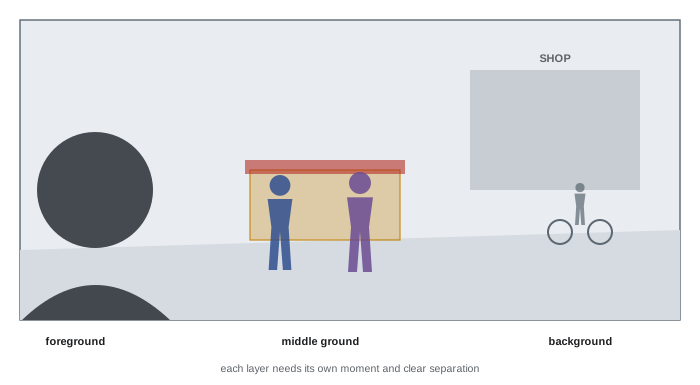
Layering arranges subjects at several distances from the camera, foreground, middle ground and background, each contributing to the image. A layered photograph might have a face close to the lens on one side, a group of people in the middle, and a sign or another figure in the distance, all readable and related. Layering creates depth and complexity and rewards close looking, but it is difficult: elements must not merge or overlap awkwardly, and each layer needs its own moment. Alex Webb's colour photographs are celebrated examples. Building toward layered images usually starts with simpler two-layer compositions, such as a foreground figure framed against a meaningful background.
Juxtaposition, humour and irony
Juxtaposition places elements side by side so that their relationship creates meaning: a person mirroring a pose on a billboard, a sign that comments on the people below it, an animal echoing a human gesture, contrasting fashions or generations. Juxtapositions can be funny, poignant, ironic or unsettling. Elliott Erwitt, a Magnum photographer, was celebrated for humorous juxtapositions involving dogs, people and their surroundings. Good juxtapositions arise from observation rather than contrivance; signs and advertisements are common sources, but images that rely only on a clever caption-like sign can feel like visual puns. Stronger juxtapositions usually involve people and gestures, and leave room for interpretation.
Light and shadow
Light shapes street photographs as much as subjects do. Hard, low sun in early morning and late afternoon creates long shadows, bright edges and pools of light that isolate figures; photographers often seek these patches and wait for subjects to enter them. Backlight creates silhouettes and glowing edges. Reflected light from windows and buildings creates soft, unexpected illumination in shaded streets. Overcast days give even light suited to faces and detail; rain brings reflections and umbrellas; fog simplifies backgrounds; night offers neon, shop windows and street lamps. Learning how light moves through particular streets at different times of day and seasons is part of knowing a place.
| Light | Opportunities | Typical approach |
|---|---|---|
| Low, hard sun | Long shadows, pools of light, rim light | Expose for highlights, wait for figures in light |
| Backlight | Silhouettes, glowing hair and breath | Shoot toward the light, expose for the background |
| Overcast | Even light on faces, detail | Work closer, focus on gesture and expression |
| Rain | Reflections, umbrellas, blurred lights | Shoot from doorways, protect the camera |
| Fog or haze | Simplified backgrounds, mood | Use silhouettes and shapes |
| Night | Neon, shop windows, street lamps | Higher ISO, find pools of artificial light |
Colour as structure
In colour street photography, colour is not decoration but a compositional element. A red coat against a grey wall draws the eye; repeated colours link separate parts of the frame; complementary colours create tension; muted palettes create calm. Photographers working in colour often look first for colour relationships and then wait for people to complete them, for example someone in yellow passing a yellow door. Colour also carries cultural and emotional associations. When working in colour, consider how colours change with light: warm low sun saturates reds and yellows, while shade turns everything blue, and mixed artificial light creates unpredictable casts at night.
Simplicity and the edges of the frame
Busy streets offer more visual information than a photograph can hold. Strong images usually simplify: a clear subject, a background that supports it, and nothing at the edges that pulls the eye away. Before pressing the shutter, check the edges and corners of the frame for half-cut figures, bright patches, signs and poles growing out of heads. Moving a step left or right, crouching or standing on a step can separate a subject from a cluttered background. Conversely, deliberately complex frames, full of activity, can capture the energy of a crowd, but even then the photographer must organize the chaos so that the eye can move through it.
Developing your eye with contact sheets
Reviewing all your frames from a session, whether as digital contact sheets in a catalogue grid or film contact sheets, is one of the best ways to improve your seeing. Look for the moments when you came close to a strong photograph: what was missing, what would have made it work, where you should have stood, and when you stopped too soon. Mark not only the best images but the near misses, and learn from them. Over time, patterns appear: the kinds of situations you notice, the distances you prefer, the light you respond to. Many photographers keep a notebook of observations and ideas alongside their contact sheets.
Patience and returning
Many great street photographs required patience measured in hours or repeated visits. Photographers often describe finding a promising stage, such as a wall with interesting shadows, a striking billboard or a window with good light, and returning again and again until the right person, gesture or alignment completes it. Returning to the same places at different times of day and in different seasons reveals how light, activity and mood change, and builds familiarity that makes photographers less conspicuous. Some photographers keep a list of such places in their city, with notes on the best times. Patience also means accepting that many outings produce nothing remarkable, and that this is part of the process rather than a failure.
Seeing exercises
Seeing can be trained deliberately. Useful exercises include spending an hour photographing only gestures of hands; photographing only reflections, or only shadows; limiting yourself to one focal length and one location for a whole day; photographing the same intersection once a week for a season; choosing a colour and photographing only scenes where it dominates; or walking without a camera and noting every photograph you would have taken, then returning with the camera. Constraints sharpen attention by forcing you to look harder within narrow limits. Reviewing the results with the contact sheet method shows what the exercise taught you and often suggests new projects.
Avoiding clichés
Certain kinds of street photographs have become clichés through repetition: silhouettes against bright walls, people walking past graffiti, elderly people on benches, homeless people asleep, umbrellas in rain, and reflections in puddles used only as a trick. These subjects are not forbidden, and they can still produce strong images, but photographers should ask what their image adds that thousands of similar images do not. Often the answer lies in a specific gesture, an unexpected relationship, a personal context, or a deeper engagement with the people photographed. Looking widely at contemporary work helps photographers recognize clichés and find fresher ways of seeing.
Reading a scene quickly
Experienced street photographers often describe a rapid mental checklist when they arrive somewhere new: where is the light coming from, and where will it be in an hour; where are people moving, waiting or gathering; what backgrounds are simple or meaningful; where can I stand without blocking anyone; and what is unusual here? Asking these questions in the first few minutes helps them decide whether to wait, move on or return later, and makes the difference between wandering aimlessly and working with purpose.
Common mistakes
MistakeStopping after the first frame.
InsteadWork the scene from different positions and moments.
MistakeWatching only faces.
InsteadWatch gestures and body language too.
MistakeRelying on signs for juxtaposition.
InsteadLook for relationships between people and gestures.
MistakeIgnoring the edges of the frame.
InsteadCheck corners and backgrounds before shooting.
MistakeReacting only after something happens.
InsteadAnticipate and be ready in position.
Summary and key terms
- Gestures often carry the meaning of candid photographs.
- The decisive moment is one ideal; quieter and messier moments also matter.
- Anticipation means predicting action and being ready.
- Working a scene produces stronger images than single frames.
- Layering and juxtaposition add depth and meaning.
- Light, shadow and colour structure street photographs.
- Contact sheets reveal near misses and develop your eye.
- Gesture
- Body movement that communicates meaning.
- Anticipation
- Predicting where and when action will occur.
- Pre-composing
- Setting up a frame before the subject arrives.
- Working a scene
- Making many frames as a situation unfolds.
- Layering
- Subjects arranged at several depths.
- Juxtaposition
- Contrasting elements creating meaning together.
- Pool of light
- Isolated area of light surrounded by shadow.
- Near miss
- A frame close to success that reveals what was missing.
- Visual pun
- Image relying on a simple joke, often from a sign.
- Frame edge
- Boundary of the image where distractions appear.
Practice problems
Work each problem on paper first, then reveal the answer to check.
Why watch gestures as well as faces?
Show answer
Gestures often carry the meaning.
Name an alternative to the decisive moment.
Show answer
The pause before, the moment after, an ambiguous quiet moment.
Name three anticipation habits.
Show answer
Watch flow, notice patterns, pre-focus, read body language, camera ready.
What does working a scene mean?
Show answer
Making many frames from different positions as events unfold.
What are the three layers?
Show answer
Foreground, middle ground, background.
What makes a juxtaposition strong?
Show answer
Relationships involving people and gestures, open to interpretation.
How do you photograph pools of light?
Show answer
Expose for the light and wait for figures to enter.
What does shade do to colour?
Show answer
Shifts it toward blue.
What should you check before pressing the shutter?
Show answer
Edges, corners and backgrounds.
What can contact sheets teach?
Show answer
Near misses, positions, timing and personal patterns.
Lesson quiz · 5 questions
Score 60% or more to complete this lesson.
Create a free account to save your progress, take quizzes and earn a certificate.