
PHOT-230 · Lesson 3 of 12 · 25 min
Street photography: history and approaches
Street photography finds meaning, humour, beauty and strangeness in ordinary public life. Its photographers work in streets, markets, beaches, parks, transit and festivals, usually without plans or permission, responding to what happens in front of them. Unlike documentary projects, which usually set out to explain a subject, street photographs often raise questions, capturing coincidences, gestures and juxtapositions that would be impossible to stage. This lesson surveys the history of street photography, its major approaches and styles, the role of colour, the differences between street and documentary work, contemporary street photography, and how to study the genre and find your own approach.
Origins
Street scenes appear in some of photography's earliest images: Louis Daguerre's 1838 view of the Boulevard du Temple in Paris shows a man having his shoes shined, the only figures still long enough to register in the minutes-long exposure. True candid street photography became practical only with faster film and smaller cameras. In the 1920s and 1930s, the Leica, a compact camera using 35 mm cinema film, introduced commercially in 1925, allowed photographers to work quickly and inconspicuously. André Kertész, a Hungarian photographer working in Paris and later New York, made lyrical, carefully observed images of everyday life. Brassaï photographed Paris at night, its streets, cafés and nightlife, published as Paris de nuit in 1932. Eugène Atget's empty streets (Lesson 1) became an influence through the Surrealists and later photographers.
Cartier-Bresson and the decisive moment
Henri Cartier-Bresson, a French photographer trained in painting and influenced by Surrealism, became the most influential figure in the history of street photography. Working with a Leica and a 50 mm lens, he made images in which form, gesture and timing come together precisely, such as Behind the Gare Saint-Lazare (1932), in which a man leaps over a puddle, his reflection mirrored below. His 1952 book Images à la sauvette, published in English as The Decisive Moment, described photography as "the simultaneous recognition, in a fraction of a second, of the significance of an event as well as of a precise organization of forms which give that event its proper expression". The idea of the decisive moment, the instant when everything in the frame aligns, has shaped how generations of photographers think about street photography, though later photographers have questioned whether there is only one such moment, or whether the idea encourages formal neatness at the expense of meaning (Lesson 4).
New York and the American street
New York became a centre of street photography from the 1930s. Helen Levitt photographed children playing and chalk drawings in the streets of East Harlem and the Lower East Side, finding theatre and imagination in everyday games. Weegee (Arthur Fellig) photographed crime scenes, fires and nightlife with flash, often arriving before the police. Members of the Photo League, a cooperative active from 1936 until it was blacklisted during the anti-communist campaigns of the early 1950s, photographed working-class neighbourhoods with a social conscience. After the war, Lisette Model, William Klein, Robert Frank and later Garry Winogrand, Lee Friedlander, Diane Arbus and Joel Meyerowitz pushed street photography in new directions. Klein's Life Is Good and Good for You in New York (1956) used wide-angle lenses, blur, grain and confrontation, rejecting polite composition. Winogrand photographed relentlessly, leaving thousands of rolls of film undeveloped at his death in 1984, and famously said he photographed "to find out what something will look like photographed". Friedlander made complex images layered with reflections, signs and shadows, including his own.
| Photographer | Active | Known for |
|---|---|---|
| Henri Cartier-Bresson | 1930s–1970s | The decisive moment, formal precision |
| Helen Levitt | 1930s–1990s | Children's play and street theatre in New York |
| William Klein | 1950s–2000s | Wide angles, grain and confrontation |
| Garry Winogrand | 1950s–1984 | Energetic, tilted, crowded frames |
| Lee Friedlander | 1960s–present | Layered reflections, signs and self-portraits |
| Vivian Maier | 1950s–1990s | Private street work discovered after her death |
| Joel Meyerowitz | 1960s–present | Early advocate of colour street photography |
| Alex Webb | 1970s–present | Dense, saturated colour layering |
Vivian Maier
One of the most remarkable stories in street photography is that of Vivian Maier, who worked as a nanny in Chicago and New York for decades and photographed constantly, mostly with a twin-lens reflex camera held at waist level, but rarely showed her work. After she fell behind on payments for storage units, their contents were sold at auction in 2007, and buyers, notably John Maloof, discovered more than 100,000 negatives and undeveloped rolls. Her photographs, published and exhibited after her death in 2009, revealed a sharp, witty and empathetic observer of urban life. Her story raises interesting questions about authorship, editing and posthumous publication: her images have been selected, printed and presented by others, in ways she never chose.
The arrival of colour
For decades, serious street photography was almost entirely black and white; colour was associated with advertising and amateur snapshots. In the 1960s and 1970s, photographers such as Joel Meyerowitz, Stephen Shore and William Eggleston began working seriously in colour; Eggleston's 1976 exhibition at the Museum of Modern Art, curated by John Szarkowski, was a turning point, though it was harshly reviewed at the time. In street photography, colour became a structural element, with photographers such as Alex Webb building dense compositions of coloured light, shadow and figures, Saul Leiter making soft, painterly images through rain-streaked windows and snow, and Martin Parr using bright flash and saturated colour to satirize consumer culture and leisure. Today, both colour and black and white are used, and the choice is part of a photographer's voice.
Approaches to street photography
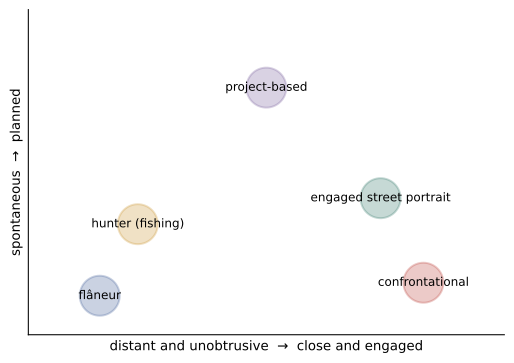
Street photographers work in many ways. Some broad approaches include:
- The flâneur or observer: wandering without a plan, watching and waiting, remaining unobtrusive. Many photographers in the Cartier-Bresson tradition work this way.
- The hunter: choosing a promising location, such as a pool of light, an interesting background or a busy corner, and waiting for the right person or moment to complete the composition, sometimes called fishing.
- The close-in, confrontational approach: working very near people with wide-angle lenses and sometimes flash, as William Klein and later Bruce Gilden did, which produces intense images but raises ethical concerns about intrusion and consent.
- The engaged street portrait: photographing strangers after a brief exchange, combining spontaneity with consent.
- The conceptual or project-based approach: photographing a particular theme, place or idea over time, such as commuters, shadows, signs, or a single street, bridging street and documentary work.
Most photographers combine approaches depending on the situation and their mood. What matters is that the method fits the photographer's temperament, the place and the ethics of the encounter.
Street photography and documentary
Street and documentary photography overlap but differ in emphasis. Documentary photographers usually choose a subject and investigate it, often with access, research, captions and relationships; street photographers usually respond to chance encounters, and their images are often untitled or identified only by place and date. Street photographs tend to be read as individual images or loose sequences that evoke a mood or a way of seeing, while documentary work aims to inform about a subject. Yet many street photographers work on long-term projects that function as documentary, such as a record of a neighbourhood over decades, and many documentary photographers use street techniques to capture public life. Understanding both traditions lets you draw on each.
Street photography in Canada
Canadian cities have their own street photography histories. Fred Herzog, a German-born photographer who moved to Vancouver in 1952, photographed the city's streets, signs, shopfronts and people in colour slides from the 1950s onward, long before colour street photography was widely accepted; his work became widely known only in the 2000s, when it was exhibited at the Vancouver Art Gallery in 2007. In Montreal, photographers associated with Quebec's documentary movements, including Gabor Szilasi and the members of the Groupe d'action photographique in the 1970s, photographed street life and communities. Contemporary street photographers across Canada document diverse, rapidly changing cities, often sharing their work through online collectives, zines and festivals.
Worked problem
Choosing an approach for a market
A photographer wants to make street photographs in a busy weekend farmers' market. They are shy, and the market has deep shade under awnings and bright sun in the aisles. Which approach might suit them, and how could they start?
Show solution
- A hunter approach may suit a shy photographer: choose a spot with interesting light, such as the edge of an awning where sun falls on faces.
- Stand still with the camera ready, letting people become used to their presence, and wait for figures to enter the light.
- Set exposure for the bright areas so that the shade falls into deep shadow, simplifying backgrounds.
- Gradually move closer and try a few engaged portraits of vendors who are comfortable being photographed.
Answer: Start with a hunter approach in a well-lit spot, expose for the highlights, wait for moments, then try engaged portraits with willing vendors.
Contemporary street photography
Street photography today is practised worldwide, with active communities of photographers sharing work online, in collectives such as In-Public (founded in 2000), festivals, competitions and photobooks. Smartphones have made it more accessible than ever, and some acclaimed street work is made entirely with phones. At the same time, the genre faces challenges: increased public concern about privacy and being photographed without consent, stricter laws in some countries, surveillance culture, and a sameness of style when many photographers chase similar visual tricks, such as silhouettes in strong light or people walking past colourful walls. Contemporary photographers often seek more personal, socially aware or conceptually grounded work, and many question whose streets are photographed and by whom.
Studying the genre
The best way to develop as a street photographer is to look at a great deal of work, especially in books, which show how photographers sequence and edit, and then to photograph regularly. When studying a photographer, ask: what subjects and places do they choose; how close do they work; what lenses and formats do they seem to use; how do they use light, colour and composition; what moods recur; and what do their images say about public life? Then try deliberately working in their way for a while, before returning to your own approach with new ideas. Over time, a personal voice emerges from what you notice and care about.
Street photography around the world
Street photography is a global practice with distinct regional traditions. In Japan, photographers associated with the magazine Provoke in the late 1960s, such as Daidō Moriyama, made grainy, blurred, high-contrast images of Tokyo that rejected conventional clarity, a style sometimes summarized by the phrase "are, bure, boke" (rough, blurred, out of focus). In India, Raghubir Singh photographed the colour and density of Indian streets from the 1970s, arguing that colour was essential to Indian life. In Latin America, photographers such as Manuel Álvarez Bravo in Mexico combined street observation with poetic and surreal elements. In Britain, Tony Ray-Jones photographed English seaside and leisure in the 1960s, influencing Martin Parr. Today, festivals and collectives in cities from Mumbai to Mexico City, Lagos to Seoul, show the many ways photographers approach public life, shaped by local cultures, laws and histories.
Series, books and the street photograph
Although street photographs are often admired singly, many of the genre's major works are books and series. The Americans, The Decisive Moment, Moriyama's Farewell Photography and Alex Webb's books build meaning through sequence, echo and accumulation, as Lesson 10 discusses. Thinking in terms of series, rather than only individual images, helps street photographers move beyond a collection of good pictures toward a body of work with a point of view. A series might focus on a place, a time of day, a type of light, a theme such as waiting or solitude, or a personal question about the city. Over time, the series gives direction to daily walks with the camera.
Common mistakes
MistakeEquating street photography only with the decisive moment.
InsteadExplore the full range of approaches and styles.
MistakeCopying fashionable visual tricks.
InsteadDevelop work rooted in your own observations.
MistakeIgnoring the ethics of close-in approaches.
InsteadConsider intrusion, consent and the subject's experience.
MistakeStudying only single famous images.
InsteadStudy books and how photographers edit and sequence.
MistakeTreating colour as decoration.
InsteadUse colour as part of structure and meaning.
Summary and key terms
- Small cameras such as the Leica made candid street photography practical.
- Cartier-Bresson's decisive moment shaped the genre's ideals.
- New York photographers broadened the genre with energy, flash and wit.
- Vivian Maier's posthumous discovery raises questions of authorship.
- Colour became a central element from the 1970s.
- Approaches range from distant observation to engaged portraits and projects.
- Street and documentary overlap; Canadian street photography includes Fred Herzog.
- Street photography
- Candid photography of public life.
- Decisive moment
- The instant when form and meaning align.
- Flâneur
- An observer wandering the city.
- Fishing
- Waiting at a chosen spot for a subject to complete a composition.
- Juxtaposition
- Placing contrasting elements together for meaning.
- Layering
- Arranging subjects at several depths in the frame.
- Candid
- Unposed and unaware of the camera.
- Engaged street portrait
- Portrait of a stranger after a brief exchange.
- Photo League
- New York photographers' cooperative, 1936 to early 1950s.
- Collective
- Group of photographers sharing work and ideas.
Practice problems
Work each problem on paper first, then reveal the answer to check.
Which camera made candid street photography practical in the 1920s?
Show answer
The Leica.
What did Brassaï photograph?
Show answer
Paris at night.
What is the English title of Images à la sauvette?
Show answer
The Decisive Moment.
What did Helen Levitt photograph?
Show answer
Children's play and street life in New York.
What was distinctive about William Klein's style?
Show answer
Wide angles, blur, grain and confrontation.
How was Vivian Maier's work discovered?
Show answer
Negatives bought at auction from storage units in 2007.
Name two pioneers of colour street photography.
Show answer
Meyerowitz, Eggleston, Leiter, Webb, Herzog.
What is the hunter approach?
Show answer
Waiting at a chosen spot for the right moment.
How do street and documentary photography differ?
Show answer
Chance encounters versus investigation of a subject.
Who photographed Vancouver in colour from the 1950s?
Show answer
Fred Herzog.
Lesson quiz · 5 questions
Score 60% or more to complete this lesson.
Create a free account to save your progress, take quizzes and earn a certificate.