
PHOT-230 · Lesson 5 of 12 · 25 min
Technique for the street
Candid photography leaves no time for fiddling with settings. When a gesture or alignment appears, the photographer has a fraction of a second to react, and a camera that is set up correctly, with focus and exposure prepared, makes the difference between a photograph and a missed moment. Street and documentary photographers therefore favour simple, reliable equipment and techniques that let them work instinctively. This lesson covers choosing cameras and lenses for the street, focal length and working distance, zone focusing and hyperfocal technique, autofocus strategies, shutter speed and motion, exposure strategies including auto ISO and exposure lock, flash on the street, working at night, smartphones, carrying and protecting gear, and personal safety.
Cameras for the street
Almost any camera can make street photographs, but some characteristics help. Small, quiet cameras attract less attention and are easier to carry all day: rangefinders, compact cameras with large sensors such as the Ricoh GR and Fujifilm X100 series, small mirrorless bodies and phones are popular. Silent electronic shutters remove the click that makes people turn (PHOT-201), though they can distort fast motion. Tilting screens allow shooting from waist level, which is less confrontational than raising a camera to the eye and gives a different perspective, much as Vivian Maier's twin-lens reflex did. Weather sealing helps in rain and snow. Physical dials for shutter speed, aperture and exposure compensation allow changes without looking at menus. Whatever camera you choose, learn it so thoroughly that you can change settings by feel.
Lenses and working distance
Focal length shapes both the look of a street photograph and the photographer's relationship with the subject. Wide and moderately wide lenses, around 28 mm and 35 mm full-frame equivalent, are the most popular for street photography: they include context, keep a lot in focus and require the photographer to be close, often within two or three metres, which creates immersive, engaged images. 50 mm lenses give a more neutral perspective from slightly farther away, the classic Cartier-Bresson approach. 21 mm and 24 mm lenses produce dramatic, enveloping images but require very close working distances and can distort people at the edges. Telephoto lenses allow photographing from a distance, which can capture unguarded moments, but they flatten perspective, isolate subjects from context and can feel voyeuristic; many street photographers avoid them for ethical as well as aesthetic reasons. Prime lenses are favoured for their small size and because a fixed focal length trains the eye to see in a consistent frame.
| Focal length (full-frame equivalent) | Working distance for a person at full length | Character |
|---|---|---|
| 21–24 mm | About 1–1.5 m | Dramatic, immersive, edge distortion |
| 28 mm | About 1.5–2 m | Context-rich, close and engaged |
| 35 mm | About 2–2.5 m | Versatile classic street focal length |
| 50 mm | About 3–3.5 m | Natural perspective, a little more distance |
| 85 mm and longer | 5 m or more | Isolating, compressed, more detached |
Zone focusing
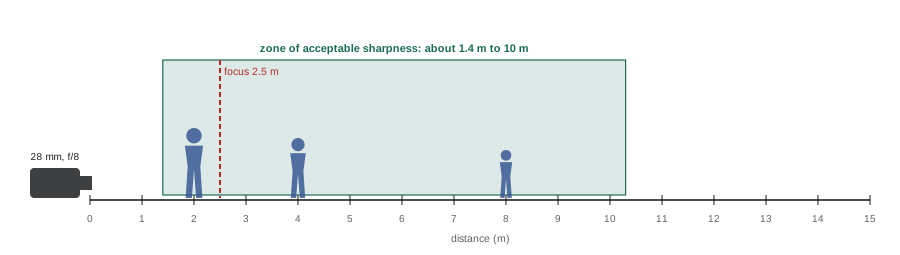
Autofocus can hesitate or choose the wrong subject in busy scenes. Zone focusing avoids the problem: the photographer sets the lens to a fixed distance and an aperture that keeps a range of distances acceptably sharp, then photographs anything within that zone without focusing. With a 28 mm lens at f/8, focused at 2.5 m, everything from about 1.4 m to about 10 m is acceptably sharp on a full-frame camera, so the photographer only needs to judge distance roughly. Many lenses have depth-of-field scales on the barrel; for lenses without them, apps or the formulas below give the zone. Zone focusing works best with wide lenses, small apertures and bright light, and it lets photographers shoot quickly, from the hip, or without raising the camera.
The near and far limits of acceptable sharpness around a focus distance \(s\) can be estimated using the hyperfocal distance \(H\):
Here \(f\) is the focal length, \(N\) the f-number and \(c\) the circle of confusion, about 0.03 mm for full frame. If \(s\) is equal to or greater than \(H\), the far limit extends to infinity.
Worked problem
Setting a focus zone
A photographer uses a 28 mm lens on full frame at f/8 and wants to photograph people about 2 to 4 m away. Where should they focus, and what is the zone of acceptable sharpness? (Use c = 0.03 mm.)
Show solution
- Hyperfocal distance: \(H = 28^2 / (8 \times 0.03) = 784 / 0.24 \approx 3{,}270\) mm, about 3.3 m.
- Focus at 2.5 m: \(D_{\text{near}} = (3.3 \times 2.5)/(3.3 + 2.5) \approx 1.4\) m.
- \(D_{\text{far}} = (3.3 \times 2.5)/(3.3 - 2.5) \approx 10.3\) m.
- The zone from about 1.4 m to 10 m comfortably covers 2 to 4 m.
Answer: Focus at about 2.5 m; at f/8 the zone runs from roughly 1.4 m to 10 m.
Autofocus strategies
Modern autofocus with subject and eye detection (PHOT-201) has made autofocus far more useful on the street than it once was. Useful strategies include using continuous autofocus with wide-area tracking and face detection for moving subjects; using a single small point placed where you expect the subject, combined with back-button focus, to lock focus on a pre-composed spot; and switching to manual or zone focus in crowds, reflections, low light or when shooting through glass, where autofocus may choose the wrong target. Test how your camera behaves in busy scenes, and know how to switch quickly between modes.
Shutter speed and motion
Shutter speed determines whether movement is frozen or blurred. To freeze people walking, 1/250 s is a common minimum; for running, cycling or fast gestures, 1/500 s to 1/1000 s. Deliberate blur can convey energy: a slow shutter speed of 1/15 s to 1/2 s with a stationary camera turns crowds into flowing streaks while static elements stay sharp, and panning with a moving subject at around 1/30 s keeps the subject relatively sharp against a streaked background. Blur from camera shake, by contrast, rarely helps; keep the shutter speed high enough for the focal length, or use stabilization.
Exposure strategies
Light in streets changes constantly as photographers move between sun and shade, so exposure must be quick and robust. Common strategies include:
- Manual exposure set for the main light, such as the sunlit side of the street, adjusted only when moving into different light. This keeps exposure consistent and avoids the camera being fooled by dark or bright backgrounds.
- Aperture priority with auto ISO and a minimum shutter speed, such as f/8 and 1/250 s, letting ISO vary with light, combined with exposure compensation (PHOT-201).
- Manual mode with auto ISO: fixed aperture and shutter speed with ISO floating, increasingly popular because modern sensors handle high ISO well.
- Exposing for highlights in high-contrast light, letting shadows go dark to simplify backgrounds and create drama.
The "sunny 16" rule, that in bright sun the correct exposure is about f/16 at a shutter speed of 1/ISO, gives a quick reference: at ISO 400, f/16 at 1/400 s, or f/8 at 1/1600 s. Shooting raw protects against exposure errors, but consistent exposure saves editing time.
Flash on the street
Flash in street photography produces a distinctive look: bright, frozen subjects against darker or blurred backgrounds, with saturated colour and hard shadows. Photographers such as Weegee, Bruce Gilden and Martin Parr used flash in very different ways, from news to satire. Fill flash in daylight can open shadows on faces in backlight. Flash is, however, highly intrusive: it surprises and can startle or upset people, and it is unsuitable in many situations, such as near drivers, at ceremonies or with vulnerable people. Many photographers reserve it for events, nightlife and situations where people are expecting photographers, or use it with consent.
Working at night
Night streets offer pools of light, neon, illuminated windows and reflections on wet pavement. Modern cameras and phones make night street photography far easier than it once was: fast lenses at f/1.4 to f/2, high ISO settings of 3200 to 12,800, stabilization and AI noise reduction (PHOT-202) allow handheld images at reasonable shutter speeds. Expose for the lit areas and let the dark areas stay dark, rather than brightening the whole scene. Find places where light falls on people, such as shop fronts, street lamps and transit stations, and wait. Zone focusing is useful in low light where autofocus struggles.
Smartphones on the street
Phones are discreet, always available and less intimidating to subjects than cameras, which makes them excellent street cameras. Their wide main lenses suit the genre, their deep depth of field makes focus easy, and computational processing handles difficult light (CRE-130). Limitations include shutter lag in some apps, limited control over shutter speed, processing that can produce an overly smooth or HDR look, and the temptation to photograph without thought. Using a camera app with manual control, locking focus and exposure, and shooting raw where possible gives more control. Many respected street photographers now work wholly or partly with phones.
Carrying, protecting and safety
Street photographers spend hours walking, so light equipment, a comfortable strap, a small bag and spare batteries and cards matter. A wrist strap gives quick access and security. Protect gear from rain with a simple cover or by sheltering in doorways. Personal safety comes first: be aware of your surroundings, avoid walking backward into traffic while composing, respect people who object to being photographed, avoid confrontations, and know when to put the camera away. In unfamiliar places, learn about local customs and risks, keep valuables discreet, and consider working with a companion. Lesson 6 discusses dealing with people who object.
Film on the street
Many street and documentary photographers continue to work with film, valuing its tonal qualities, the discipline of limited frames, the delayed result that encourages reflection, and the archival permanence of negatives. Black-and-white films such as ISO 400 stock, pushed to higher ratings in low light, have long been standard for street work, and compact rangefinders and point-and-shoot film cameras remain popular. Film requires planning for processing, scanning and storage (PHOT-240), and its costs per frame encourage selective shooting. The techniques of zone focusing, sunny 16 and pre-composing were developed in the film era and remain as useful with digital cameras.
Settings checklist for a street walk
Before setting out, many photographers prepare their camera so that it is ready the moment a photograph appears. A typical checklist: battery charged and a spare in a pocket; card formatted with plenty of space; raw or raw plus JPEG; exposure mode chosen, for example manual with auto ISO at f/8 and 1/500 s, with a maximum ISO set; focus mode chosen, either zone focus at a set distance or autofocus with a defined area; silent shutter on or off depending on subject motion; image review turned off or brief, so that the screen does not distract; and the strap wrapped around the wrist. Spending two minutes on these settings at the start of a walk avoids missing moments while adjusting menus.
Lens and sensor equivalence
Focal lengths in this lesson are given as full-frame equivalents. On cameras with smaller sensors, multiply the actual focal length by the crop factor to find the equivalent field of view: a 23 mm lens on an APS-C camera with a crop factor of 1.5 behaves like about 35 mm, and a 17 mm lens on Micro Four Thirds (crop factor 2) like 34 mm. Smaller sensors also give greater depth of field at the same f-number and framing, which helps zone focusing: f/5.6 on APS-C gives roughly the same depth of field as f/8 on full frame. PHOT-201 explains equivalence in detail.
Common mistakes
MistakeRelying on autofocus in crowds and reflections.
InsteadUse zone focus or a locked point.
MistakeShutter speeds too slow to freeze walking people.
InsteadUse 1/250 s or faster unless blur is intended.
MistakeLetting auto exposure jump between frames.
InsteadUse manual or auto ISO with fixed settings.
MistakeUsing telephotos to avoid any engagement.
InsteadWork closer with wider lenses and consider ethics.
MistakeUsing flash without regard for people's reactions.
InsteadUse flash selectively and respectfully.
Summary and key terms
- Small, quiet cameras and phones suit candid work.
- 28 mm and 35 mm lenses are classic street focal lengths requiring close distances.
- Zone focusing uses hyperfocal principles to keep a range of distances sharp.
- Autofocus strategies include tracking, locked points and switching to manual.
- Use 1/250 s or faster to freeze walking people, slower for deliberate blur.
- Manual exposure or auto ISO keeps exposure consistent in changing light.
- Flash is distinctive but intrusive; night work relies on fast lenses and high ISO.
- Zone focusing
- Pre-setting focus and aperture to cover a range of distances.
- Hyperfocal distance
- Focus distance giving sharpness from half that distance to infinity.
- Circle of confusion
- Largest blur spot perceived as sharp.
- Depth-of-field scale
- Markings on a lens showing the sharp zone.
- Shooting from the hip
- Photographing without raising the camera to the eye.
- Auto ISO
- Camera-selected ISO within set limits.
- Sunny 16 rule
- f/16 at 1/ISO in bright sun.
- Panning
- Following a moving subject during exposure.
- Fill flash
- Flash used to lighten shadows.
- Shutter lag
- Delay between pressing and capturing.
Practice problems
Work each problem on paper first, then reveal the answer to check.
Why do street photographers favour small cameras?
Show answer
They are discreet and easy to carry.
Working distance for a full-length person at 35 mm?
Show answer
About 2–2.5 m.
Why avoid telephotos on the street?
Show answer
Detached, voyeuristic feel and loss of context.
Hyperfocal distance for 35 mm at f/8, c = 0.03 mm?
Show answer
About 5.1 m.
Near limit when focused at the hyperfocal distance?
Show answer
Half the hyperfocal distance.
Minimum shutter speed to freeze walking people?
Show answer
About 1/250 s.
What is manual with auto ISO?
Show answer
Fixed aperture and shutter, floating ISO.
Sunny 16 exposure at ISO 200?
Show answer
f/16 at 1/200 s.
Why is flash intrusive?
Show answer
It startles people and draws attention.
Name two advantages of phones on the street.
Show answer
Discreet, always available, deep depth of field.
Lesson quiz · 5 questions
Score 60% or more to complete this lesson.
Create a free account to save your progress, take quizzes and earn a certificate.